
Life, 1895-11-14 · page 8 of 20
Life — November 14, 1895 — page 8: what you’re looking at
What you’re looking at
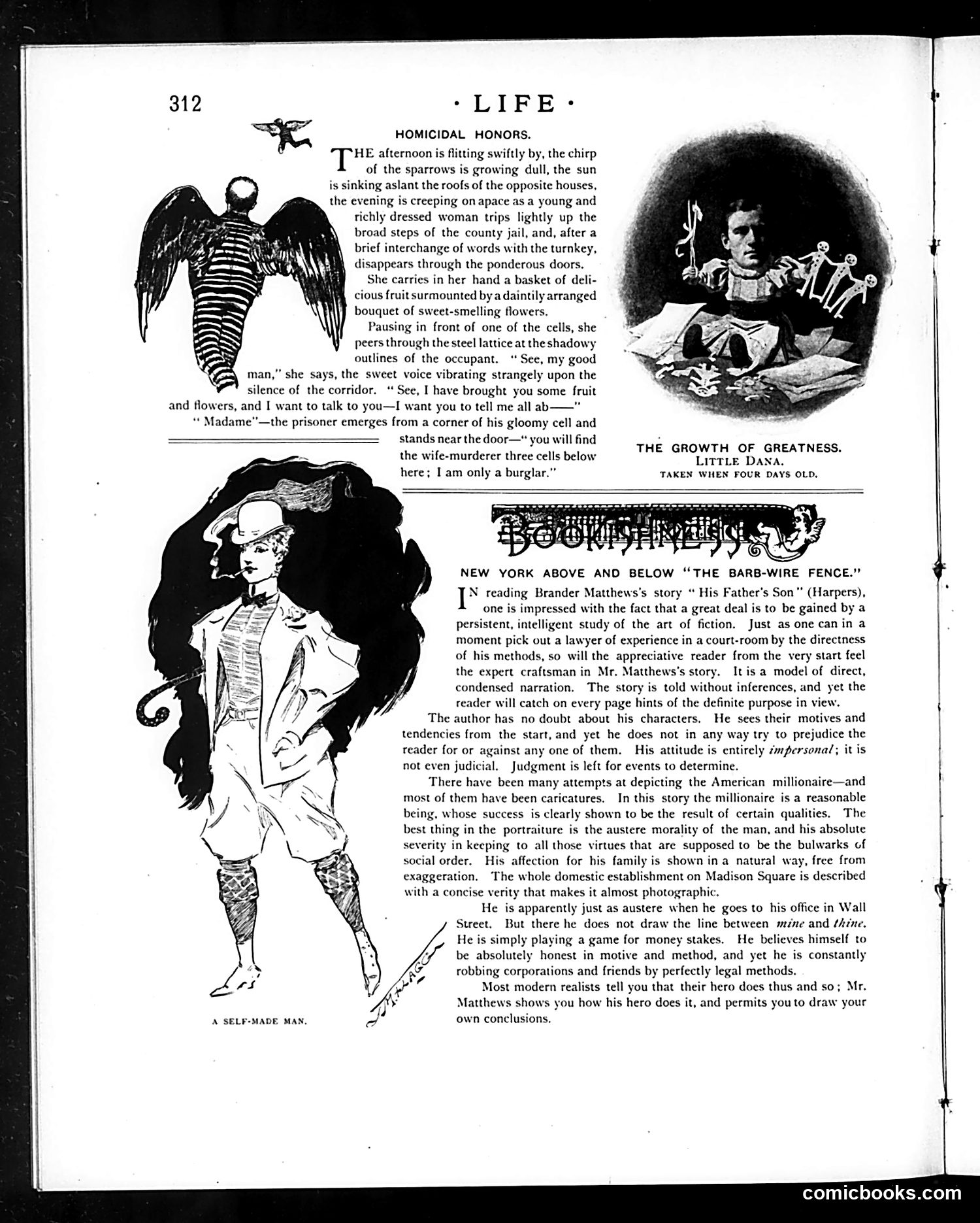
This page contains three sections: **"Homicidal Honors"** (top left): A skeletal winged figure with an elephant's trunk illustrates a dark narrative about a woman visiting a county jail prisoner. She brings flowers and fruit, offering kind words to what's revealed to be a "wife-murderer" in the cell below. The satire suggests the grim irony of civilized gestures extended to violent criminals. **"The Growth of Greatness: Little Dana"** (right): A portrait of an infant labeled as "taken when four days old"—likely satirizing excessive celebration or media attention given to notable births, though the specific identity isn't stated. **"New York Above and Below 'The Barb-Wire Fence'"** (bottom): A book review of Brander Matthew's story "His Father's Son," praising its realistic depiction of an American millionaire character and his morally ambiguous business practices.
📄 Transcribed text from this page (OCR, searchable)
Machine-transcribed from the original scan — historical spelling and the odd misread are preserved.
312 > LIFE: HOMICIDAL HONORS. HE afternoon is flitting swiftly by, the chirp of the sparrows is growing dull, the sun is sinking aslant the roofs of the opposite houses, the evening is creeping on apace as a young and tichly dressed woman trips lightly up the broad steps of the county jail, and, after a brief interchange of words with the turnkey, disappears through the ponderous doors. She carries in her hand a basket of deli- cious fruit surmounted by a daintily arranged. bouquet of sweet-smelling flowers, Pausing in front of one of the cells, she peers through the steel lattice at the shadowy outlines of the occupant. “ See, my good man,” she says, the sweet voice vibrating strangely upon the silence of the corridor. “ See, I have brought you some fruit and flowers, and I want to talk to you—I want you to tell me all ab——" jame"—the prisoner emerges from a corner of his gloomy cell and = stands near the door—“ you will find THE GROWTH OF GREATNESS. the wife-murderer three cells below Leet DANA. here; I am only a burglar.” TAKEN WHEN FOUR DAYS OLD. NEW YORK ABOVE AND BELOW “THE BARB-WIRE FENCE.’ ¢ N reading Brander Matthews's story “ His Father's Son” (Harpers), one is impressed with the fact that a great deal is to be gained by a persistent, intelligent study of the art of fiction, Just as one canin a moment pick out a lawyer of experience in a court-room by the directness of his methods, so will the appreciative reader from the very start feel the expert craftsman in Mr. Matthews’s story. It is a model of direct, condensed narration. The story is told without inferences, and yet the reader will catch on every page hints of the definite purpose in view. { The author has no doubt about his characters. He sees their motives and tendencies from the start, and yet he does not in any way try to prejudice the reader for or against any one of them. His attitude is entirely zwpersona/; it is not even judicial. Judgment is left for events to determine. There have been many attempts at depicting the American millionaire—and most of them have been caricatures. In this story the millionaire is a reasonable being, whose success is clearly shown to be the result of certain qualities. The } best thing in the portraiture is the austere morality of the man, and his absolute severity in keeping to all those virtues that are supposed to be the bulwarks of social order. His affection for his family is shown in a natural way, free from exaggeration. The whole domestic establishment on Madison Square is described with a concise verity that makes it almost photographic. He is apparently just as austere when he goes to his office in Wall Street. But there he does not draw the line between mene and thine. He is simply playing a game for money stakes. He believes himself to be absolutely honest in motive and method, and yet he is constantly robbing corporations and friends by perfectly legal methods. Most modern realists tell you that their hero does thus and so; Mr. Matthews shows you how his hero does it, and permits you to draw your own conclusions. wv A SELF-MADE MAN, comicbooks.com