
Life, 1895-11-14 · page 4 of 20
Life — November 14, 1895 — page 4: what you’re looking at
What you’re looking at
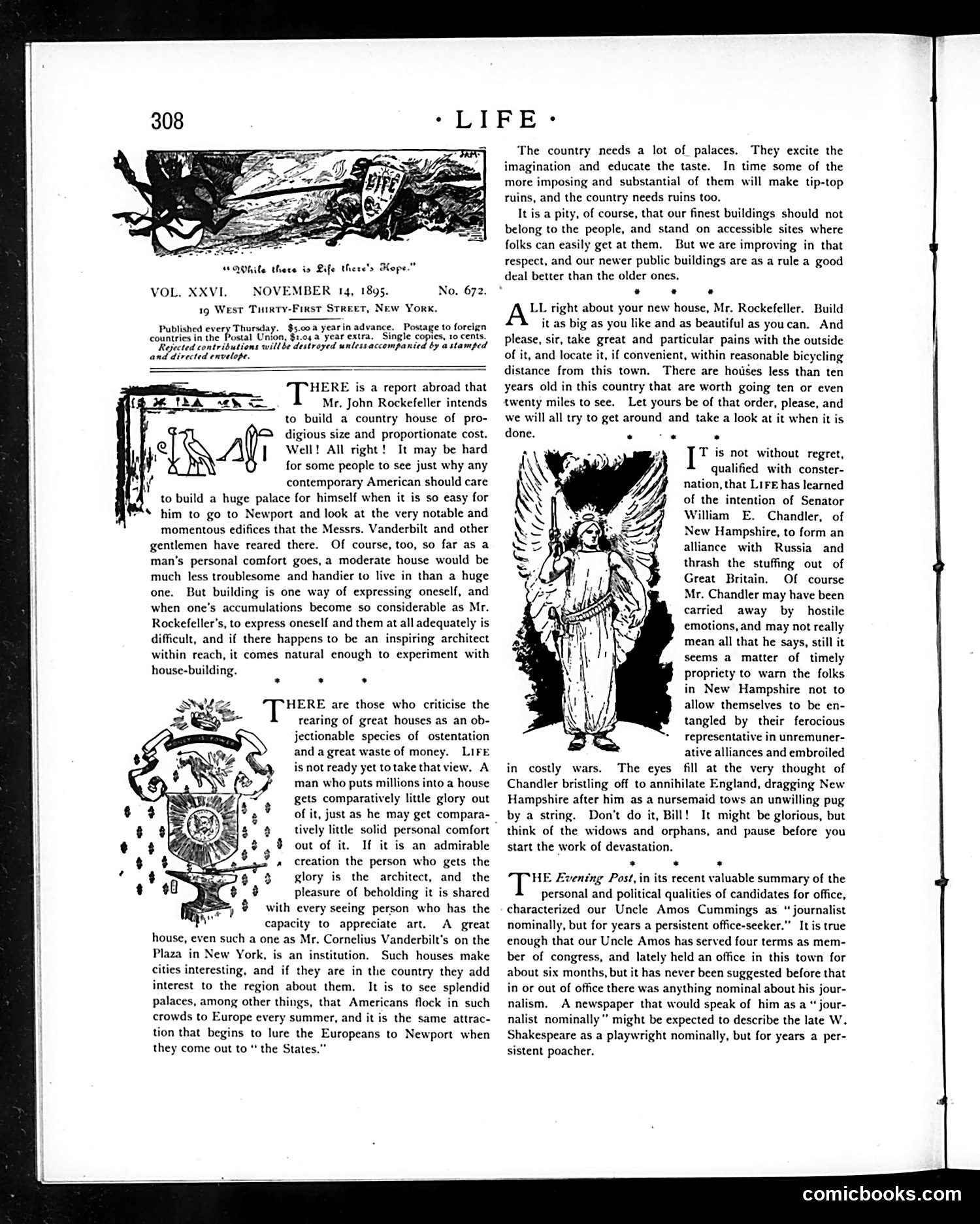
The page contains editorial commentary rather than political cartoons. The main content discusses John D. Rockefeller's plans to build a large country house, debating whether such grand private mansions represent admirable artistic achievement or wasteful ostentation. The author argues that great houses, while potentially frivolous, serve a cultural purpose by attracting European visitors and showcasing American wealth and taste. A secondary piece criticizes William E. Chandler of New Hampshire for forming an alliance with Russia and making inflammatory anti-British statements. The satire suggests Chandler's patriotic posturing masks political opportunism—comparing him to someone who would superficially adopt nominal positions for career advancement, using Shakespeare as an analogy for shallow characterization.
📄 Transcribed text from this page (OCR, searchable)
Machine-transcribed from the original scan — historical spelling and the odd misread are preserved.
* LIFE: “HAVHile there io Life there's Hope VOL. XXVI. NOVEMBER 14, 1895. 1g West Tuirty-Fixst Street, New York. Published every Thursday. $5.00 yearin advance. Postage to foreign countries in the Postal Union, $1.04 year extra. Single copies, 10 cents. ‘Rejected contributions willbe destroyed unlessaccompanied by astamped and directed envelope. for some people to see just why any : f contemporary American should care to build a huge palace for himself when it is so easy for ‘Shim to go to Newport and look at the very notable and momentous edifices that the Messrs. Vanderbilt and other gentlemen have reared there. Of course, too, so far as a man’s personal comfort goes, a moderate house would be much less troublesome and handier to live in than a huge one. But building is one way of expressing oneself, and when one’s accumulations become so considerable as Mr. Rockefeller’s, to express oneself and them at all adequately is difficult, and if there happens to be an inspiring architect within reach, it comes natural enough to experiment with house-building. HERE is a report abroad that Mr. John Rockefeller intends to build a country house of pro- digious size and proportionate cost. Well! All right! It may be hard . . HERE are those who criticise the rearing of great houses as an ob- jectionable species of ostentation and a great waste of money. LIFE is not ready yet totake thatview. A man who puts millions into a house gets comparatively little glory out of it, just as he may get compara- Se tively little solid personal comfort — out of it. If it is an admirable creation the person who gets the glory is the architect, and the pleasure of beholding it is shared with every seeing person who has the capacity to appreciate art. A great house, even such a one as Mr. Cornelius Vanderbilt's on the Plaza in New York, is an institution. Such houses make cities interesting, and if they are in the country they add interest to the region about them. It is to see splendid palaces, among other things, that Americans flock in such crowds to Europe every summer, and it is the same attrac- tion that begins to lure the Europeans to Newport when they come out to “ the States.” The country needs a lot of palaces. They excite the imagination and educate the taste. In time some of the more imposing and substantial of them will make tip-top ruins, and the country needs ruins too. It is a pity, of course, that our finest buildings should not belong to the people, and stand on accessible sites where folks can easily get at them. But we are improving in that respect, and our newer public buildings are as a rule a good deal better than the older ones, * * . LL right about your new house, Mr. Rockefeller. Build it as big as you like and as beautiful as youcan. And please, sir, take great and particular pains with the outside of it, and locate it, if convenient, within reasonable bicycling distance from this town, There are houses less than ten years old in this country that are worth going ten or even twenty miles to see. Let yours be of that order, please, and we will all try to get around and take a look at it when it is done. * * I" is not without regret, qualified with conster- nation, that L1FE has learned of the intention of Senator William E. Chandler, of New Hampshire, to form an alliance with Russia and thrash the stuffing out of Great Britain. Of course Mr. Chandler may have been carried away by hostile emotions, and may not really mean all that he says, still it seems a matter of timely Propriety to warn the folks in New Hampshire not to allow themselves to be en- tangled by their ferocious representative in unremuner- ative alliances and embroiled in costly wars. The eyes fill at the very thought of Chandler bristling off to annihilate England, dragging New Hampshire after him as a nursemaid tows an unwilling pug by a string. Don't do it, Bill! It might be glorious, but think of the widows and orphans, and pause before you start the work of devastation. . . . HE Evening Post, in its recent valuable summary of the personal and political qualities of candidates for office, characterized our Uncle Amos Cummings as “journalist nominally, but for years a persistent office-seeker.” It is true enough that our Uncle Amos has served four terms as mem- ber of congress, and lately held an office in this town for about six months, but it has never been suggested before that in or out of office there was anything nominal about j nalism. A newspaper that would speak of him as a nalist nominally” might be expected to describe the late W. Shakespeare as a playwright nominally, but for years a per- sistent poacher. comicbooks.com