
Life, 1895-11-14 · page 9 of 20
Life — November 14, 1895 — page 9: what you’re looking at
What you’re looking at
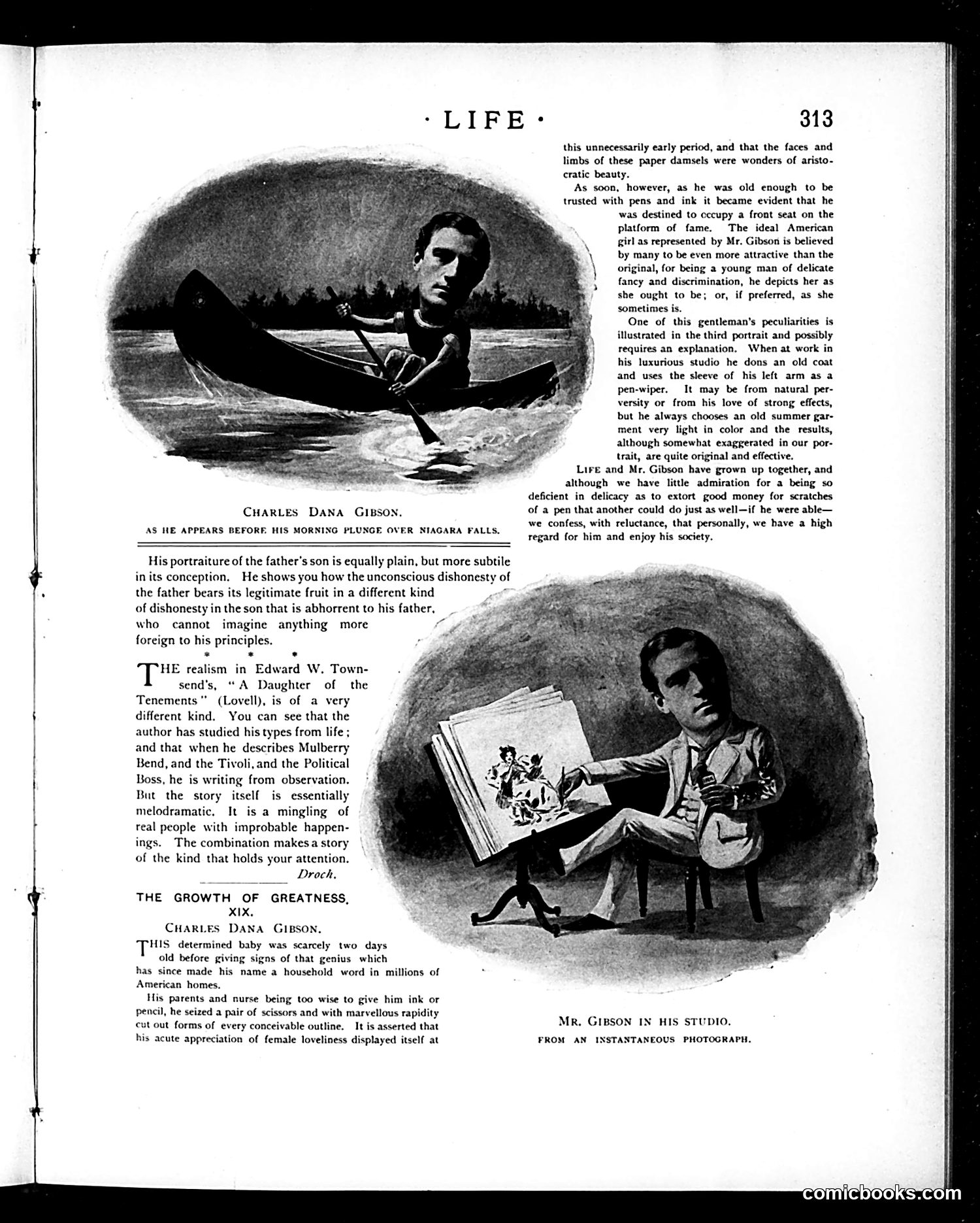
This page features Charles Dana Gibson, the famous illustrator and creator of the "Gibson Girl" ideal of American beauty. The two sketches show Gibson at work—one depicting him at his drawing board in his studio, the other showing him preparing to sketch before Niagara Falls. The text celebrates Gibson's artistic genius and influence. It notes he achieved fame young for depicting idealized female beauty, and praises his subtle character studies of types like those in Edward W. Townsend's social realist fiction. The satire appears gentle—acknowledging Gibson's delicate aesthetic preferences (he uses light summer garments for color effects) while gently mocking his refined artistic sensibilities as somewhat affected or precious compared to broader public taste.
📄 Transcribed text from this page (OCR, searchable)
Machine-transcribed from the original scan — historical spelling and the odd misread are preserved.
313 this unnecessarily early period, and that the faces and limbs of these paper damsels were wonders of aristo- cratic beauty. As soon, however, as he was old enough to be trusted with pens and ink it became evident that he was destined to occupy a front seat on the platform of fame. The ideal American girl as represented by Mr. Gibson is believed by many to be even more attractive than the original, for being a young man of delicate fancy and discrimination, he depicts her as she ought to be; or, if preferred, as she sometimes is. One of this gentleman's peculiarities is illustrated in the third portrait and possibly requires an explanation, When at work in his luxurious studio he dons an old coat and uses the sleeve of his left arm as a pen-wiper, It may be from natural per- versity or from his love of strong effects, but he always chooses an old summer gar- ment very light in color and the results, although somewhat exaggerated in our por- trait, are quite original and effective. Lire and Mr. Gibson have grown up together, and although we have little admiration for a being so deficient in delicacy as to extort good money for scratches CHARLES DANA GIBSON. of a pen that another could do just as well—if he were able— we confess, with reluctance, that personally, we have a high regard for him and enjoy his society. AS HE APPEARS BEFORF. HIS MORNING PLUNGE OVER NIAGARA FALLS. His portraiture of the father's son is equally plain, but more subtile ¢ in its conception. He shows you how the unconscious dishonesty of . the father bears its legitimate fruit in a different kind f of dishonesty in the son that is abhorrent to his father, who cannot imagine anything more c foreign to his principles. fs . . HE realism in Edward W. Town- send's, “A Daughter of the | Tenement (Lovell), is of a very 4 different kind. You can see that the | author has studied his types from life; | and that when he describes Mulberry Bend, and the Tivoli, and the Political Boss, he is writing from observation. But the story itself is essentially melodramatic. It is a mingling of teal people with improbable happen- ings. The combination makesa story of the kind that holds your attention. Droch, THE GROWTH OF GREATNESS, XIX, CHARLES DANA GIBSON, THUS determined baby was scarcely two days old before giving signs of that genius which has since made his name a household word in millions of American homes, His parents and nurse being too wise to give him ink or pencil, he seized a pair of scissors and with marvellous rapidity cut out forms of every conceivable outline. It is asserted that his acute appreciation of female loveliness displayed itself at FROM AN INSTANTANEOUS PHOTOGRAPH. Mr, GIBSON IN HIS STUDIO,