
A complete issue · 21 pages · 1895
Life — June 27, 1895
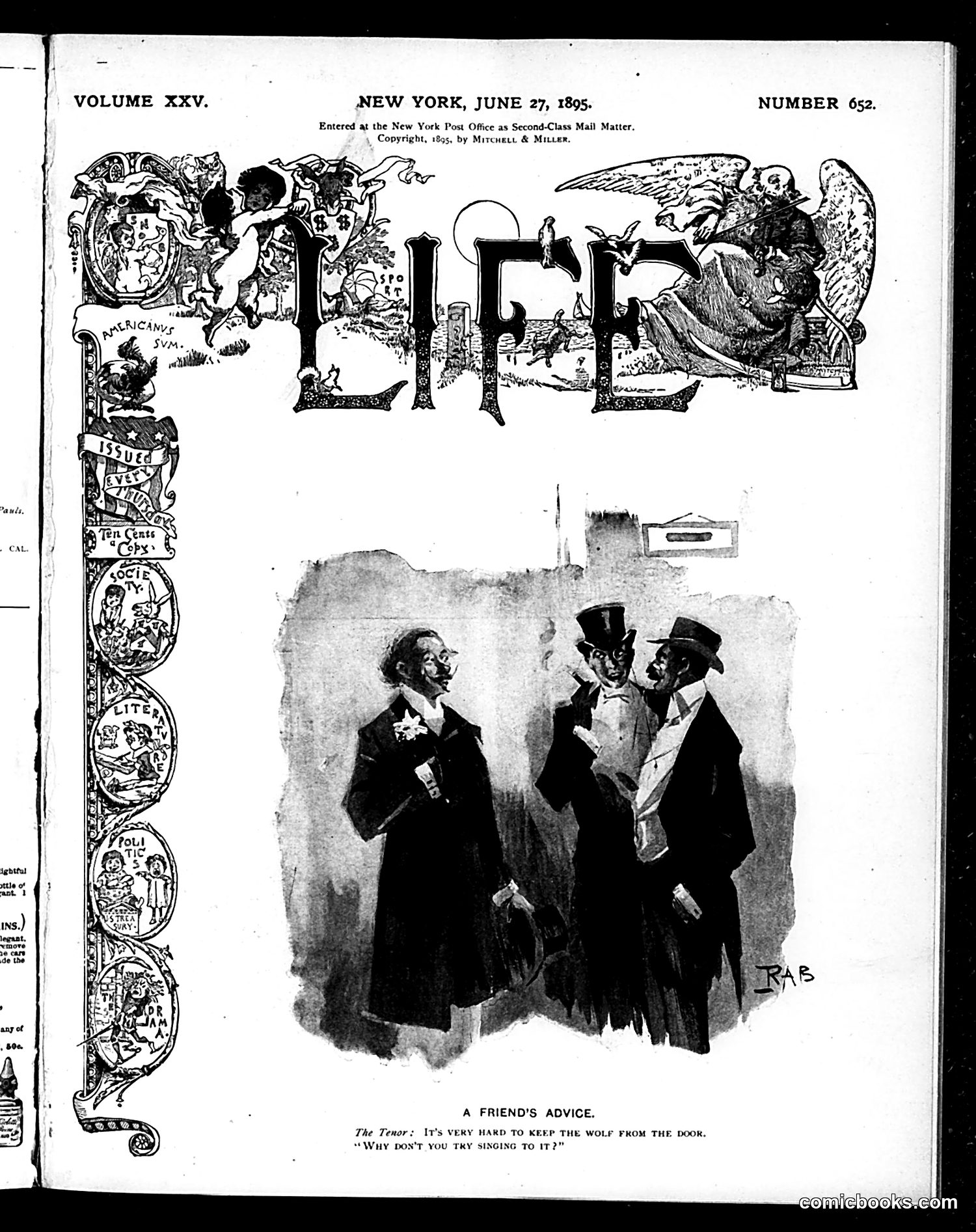
This cartoon depicts three well-dressed men in formal attire and top hats in what appears to be a European city setting. One man, labeled "The Tenor," is being given advice by two companions. The caption reads: "It's very hard to keep the wolf from the door. 'Why don't you try singing to it?'" This is a pun-based joke playing on the phrase "keep the wolf from the door" (meaning to avoid poverty). The humor suggests that a tenor (opera singer) should use his vocal talents literally—singing to an actual wolf—rather than struggling financially. The satire likely mocks either a specific struggling tenor performer or the pretensions of European opera culture in the 1890s.
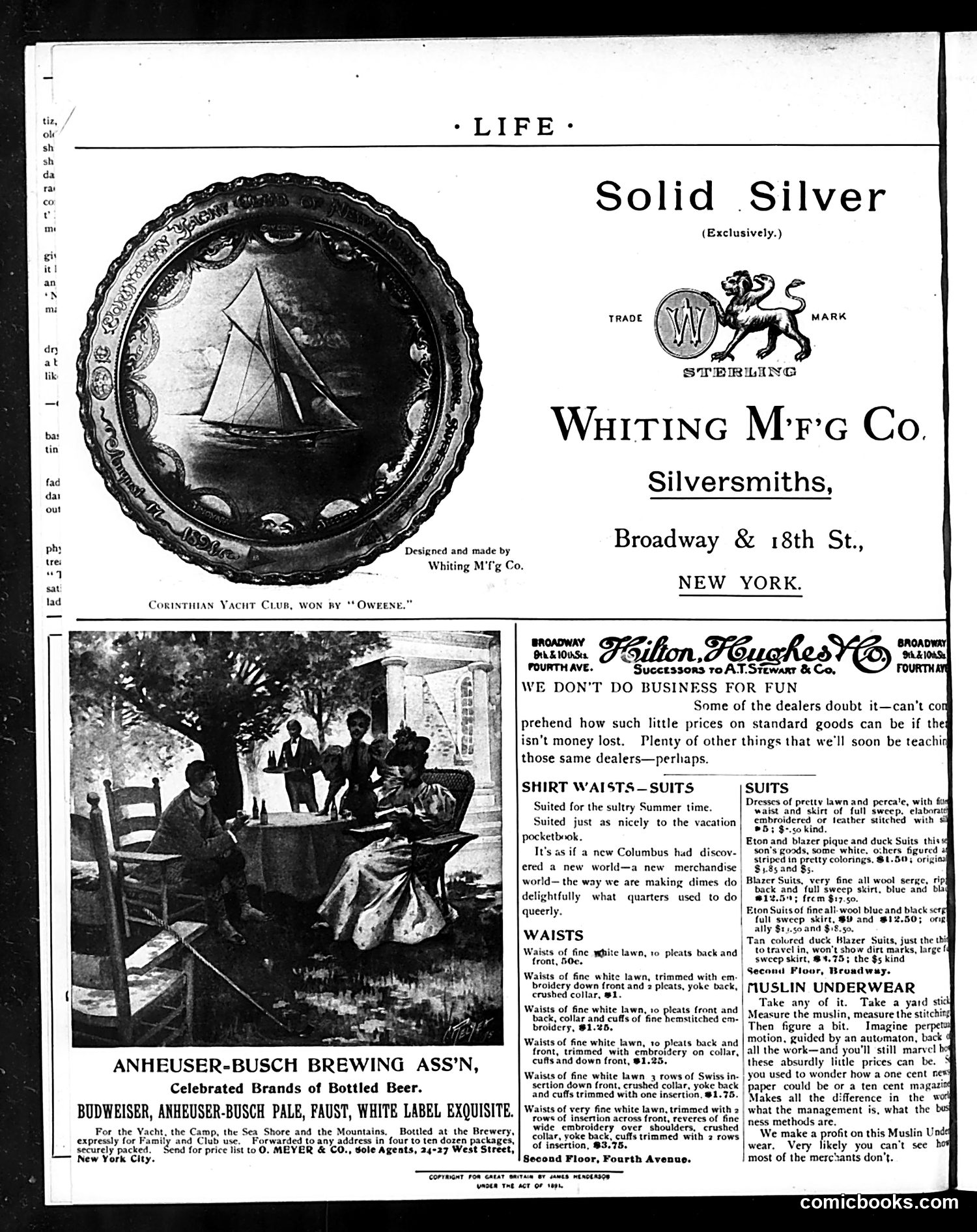
This page is primarily **advertising**, not satire or political commentary. The upper half features an advertisement for **Whiting Mfg Co.**, a New York silversmith, showcasing a solid silver dish depicting the "Corinthian Yacht Club, won by 'Oweene.'" The image shows an ornate circular plate with a sailing yacht in relief. The lower section contains advertisements for **Anheuser-Busch brewing** and **Hamilton, Houckes & Co.** clothing merchants, along with product descriptions for shirt waists and suits. The photograph shows what appears to be a casual social gathering, likely meant to evoke leisure and consumption—typical advertising imagery of the era. There is no apparent political satire or social commentary on this page; it functions as a commercial publication space.
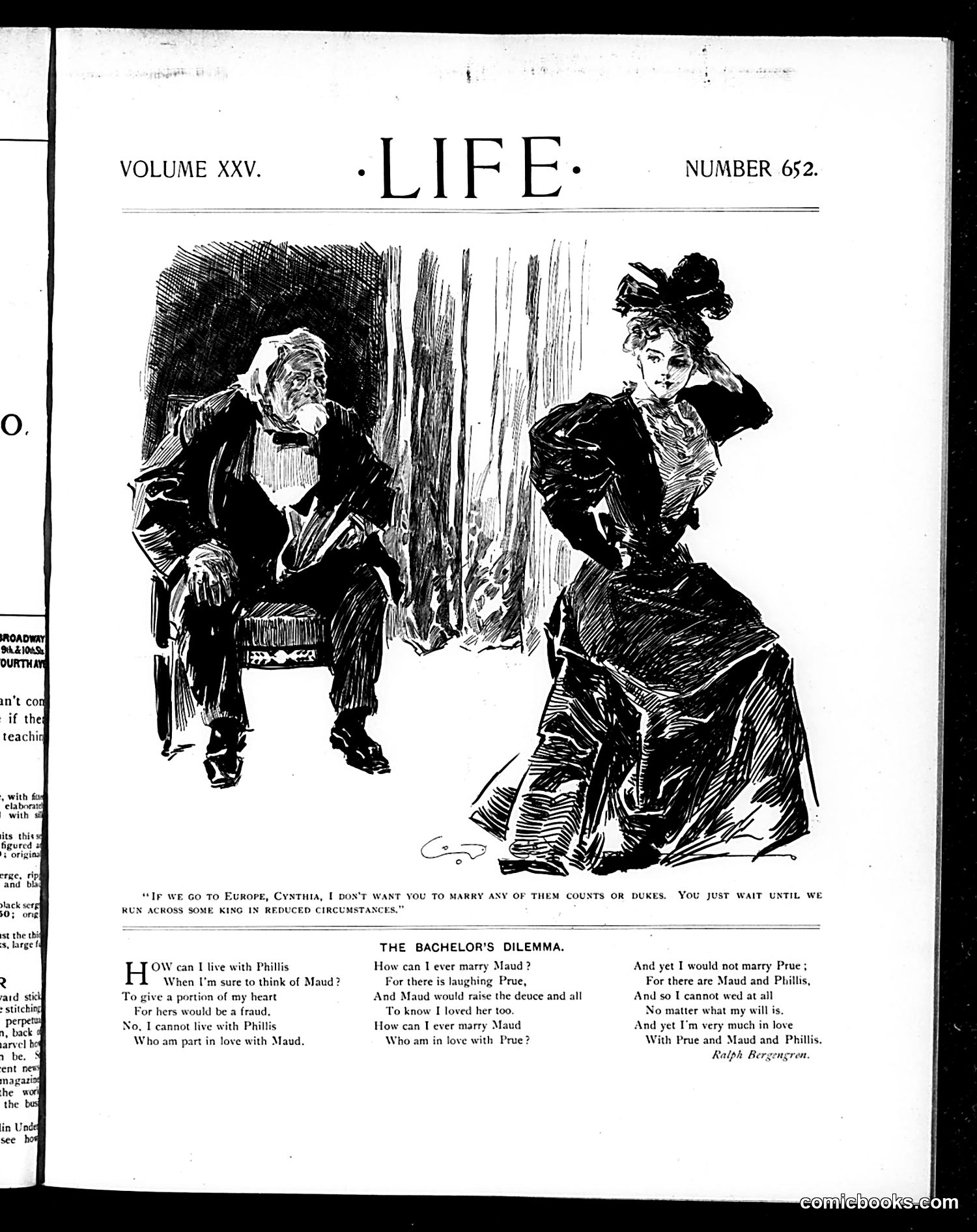
This is a humorous poem about romantic indecision, not political satire. The illustration shows a well-dressed older gentleman and an elegantly dressed woman in late 19th/early 20th-century attire. **The Joke:** The poem presents a bachelor's impossible romantic predicament—he loves three women (Phillis, Maud, and Prue) equally and cannot decide which to marry. Each verse explores why he cannot choose one without losing the others, concluding he'd rather stay unmarried than sacrifice any of them. The satire targets male romantic indecision and the era's courtship conventions. The caption above the poem suggests wealthy European travel as an escape from marriage expectations—a running theme in period humor about bachelor reluctance. This represents typical *Life* magazine content: lighthearted social commentary on dating and matrimony.
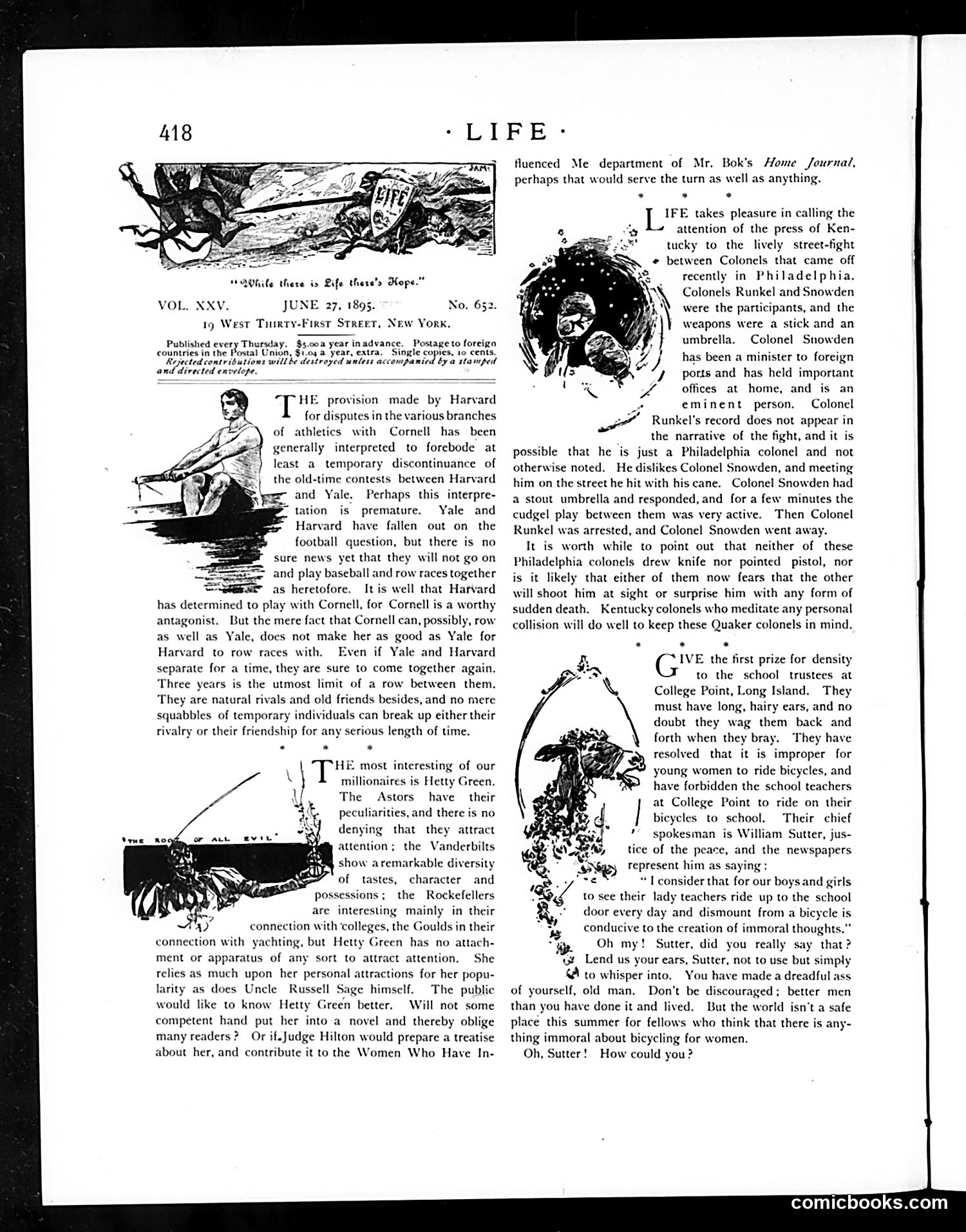
This page contains three satirical pieces: 1. **Top cartoon** ("While there is Life there's Hope"): A political figure appears trapped or cornered, likely referencing a contemporary scandal or controversy. 2. **Harvard-Yale rowing rivalry**: The text mocks Harvard's attempt to partner with Cornell for races instead of Yale, suggesting athletic rivalry masks deeper institutional tension. The satire suggests Harvard is avoiding Yale as a competitor. 3. **Hetty Green feature**: The main article celebrates the eccentric millionaire Hetty Green, comparing her to other wealthy families (Vanderbilts, Rockefellers, Goulds). The satire suggests Green deserves literary attention for her colorful personality. 4. **College Point controversy**: A humorous piece criticizing school trustees' ban on female teachers riding bicycles to school, framing it as prudish and outdated.
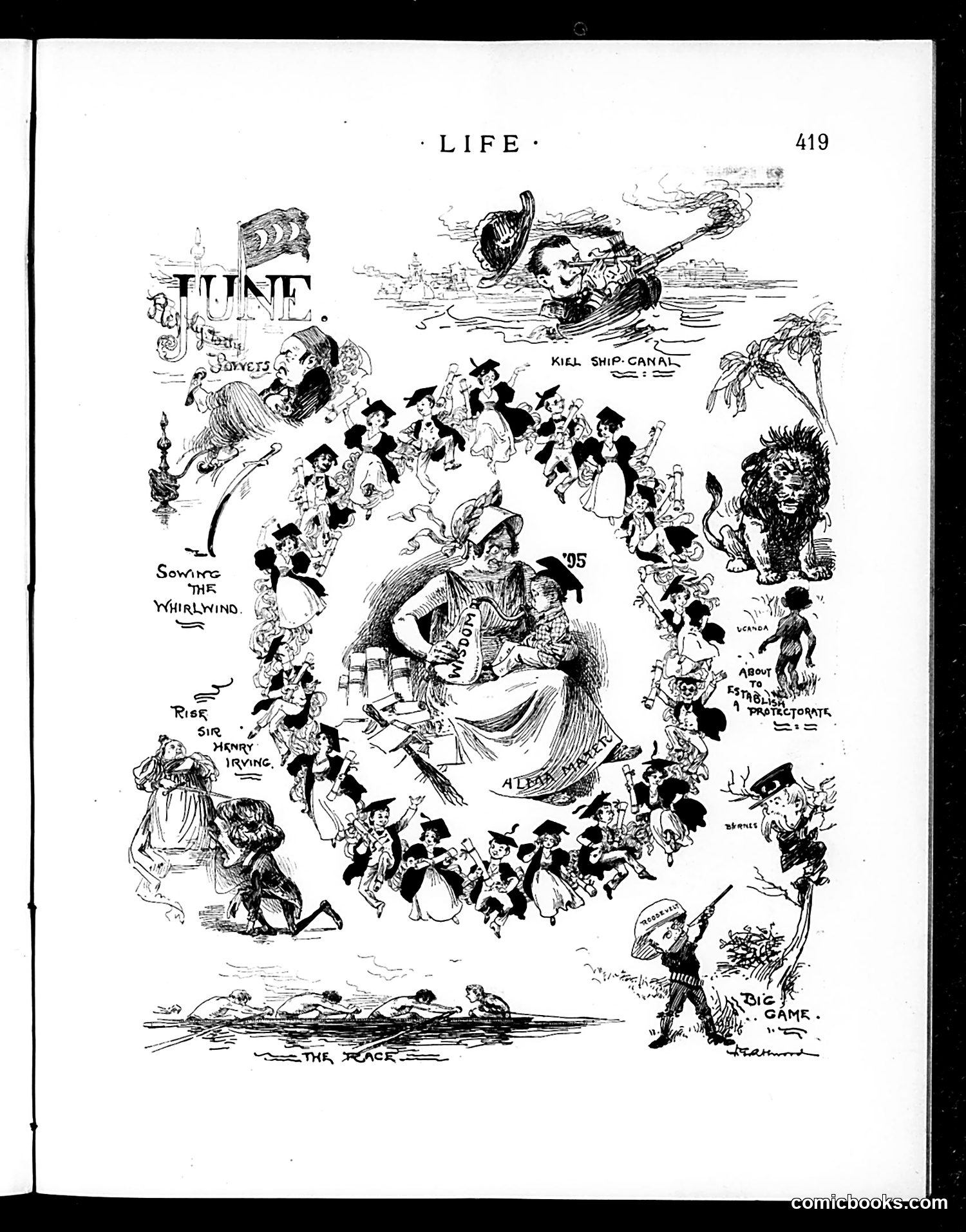
This is a satirical cartoon map showing "June" personified as a large figure surrounded by smaller figures representing various social activities and concerns of the season. The labeled vignettes include: - "Kill Ship Canal" (upper right) - likely referencing a contemporary engineering or urban development controversy - "Sowing the Whirlwind" (left) - appears to reference consequences of actions - References to "Sir Henry Irving" (a famous actor of the era) - "The Race" (bottom) - "Indian Game" (lower right) - Various other social scenes depicting leisure activities, romance, and summer pastimes The overall composition uses crowded, chaotic imagery typical of Life's satirical style to comment on the frivolous or problematic preoccupations of American society during the month of June. Without dated publication information visible, the specific topical references remain somewhat unclear, though the satirical intent is evident.
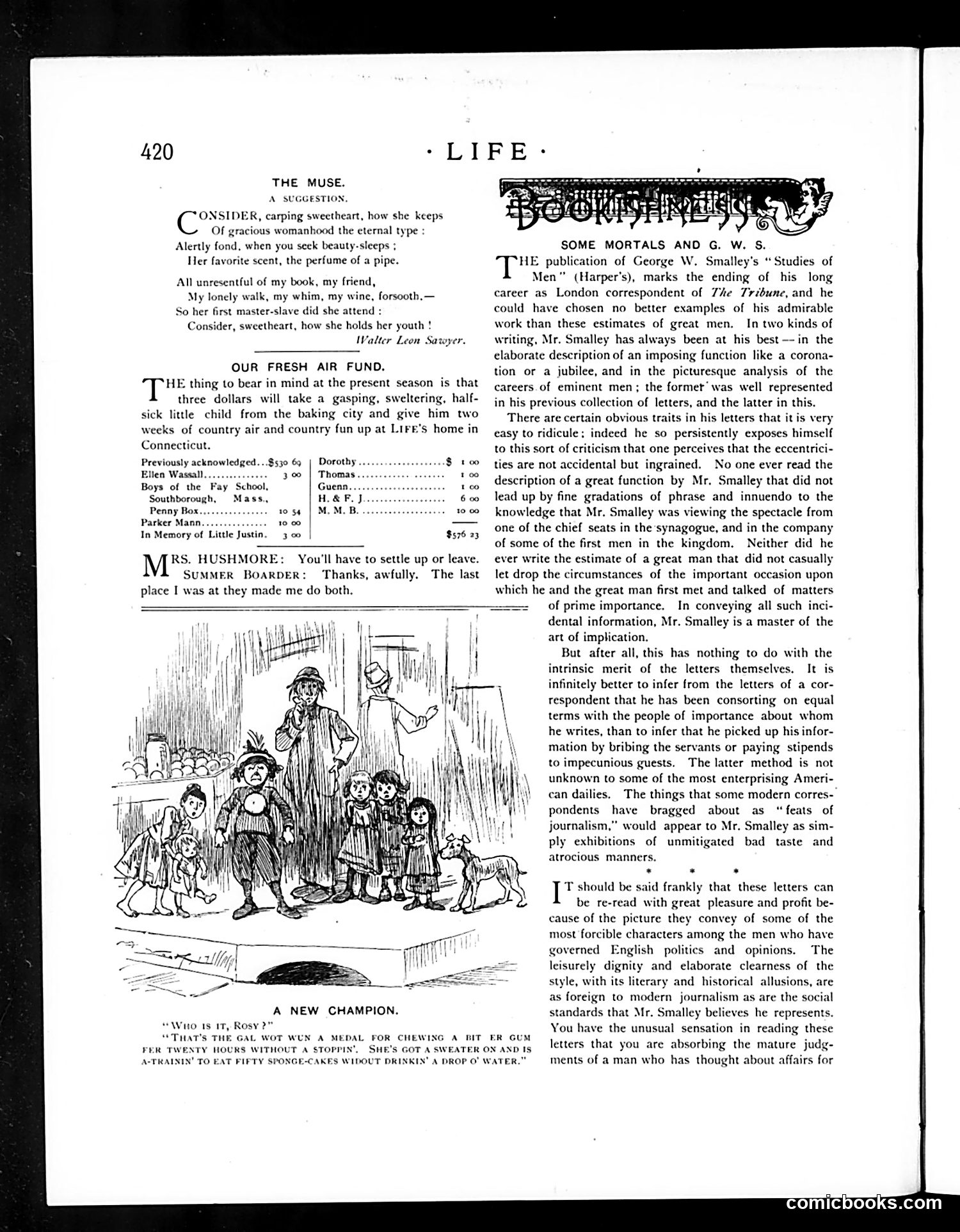
This cartoon satirizes childhood poverty and neglect in early 20th-century America. The illustration shows a ragged street child surrounded by other impoverished children, with the caption quoting dialogue: "Who is it, Rosy?" "That's the gal wot wus a medal for chewing a bit er gum for twenty hours without a stoppin'. She's got a sweater on and is a-tryin' to eat fifty doughnuts drinkin' a drop o' water." The satire mocks both the exploitative treatment of poor children and the sensationalized "feats" used to entertain or profit from them. The caption's cockney dialect emphasizes the working-class subjects, while the exaggerated challenge (eating fifty doughnuts) highlights how desperate poverty made children perform degrading stunts for minimal reward—a dark commentary on American urban childhood conditions.
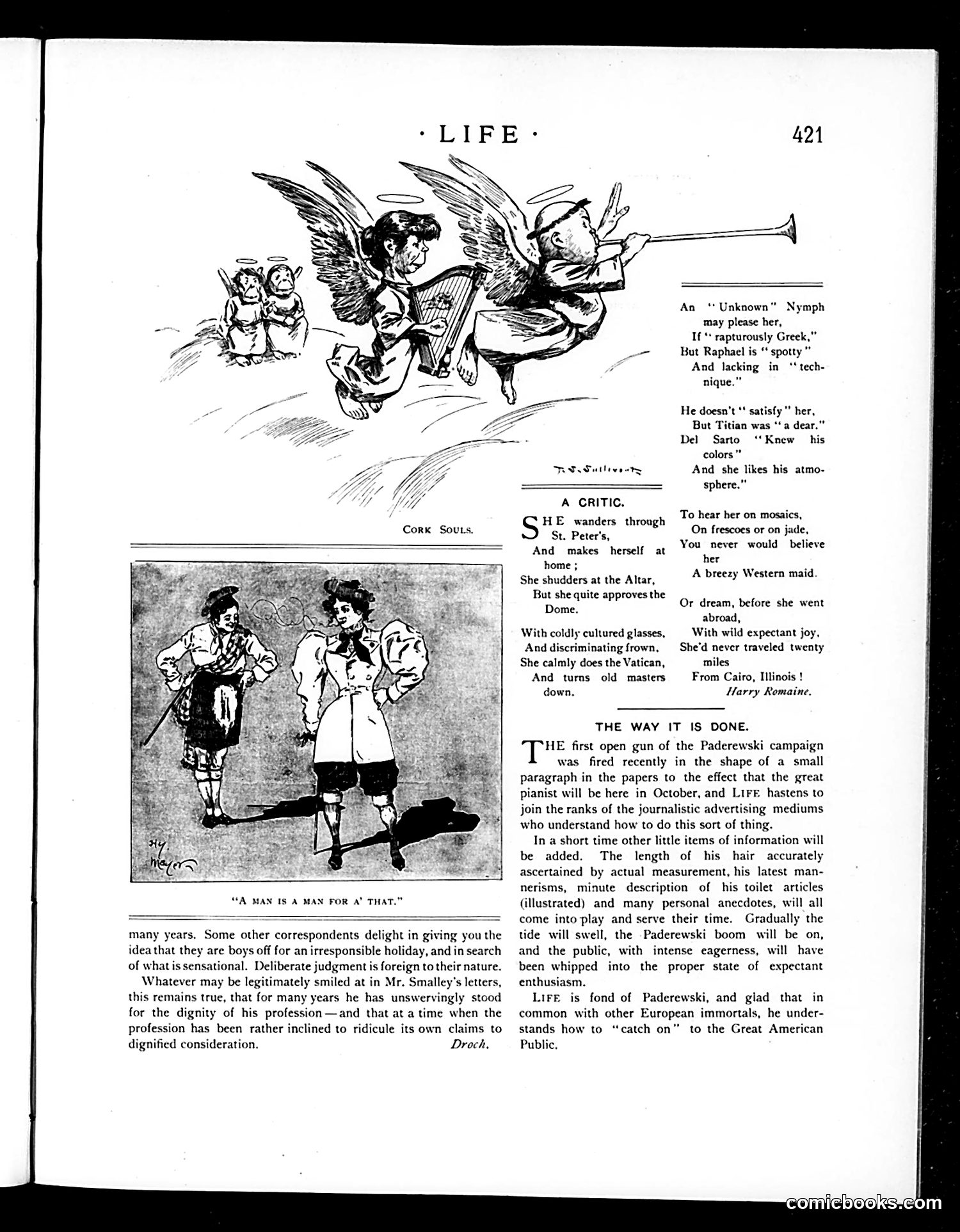
This page contains two cartoons and accompanying commentary satirizing art criticism and artists. **"Cork Souls"** (top): Depicts cherubs/putti (classical art references) with one playing a trumpet. The caption mocks pretentious art appreciation—suggesting an "unknown nymph" might please philistines, but lacks the technical sophistication of Raphael. **"A Man Is a Man For A' That"** (bottom): Shows two figures in casual dress. The accompanying poem "A Critic" ridicules a female art enthusiast who visits St. Peter's Basilica and the Vatican with "coldly cultured glasses" and a "discriminating frown," yet dismisses classical masterworks. The satire targets affected cultural pretension and shallow connoisseurship—someone performing sophistication without genuine understanding. Both pieces mock bourgeois art snobbery and fraudulent expertise among amateur collectors.
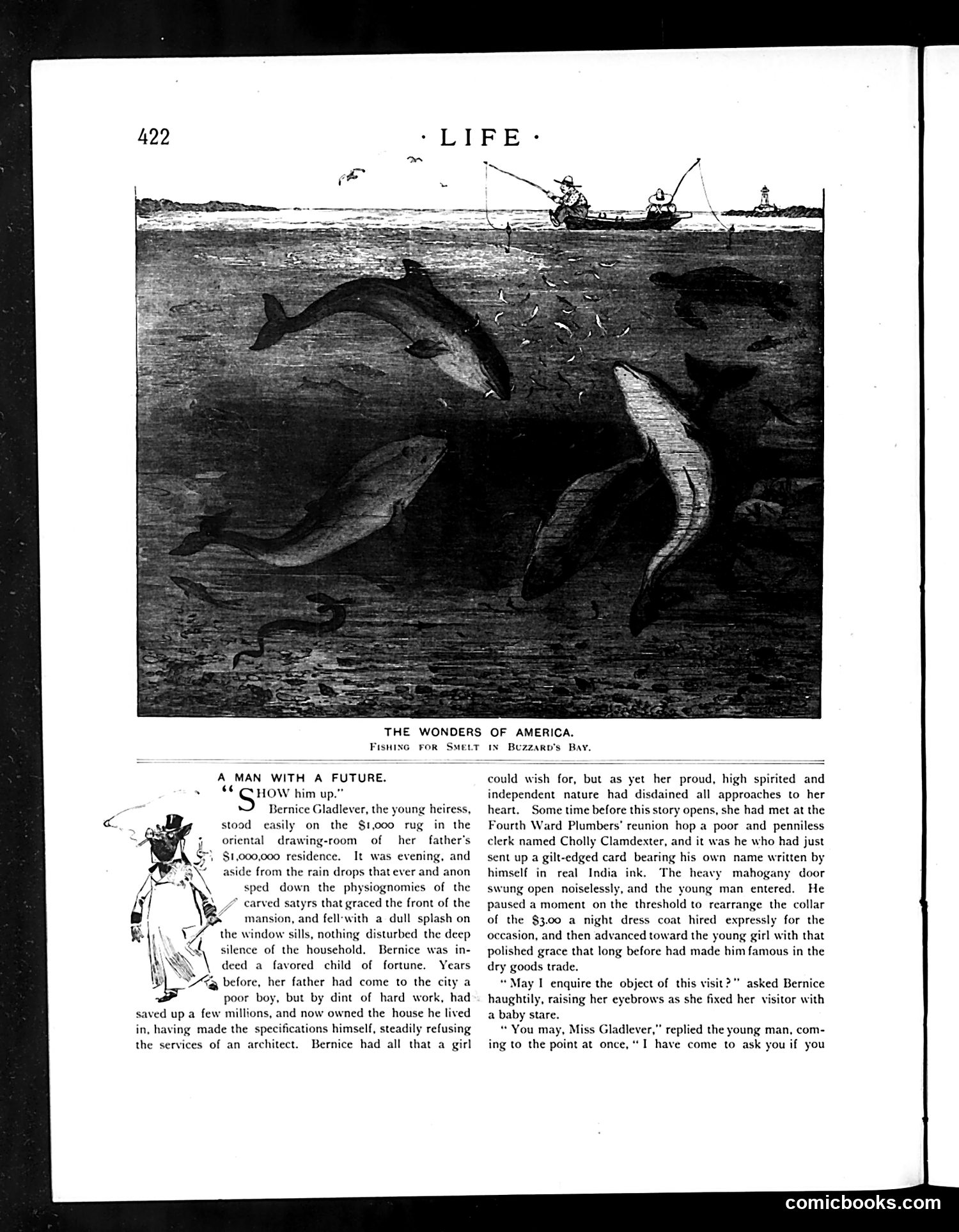
This page contains an illustration titled "The Wonders of America: Fishing for Smelt in Buzzard's Bay" showing a fishing vessel and multiple fish (or possibly dolphins) underwater. Below is the beginning of a short story titled "A Man with a Future." The story opens with Bernice Gladiever, a young heiress, receiving a visitor—Cholly Clamdexter, a clerk from a plumbers' reunion who has sent her an invitation written in "real India ink." The narrative establishes Bernice as proud and independent, while Clamdexter is portrayed as an ambitious social climber attempting to court her. The illustration and story appear designed for satirical humor about class aspiration and romantic pursuit among wealthy Americans, typical of *Life* magazine's social commentary content.
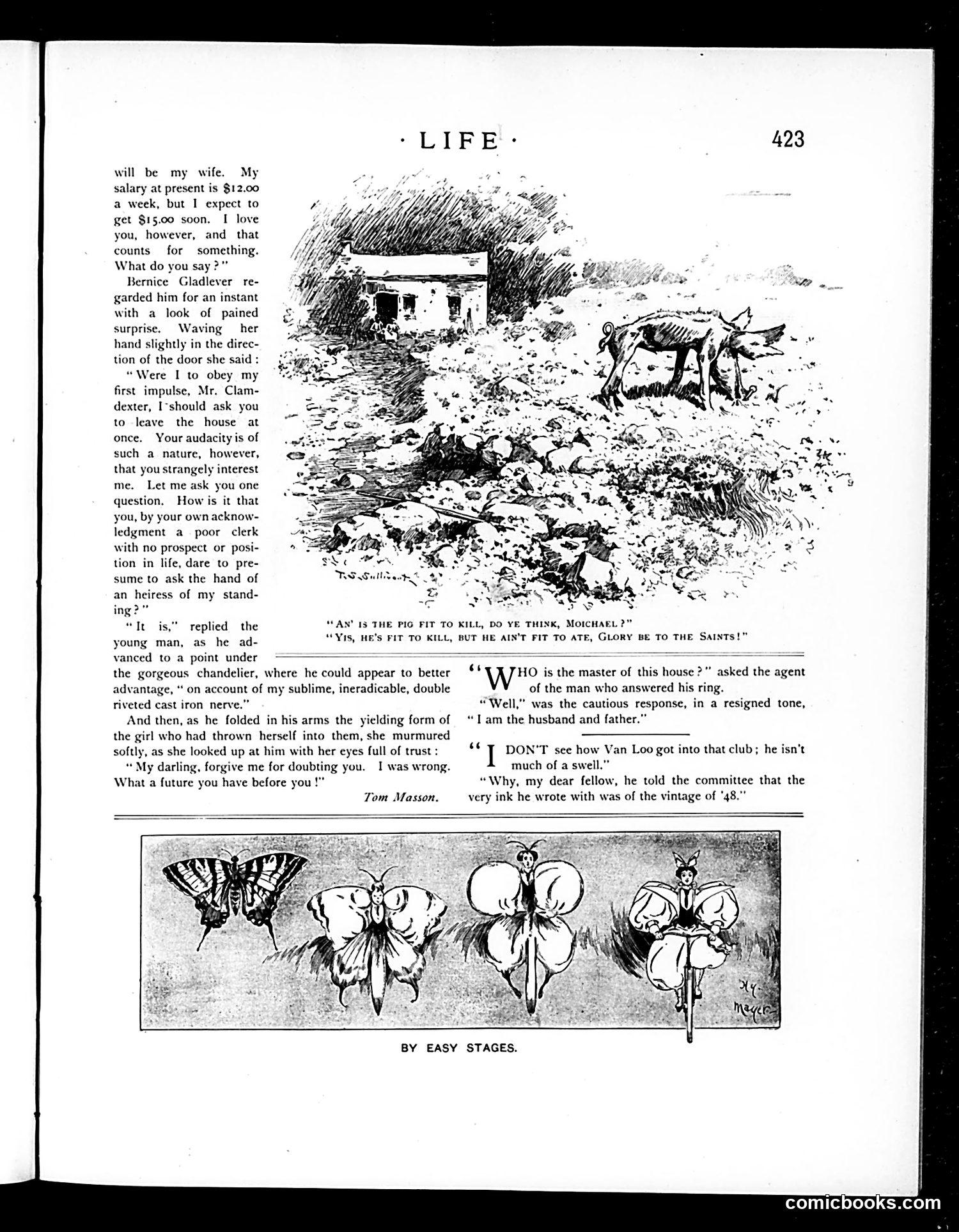
This page contains two distinct elements: **Upper section:** A romantic narrative excerpt from "Tom Mason" about a young couple's courtship, with an accompanying sketch of a rural cottage, animals, and landscape. **Lower section:** A satirical cartoon titled "By Easy Stages" depicting the transformation of insects—specifically showing the metamorphosis of a butterfly and what appear to be flower-like or fairy-like creatures. This is likely social satire about human transformation or evolution, a common theme in turn-of-century humor. The bottom dialogue mocks someone named Van Loo joining a club, suggesting he's "not much of a swell" (fashionable person). The reference to "vintage of '48" is unclear without broader context. The overall page juxtaposes sentimental romance writing with witty social commentary typical of Life magazine's satirical approach.
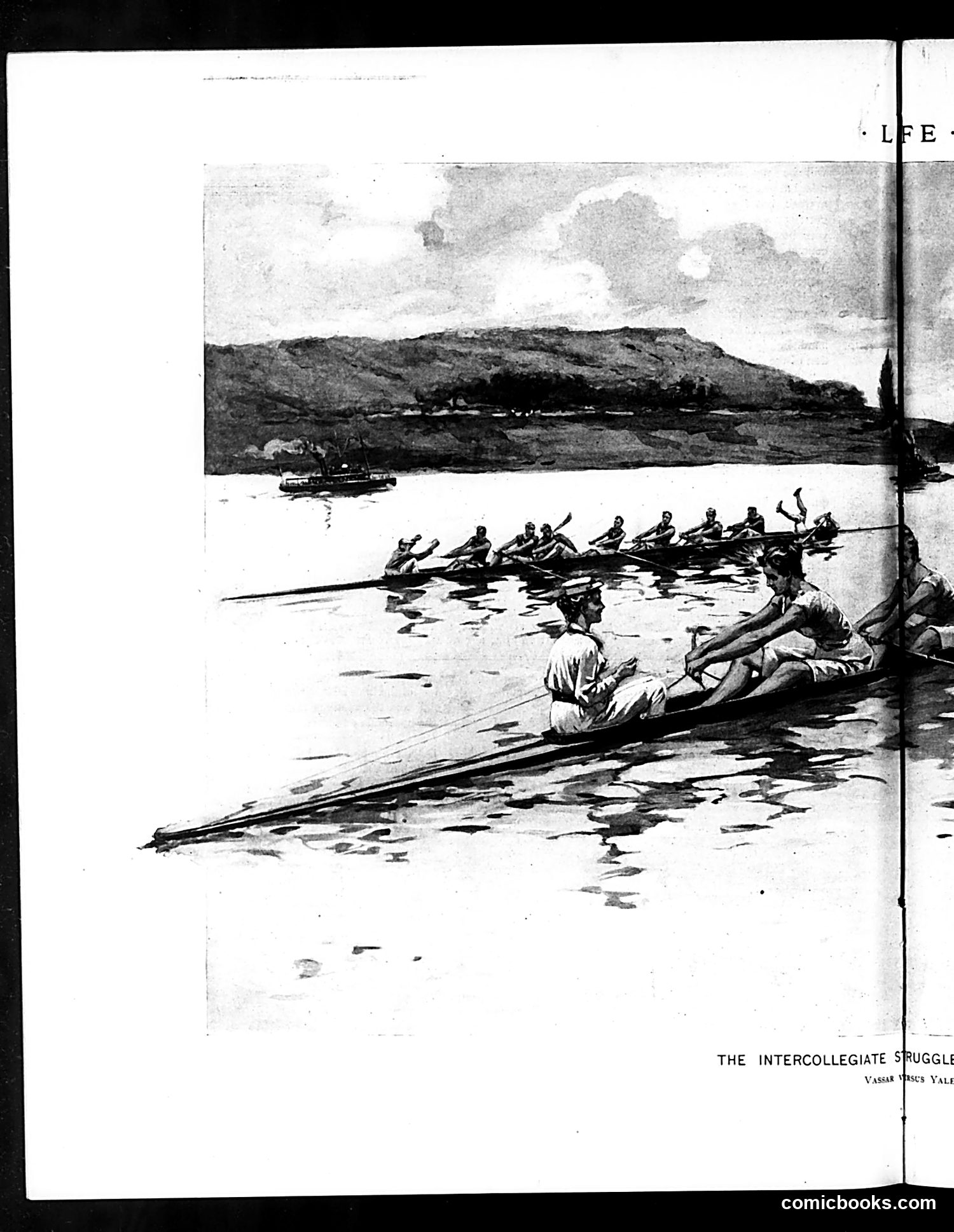
This page from *Life* magazine shows a rowing competition between college teams. The image depicts two racing shells on water with hills in the background. One shell is in the foreground (appearing to be from Yale, based on the partial caption "Vassar Vice Yale"), while another crew team rows in the middle distance. The caption "THE INTERCOLLEGIATE STRUGGLE" humorously frames competitive college rowing as a dramatic "struggle." This appears to be satirizing the intense rivalry and serious tone surrounding intercollegiate athletics in the early 20th century, treating a sporting event with mock-epic language. The image captures the actual competitive action while the caption provides ironic commentary on how seriously colleges and their supporters took these competitions.
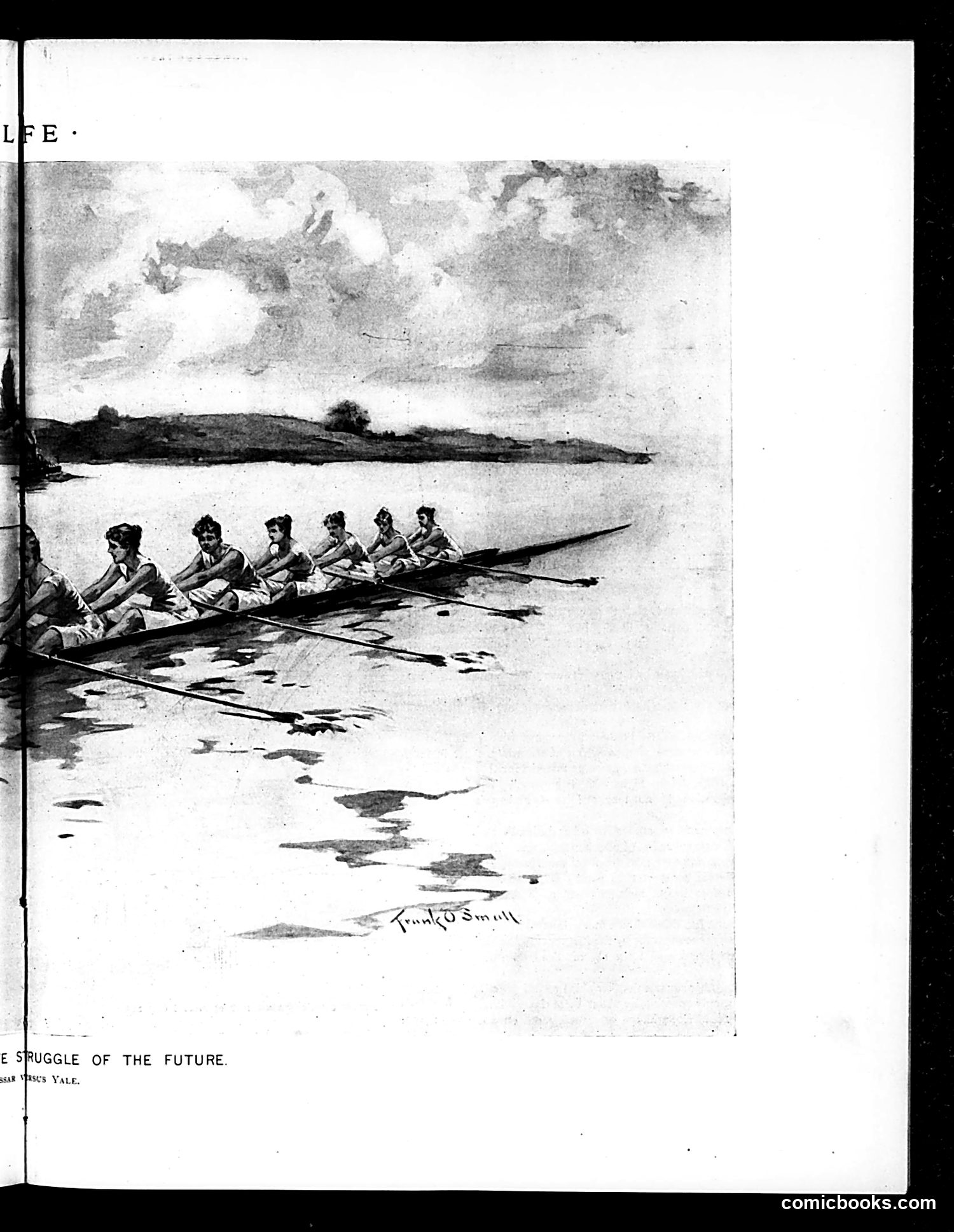
This illustration depicts a rowing crew of six women in a shell boat on water, with oars extended. The caption reads "THE STRUGGLE OF THE FUTURE," and the artist's signature appears to read "Frederic Remington" or similar. The satire likely references early 20th-century debates over women's roles and rights, particularly women's suffrage and expanding female participation in sports and competitive activities. By showing women rowing—a sport traditionally dominated by men—the cartoon appears to comment on women's growing ambitions and physical capabilities. Whether satirical or celebratory of female advancement remains ambiguous, though the titled reference to "struggle" suggests the piece addresses ongoing social conflicts over gender expectations during the Progressive Era.
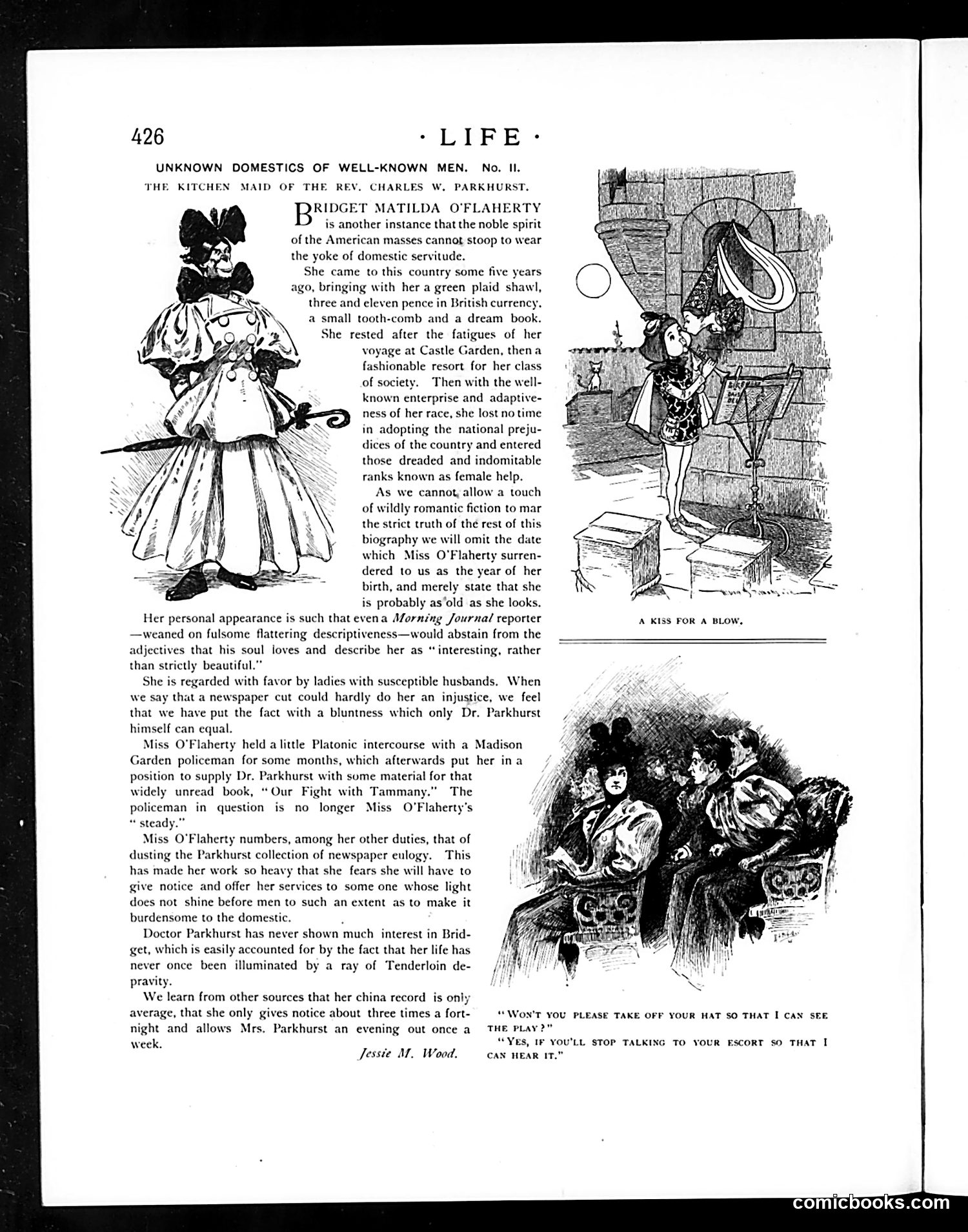
This 1890s *Life* magazine piece satirizes Reverend Charles W. Parkhurst, a prominent New York clergyman known for crusading against Tammany Hall corruption and moral vice in the "Tenderloin" district. The satire targets the hypocrisy of his public moralizing by focusing on his household help, Bridget Matilda O'Flaherty. The joke: Parkhurst preaches virtue while employing a kitchen maid of questionable character. The text sarcastically notes she had a romantic involvement with a Madison Square Garden policeman (possibly corrupted by the very Tammany system Parkhurst attacks), yet he ignores her entirely. The cartoons mock pretentious theatergoers—one showing a woman blocking the view with her hat, complaining others talk too loudly. This contrasts with Parkhurst's self-righteous public crusading: he lectures the public about morality while remaining oblivious to (or indifferent toward) misconduct under his own roof. The satire exposes the gap between public virtue-signaling and private negligence.
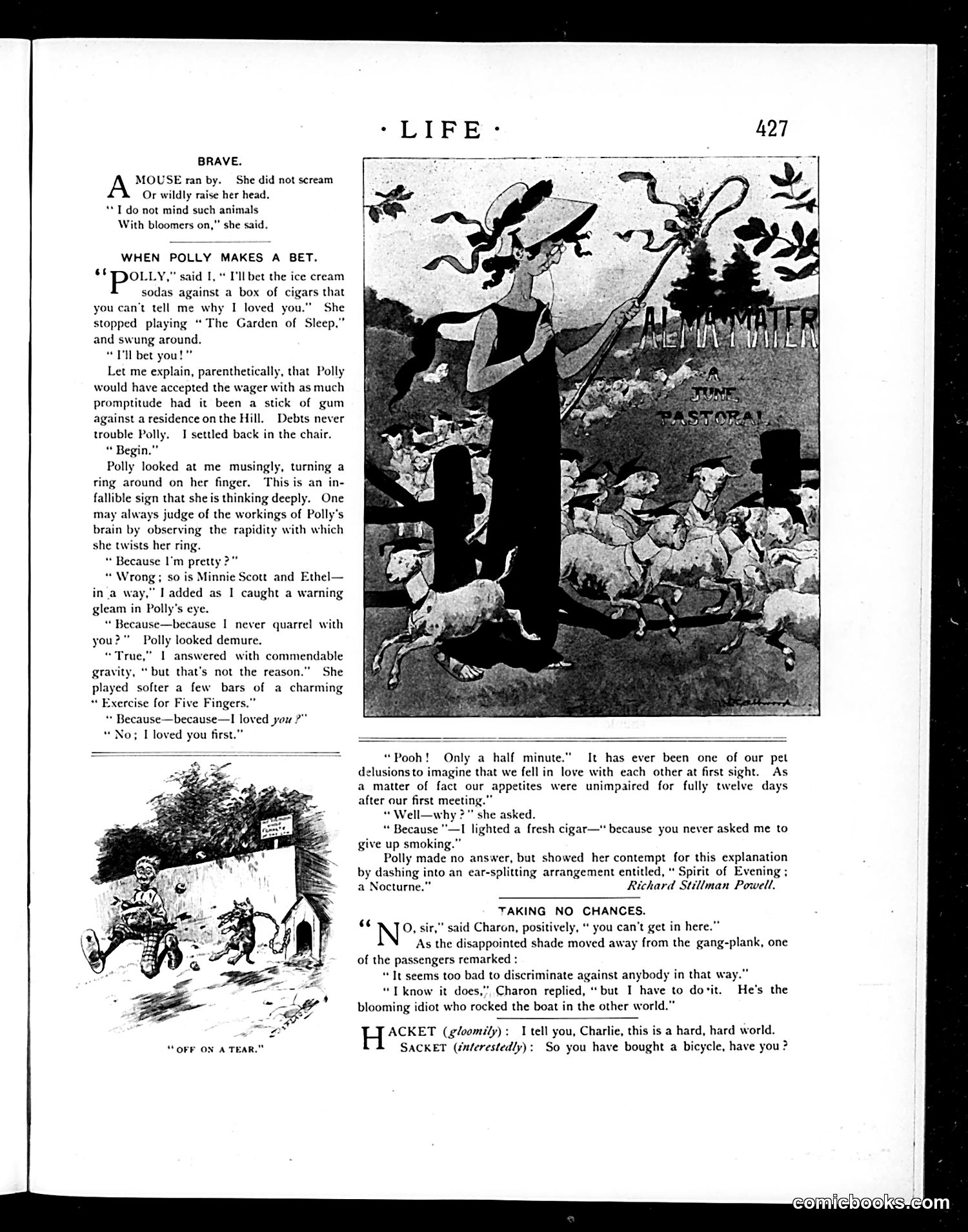
This page collects brief humorous sketches typical of Life magazine's satirical style: **"Brave"** mocks the "New Woman" — a mouse wearing bloomers (women's split pants, then controversial) passes by without causing alarm, suggesting progressive attitudes toward women's dress. **"When Polly Makes a Bet"** depicts a romantic couple's banter about why he loves her. The joke relies on period courtship conventions and the witty deflation of romantic idealism — they admit they didn't fall in love at first sight but over mundane comfort (his refusal to quit smoking). **"Off on a Tear"** shows a scene labeled this way, likely referencing emotional outbursts. **"Taking No Chances"** features Charon (the mythological ferryman of the dead) refusing entry to a shade because that person rocked the boat in life, creating an afterlife consequence for recklessness. The bottom text humorously contrasts life's hardship with the specific complaint about buying a bicycle — suggesting trivial modern consumer problems represent "hardship."
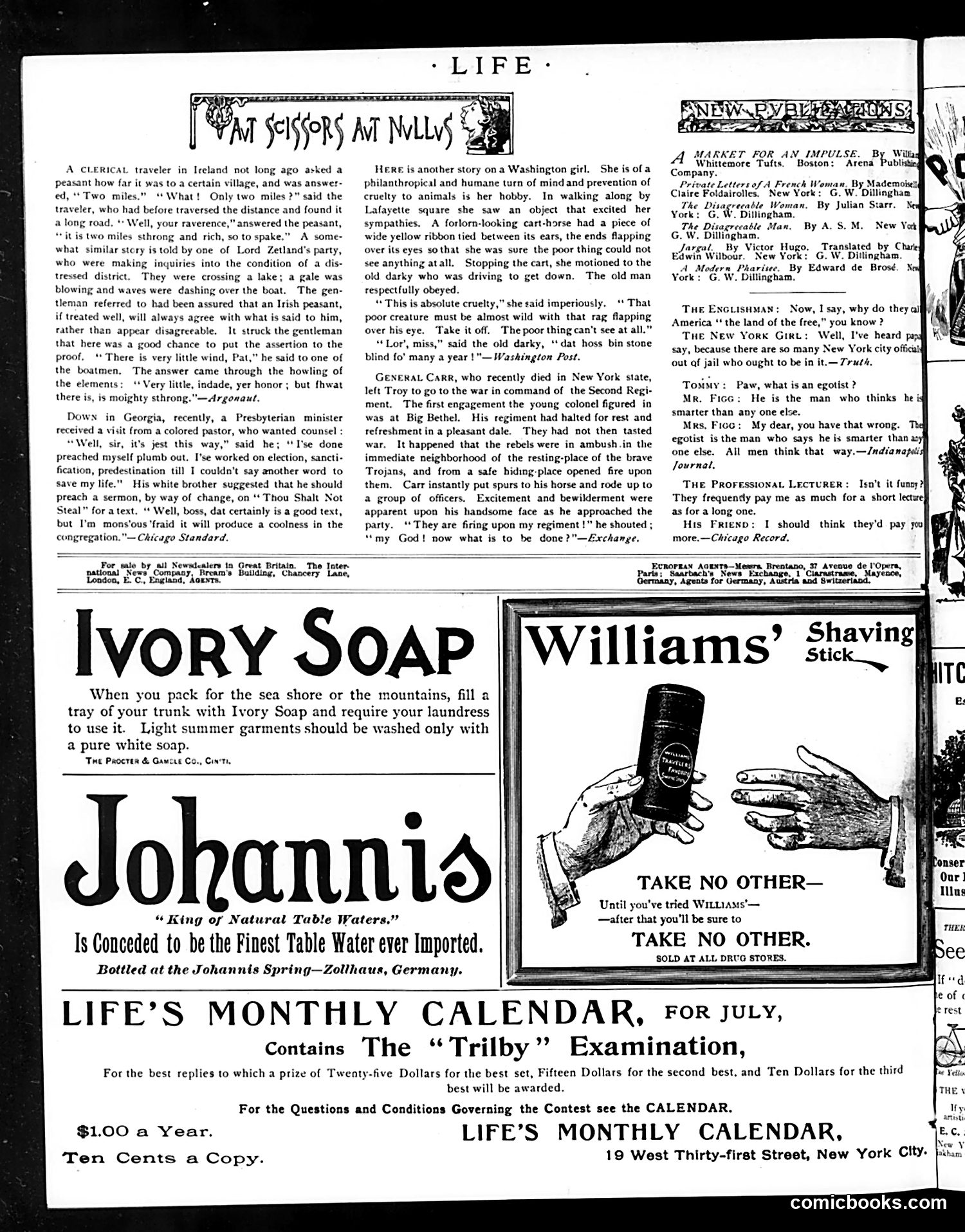
This page is primarily a collection of humorous anecdotes rather than political cartoons. The jokes exploit period stereotypes: 1. **Irish peasant stories**: Two anecdotes mock Irish speech patterns ("sthrong") and supposed agreeableness, presenting them as quaint or foolish. 2. **The colored pastor joke**: A Black minister tells a white Presbyterian that he fears preaching against theft ("Thou Shalt Not Steal") will "produce a coolness in the congregation"—implying his congregation consists of thieves. This relies on racist caricature. 3. **The Washington girl and the blind horse**: A well-meaning white woman mistakes a blind horse's ribbon for cruelty, revealing her naïveté. The "old darky" driver is portrayed as patiently correcting her. 4. **General Carr anecdote**: A military story about confusion during combat. The humor depends on period racial and ethnic stereotypes that modern readers would find offensive. The page also contains period advertisements (Ivory Soap, Johannis water, Williams' Shaving Stick).
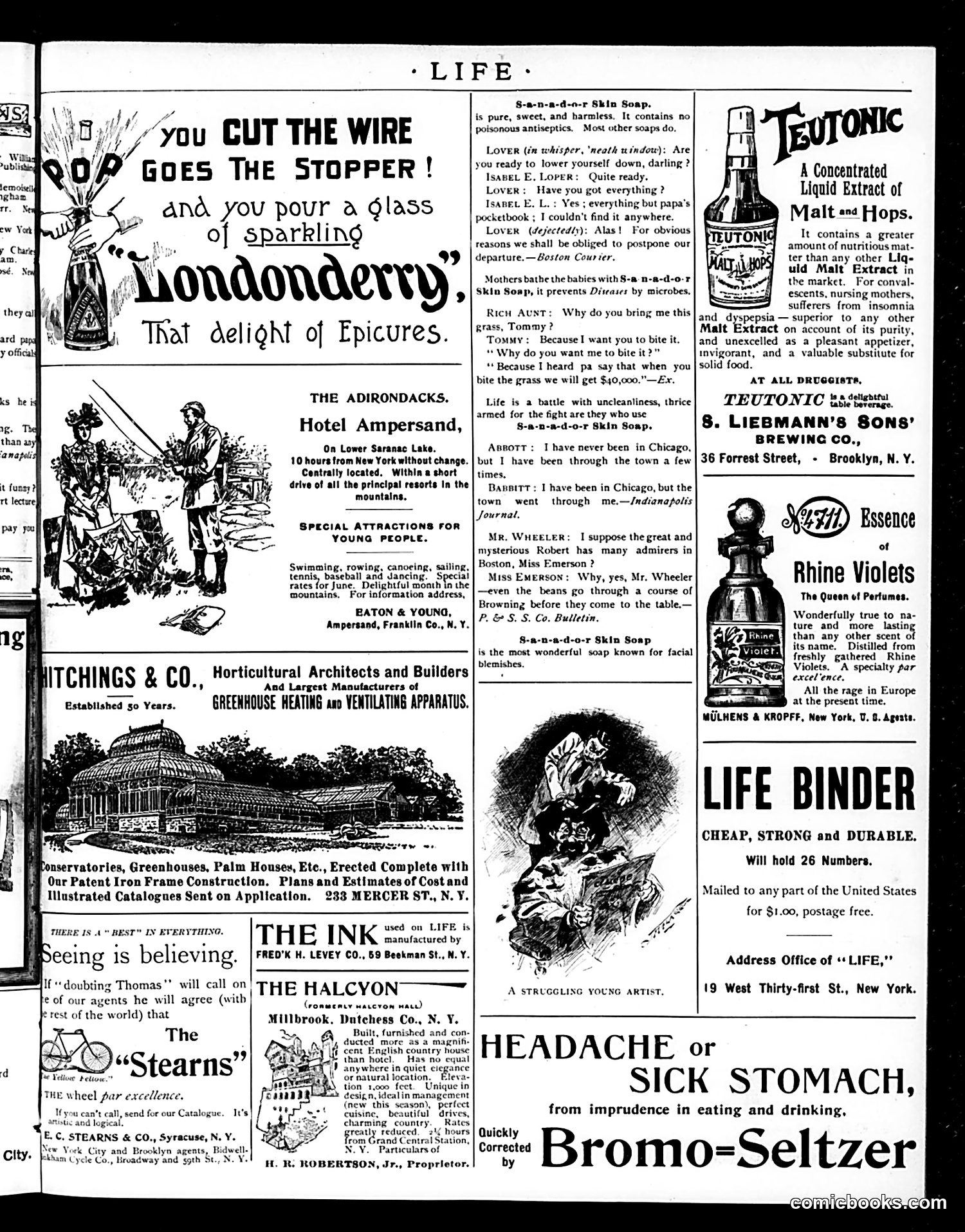
This page is primarily **advertising** for various products and services, with minimal satirical content. The few small humorous items include: **"Cut the Wire" cartoon**: A play on parlor tricks—cutting a wire makes a champagne bottle stopper pop, allowing sparkling cider ("Londonderry") to be poured. This advertises the beverage as an elegant alternative to alcohol. **Romance sketch**: A couple's elopement plan fails when the young woman realizes she forgot her father's pocketbook—satirizing romantic melodrama and young people's materialism. **Browning joke**: A pun mocking the poet Robert Browning, suggesting Boston society discusses him so much that even beans "go through a course of Browning" before being served. The page is dominated by **product advertisements**: soaps, hotels, bicycles, greenhouse equipment, patent medicines (Bromo-Seltzer), and malt extract tonics typical of late 19th-century publishing. The tone is genteel and directed at middle-class readers. There is no significant political or social satire present.
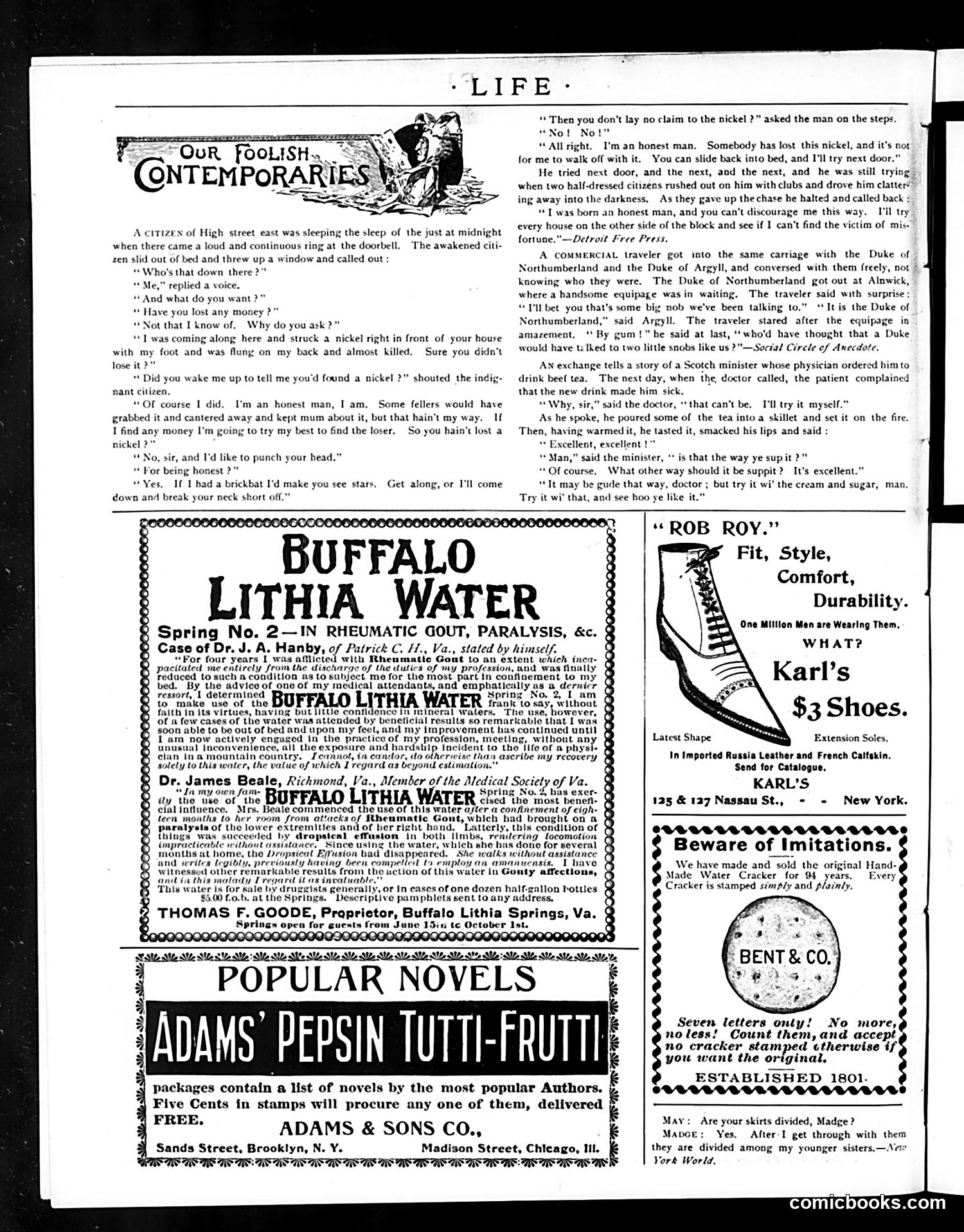
This page features three humorous anecdotes satirizing human nature and social pretension: 1. **The "Honest Man" story**: A man wakes neighbors repeatedly, claiming to have found a nickel and insisting on locating its owner. The joke mocks excessive honesty taken to absurd extremes—the man's rigid moral code becomes more annoying than criminal dishonesty would be. 2. **The Duke anecdote**: A commercial traveler unknowingly converses casually with nobility, then expresses surprise that a "Duke would have talked to two little snobs like us." The satire targets class consciousness and the traveler's assumption that rank determines who deserves conversation. 3. **The Scottish minister story**: A doctor demonstrates beef tea is "excellent" by drinking it plain, but the minister suggests adding cream and sugar makes it palatable. The humor lies in the doctor's pompous certainty versus practical wisdom. All three target self-righteousness, social pretension, and the gap between theory and practice—typical Life magazine satire of everyday foolishness.
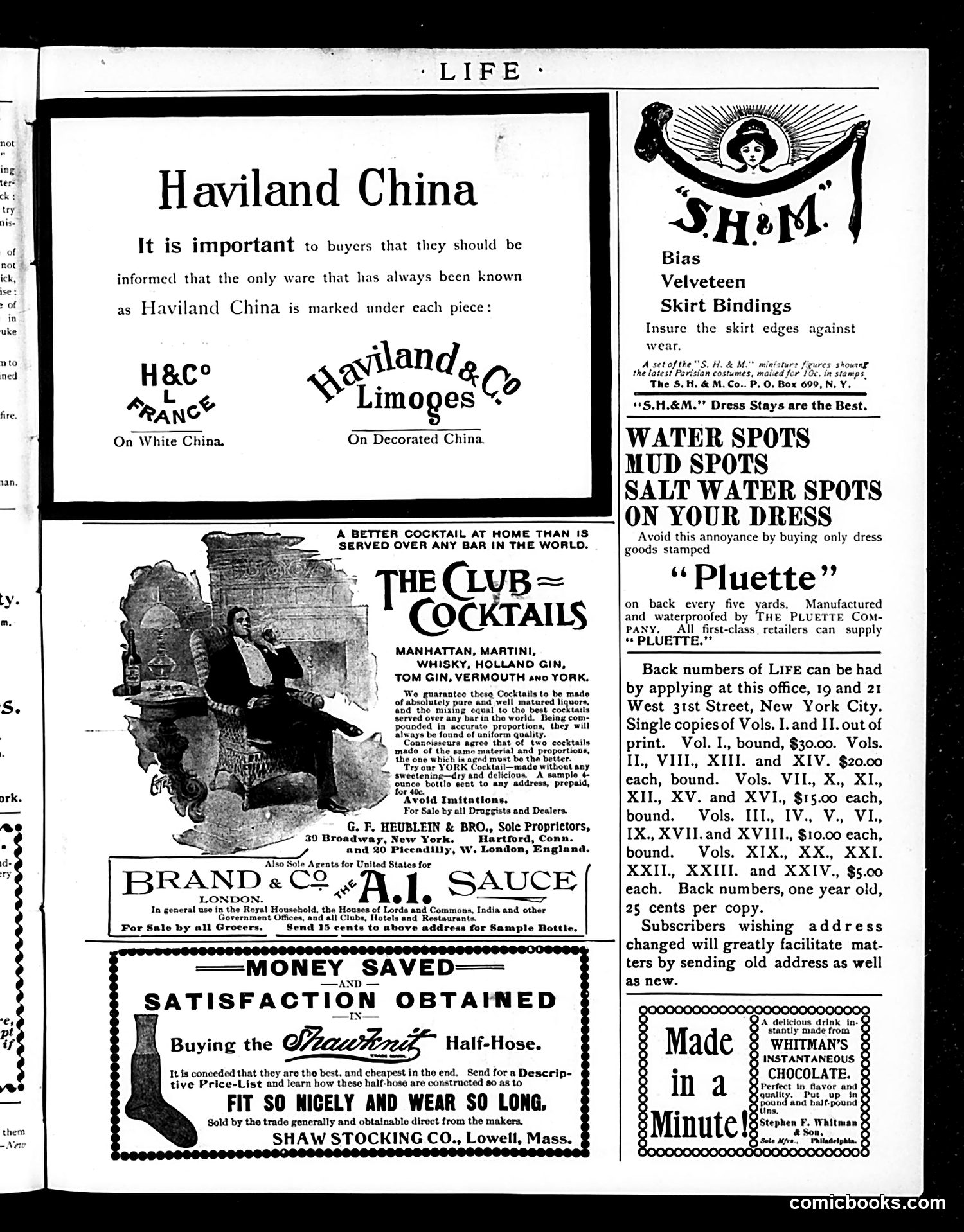
This is primarily a **advertisements page** from Life magazine, not a satirical cartoon page. The content consists of period product advertisements with minimal satirical commentary. **Main advertisements include:** - **Haviland China**: Distinguishing marks for authentic dinnerware (H&C° for white, Haviland & Co. Limoges for decorated) - **The Club Cocktails**: Pre-mixed cocktails by Heublein & Bro., marketed as superior to bar-made drinks—a reference to **Prohibition era concerns** about quality and safety of commercial alcohol - **Brand & Co. A.1. Sauce**: Endorsement from Royal Household and government offices - **Shaw Stocking Co.**: Half-hose hosiery - **S.H. & M. dress goods**: Skirt bindings and dress stays with miniature Parisian fashion figures - **Pluette fabric**: Waterproof dress goods to prevent water/mud/salt stains - **Whitman's Instantaneous Chocolate**: Powdered hot chocolate The page reflects early 20th-century consumer culture and domestic concerns (staining, quality control, fashion). No specific political satire is evident.
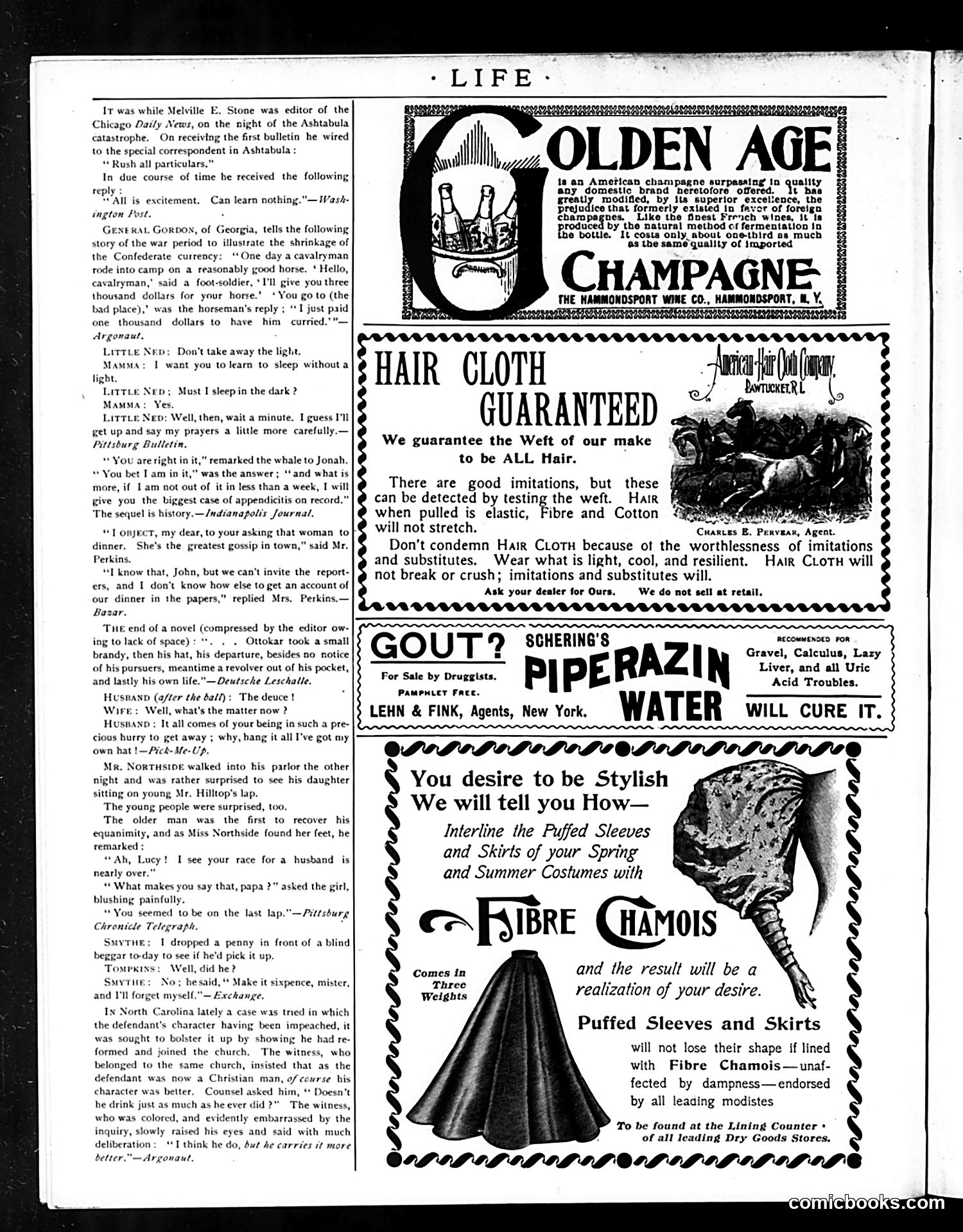
This page from *Life* magazine comprises primarily **humorous anecdotes** and **period advertisements** rather than editorial cartoons. The text contains short jokes and stories typical of turn-of-century American humor: - A reporter's inability to gather details during the Ashtabula catastrophe (a major train disaster) - Confederate currency depreciation during the Civil War - Domestic comedy involving children, marriage, and social awkwardness - A North Carolina courtroom scene featuring a Black witness whose malapropism ("carries it more better") was apparently considered humorous by contemporary standards The **advertisements** promote products marketed to early-1900s consumers: Olden Age Champagne, Hair Cloth fabric (guaranteed to be all hair), Piperazin Water for gout, and Fibre Chamois for clothing. The humor reflects period sensibilities: wordplay, situational comedy, and racial stereotyping that modern readers would find offensive. The page primarily entertained through lighthearted anecdotes rather than political satire.
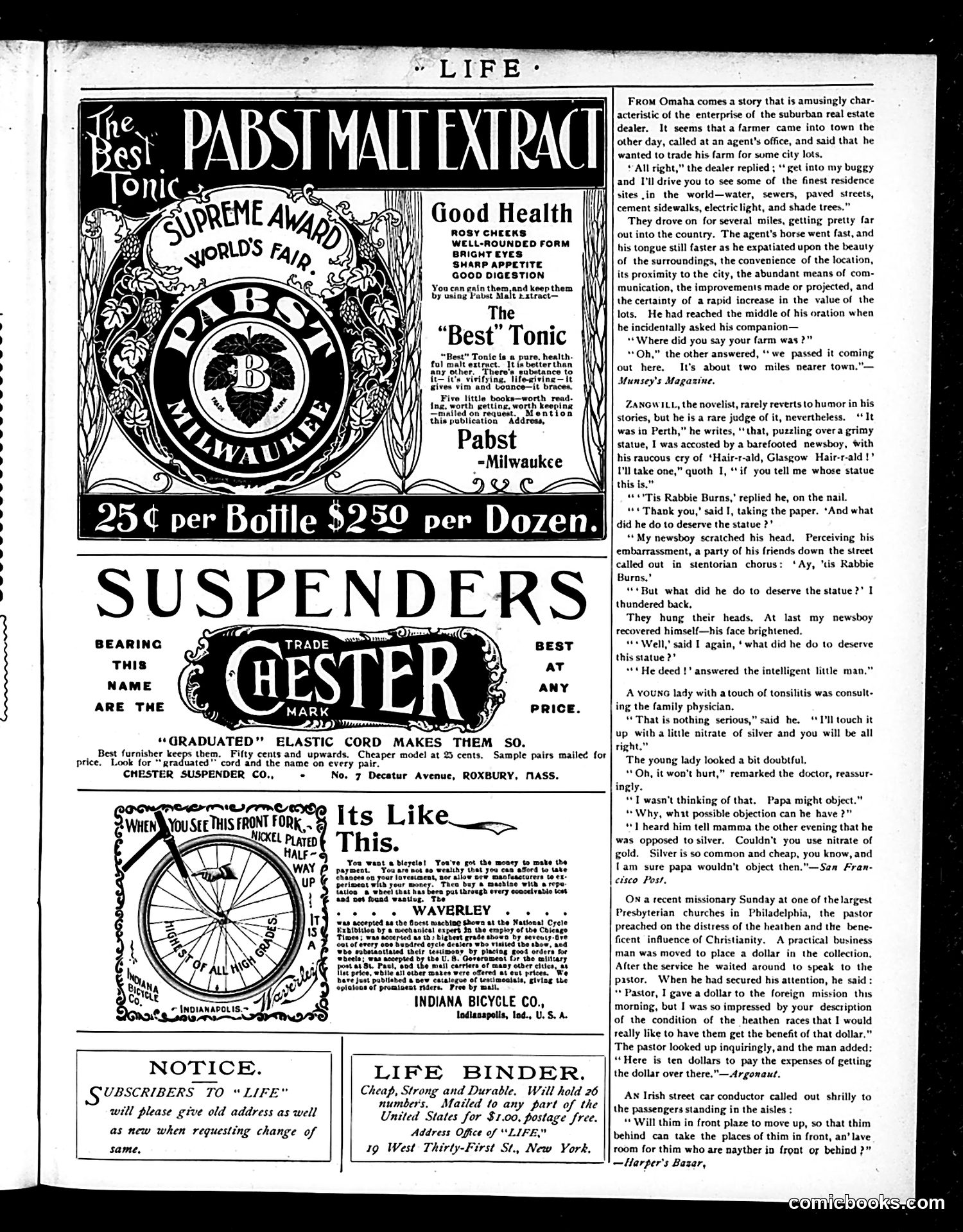
This page is primarily **advertisements and humorous anecdotes** rather than political cartoons. The ads promote consumer products (Pabst Malt Extract tonic, Chester suspenders, Indiana bicycles, Life binder) using health and lifestyle appeals typical of early 1900s marketing. The humor pieces are social satire: 1. **Real estate dealer story**: Mocks aggressive suburban real estate salesmen who use high-pressure tactics, praising nonexistent improvements while driving a farmer past his own property—satirizing urban expansion hype. 2. **Rabbie Burns anecdote**: A British newsboy cannot explain why the Scottish poet deserves a statue, suggesting cultural ignorance about public monuments. 3. **Doctor/tonsilitis joke**: A young woman worried her father will object to silver nitrate treatment—likely implying concern about an older male's controlling authority over her medical decisions. These pieces mock social pretension, commercial dishonesty, and paternalism—common Life magazine targets of the era.
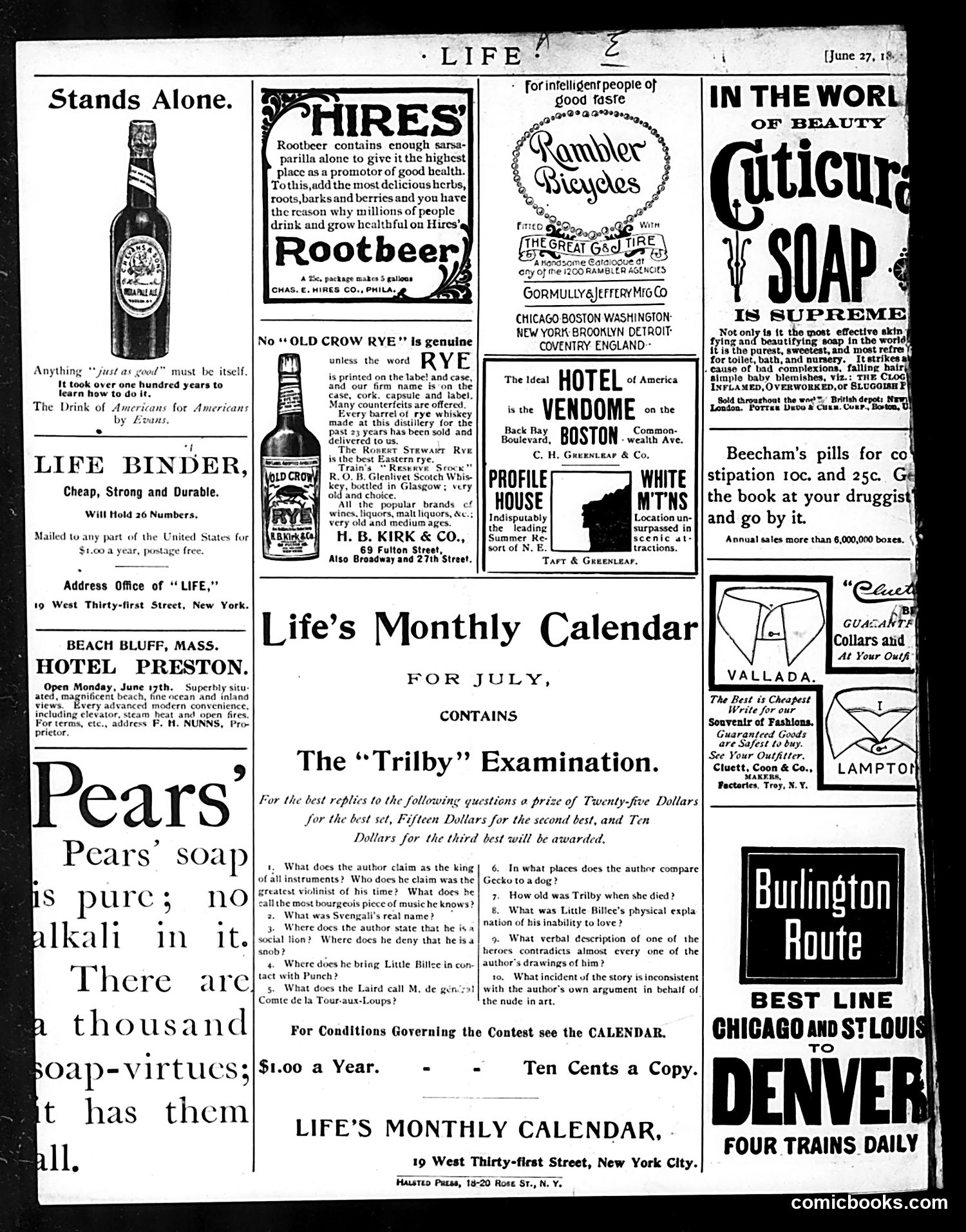
This is primarily a **advertisements and announcements page** from Life magazine (June 27, 1892), not a political cartoon page. The main content is **Life's Monthly Calendar for July**, which announces a contest based on the novel *Trilby* by George du Maurier—a hugely popular book of that era. Readers competed by answering detailed questions about the plot and characters for cash prizes ($25, $15, and $10). The surrounding advertisements reflect late-Victorian consumer culture: patent medicines (Beecham's pills for constipation), soaps (Pears', Cutícura), rootbeer, whiskey, bicycles, hotels, and railroads. These ads emphasize health benefits and quality ("genuine," "pure") typical of the period. The page itself contains **no political satire or caricatures**—it's a business/entertainment page showing how Life magazine operated as both a humor publication and advertising medium for middle-class American products and leisure activities.

I can see this is a page from Life magazine with significant black space, making it difficult to discern specific cartoon content or illustrations. The left margin shows some fragmented text that appears to be partial column headers or article snippets, but they're too incomplete to read coherently. The right side is predominantly blank/black. Without being able to clearly identify distinct cartoon panels, caricatures, or legible text content on this particular page, I cannot reliably explain what political or social satire it contains, who is depicted, or what contemporary references it makes. To provide accurate historical context as requested, I would need a clearer image where the actual cartoon artwork and accompanying text are visible and readable.