
Life, 1895-06-27 · page 6 of 21
Life — June 27, 1895 — page 6: what you’re looking at
What you’re looking at
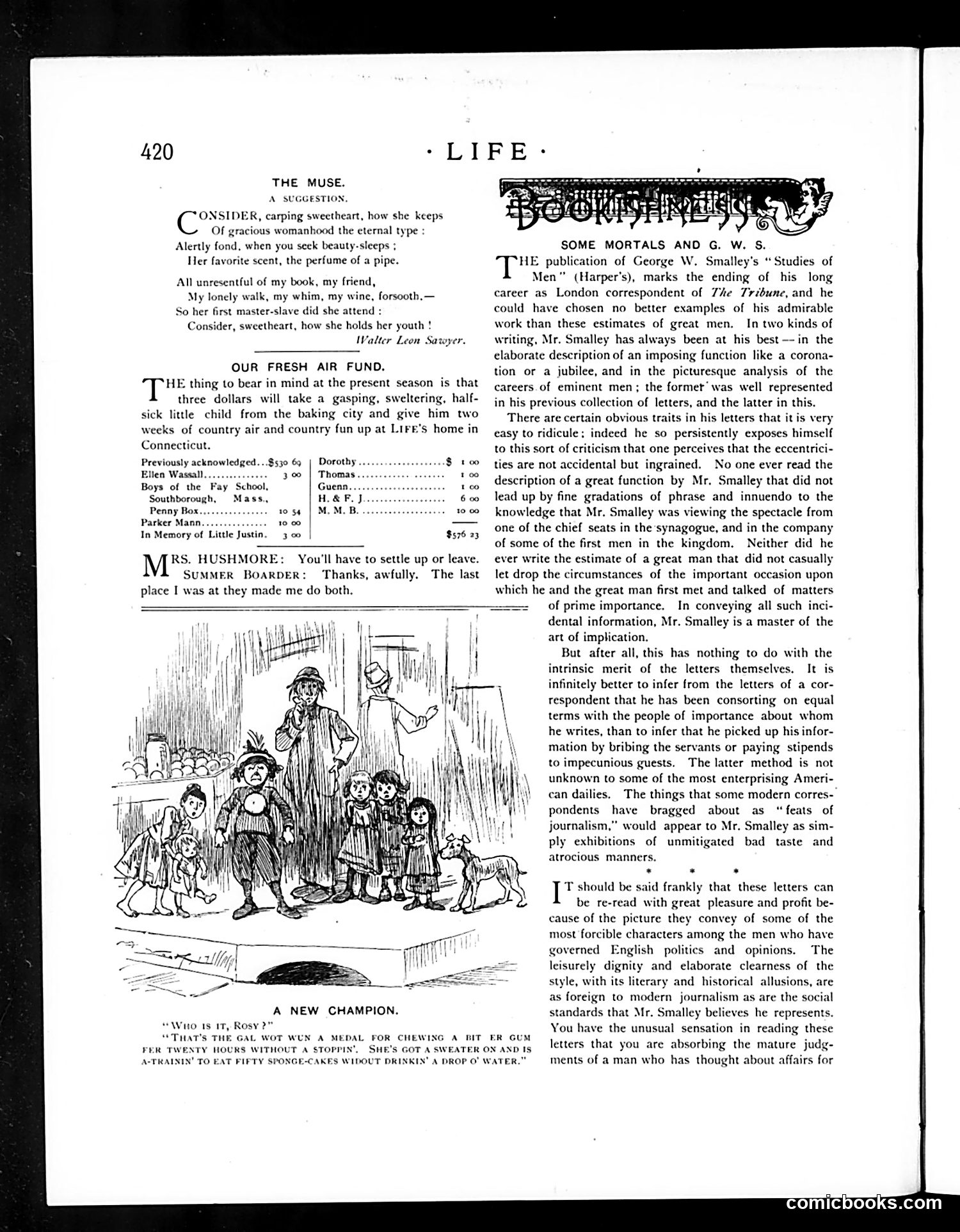
This cartoon satirizes childhood poverty and neglect in early 20th-century America. The illustration shows a ragged street child surrounded by other impoverished children, with the caption quoting dialogue: "Who is it, Rosy?" "That's the gal wot wus a medal for chewing a bit er gum for twenty hours without a stoppin'. She's got a sweater on and is a-tryin' to eat fifty doughnuts drinkin' a drop o' water." The satire mocks both the exploitative treatment of poor children and the sensationalized "feats" used to entertain or profit from them. The caption's cockney dialect emphasizes the working-class subjects, while the exaggerated challenge (eating fifty doughnuts) highlights how desperate poverty made children perform degrading stunts for minimal reward—a dark commentary on American urban childhood conditions.
📄 Transcribed text from this page (OCR, searchable)
Machine-transcribed from the original scan — historical spelling and the odd misread are preserved.
THE MUSE. A SUGGESTION, ONSIDER, carping sweetheart, how she keeps Of gracious womanhood the eternal type : Alertly fond, when you seck beauty-sleeps ; Her favorite scent, the perfume of a pipe. All unresentful of my book, my friend, My lonely walk, my whim, my wine, forsooth,— So her first master-slave did she attend : Consider, sweetheart, how she holds her youth ! Walter Leon Sawyer. OUR FRESH AIR FUND. HE thing to bear in mind at the present season is that three dollars will take a gasping, sweltering, half- sick little child from the baking city and give him two weeks of country air and country fun up at LIFE’s home in Connecticut. Dorothy ‘Thomas Guenn.. H&F. J. M.M. B. 8 to Previously acknowledged. ..$530 69 Ellen Wassall.... 3 00 Boys of the Fay School, Southborough, Mass. Penny Bo: Parker Mann. In Memory of L 1 co 6 00 10 00 $576 23 RS. HUSHMORE ‘ou'll have to settle up or leave. SUMMER BOARDER: si Thanks, awfully, The place I was at they made me do both, SOME MORTALS AND G. W. HE publication of George W. Smalley's “ Studies of Men” (Harper's), marks the ending of his long career as London correspondent of Zhe Trébune, and he could have chosen no better examples of his admirable work than these estimates of great men. In two kinds of writing, Mr. Smalley has always been at his best — in the elaborate description of an imposing function like a corona- tion or a jubilee, and in the picturesque analysis of the careers of eminent men; the former’ was well represented in his previous collection of letters, and the latter in this. There are certain obvious traits in his letters that itis very easy to ridicule; indeed he so persistently exposes himself to this sort of criticism that one perceives that the eccentrici- ties are not accidental but ingrained. No one ever read the description of a great function by Mr. Smalley that did not lead up by fine gradations of phrase and innuendo to the knowledge that Mr. Smalley was viewing the spectacle from one of the chief seats in the synagogue, and in the company of some of the first men in the kingdom, Neither did he ever write the estimate of a great man that did not casually let drop the circumstances of the important occasion upon which he and the great man first met and talked of matters of prime importance. In conveying all such inci- A NEW CHAMPION. “Wuo 1s tT, Rosy 2” “THAT'S THE GAL WOT WUN A MEDAL FOR CHEWING FER TWENTY HOURS WITHOUT A STOPPIN’. A RIT ER GUM SHE'S GOT A SWEATER ON AND 15 A-TRAININ' TO EAT FIPTY SPONGE-CAKES WIDOUT DRINKIN’ A DROP O' WATER.” dental information, Mr. Smalley is a master of the art of implication, But after all, this has nothing to do with the intrinsic merit of the letters themselves. It is infinitely better to infer from the letters of a cor- respondent that he has been consorting on equal terms with the people of importance about whom he writes, than to infer that he picked up his infor- mation by bribing the servants or paying stipends to impecunious guests. The latter method is not unknown to some of the most enterprising Ameri- can dailies, The things that some modern corres- pondents have bragged about as “feats of journalism,” would appear to Mr. Smalley as sim- ply exhibitions of unmitigated bad taste and atrocious manners. . . * I" should be said frankly that these letters can be re-read with great pleasure and profit be- cause of the picture they convey of some of the most forcible characters among the men who have governed English politics and opinions. The leisurely dignity and elaborate clearness of the style, with its literary and historical allusions, are as foreign to modern journalism as are the social standards that Mr. Smalley believes he represents. You have the unusual sensation in reading these letters that you are absorbing the mature judg- ments of a man who has thought about affairs for comicbooks.com