
Life, 1895-06-27 · page 12 of 21
Life — June 27, 1895 — page 12: what you’re looking at
What you’re looking at
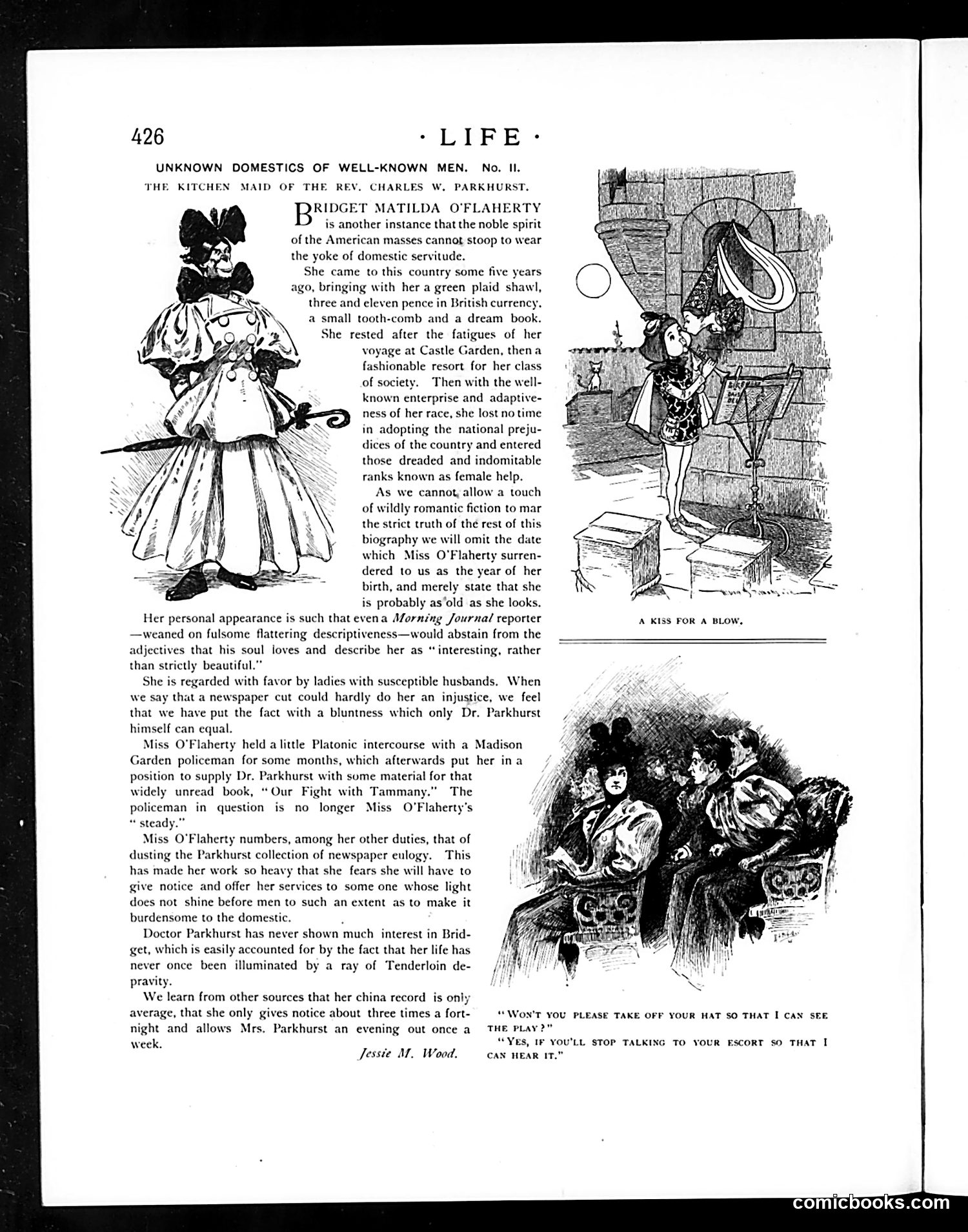
This 1890s *Life* magazine piece satirizes Reverend Charles W. Parkhurst, a prominent New York clergyman known for crusading against Tammany Hall corruption and moral vice in the "Tenderloin" district. The satire targets the hypocrisy of his public moralizing by focusing on his household help, Bridget Matilda O'Flaherty. The joke: Parkhurst preaches virtue while employing a kitchen maid of questionable character. The text sarcastically notes she had a romantic involvement with a Madison Square Garden policeman (possibly corrupted by the very Tammany system Parkhurst attacks), yet he ignores her entirely. The cartoons mock pretentious theatergoers—one showing a woman blocking the view with her hat, complaining others talk too loudly. This contrasts with Parkhurst's self-righteous public crusading: he lectures the public about morality while remaining oblivious to (or indifferent toward) misconduct under his own roof. The satire exposes the gap between public virtue-signaling and private negligence.
📄 Transcribed text from this page (OCR, searchable)
Machine-transcribed from the original scan — historical spelling and the odd misread are preserved.
426 -*LIFE: UNKNOWN DOMESTICS OF WELL-KNOWN MEN. No. II. THE KITCHEN MAID OF THE REV, CHARLES W. PARKHURST. RIDGET MATILDA O'FLAHERTY is another instance that the noble spirit of the American masses cannot stoop to wear the yoke of domestic servitude. She came to this country some five years ago, bringing with her a green plaid shawl, three and eleven pence in British currency. a small tooth-comb and a dream book. She rested after the fatigues of her voyage at Castle Garden, thena fashionable resort for her class of society. Then with the well- known enterprise and adaptive- ness of her race, she lost no time in adopting the national preju- dices of the country and entered those dreaded and indomitable ranks known as female help. As we cannot, allow a touch of wildly romantic fiction to mar the strict truth of the rest of this biography we will omit the date which Miss O'Flaherty surren- dered to us as the year of her birth, and merely state that she is probably as’old as she looks. Her personal appearance is such that evena Morning Journal reporter KGS FORK BEDE —weaned on fulsome flattering descriptiveness—would abstain from the adjectives that his soul ioves and describe her as “ interesting, rather than strictly beautiful.” She is regarded with favor by ladies with susceptible husbands. When we say that a newspaper cut could hardly do her an injustice, we feel that we have put the fact with a bluntness which only Dr. Parkhurst himself can equal. Miss O'Flaherty held a little Platonic intercourse with a Madison Garden policeman for some months, which afterwards put her ina position to supply Dr. Parkhurst with some material for that widely unread book, “Our Fight with Tammany.” The policeman in question is no longer Miss O’Flaherty’s “ steady.” Miss O'Flaherty numbers, among her other duties, that of dusting the Parkhurst collection of newspaper eulogy. This has made her work so heavy that she fears she will have to give notice and offer her services to some one whose light does not shine before men to such an extent as to make it burdensome to the domestic. . Doctor Parkhurst has never shown much interest in Brid- get, which is easily accounted for by the fact that her life has never once been illuminated by a ray of Tenderloin de- learn from other sources that her china record is only average, that she only gives notice about three times a fort- “Won'T YOU PLEASE TAKE OFF YOUR HAT SO THAT I CAN SEE night and allows Mrs. Parkhurst an evening out once a THE PLay?” Week “YES, IF YOU'LL STOP TALKING TO VOUR ESCORT SO THAT I Jessie M. Wood. CAN HEAR IT.” comicbooks.com