
Life, 1895-06-27 · page 4 of 21
Life — June 27, 1895 — page 4: what you’re looking at
What you’re looking at
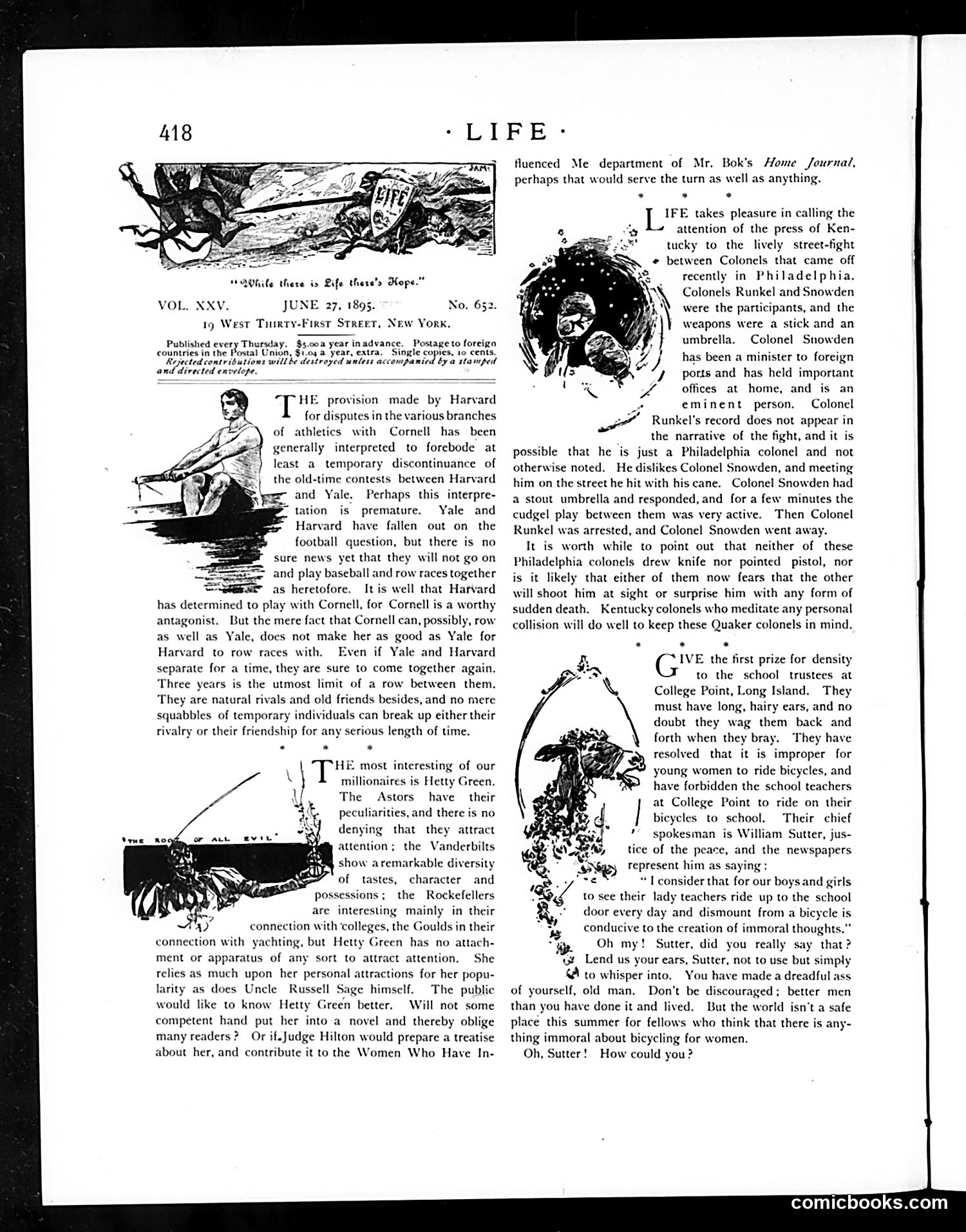
This page contains three satirical pieces: 1. **Top cartoon** ("While there is Life there's Hope"): A political figure appears trapped or cornered, likely referencing a contemporary scandal or controversy. 2. **Harvard-Yale rowing rivalry**: The text mocks Harvard's attempt to partner with Cornell for races instead of Yale, suggesting athletic rivalry masks deeper institutional tension. The satire suggests Harvard is avoiding Yale as a competitor. 3. **Hetty Green feature**: The main article celebrates the eccentric millionaire Hetty Green, comparing her to other wealthy families (Vanderbilts, Rockefellers, Goulds). The satire suggests Green deserves literary attention for her colorful personality. 4. **College Point controversy**: A humorous piece criticizing school trustees' ban on female teachers riding bicycles to school, framing it as prudish and outdated.
📄 Transcribed text from this page (OCR, searchable)
Machine-transcribed from the original scan — historical spelling and the odd misread are preserved.
-LIFE: “While there is Life there’s Hope.” VOL. XXV. JUNE 27, 1895. 1g West Tiirty-First Street, New York, $5.00a year inadvance. Postage to foreign Single copies, 10 cents. D by a stamped Published every Thursday. countries in the Postal Union, $1.04 a year, extra, ¢ Rejected contributions will be destroyed unless acconipanies and directed envelope. HE provision made by Harvard for disputes in the various branches of athletics with Cornell has been generally interpreted to forebode at least a temporary discontinuance of the old-time contests between Harvard and Yale. Perhaps this interpre- tation is premature. Yale and Harvard have fallen out on the football question, but there is no sure news yet that they will not go on Sse and play baseball and row races together “waar as heretofore. It is well that Harvard has determined to play with Cornell, for Cornell is a worthy antagonist. But the mere fact that Cornell can, possibly, row as well as Yale, does not make her as good as Yale for Harvard to row races with. Even if Yale and Harvard separate for a time, they are sure to come together again. Three years is the utmost limit of a row between them, They are natural rivals and old friends besides, and no mere squabbles of temporary individuals can break up either their rivalry or their friendship for any scrious length of time. . . HE most interesting of our millionaires is Hetty Green. The Astors have their peculiarities, and there is no denying that they attract attention; the Vanderbilt: show aremarkable diversity of tastes, character and the Rockefellers are interesting mainly in their connection with colleges, the Goulds in their connection with hting, but Hetty Green has no attach- ment or apparatus of any sort to attract attention. She relies as much upon her personal attractions for her popu- larity as does Uncle Russell Sage himself. The public would like to know Hetty Green better. Will not some competent hand put her into a novel and thereby oblige many readers? Or if.Judge Hilton would prepare a treatise about her, and contribute it to the Women Who Have In- fluenced Me department of Mr. Bok’s Home Journal, perhaps that would serve the turn as well as anything. . . . IFE takes pleasure in calling the ~ attention of the press of Ken- tucky to the lively street-fight ¢ between Colonels that came off recently in Philadelphia. Colonels Runkel and Snowden were the participants, and the weapons were a stick and an umbrella. Colonel Snowden has been a minister to foreign ports and has held important offices at home, and is an eminent person. Colonel Runkel's record does not appear in the narrative of the fight, and it is possible that he is just a Philadelphia colonel and not otherwise noted. He dislikes Colonel Snowden, and meeting him on the street he hit with his cane. Colonel Snowden had a stout umbrella and responded, and for a few minutes the cudgel play between them was very active. Then Colonel Runkel was arrested, and Colonel Snowden went away. It is worth while to point out that neither of these Philadelphia colonels drew knife nor pointed pistol, nor is it likely that either of them now fears that the other will shoot him at sight or surprise him with any form of sudden death. Kentucky colonels who meditate any personal collision will do well to keep these Quaker colonels in mind. . . . GPE the first prize for density to the school trustees at College Point, Long Island. They must have long, hairy ears, and no doubt they wag them back and forth when they bray. They have resolved that it is improper for young women to ride bicycles, and have forbidden the school teachers at College Point to ride on their bicycles to school, Their chief spokesman is William Sutter, jus- tice of the peace, and the newspapers represent him as saying : “ I consider that for our boysand girls to see their lady teachers ride up to the school door every day and dismount from a bicycle is to the creation of immoral thoughts.” Oh my! Sutter, did you really say that ? «Lend us your ears, Sutter, not to use but simply @ to whisper into. You have made a dreadful ass of yourself, old man. Don’t be discouraged; better men than you have done it and lived. But the world isn’t a safe place this summer for fellows who think that there is any- thing immoral about bicycling for women. Oh, Sutter! How could you? comicbooks.com