
A complete issue · 16 pages · 1895
Life — June 6, 1895
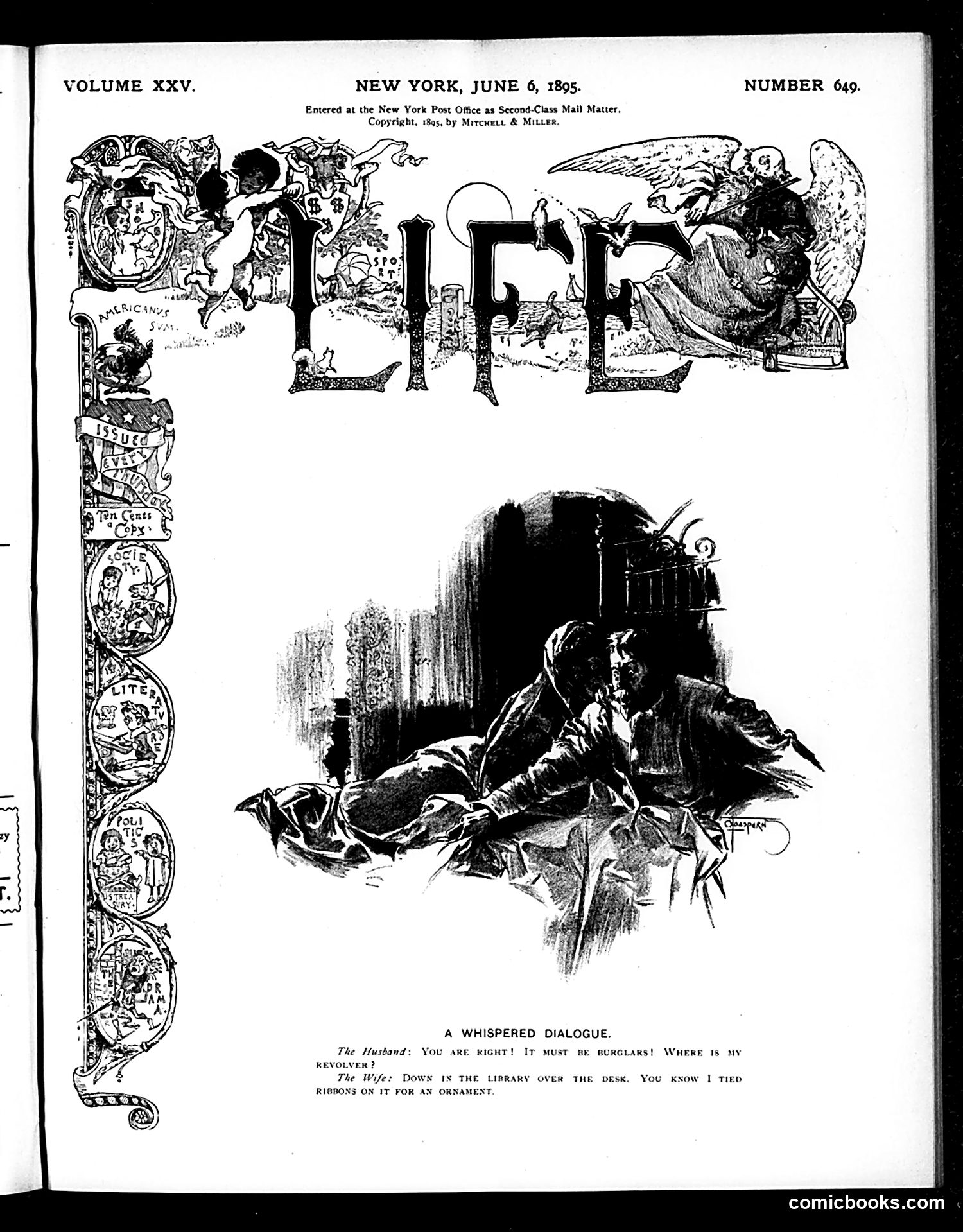
This page from Life magazine (June 6, 1895) features a domestic comedy sketch titled "A Whispered Dialogue." The illustration shows a husband and wife in conversation. The husband accuses his wife of being a burglar and asks where his revolver is. The wife responds that she placed it in the library over the desk, where she tied ribbons on it "for an ornament." The humor derives from a common Victorian-era anxiety: wives decorating or rearranging their husbands' possessions (particularly masculine items like firearms) without permission. The joke plays on gender roles and domestic tension—the wife has essentially feminized the husband's weapon by treating it as decorative rather than functional, while also unknowingly creating a security problem by making the gun inaccessible.
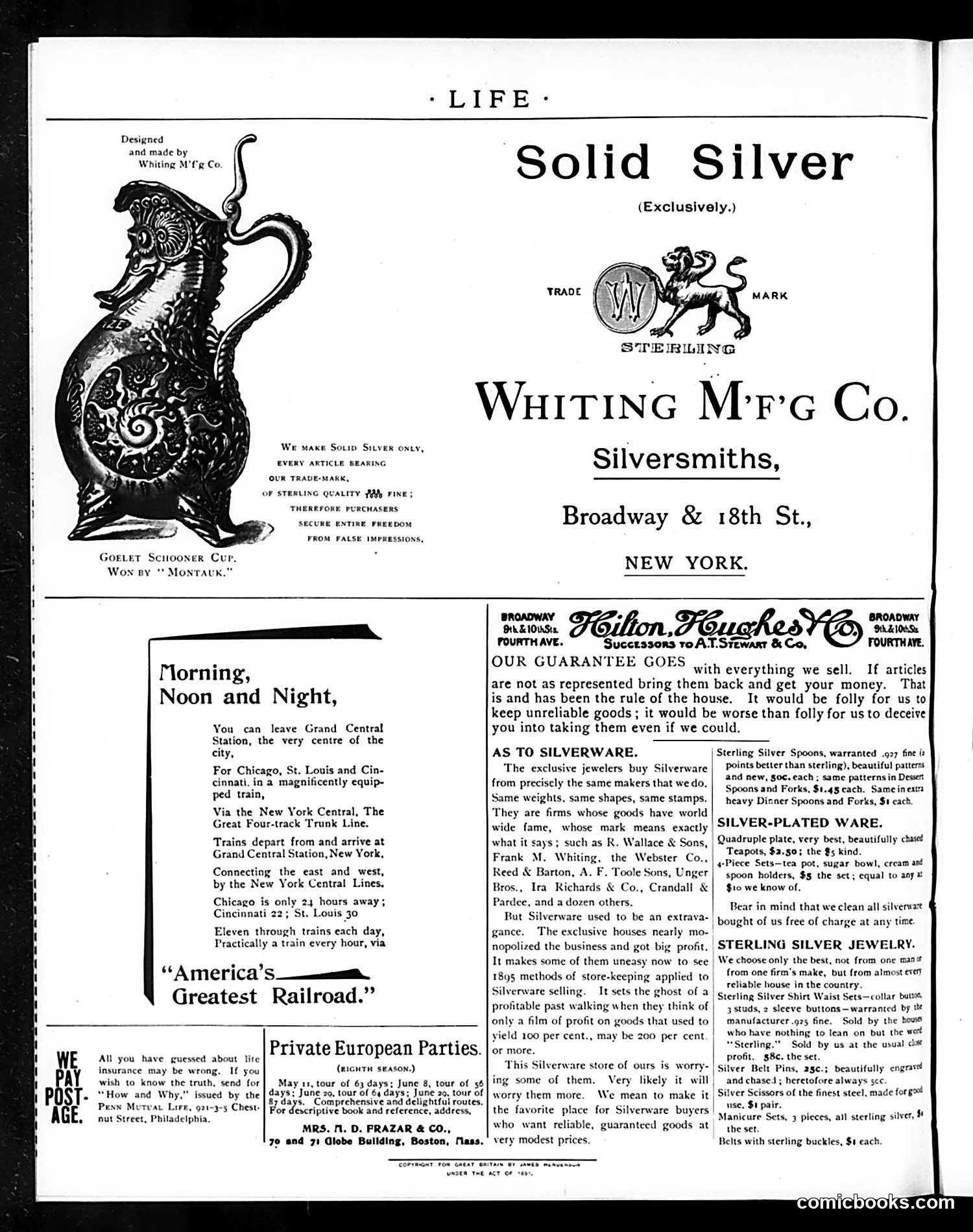
This page is primarily **advertising**, not satire or political commentary. The main content advertises **Whiting Manufacturing Company**, silversmiths located on Broadway & 18th Street in New York. The ornate silver pitcher image (labeled "Goblet Schooner Cup Won by 'Montauk'") showcases their craftsmanship. Supporting ads include: - **New York Central Railroad** ("America's Greatest Railroad"), promoting train service between major cities - **Hamilton, Houckes & Co.**, jewelry and silverware successors advertising their exclusive goods and reasonable prices - **Mrs. D. Frazer & Co.**, promoting private European parties and tours The page reflects **Gilded Age consumer culture**—targeting wealthy readers with luxury goods (sterling silver, fine jewelry) and leisure travel. There is no political cartoon or satire present.
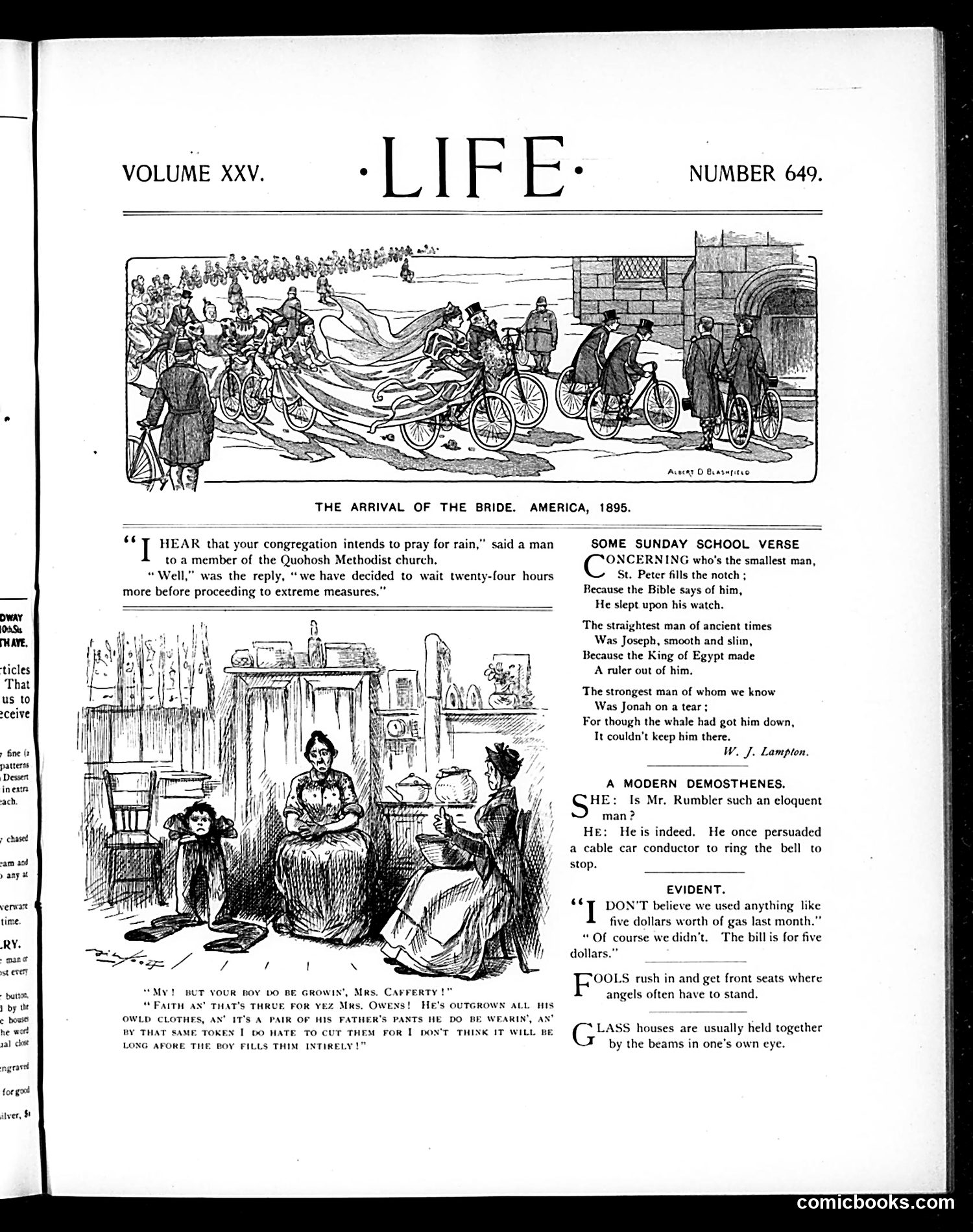
The top illustration, "The Arrival of the Bride, America, 1895," depicts a bride arriving by bicycle—a satirical commentary on the bicycle craze sweeping 1890s America. The elaborate bridal dress comically clashes with the practical bicycle transportation, suggesting tension between traditional femininity and modern technology. Women's increasing independence and mobility via bicycles challenged Victorian social norms. The lower cartoon humorously depicts domestic poverty, with a mother defending her son's threadbare appearance to a neighbor, justifying his worn clothing as hand-me-downs from his father. The satire targets economic hardship and working-class struggles of the era. The page also includes brief humorous one-liners and verse mocking various social absurdities of the period.
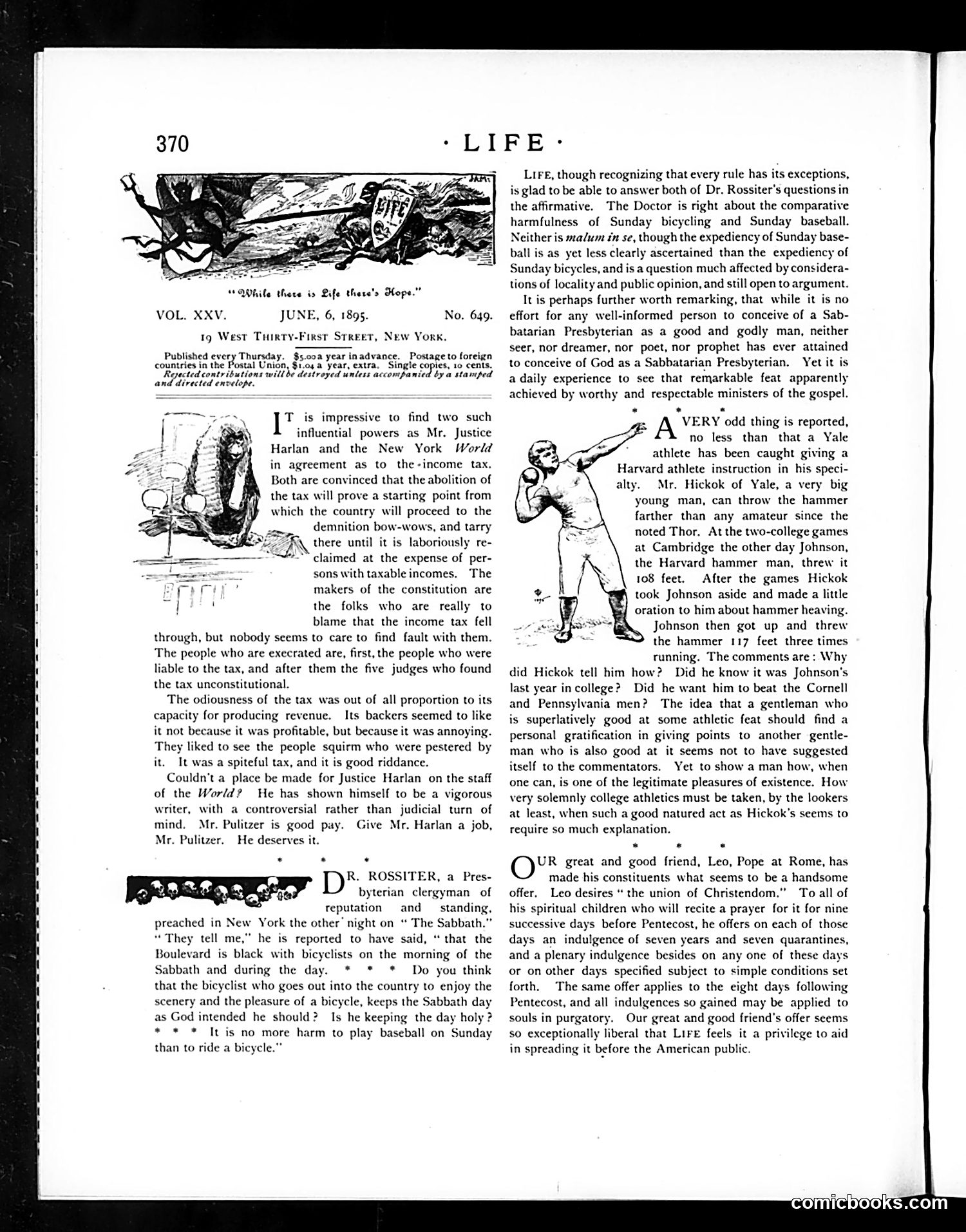
This page contains editorial commentary on three topics: 1. **Income Tax Debate**: Discusses influential figures (Justice Harlan and the *New York World*) debating whether abolishing income tax will help poor citizens or benefit the wealthy. 2. **Dr. Rossiter's Sabbath Sermon**: Critiques a clergyman's argument that Sunday bicycling violates the Sabbath, while Sunday baseball is acceptable. The satire questions this inconsistent moral reasoning—if bicycles desecrate Sunday, shouldn't baseball too? 3. **Yale Athlete's Hammer Throw**: Reports on a Yale student (Hickok) throwing a hammer 117 feet, discussing whether college athletes should prioritize winning or sportsmanship. The page reflects 1890s debates about moral regulation, wealth distribution, and competitive athletics.
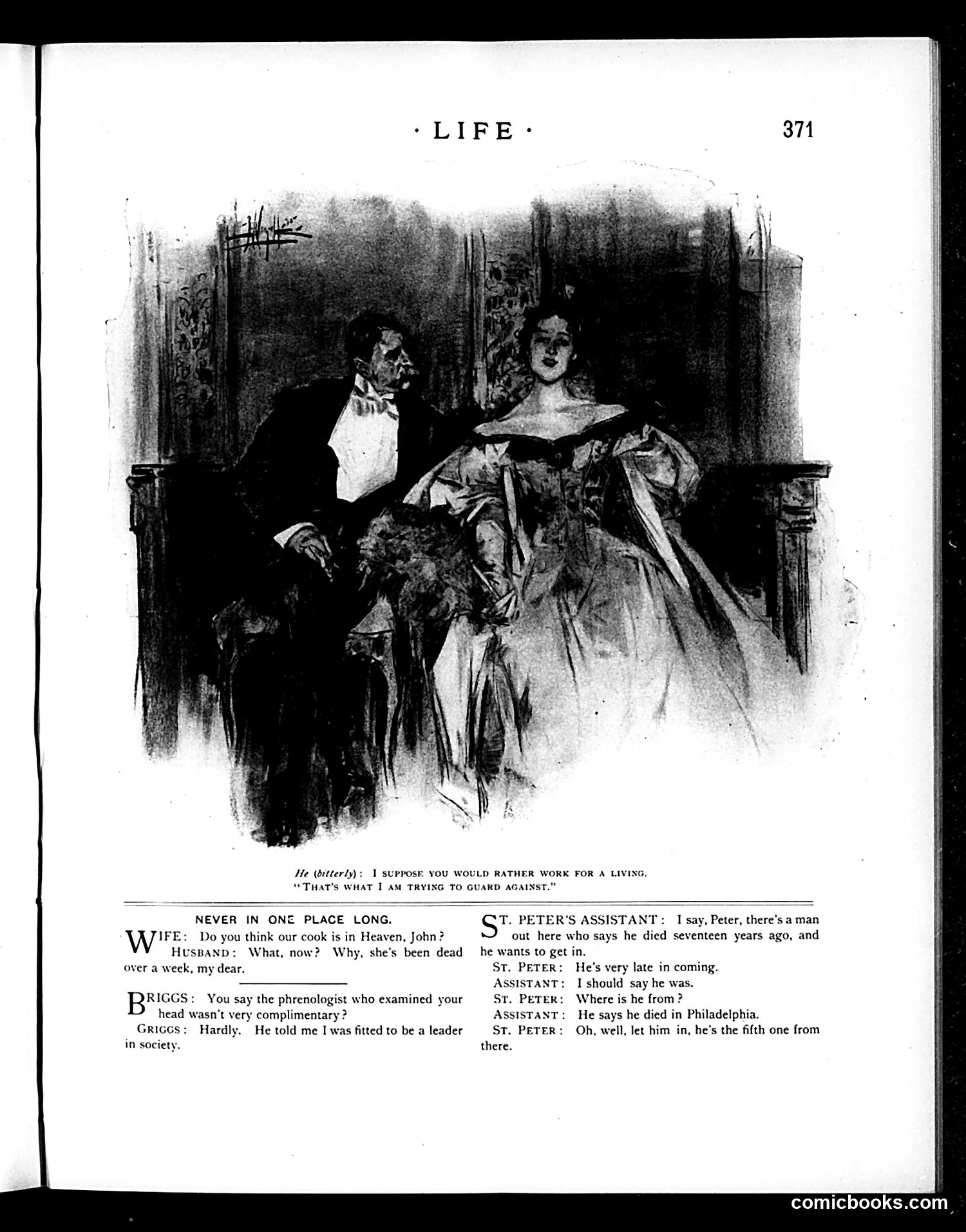
This page contains two separate satirical pieces: **Top cartoon**: A couple's domestic exchange where the husband defends himself against accusations about working for a living, saying "That's what I am trying to guard against"—suggesting anxiety about economic security and class status. **Bottom section** ("Never in One Place Long"): A conversation between a wife, husband, and servants (Briggs and St. Peter's Assistant) discussing a cook's death and the difficulty of household staff retention. The joke appears to target both the unreliability of domestic servants and employers' frustration with constant turnover. St. Peter's involvement suggests the cook is deceased, adding dark humor about the scarcity of good household help. Both pieces satirize early 20th-century middle-class anxieties about money, servants, and social stability.
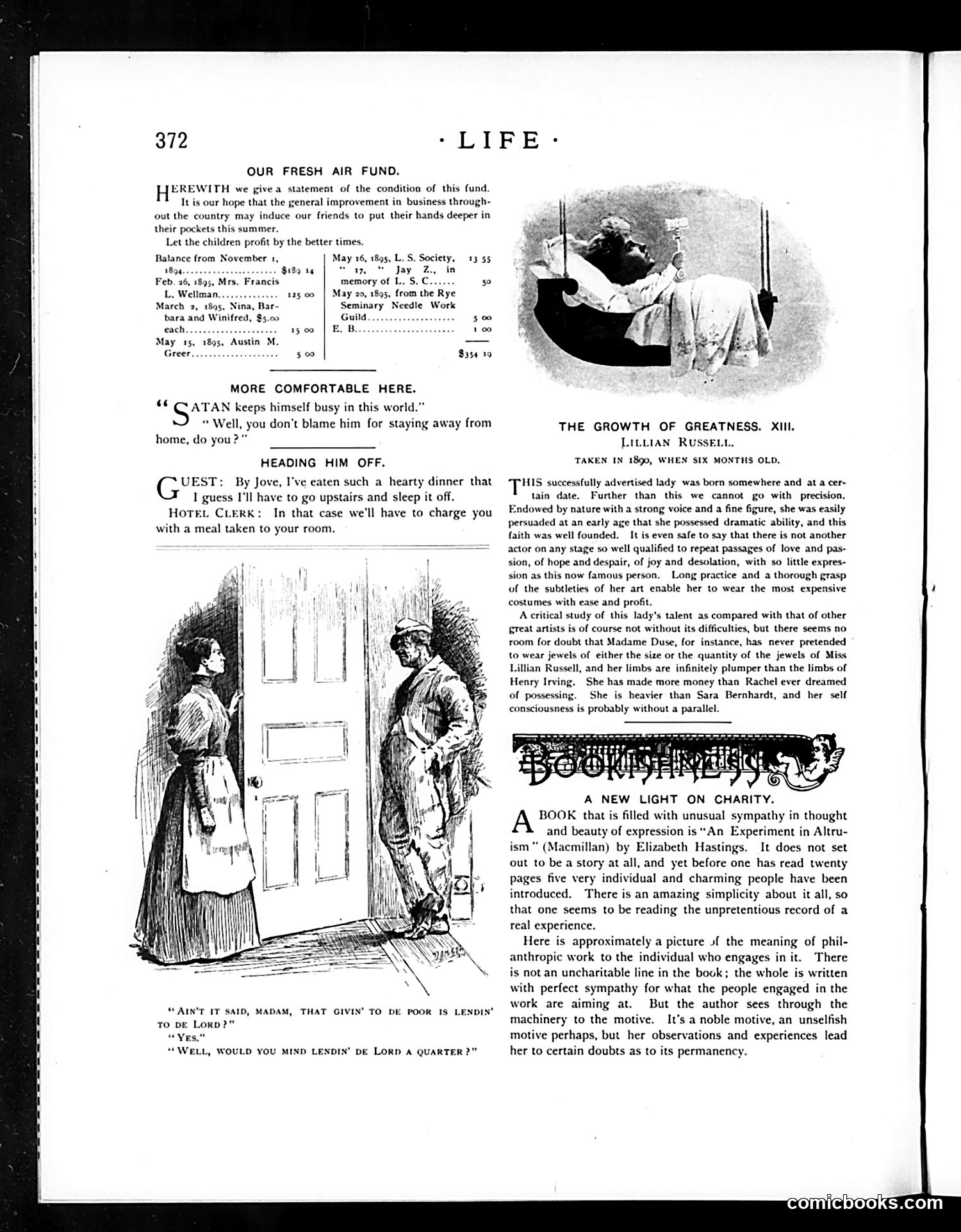
The main cartoon titled "HEADING HIM OFF" depicts a hotel clerk confronting a guest departing after a heavy meal. The guest claims he must leave immediately to digest, while the clerk insists on charging for the room. The joke plays on the guest's excuse—he needs to "go upstairs and sleep it off"—versus the hotel's financial interest in collecting payment regardless. This is a straightforward hospitality humor piece with no clear political reference. It satirizes the tension between guests' comfort and hotels' profit motives, a relatable scenario for the magazine's audience. The page also features a profile piece on actress Lillian Russell and a book review of Elizabeth Hastings' "An Experiment in Altruism," neither of which are satirical cartoons.
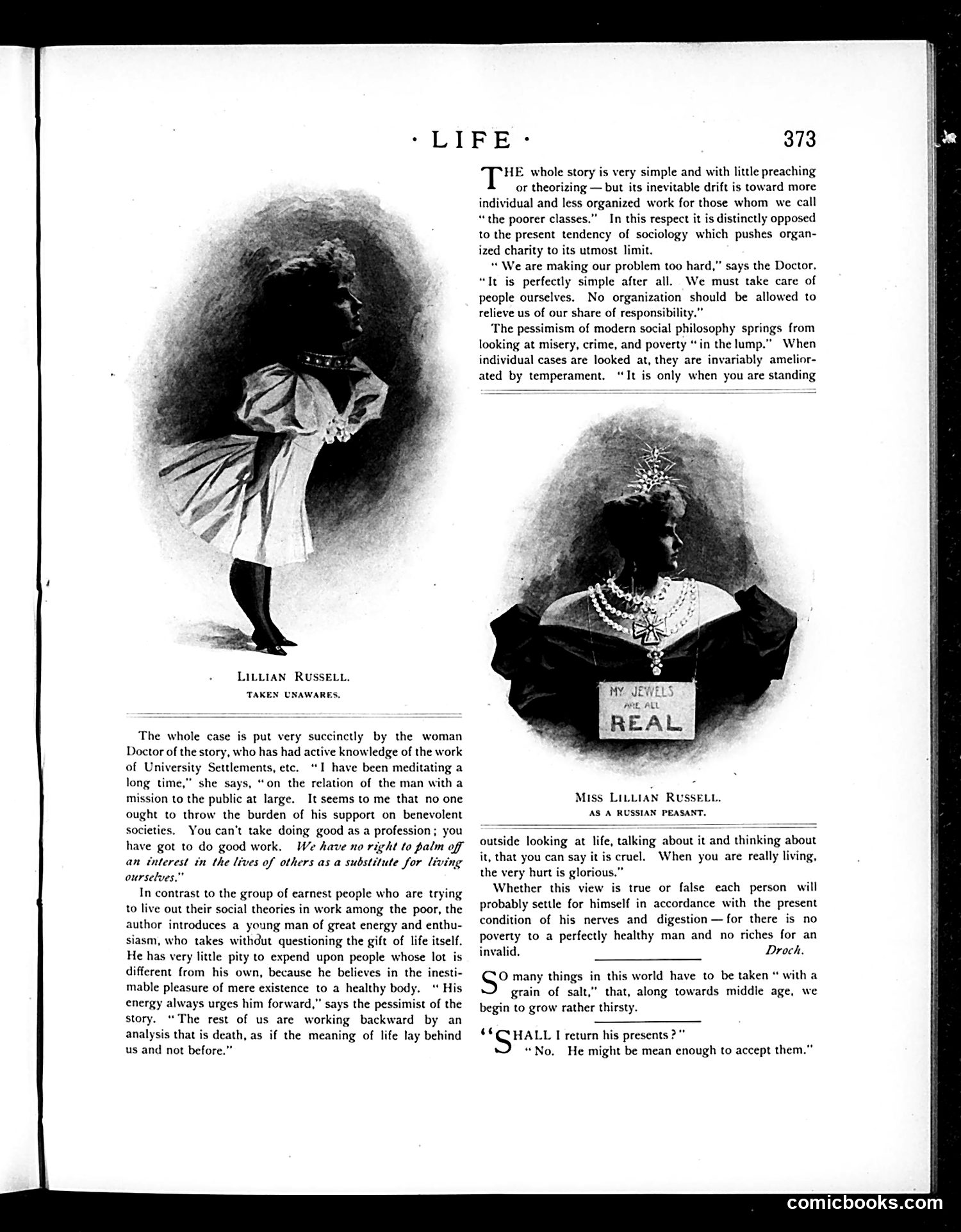
This page features two illustrations of **Lillian Russell**, a famous American actress and singer of the late 1800s/early 1900s. The left image shows her in a provocative pose ("Taken Unawares"), while the right depicts her wearing jewelry with a sign reading "MY JEWELS ARE ALL REAL," labeled "As a Russian Peasant." The satire appears to mock Russell's reputation and public persona. The "Russian peasant" caption is ironic—she's adorned with expensive jewels, contrasting sharply with peasant status. The accompanying text discusses social responsibility, poverty, and charity, suggesting the cartoonist critiques wealthy entertainers like Russell for their detachment from social problems while flaunting their wealth. The humor relies on readers' familiarity with Russell's celebrity status and known affectations.
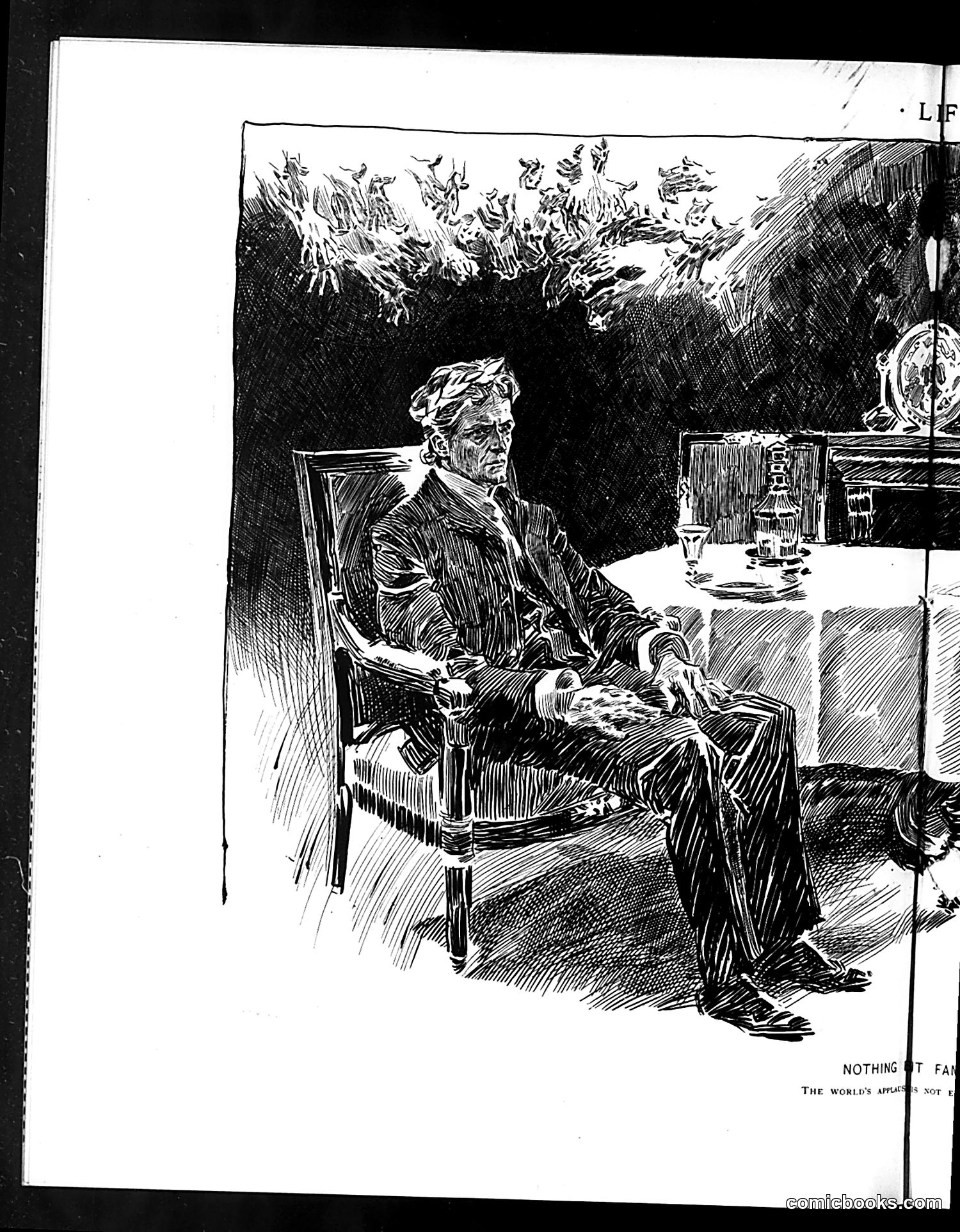
This is a black ink illustration showing a well-dressed man seated in an armchair in what appears to be an elegant interior setting, with flowers visible above and drinking glasses on a table nearby. The figure appears contemplative or troubled. The partial text visible at bottom reads "NOTHING OF FAM..." and "THE WORLD'S APPAR... NOT..." which is cut off and unclear from the OCR. Without the complete caption or accompanying text, I cannot definitively identify the specific figure or the satirical point being made. The formal setting and the man's posture suggest this may comment on wealth, privilege, or some personal crisis among the elite, but the exact political or social reference remains unclear from the visible portions of this page.
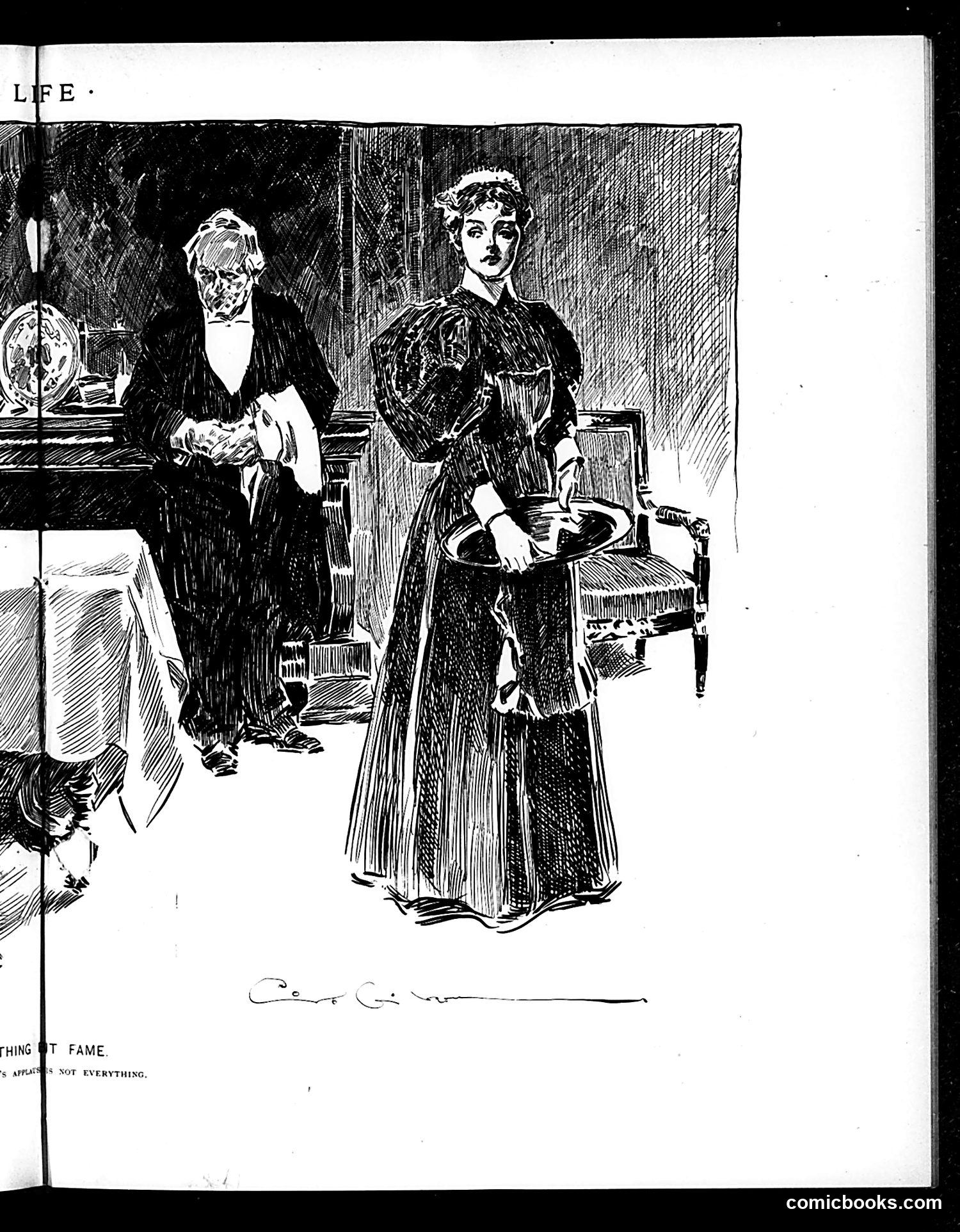
This appears to be an illustration from Life magazine's satirical section. The image shows two figures in an interior setting: a woman in an elaborate dark dress standing prominently in the foreground, and a man seated behind her wearing formal attire. The visible text fragments suggest social commentary—"THING OF FAME" and references to "NOT EVERYTHING" appear at the bottom, though the complete caption is partially obscured. The illustration's style and composition suggest this is satirizing upper-class or society figures, likely commenting on vanity, social pretension, or the pursuit of fame and status. Without the complete caption visible, the specific targets and exact satirical point remain unclear, though the formal dress and interior setting indicate this critiques wealthy or prominent individuals.
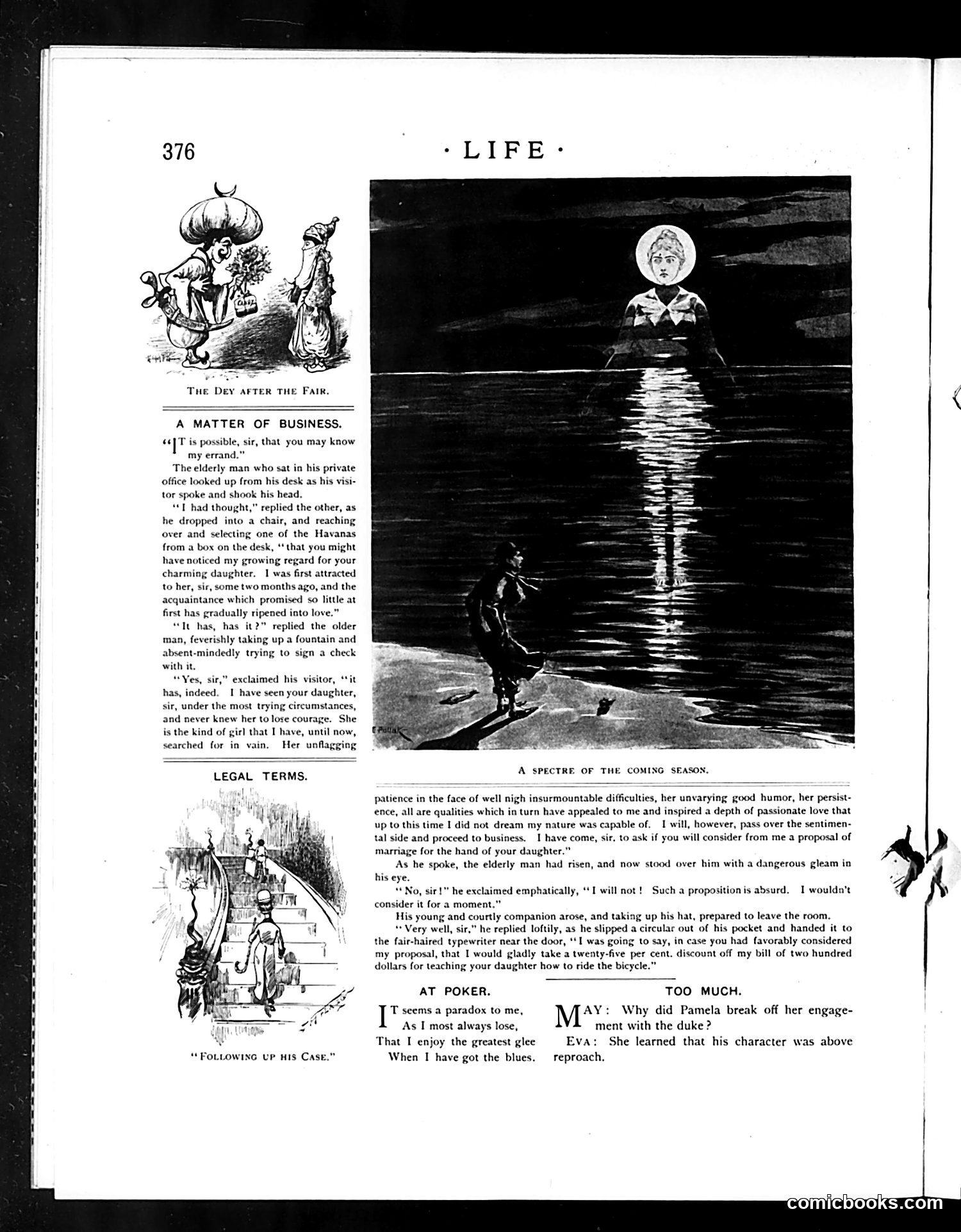
This page contains three distinct satirical pieces: 1. **"The Dev After the Fair"** - A cartoon depicting a hungover, disheveled demon-like figure, satirizing the morning-after consequences of excessive celebration. 2. **"A Matter of Business"** - A prose narrative about an elderly businessman being courted by a suitor interested in his daughter. The humor lies in the suitor's clumsy attempt to secure a marriage proposal through financial negotiation rather than genuine affection. 3. **"Legal Terms," "At Poker," and "Too Much"** - Brief joke segments including a cartoon labeled "Following up His Case" and short dialogue exchanges satirizing social pretension and romantic complications. The page exemplifies Life's characteristic blend of visual and textual satire targeting middle-class social conventions and relationship dynamics of the era.
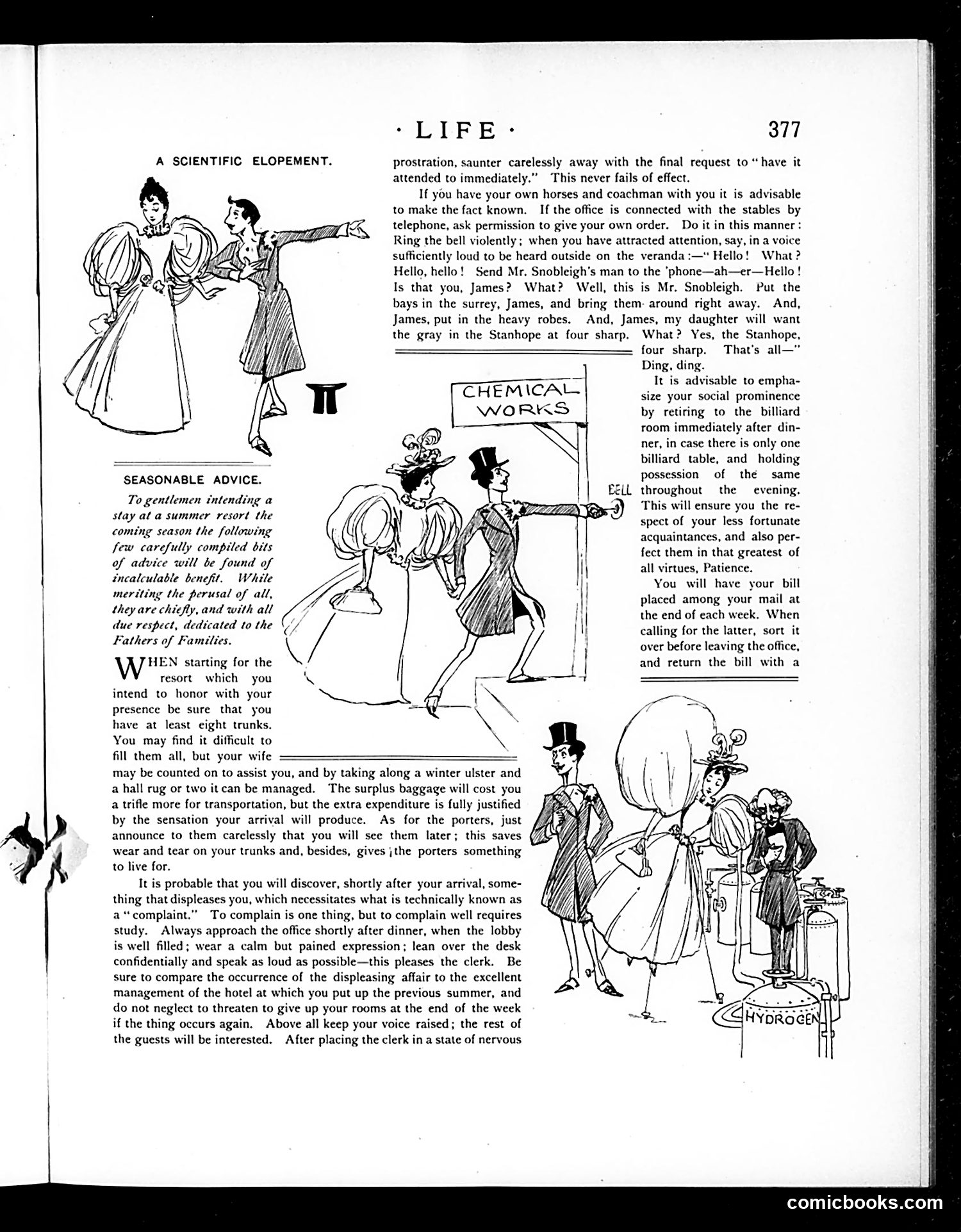
This page offers humorous etiquette advice for wealthy travelers visiting summer resorts. The cartoons mock the pretensions and complaints of affluent guests. **"A Scientific Elopement"** (top left) shows a couple departing dramatically with enormous luggage, satirizing theatrical departures. **"Seasonable Advice"** provides tongue-in-cheek guidance on managing resort life: pack light trunks, arrive with minimal fanfare, and handle complaints discreetly through proper channels rather than loudly. The accompanying cartoons illustrate absurd scenarios—guests making excessive demands at "Chemical Works," porters struggling with oversized baggage, and a woman arriving with a hydrogen balloon. The satire targets nouveau riche guests who lack refinement and grace, emphasizing restraint and dignity as markers of true class status.
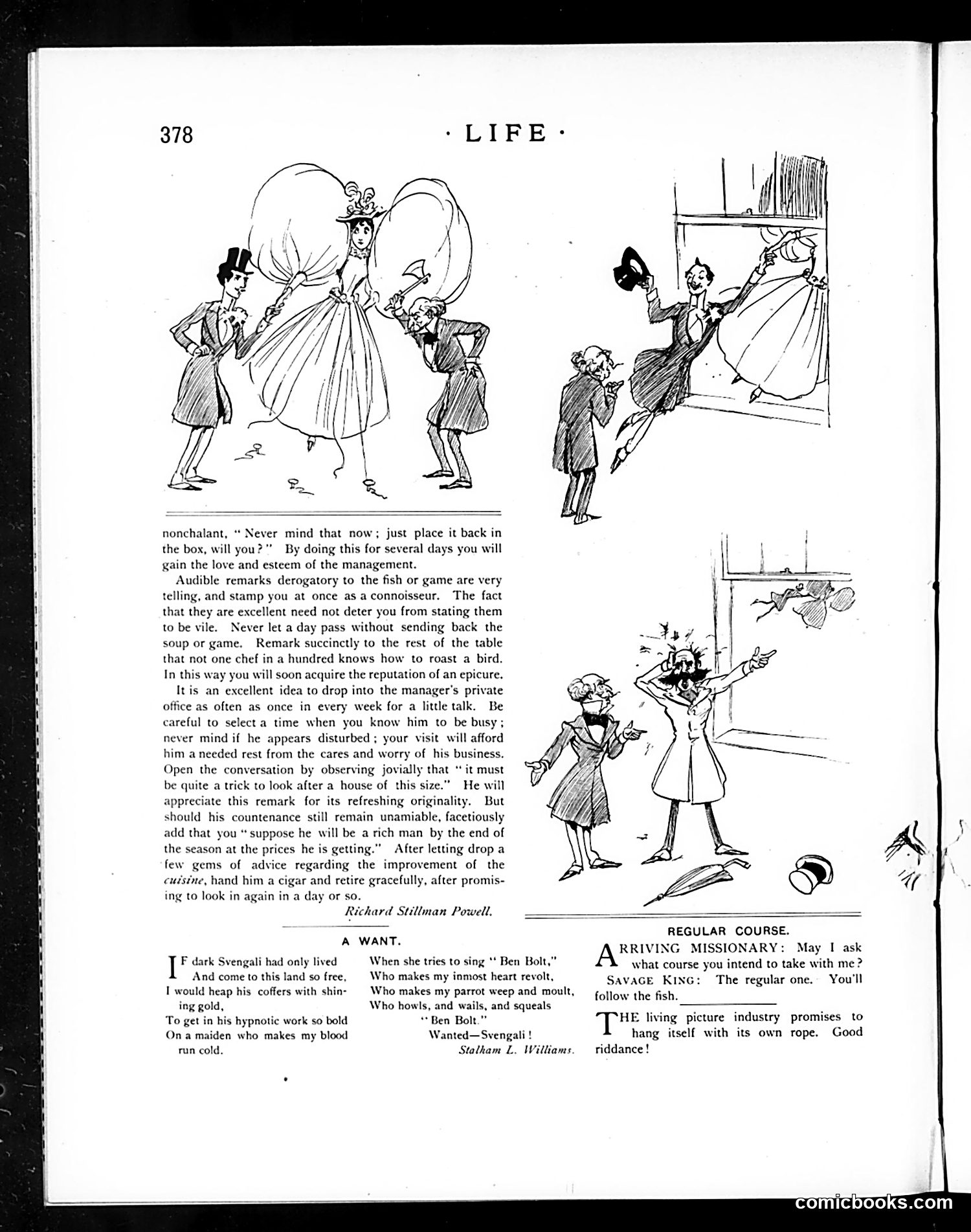
This page contains satirical humor pieces mocking social pretension and emerging entertainment industries. **Top cartoon**: Advises readers how to impress restaurant management through affected sophistication—complaining about food quality, pestering the busy manager, and offering unsolicited advice. The satire targets diners who fake expertise to appear cultured while actually being rude and oblivious. **"Regular Course" cartoon**: A crude colonial-era joke equating missionary work to being served as food ("follow the fish"), presenting the "savage king" as a cannibal host. This reflects period attitudes toward non-Western peoples. **"A Want" section**: References *Trilby* and its villain Svengali (a hypnotist who controlled a woman through music), expressing frustration with a woman's terrible singing. The final note mocks the nascent "living picture industry" (early cinema) as destined for failure—a prescient joke, since cinema obviously thrived despite this prediction. All three pieces employ satire about pretension, exoticism, and emerging modern anxieties.
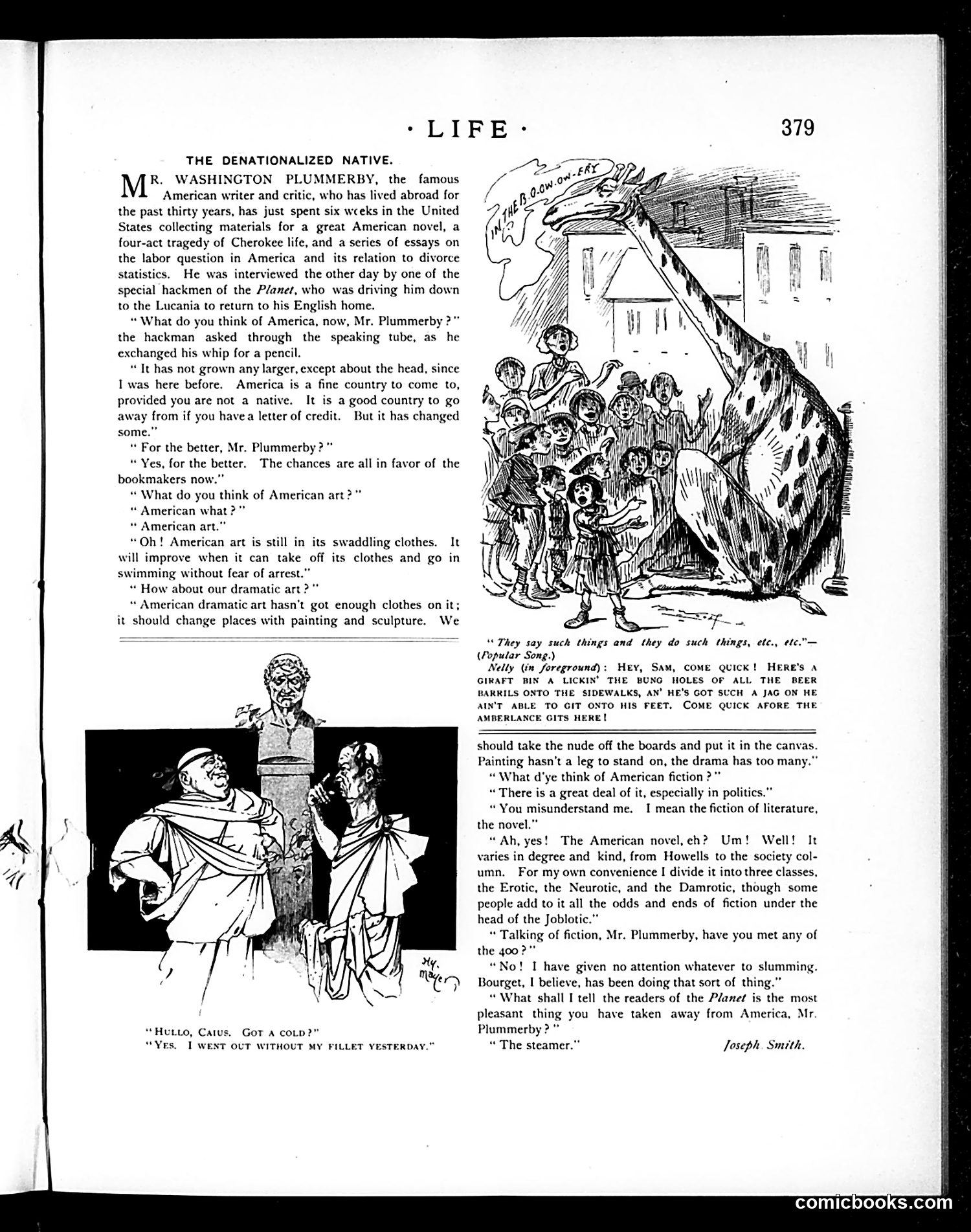
This satirical piece mocks **Washington Plummerby**, a caricatured American expatriate writer who has lived abroad for thirty years and now returns to America as a supercilious critic. The interview lampoons his affected superiority and contradictory complaints: he criticizes American art, drama, and fiction as underdeveloped, yet makes nonsensical pronouncements (dividing novels into "Erotic, Neurotic, and Damrotic" classes). His barbs about American morality—suggesting art/drama need fewer/more clothes respectively—expose pretentiousness masking shallow judgment. The cartoon appears to contrast his intellectual posturing with the crude reality of American street life, shown in the lower comic panel depicting urban workers and a drunken man—the actual America he's too refined to acknowledge. The satire targets expatriate American intellectuals who abandoned their homeland, then returned to disparage it from a false position of European sophistication.
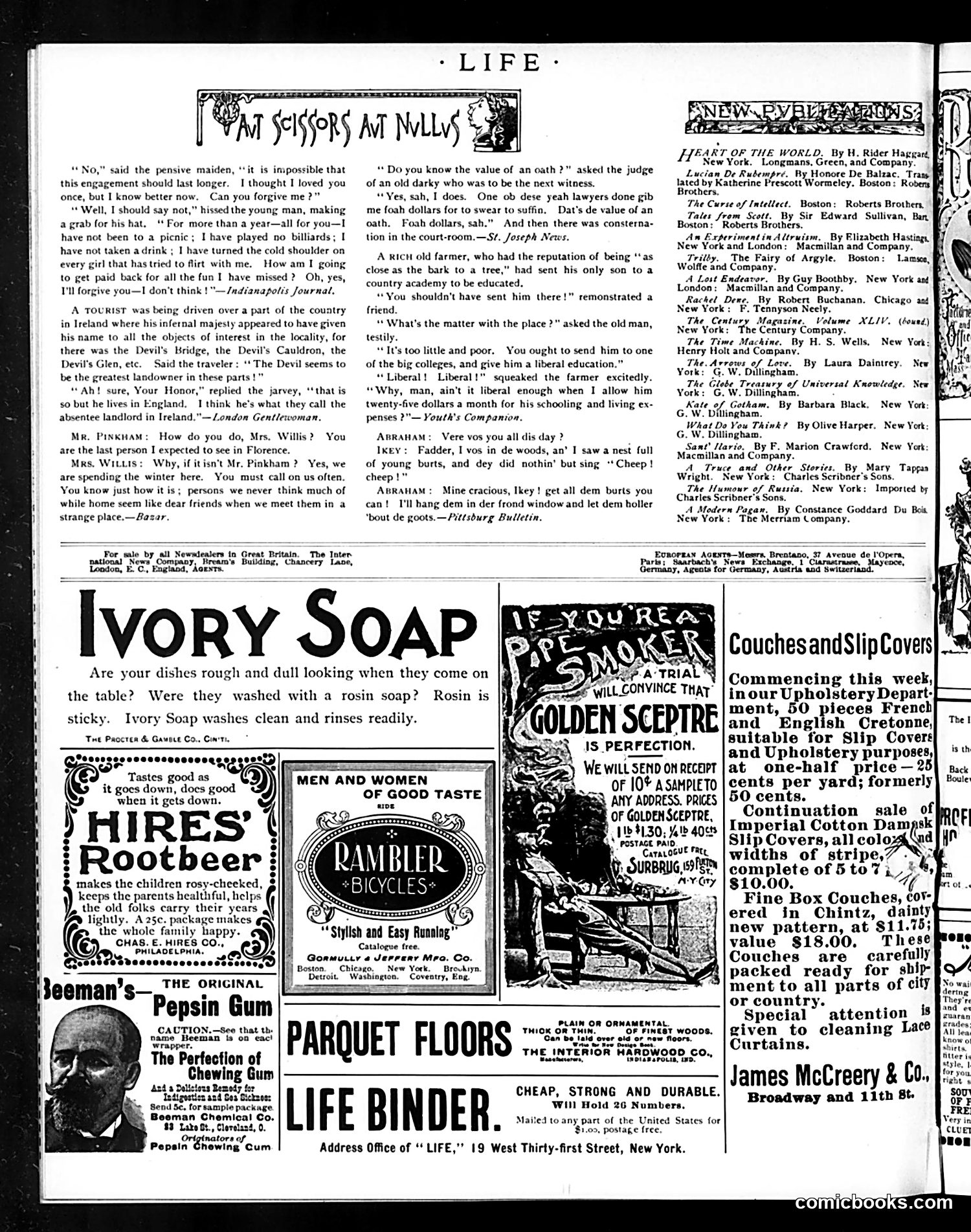
This page primarily consists of **humorous anecdotes and advertisements** rather than political cartoons. The text contains several short jokes reflecting late 19th/early 20th-century social attitudes: 1. **Broken engagement story**: A young man demands compensation for sacrifices made during courtship (skipped picnics, billiards, avoided other women), satirizing transactional views of romance. 2. **Irish landlord joke**: A tourist notes the "Devil" owns all Irish landmarks; the driver jokes the Devil is an "absentee landlord" living in England—a reference to the real grievance of English absentee landlords exploiting Irish estates. 3. **Florence snobbishness**: Social climbers befriend people abroad they'd ignore at home. 4. **African American dialect humor**: A stereotypical "darky" values an oath at four dollars (the amount a lawyer paid him to perjure himself)—crude racial satire common to the era. 5. **Immigrant humor**: Yiddish-accented "Abraham" and "Ikey" trap birds for caged singing—ethnic stereotyping. The page is dominated by **period advertisements** for Ivory Soap, Hires Rootbeer, and other products.
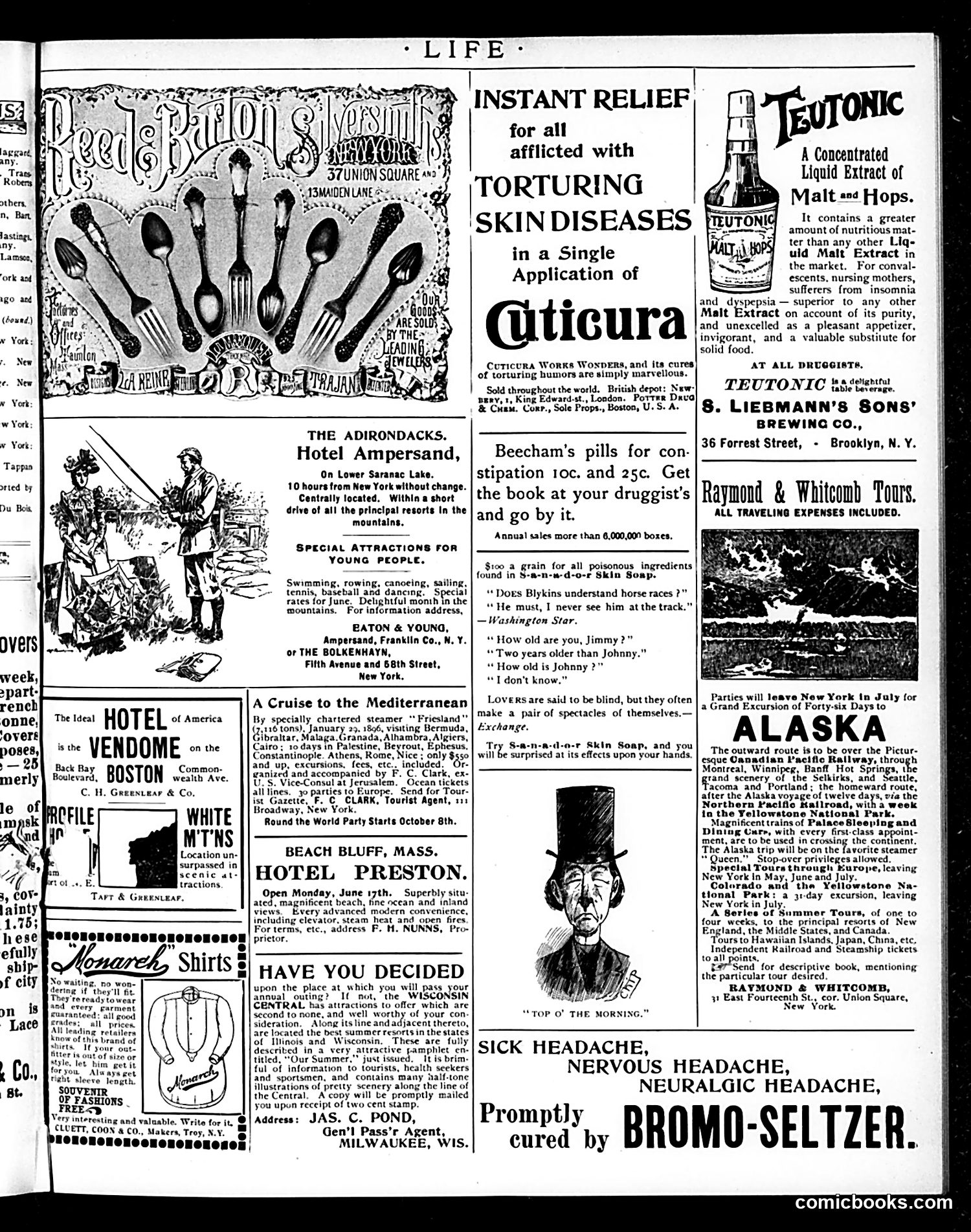
This page is primarily **advertisements and light humor**, not political satire. The content reflects turn-of-the-century American commercial culture. **Main Elements:** The top-left shows a decorative illustration for "Peel & Robbins" restaurant in New York—ornamental but not satirical. The page is dominated by **patent medicine and travel ads**: Cuticura (skin treatment), Teutonic (malt extract), Beecham's pills, Bromo-Seltzer, and various luxury hotel/tour promotions. These ads reveal period attitudes: aggressive marketing of remedies for ailments (constipation, insomnia, headaches) and aspirational leisure travel (Alaska cruises, Mediterranean voyages). **The humor** is mild wordplay: jokes about horse racing and children's ages that would appear in any era's humor column. **Historical context**: This reflects the Gilded Age's commercialism, when dubious "remedies" were freely advertised, and wealthy Americans pursued exotic travel as status markers. No political commentary is evident—this is simply a typical Life magazine page showcasing period consumer culture.
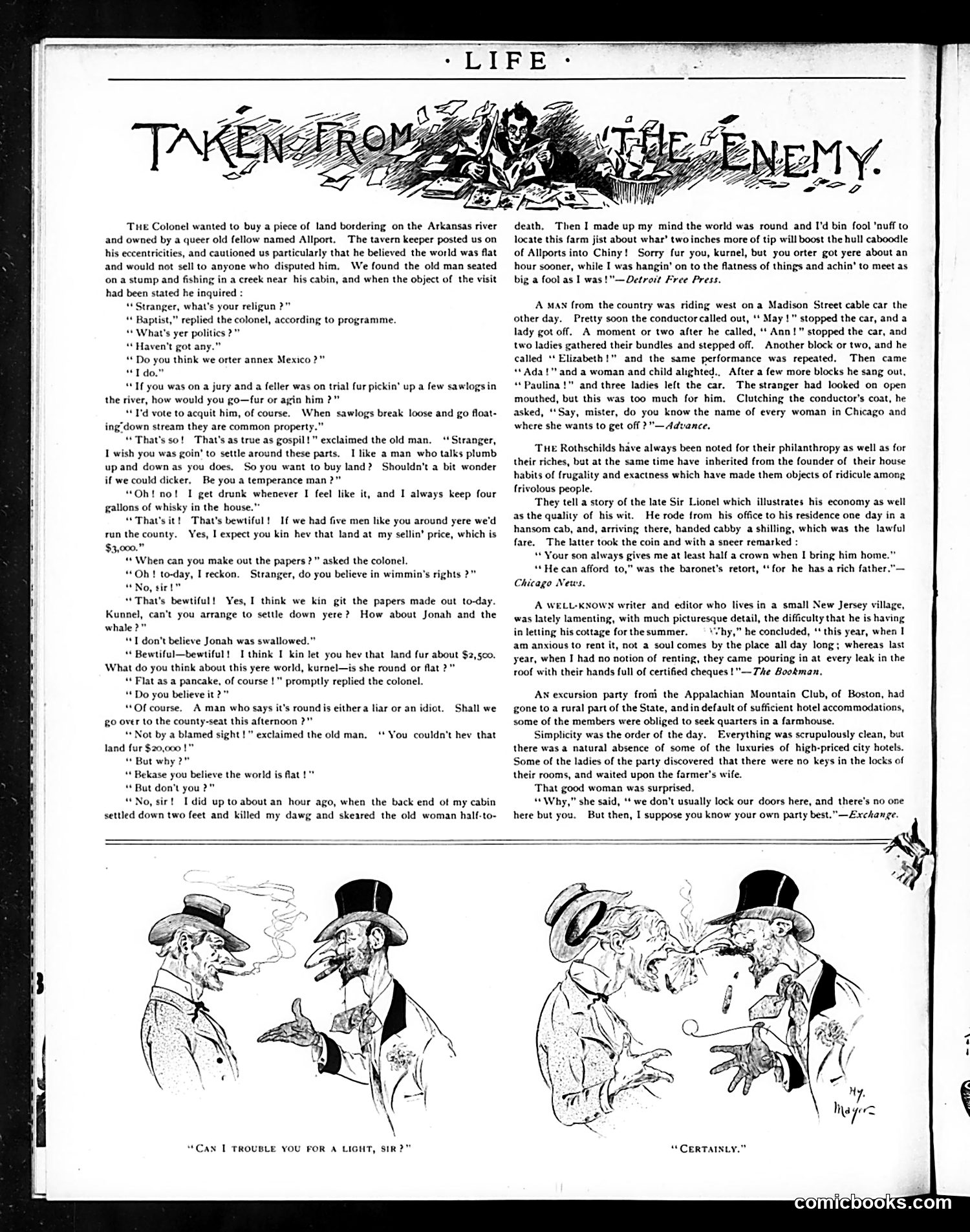
This page contains two satirical pieces mocking rural American ignorance and credulity. **Main Story**: A colonel attempts to buy land from "Allport," an Arkansas farmer who believes the Earth is flat. Through a series of leading questions about religion, politics, and social issues, the colonel craftily agrees with every eccentric belief Allport holds—temperance opposition, anti-feminism, flat-earth theory. The farmer, charmed by finding a kindred spirit, repeatedly lowers his asking price ($3,000 to $2,500). The joke's punchline: when Allport's cabin literally settles, he finally accepts the Earth's roundness and realizes he's been swindled by the con artist colonel. **Cartoons Below**: Two comic sketches (captioned "Can I trouble you for a light, sir?" and "Certainly") depict gentlemen in conversation—likely illustrating social etiquette or class humor, though specific reference is unclear. **Secondary Anecdote**: A brief story about a Chicago cable-car conductor calling out women's names at stops, confusing a rural visitor—mocking rural people's bewilderment at urban efficiency and familiarity. The overall theme satirizes rural simplicity versus urban sophistication.