
Life, 1895-06-06 · page 6 of 16
Life — June 6, 1895 — page 6: what you’re looking at
What you’re looking at
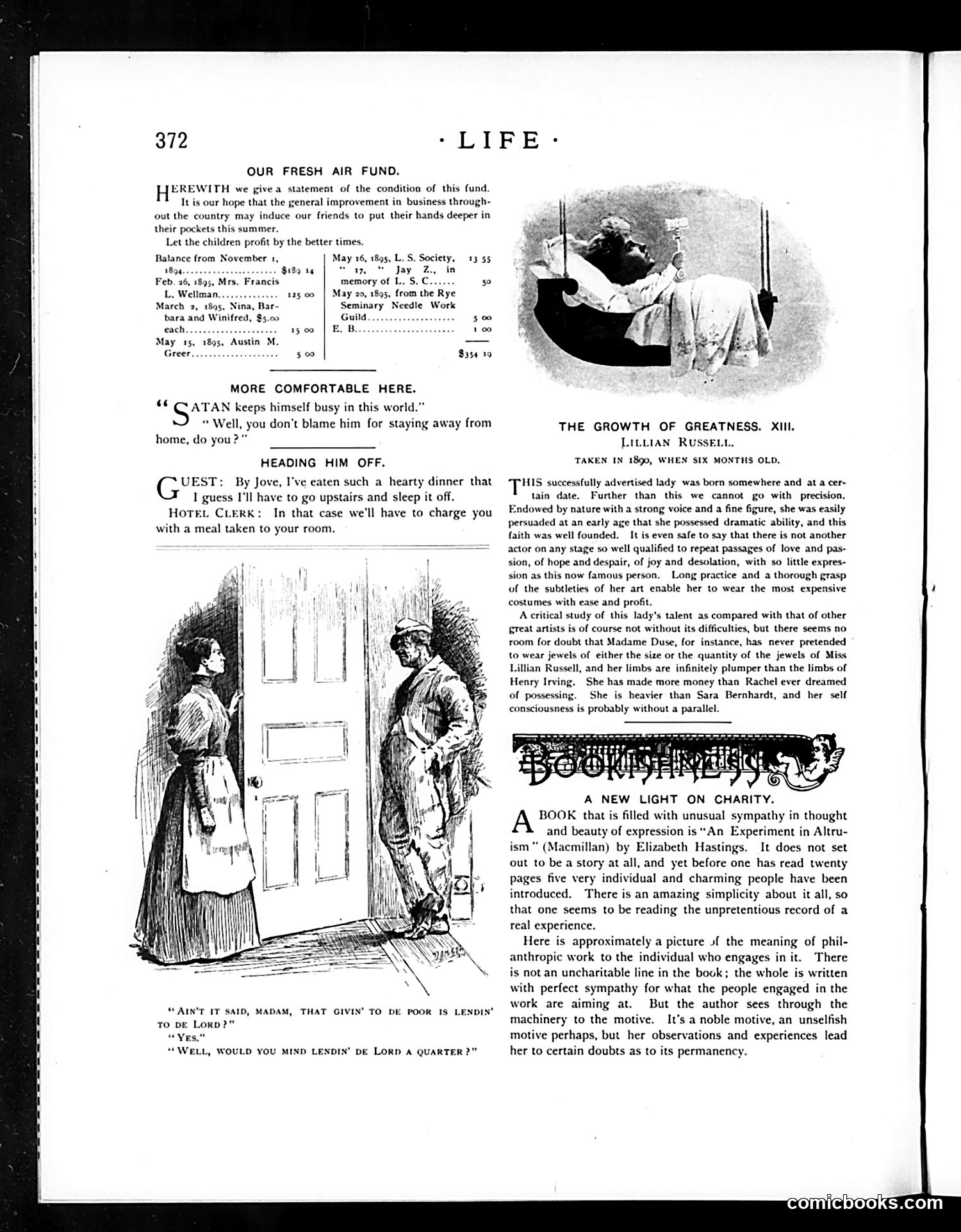
The main cartoon titled "HEADING HIM OFF" depicts a hotel clerk confronting a guest departing after a heavy meal. The guest claims he must leave immediately to digest, while the clerk insists on charging for the room. The joke plays on the guest's excuse—he needs to "go upstairs and sleep it off"—versus the hotel's financial interest in collecting payment regardless. This is a straightforward hospitality humor piece with no clear political reference. It satirizes the tension between guests' comfort and hotels' profit motives, a relatable scenario for the magazine's audience. The page also features a profile piece on actress Lillian Russell and a book review of Elizabeth Hastings' "An Experiment in Altruism," neither of which are satirical cartoons.
📄 Transcribed text from this page (OCR, searchable)
Machine-transcribed from the original scan — historical spelling and the odd misread are preserved.
372 OUR FRESH AIR FUND. HEREWITH we give a statement of the condition of this fund. It is our hope that the general improvement in business through- out the country may induce our friends to put their hands deeper in their pockets this summer, Let the children profit by the better times, May 16, 1895, L. S. Society, oF a7 Jay Z., in memory of L. $.C...... May 29, 1895, from the Rye Seminary Needle Work Balance from November 1, IBGE: snprsGaes Feb, 26, 1895, Mrs. Francis L. Wellman, March 2, 1895. bara and Wi each..... B. May 15, 1895, Austin 3 125 00 500 109 $354 19 MORE COMFORTABLE HERE. - Geren keeps himself busy in this world.” “ Well, you don't blame him for staying away from home, do you?” HEADING HIM OFF. UEST: By Jove, I've eaten such a hearty dinner that 1 guess I'll have to go upstairs and sleep it off. HOTEL CLER'! In that case we'll have to charge you with a meal taken to your room. 1D, MADAM, THAT GIVIN' TO DE POOR IS LENDIN' To DE Loxp “Ve “WELL, WOULD YOU MIND LENDIN’ DE LoRD A QUARTER?” *LIFE: THE GROWTH OF GREATNESS. XiIll. LILLIAN RUSSELL, TAKEN IN 1890, WHEN SIX MONTHS OLD. THs successfully advertised lady was born somewhere and at a cet tain date. Further than this we cannot go with precision. Endowed by nature with a strong voice and a fine figure, she was easily persuaded at an early age that she possessed dramatic ability, and this faith was well founded. It is even safe to say that there is not another actor on any stage so well qualified to repeat passages of love and pas- sion, of hope and despair, of joy and desolation, with so little expres- Long practice and a thorough grasp of the subtleties of her art enable her to wear the most expensive costumes with ease and profit. A critical study of this lady's talent as compared with that of other Great artists is of course not without its difficulties, but there seems no room for doubt that Madame Duse, for instance, has never pretended to wear jewels of either the size or the quantity of the jewels of Miss Lillian Russell, and her limbs are infinitely plumper than the limbs of Henry Irving. She has made more money than Rachel ever dreamed of possessing. She is heavier than Sara Bernhardt, and her self consciousness is probably without a parallel. sion as this now famous person. A NEW LIGHT ON CHARITY. BOOK that is filled with unusual sympathy in thought and beauty of expression is *An Experiment in Altru- ism” (Macmillan) by Elizabeth Hastings. It does not set out to be a story at all, and yet before one has read twenty pages five very individual and charming people have been introduced. There is an amazing simplicity about it all, so that one seems to be reading the unpretentious record of a real experience. Here is approximately a picture of the meaning of phil- anthropic work to the individual who engages in it. There is not an uncharitable line in the book; the whole is written with perfect sympathy for what the people engaged in the work are aiming at. But the author sees through the machinery to the motive. It’s a noble motive, an unselfish motive perhaps, but her observations and experiences lead her to certain doubts as to its permanency. icbooks.com