
Life, 1895-06-06 · page 7 of 16
Life — June 6, 1895 — page 7: what you’re looking at
What you’re looking at
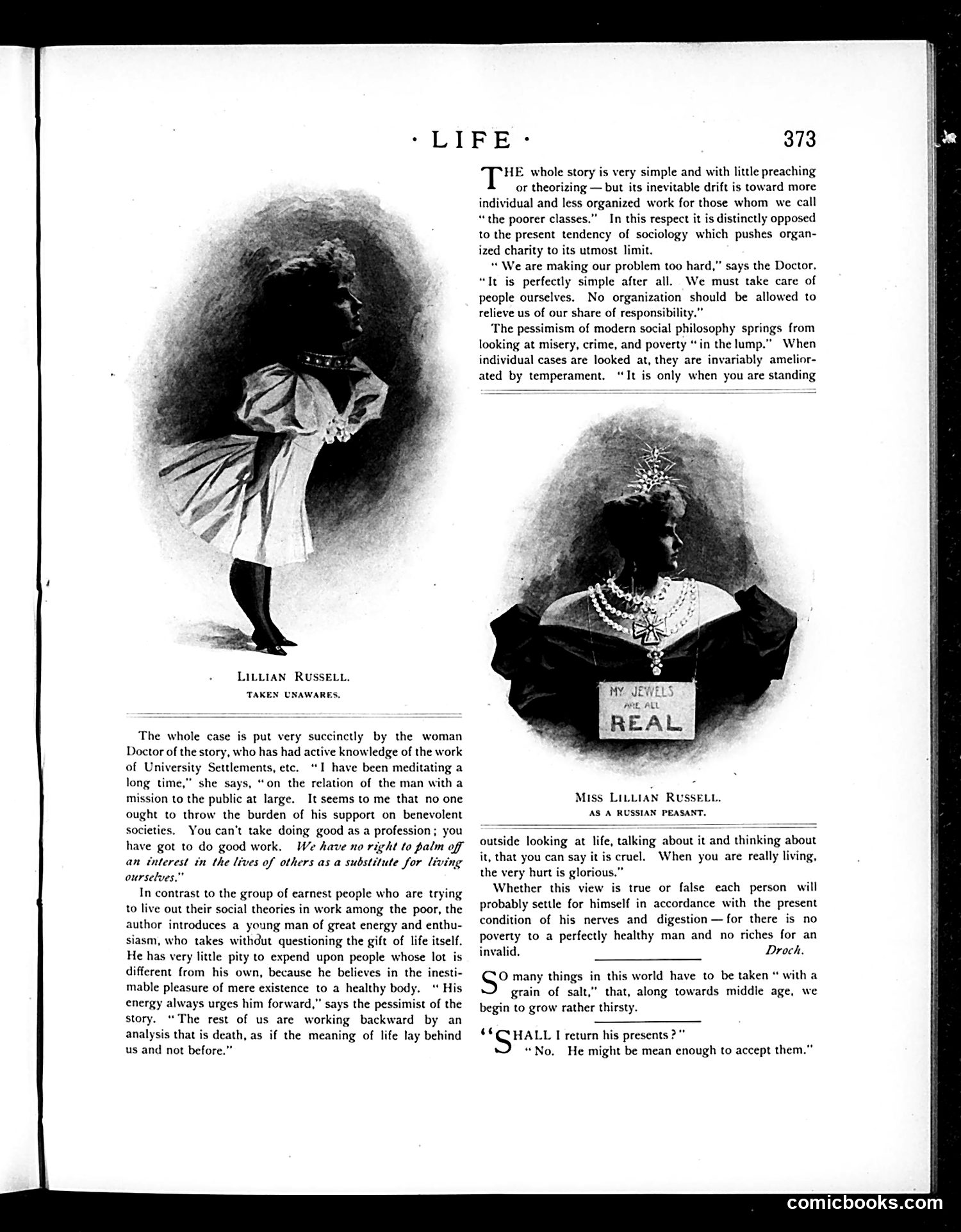
This page features two illustrations of **Lillian Russell**, a famous American actress and singer of the late 1800s/early 1900s. The left image shows her in a provocative pose ("Taken Unawares"), while the right depicts her wearing jewelry with a sign reading "MY JEWELS ARE ALL REAL," labeled "As a Russian Peasant." The satire appears to mock Russell's reputation and public persona. The "Russian peasant" caption is ironic—she's adorned with expensive jewels, contrasting sharply with peasant status. The accompanying text discusses social responsibility, poverty, and charity, suggesting the cartoonist critiques wealthy entertainers like Russell for their detachment from social problems while flaunting their wealth. The humor relies on readers' familiarity with Russell's celebrity status and known affectations.
📄 Transcribed text from this page (OCR, searchable)
Machine-transcribed from the original scan — historical spelling and the odd misread are preserved.
‘LIFE: LILLIAN RUSSELL. TAKEN UNAWARES, The whole case is put very succinctly by the woman Doctor of the story, who has had active knowledge of the work of University Settlements, etc. “I have been meditating a long time,” she sa “on the relation of the man with a mission to the public at large. It seems to me that no one ought to throw the burden of his support on benevolent societies. You can't take doing good as a profession; you have got to do good work. We have no right to palm off an interest in the lives of others as a substitute for living ourselves.” In contrast to the group of earnest people who are trying to live out their social theories in work among the poor, the author introduces a young man of great energy and enthu- siasm, who takes withdut questioning the gift of life itself. He has very little pity to expend upon people whose lot is different from his own, because he believes in the inesti- mable pleasure of mere existence to a healthy body. “ His energy always urges him forward,” says the pessimist of the story. “The rest of us are working backward by an analysis that is death, as if the meaning of life lay behind us and not before.” 373 HE whole story is very simple and with little preaching or theorizing — but its inevitable drift is toward more individual and less organized work for those whom we call “the poorer classes.” In this respect it is distinctly opposed to the present tendency of sociology which pushes organ- ized charity to its utmost limit. “ We are making our problem too hard,” says the Doctor. “It is perfectly simple after all. We must take care of people ourselves. No organization should be allowed to relieve us of our share of responsibility.” The pessimism of modern social philosophy springs from looking at misery, crime, and poverty “in the lump.” When individual cases are looked at, they are invariably amelior- ated by temperament. “It is only when you are standing Miss LILLIAN RUSSELL. AS A RUSSIAN PEASANT, outside looking at life, talking about it and thinking about it, that you can say it is cruel. When you are really living, the very hurt is glorious.” Whether this view is true or false each person will probably settle for himself in accordance with the present condition of his nerves and digestion —for there is no poverty to a perfectly healthy man and no riches for an invalid. Droch. O many things in this world have to be taken “ with a grain of salt,” that, along towards middle age, we begin to grow rather thirsty. §©CHALL I return his presents ?” “No, He might be mean enough to accept them.” comicbooks.com