
Life, 1895-06-06 · page 4 of 16
Life — June 6, 1895 — page 4: what you’re looking at
What you’re looking at
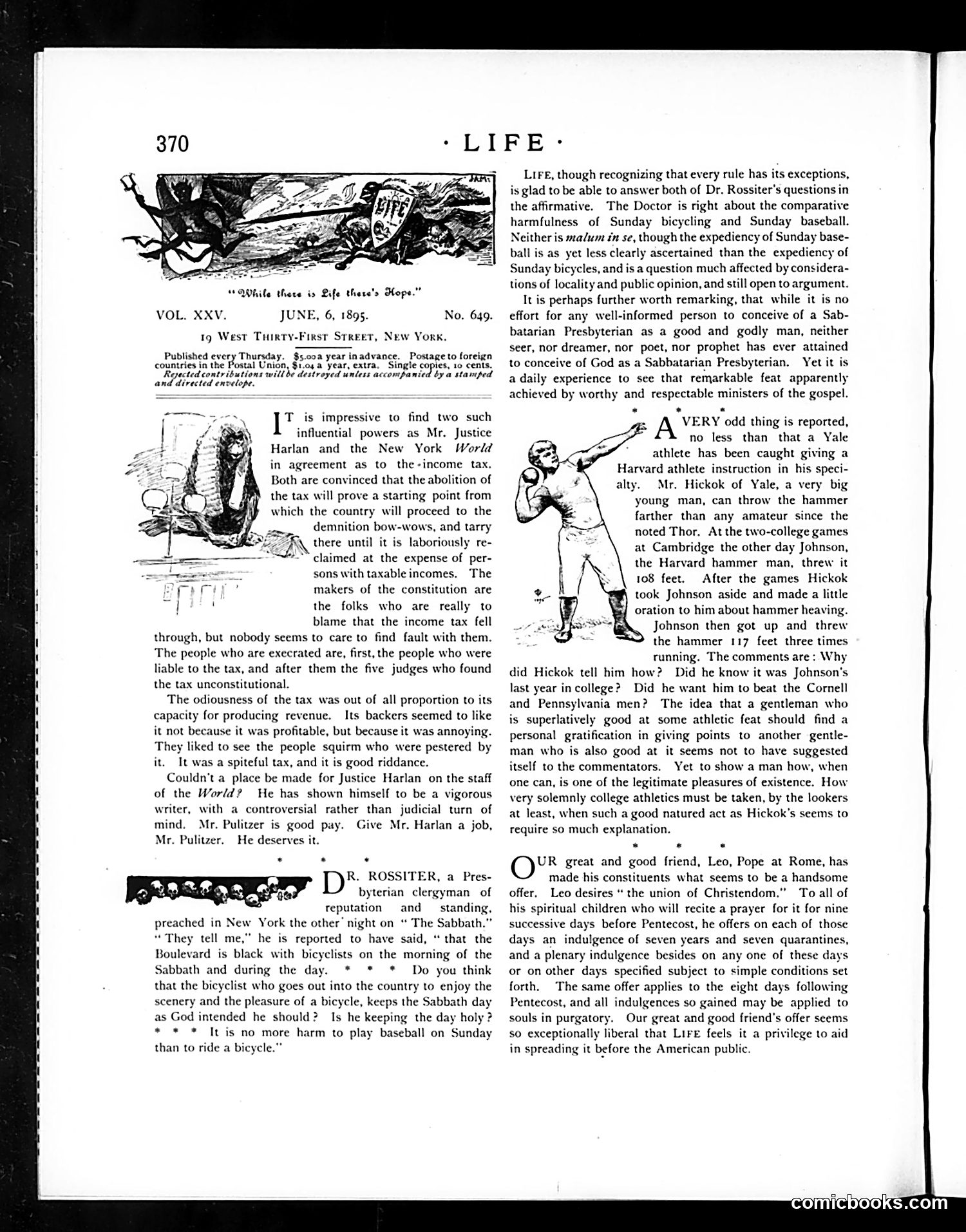
This page contains editorial commentary on three topics: 1. **Income Tax Debate**: Discusses influential figures (Justice Harlan and the *New York World*) debating whether abolishing income tax will help poor citizens or benefit the wealthy. 2. **Dr. Rossiter's Sabbath Sermon**: Critiques a clergyman's argument that Sunday bicycling violates the Sabbath, while Sunday baseball is acceptable. The satire questions this inconsistent moral reasoning—if bicycles desecrate Sunday, shouldn't baseball too? 3. **Yale Athlete's Hammer Throw**: Reports on a Yale student (Hickok) throwing a hammer 117 feet, discussing whether college athletes should prioritize winning or sportsmanship. The page reflects 1890s debates about moral regulation, wealth distribution, and competitive athletics.
📄 Transcribed text from this page (OCR, searchable)
Machine-transcribed from the original scan — historical spelling and the odd misread are preserved.
‘LIFE: “OMhile there is Life there's Hope.” VOL. XXV. JUNE, 6, 1895. 1g West Tuirty-First Street, New York. No. 649. Published every Thursday. $5.00a year inadvance. Postage to foreign countries in the Postal Union, $1.04 a year, extra. Single copies, 10 cents. Reyected contributions will be destroyed unless accompanied by a stamped [7's impressive to find two such \ influential powers as Mr. Justice y Harlan and the New York World in agreement as to the-income tax, Both are convinced that the abolition of the tax will prove a starting point from which the country will proceed to the demnition bow-wows, and tarry there until it is laboriously re- claimed at the expense of per- sons with taxable incomes. The makers of the constitution are the folks who are really to blame that the income tax fell through, but nobody seems to care to find fault with them. The people who are execrated are, first, the people who were liable to the tax, and after them the five judges who found the tax unconstitutional. The odiousness of the tax was out of all proportion to its capacity for producing revenue. Its backers seemed to like it not because it was profitable, but because it was annoying. They liked to see the people squirm who were pestered by it. It was a spiteful tax, and it is good riddance. Couldn't a place be made for Justice Harlan on the staff of the World? He has shown himself to be a vigorous writer, with a controversial rather than judicial turn of mind. Mr. Pulitzer is good pay. Give Mr. Harlan a job, Mr. Pulitzer. He deserves it. R. ROSSI R, a Pres- PURI byterian clergyman of reputation and standing, preached in New York the other’ night on “ The Sabbath.” “ They tell me,” he is reported to have said, * that the Boulevard is black with bicyclists on the morning of the Sabbath and during the day. * * * Do you think that the bicyclist who goes out into the country to enjoy the scenery and the pleasure of a bicycle, keeps the Sabbath day as God intended he should? Is he keeping the day holy ? * * * It is no more harm to play baseball on Sunday than to ride a bicycle.” LiFe, though recognizing that every rule has its exceptions, is glad to be able to answer both of Dr. Rossiter’s questions in the affirmative. The Doctor is right about the comparative harmfulness of Sunday bicycling and Sunday baseball. Neither is ma/um én se, though the expediency of Sunday base- bal ess clearly ascertained than the expediency of Sunday bicycles, and is a question much affected by considera- tions of locality and public opinion, and still open to argument. It is perhaps further worth remarking, that while it is no effort for any well-informed person to conceive of a Sab- batarian Presbyterian as a good and godly man, neither seer, nor dreamer, nor poet, nor prophet has ever attained to conceive of God as a Sabbatarian Presbyterian. Yet it is a daily experience to see that remarkable feat apparently achieved by worthy and respectable ministers of the gospel. * « _ VERY odd thing is reported, no less than that a Yale athlete has been caught giving a Harvard athlete instruction in his speci- alty. Mr. Hickok of Yale, a very big young man, can throw the hammer farther than any amateur since the noted Thor, At the two-college games at Cambridge the other day Johnson, the Harvard hammer man, threw it 108 feet. After the games Hickok took Johnson aside and made a little oration to him about hammer heaving. Johnson then got up and threw the hammer 117 feet three times running. The comments are: Why did Hickok tell him how? Did he know it was Johnson's last year in college? Did he want him to beat the Cornell and Pennsylvania men? The idea that a gentleman who is superlatively good at some athletic feat should find a personal gratification in giving points to another gentle- man who is also good at it seems not to have suggested itself to the commentators. Yet to show a man how, when one can, is one of the legitimate pleasures of existence. How very solemnly college athletics must be taken, by the lookers at least, when such a good natured act as Hickok’s seems to require so much explanation. . * . UR great and good friend, Leo, Pope at Rome, has made his constituents what seems to be a handsome offer. Leo desires * the union of Christendom.” To all of his spiritual children who will recite a prayer for it for nine successive days before Pentecost, he offers on each of those days an indulgence of seven years and seven quarantines, and a plenary indulgence besides on any one of these days or on other days specified subject to simple conditions set forth. The same offer applies to the eight days following Pentecost, and all indulgences so gained may be applied to souls in purgatory. Our great and good friend's offer seems so exceptionally liberal that LiFE feels it a privilege to aid in spreading it before the American public.