
A complete issue · 22 pages · 1895
Life — May 30, 1895
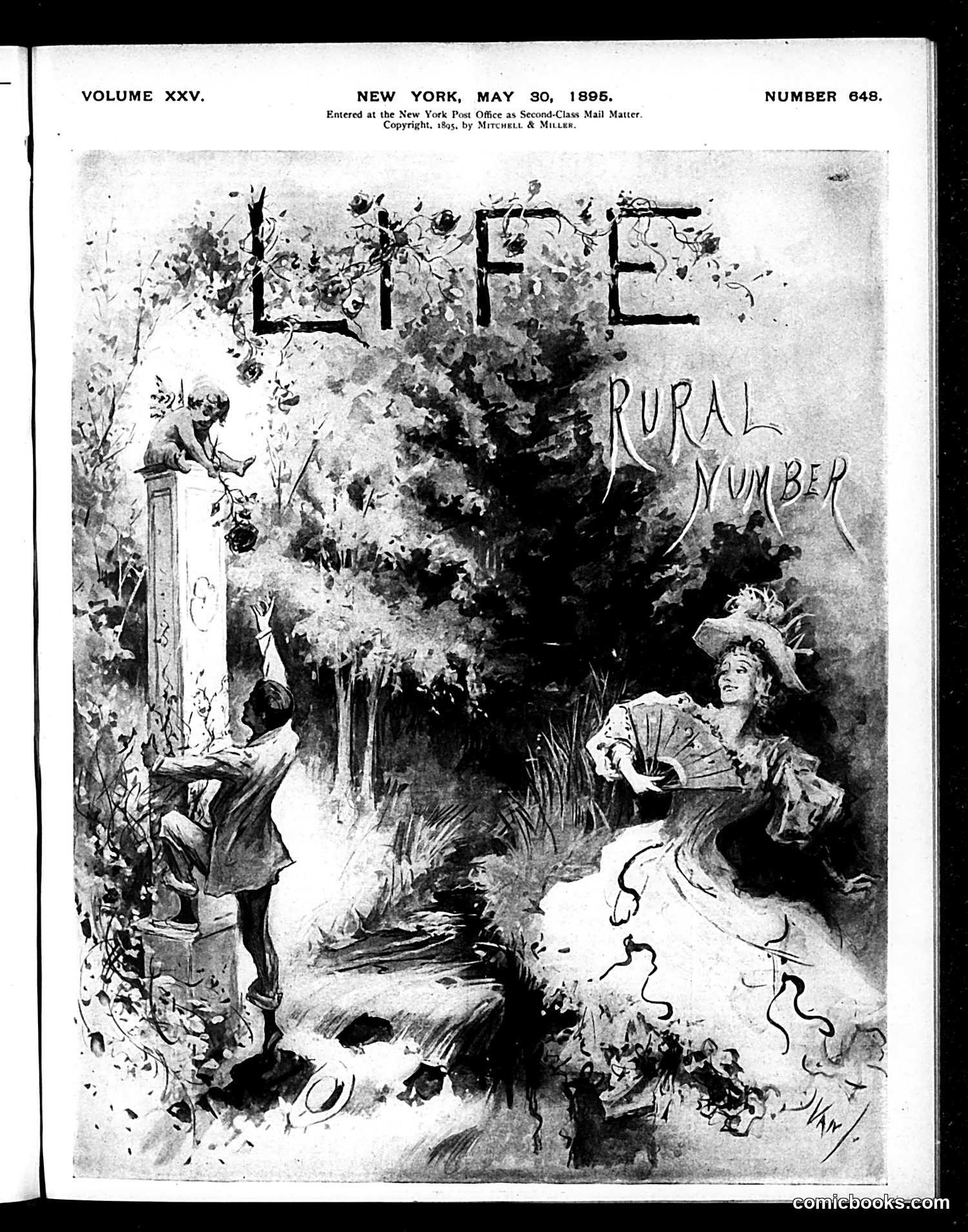
This is a cover illustration titled "Rural Number," depicting a romantic garden scene. A young man in formal attire stands at left, reaching toward vines or climbing plants on what appears to be a garden structure. A woman in an elaborate hat and dress holds a fan at right, gazing upward in a coquettish pose. The artistic style and subject matter suggest this "Rural Number" issue celebrates pastoral romance and courtship—themes popular in 1890s satirical magazines. The couple's refined clothing and mannered poses reflect upper-class leisure activities of the era. The illustration exemplifies Life's focus on social satire and romantic comedy during the Victorian period, though the specific satirical point remains unclear without additional context.
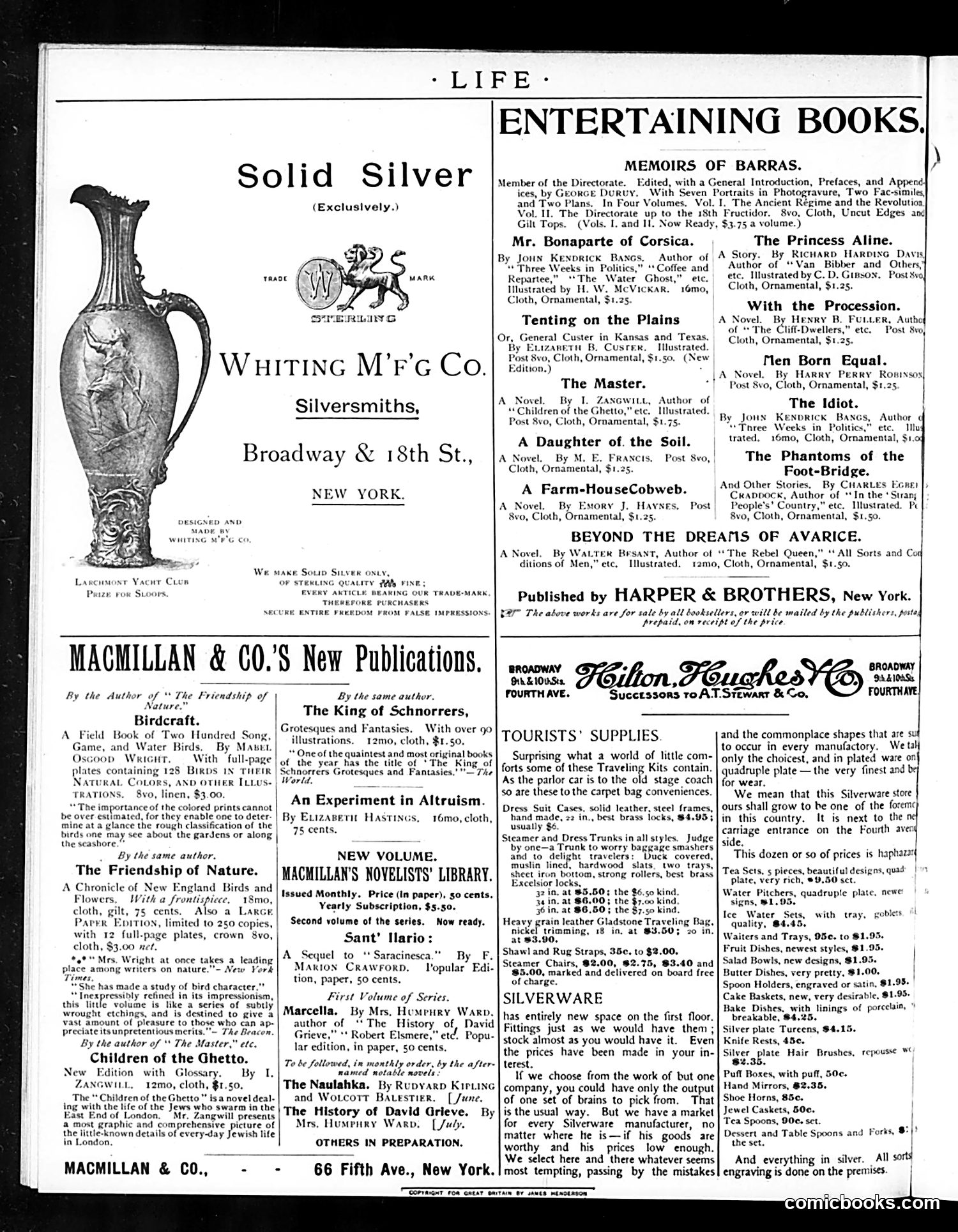
This page is primarily **advertising and book listings**, not political satire or editorial cartooning. The left side features an advertisement for **Whiting Manufacturing Company's solid silver serving pieces** (a pitcher shown), marketed to the wealthy as "Lauchmont Yacht Club Prize for Sloops." The right side consists of **book advertisements** from major publishers Harper & Brothers and Macmillan & Co., listing novels and non-fiction works available for purchase. Titles include "Memoirs of Barras," "The Princess Aline," and "The Master." The bottom section advertises **Hilton, Holles & Co.**, a silverware store offering tourist supplies and various decorative items. There is **no political cartoon or satirical content** visible on this page—it represents typical turn-of-the-century magazine advertising and publishing announcements.
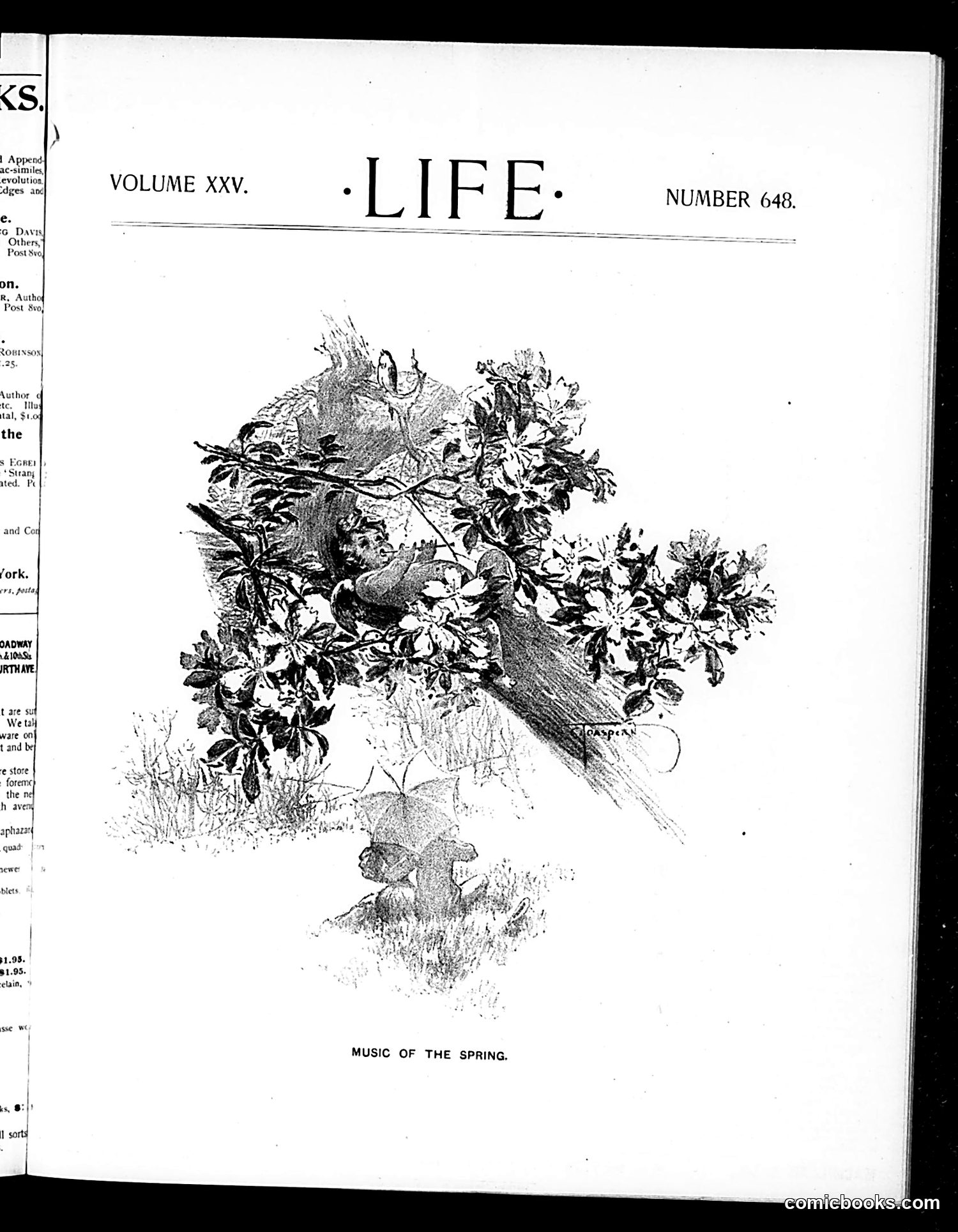
This page from *Life* magazine (Volume XXV, Number 648) features a naturalistic illustration titled "Music of the Spring." The image depicts a bird perched among flowering branches and foliage, rendered in detailed pen-and-ink style. Rather than political satire, this appears to be **nature illustration or seasonal content** — common in *Life* magazine, which regularly published artistic drawings alongside humor and commentary. The title suggests a poetic celebration of spring's return and birdsong, a typical theme for the season. Without accompanying text explaining satirical intent, this functions as decorative or editorial art rather than political commentary. The naturalistic style reflects late 19th/early 20th-century *Life* magazine's blend of illustration, humor, and cultural observation.
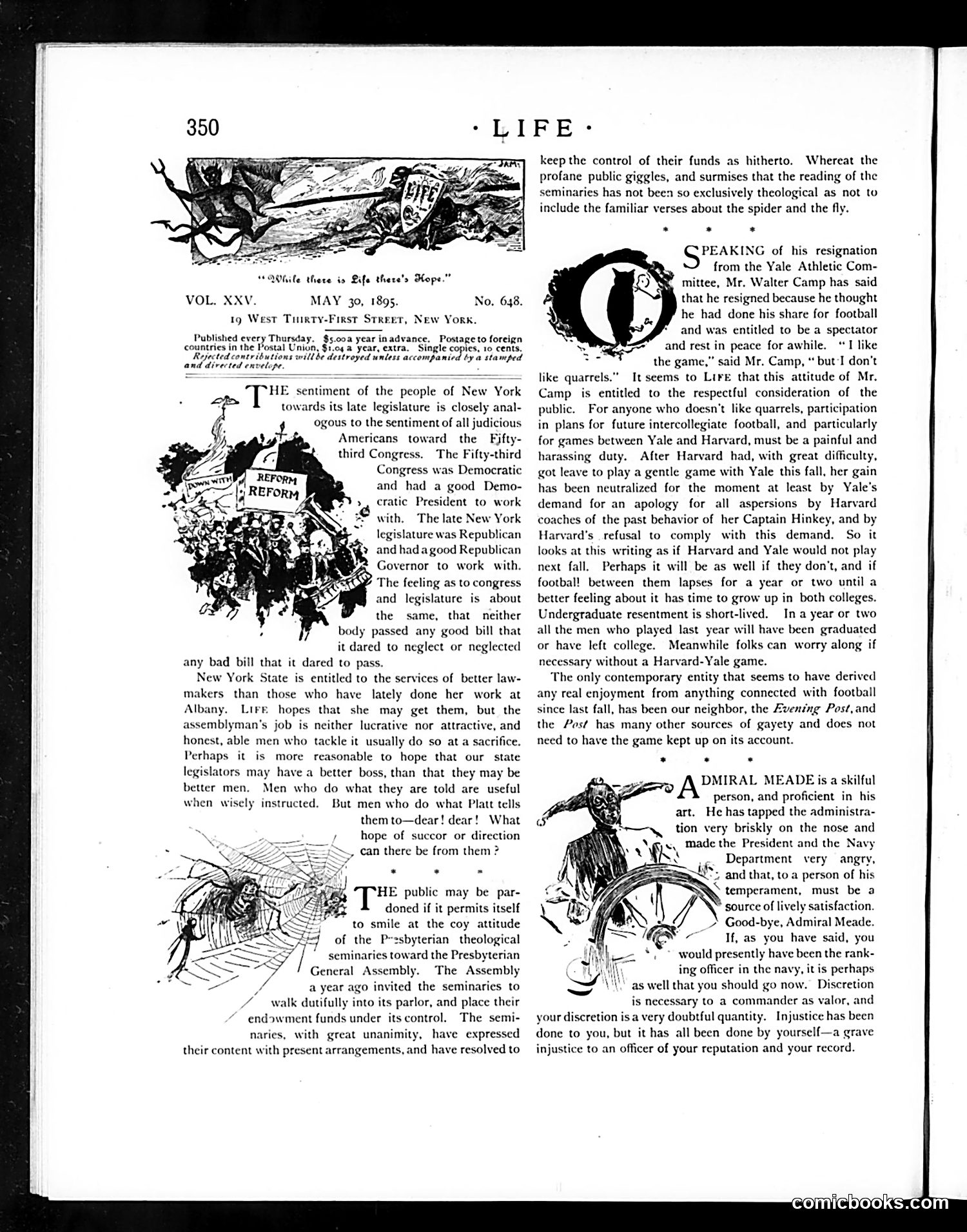
The page contains editorial commentary and cartoons addressing New York State politics and governance. A central cartoon depicts a figure labeled "Reform" being crushed or burdened, satirizing the difficulty of implementing legislative reform in New York. The text discusses the state legislature's Republican majority and Democratic governor, noting their inability to pass necessary bills despite good intentions. The author critiques lawmakers' tendency to ignore problems rather than address them responsibly. A second cartoon shows a ship's wheel, accompanying commentary about Admiral Meade's resignation, suggesting concerns about executive discretion and naval administration. The overall thrust criticizes political gridlock and the failure of competing parties to govern effectively.
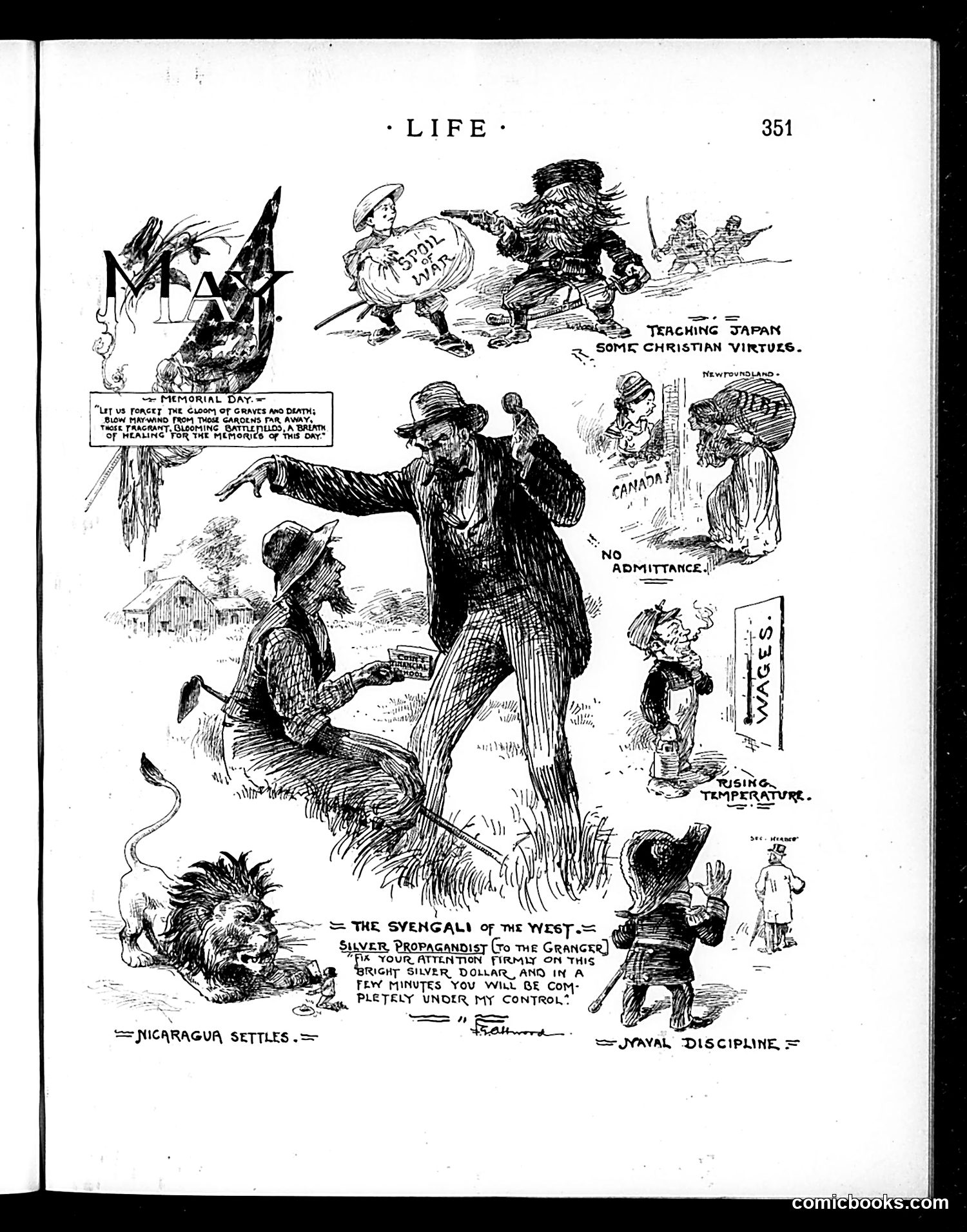
This page contains several political cartoons satirizing early 1900s American foreign policy and domestic issues: **"Memorial Day"** (top left): Critiques militarism by depicting crossed swords and mourning symbolism, urging remembrance of war's costs. **"Teaching Japan Some Christian Virtue"** (top right): Mocks American moral superiority, showing a figure forcibly "teaching" Japan, likely referencing US interventionism in Asia. **"Nicaragua Settles"** (bottom left): References US involvement in Nicaraguan politics, depicting a large figure dominating a smaller one—typical of how Life portrayed American imperial overreach. **"Naval Discipline"** (bottom right): Comments on military hierarchy and control mechanisms. The page satirizes American imperial ambitions, military culture, and the contradiction between professed Christian values and aggressive foreign intervention—common Life magazine themes during the Progressive era.
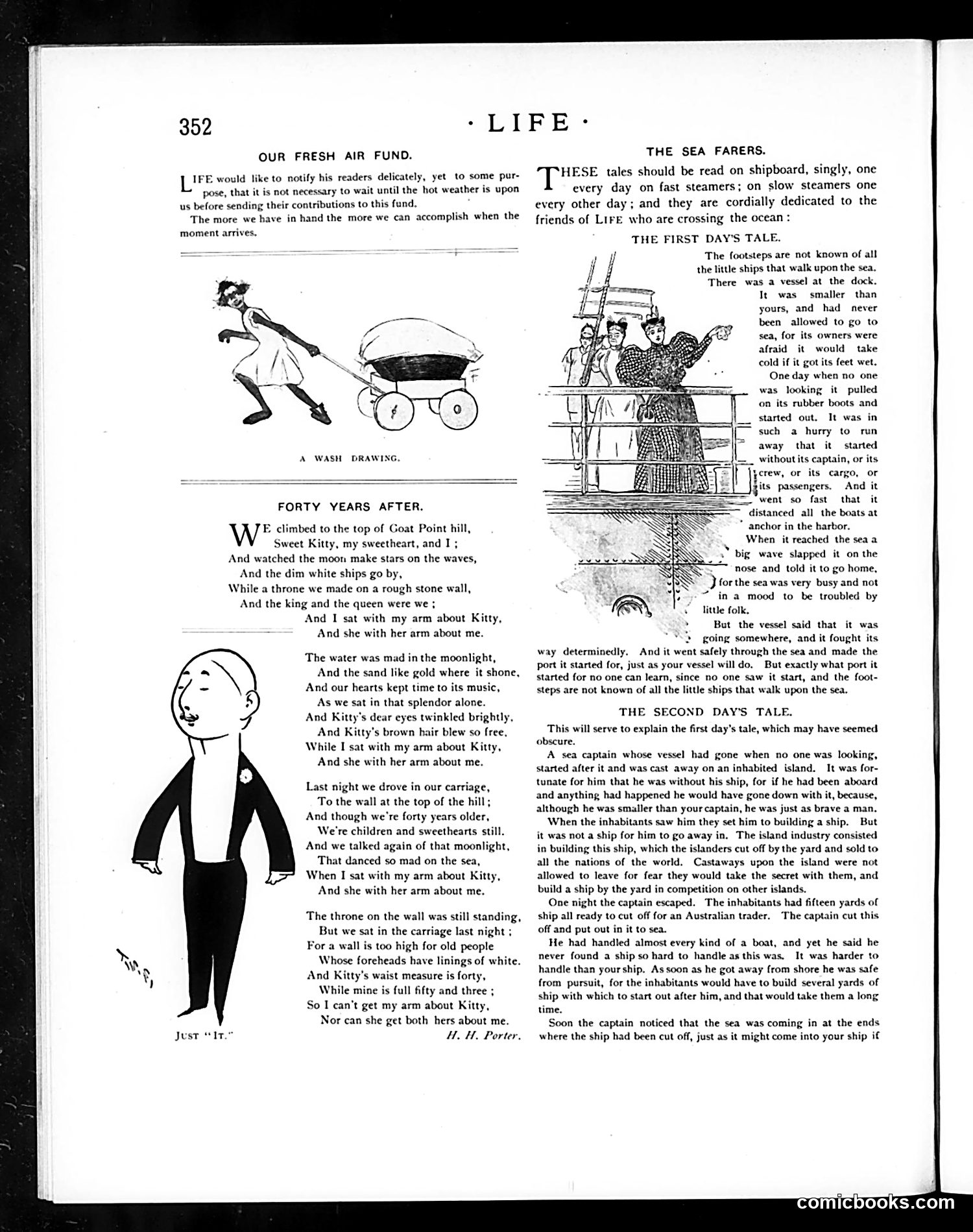
This page contains three distinct pieces: **"Our Fresh Air Fund"** (top left): A brief fundraising notice encouraging readers to contribute to provide fresh air experiences for those unable to afford them—a charitable cause. **"A Wash Drawing"** (center left): A simple cartoon sketch of a figure pulling a baby carriage, labeled as a "wash drawing" (a pen-and-ink technique). **"Forty Years After"** (left): A sentimental poem by H.H. Porter about romantic nostalgia, accompanied by an illustration of a man in formal dress reflecting on past romance with "Kitty." The poem employs typical Victorian sentimentality about lost youth and love. **"The Sea Farers"** (right): A serialized fictional tale about sea voyages and shipbuilding, with accompanying illustrations. This appears to be serialized fiction for entertainment. The page primarily features literary and artistic content rather than political satire.
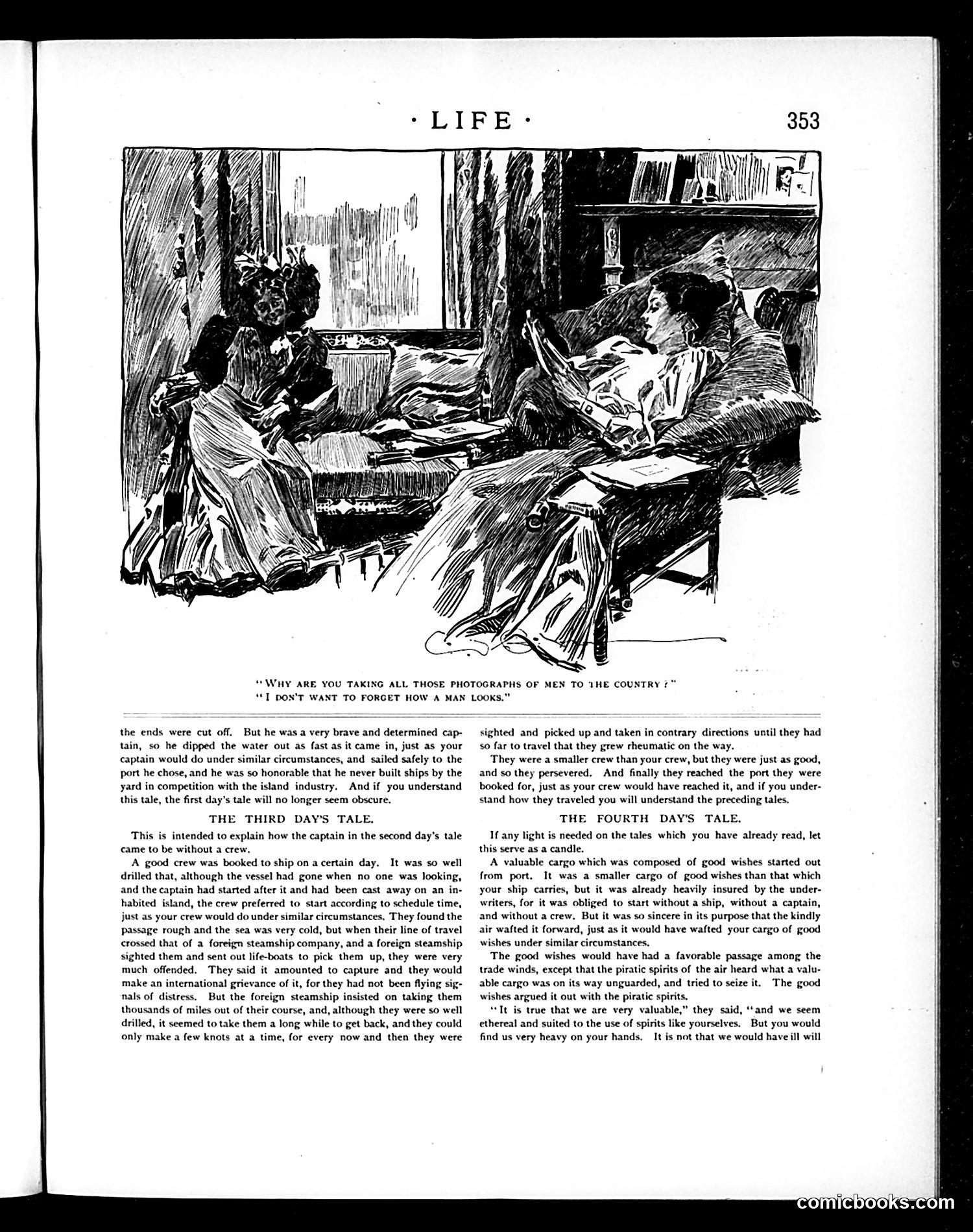
This page from *Life* magazine features a single-panel cartoon captioned: "Why are you taking all those photographs of men to the country? / I don't want to forget how a man looks." The cartoon depicts women in what appears to be early 20th-century dress examining or exchanging photographs of men. The satire likely comments on gender dynamics of the era—possibly mocking women's perceived obsession with men's appearances, or conversely, suggesting women are preparing for men's absence (perhaps due to war or travel). The accompanying text discusses maritime tales, but the cartoon's humor relies on the tension between women's documented interest in masculine appearance and contemporary attitudes about female behavior and propriety.
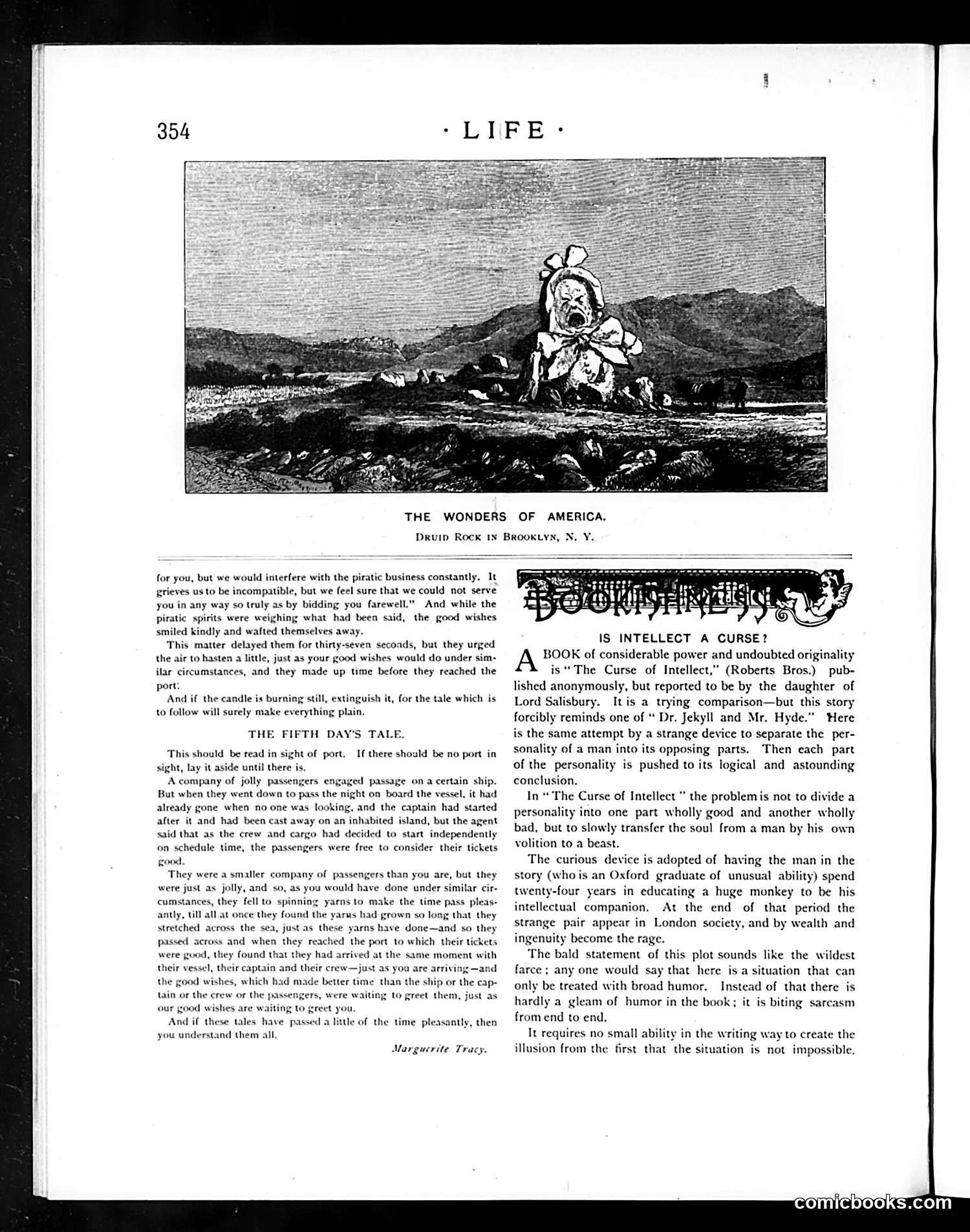
**The Image**: Shows a crude giant figure (appears to be a caricatured Native American or "savage") standing in a landscape labeled "Druid Rock in Brooklyn, N.Y." This is satirizing the notion that Brooklyn contains ancient "wonders" comparable to natural monuments. **The Text Content**: The page contains two unrelated pieces: 1. A ship captain's story ("The Fifth Day's Tale") about passengers passing time at sea 2. A book review of "The Curse of Intellect" (Roberts Bros.), critiquing a story about an Oxford graduate whose personality splits into good and evil halves **The Satire**: The cartoon mocks American claims of having natural/historical "wonders" by presenting an absurd Brooklyn rock formation as if it were comparable to genuine archaeological sites. The humor lies in the obvious mundanity of the location juxtaposed with grandiose titling.
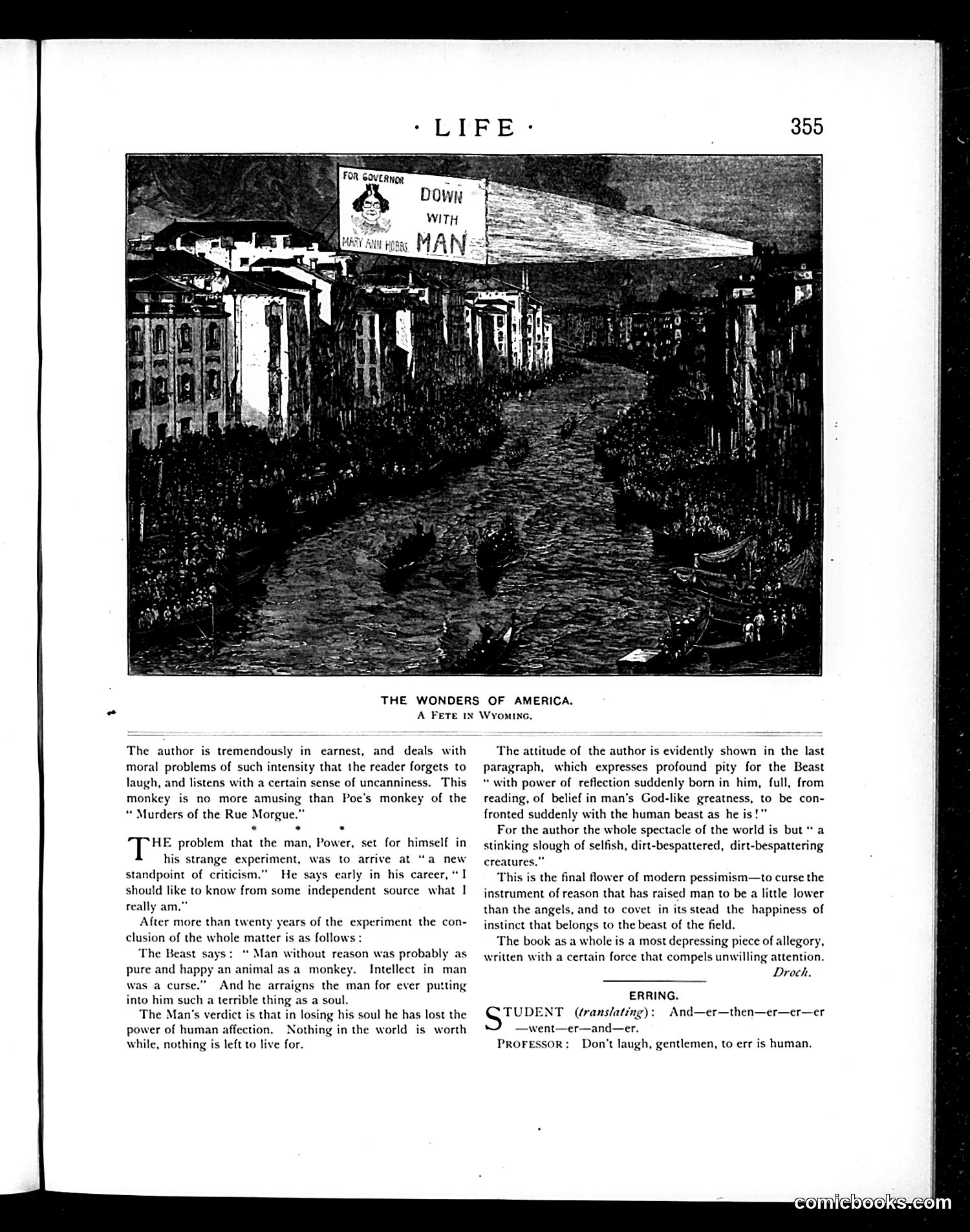
The photograph shows a street scene from a Wyoming fete (fair/festival) with a political banner reading "DOWN WITH MAN" and appearing to reference a governor candidate named "EAST ANN PERRY." The accompanying article critiques an author (unnamed in this excerpt) whose work "The Murders of the Morgue" presents an extremely pessimistic philosophy: that man is inherently a selfish, bestial creature lacking reason or human affection. The text argues this represents "modern pessimism," where reason has degraded humans below angels, stripping them of dignity. The satirical point appears to be mocking the author's misanthropy—his belief that mankind deserves contempt—by juxtaposing it with the photograph's populist political sentiment ("Down with Man"). The ironic message: even ordinary people at a county fair express anti-human sentiments matching the author's philosophy.
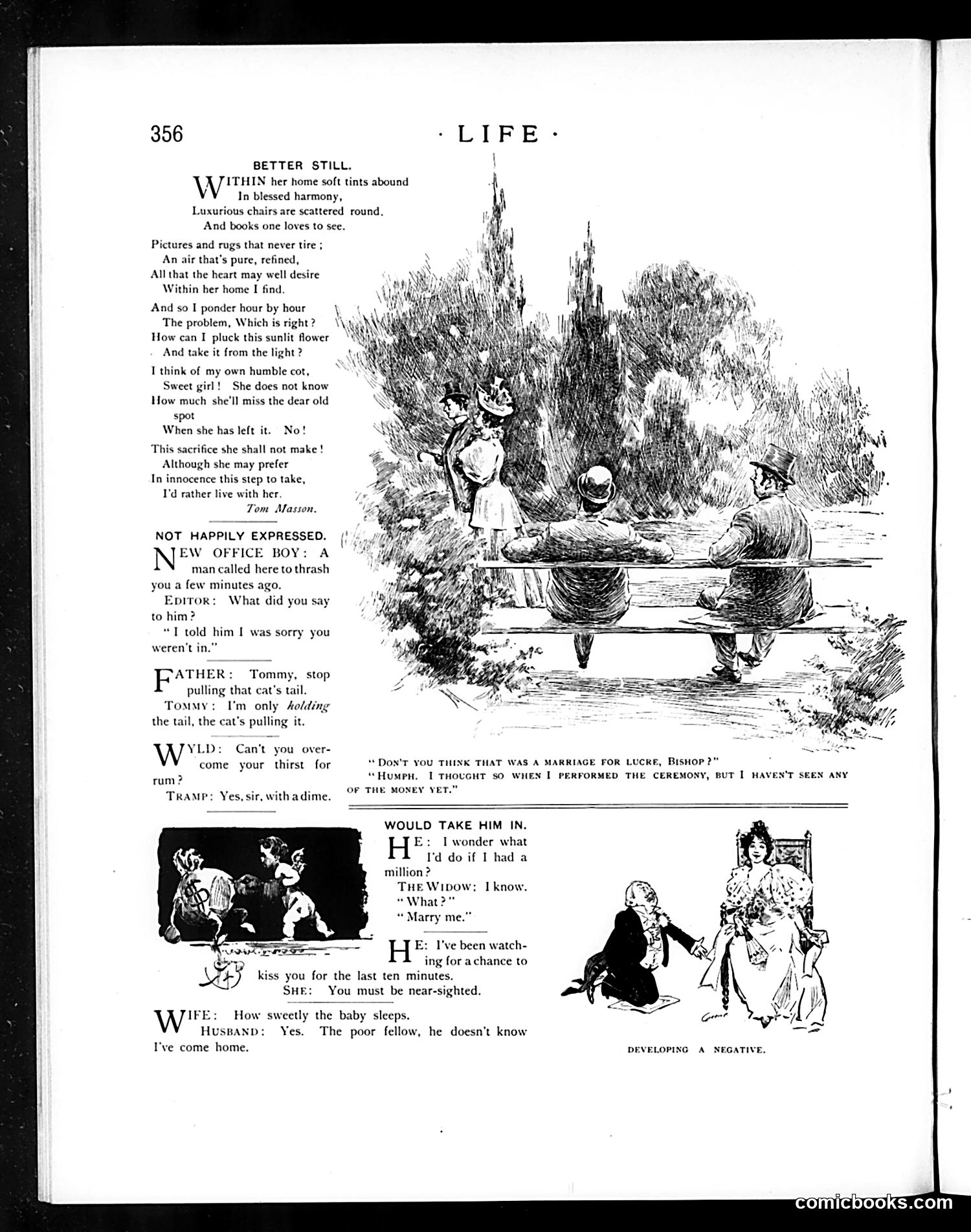
This page contains literary excerpts and humorous domestic sketches rather than political cartoons. **"Better Still"** is a poem (attributed to Tom Marson) expressing nostalgia for home and reluctance to sacrifice domestic comfort for duty. The dialogue scenes depict **Victorian-era domestic humor**: - A father stops his son from pulling a cat's tail - An office boy apologizes for being late - A tramp requests a drink - A widow proposes marriage to a man, joking he'd "take him in" if he had a million The final sketch, "Developing a Negative," shows a social interaction with the caption implying misunderstanding or comedic reversal. These reflect **period attitudes about class, courtship, and family discipline** rather than political satire—typical of Life's genteel humor during this era (likely early 1900s).
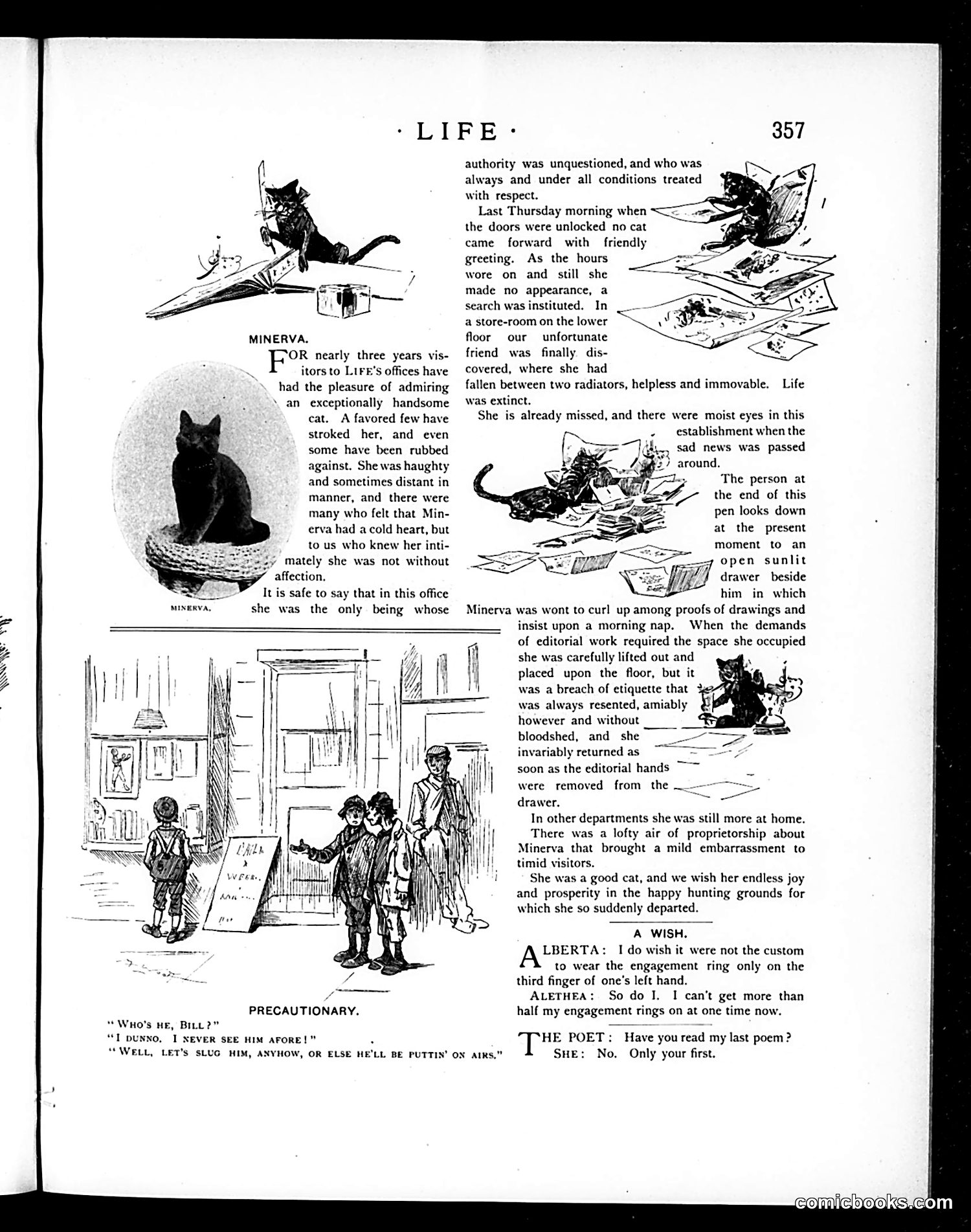
This page is primarily a tribute to **Minerva**, the office cat at Life magazine's headquarters. The text describes how Minerva had been a beloved fixture for nearly three years, admired by visitors and staff who occasionally petted her despite her sometimes aloof demeanor. The narrative describes Minerva's death—she was discovered lifeless between two radiators in a storage room. The piece celebrates her as "a good cat" and expresses wishes for her happiness in "happy hunting grounds." The bottom section contains unrelated satirical content: a brief comic dialogue titled "Precautionary" about someone named Bill, and a separate humorous exchange titled "A Wish" regarding engagement ring customs. The sketches throughout illustrate Minerva and the office staff.
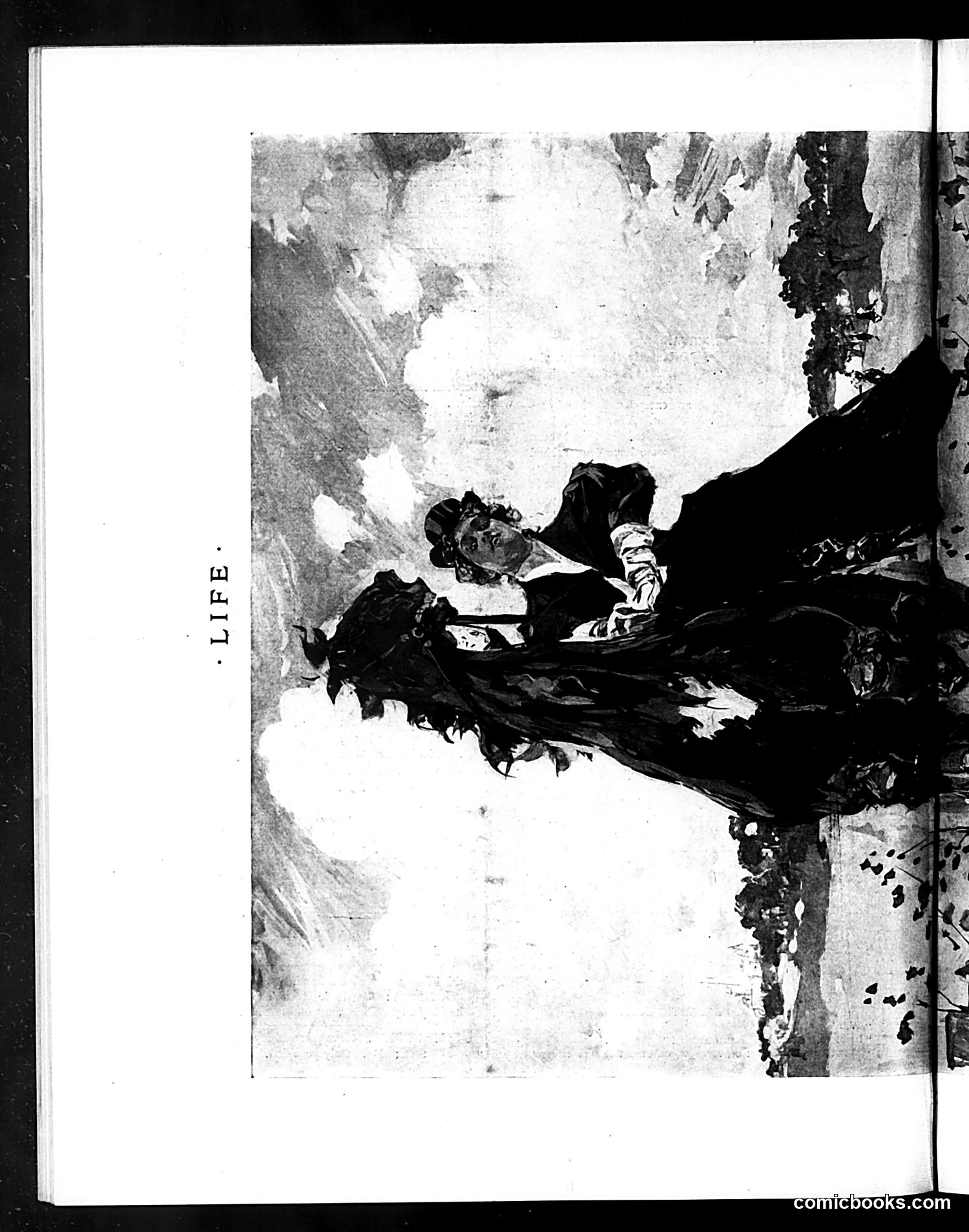
This page appears to be rotated 90 degrees, making it difficult to interpret the full content. The visible text consists only of scattered letters ("E," "LIFE" printed vertically on the left margin), which are typical page markers rather than substantive content. The image shows what appears to be a dark, high-contrast illustration depicting figures in period dress, though the quality and rotation make specific identification challenging. Without legible text or clearer imagery, I cannot reliably identify the cartoon's subject, political references, or satirical intent. The page may be a title page, section divider, or illustration that requires accompanying text to properly understand its meaning and historical context.
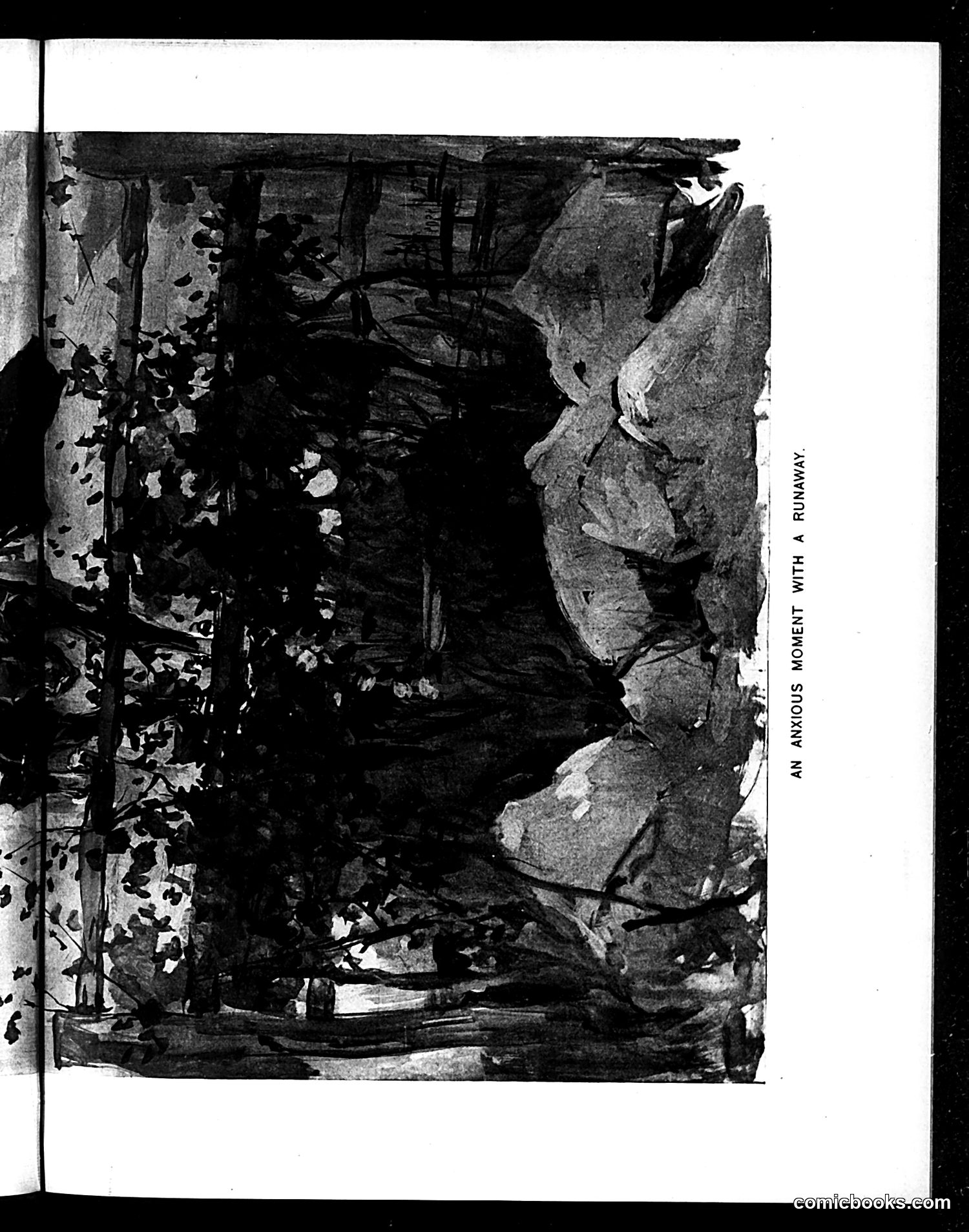
I can see this is a black and white photograph or illustration showing what appears to be a dramatic scene with figures and architectural elements, but the image quality is quite poor and heavily degraded, making it difficult to discern clear details. The OCR text appears to be corrupted or inverted and doesn't provide readable context. The caption on the right side reads "AN AWKWARD MOMENT WITH A RUNAWAY," which suggests this depicts a comedic or dramatic scene involving an out-of-control horse or vehicle. However, without clearer visibility of the specific figures, their expressions, and the exact scene depicted, I cannot reliably identify who is caricatured or what political/social commentary this satirizes. The degradation of the image prevents me from determining the specific joke or reference intended for Life magazine's readers.
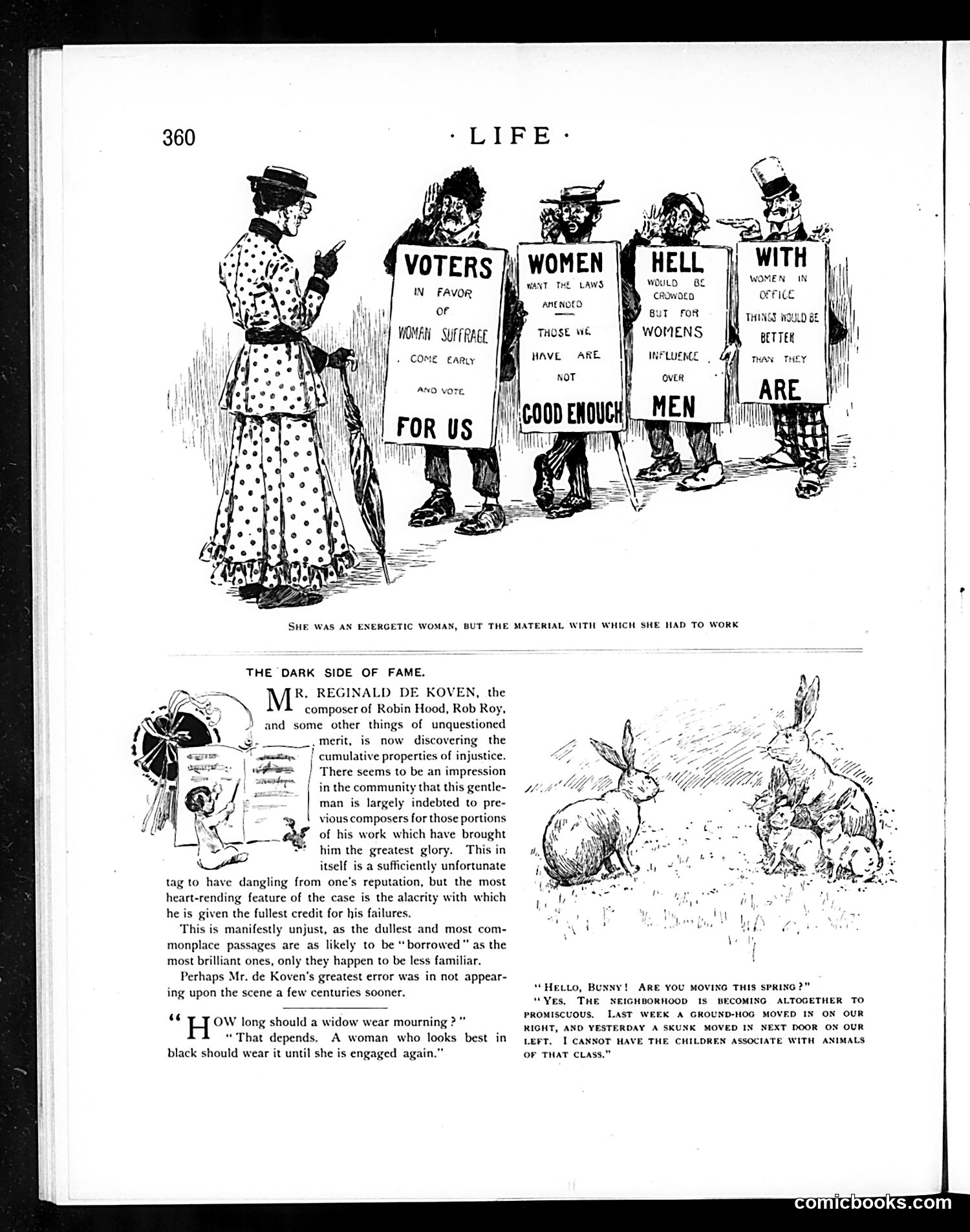
The top cartoon mocks women's suffrage advocates through exaggerated caricatures holding protest signs. A well-dressed woman observes men bearing absurd arguments: "Voters in favor of woman suffrage come early and vote for us," "Women have the laws amended," "Hell would be crowded but for women's influence over men," and "With women in office things would be better than they are." The satire ridicules anti-suffrage male resistance by presenting their objections as ridiculous—suggesting men fear women's actual competence and moral influence. The caption "She was an energetic woman, but the material with which she had to work" implies women face obstinate opposition despite their capability. The page also contains unrelated content: a piece on composer Reginald de Koven plagiarism accusations, and humor pieces about widow mourning and snobbish neighbors. This reflects the pre-1920 American suffrage debate, when such cartoons appeared in mainstream magazines.
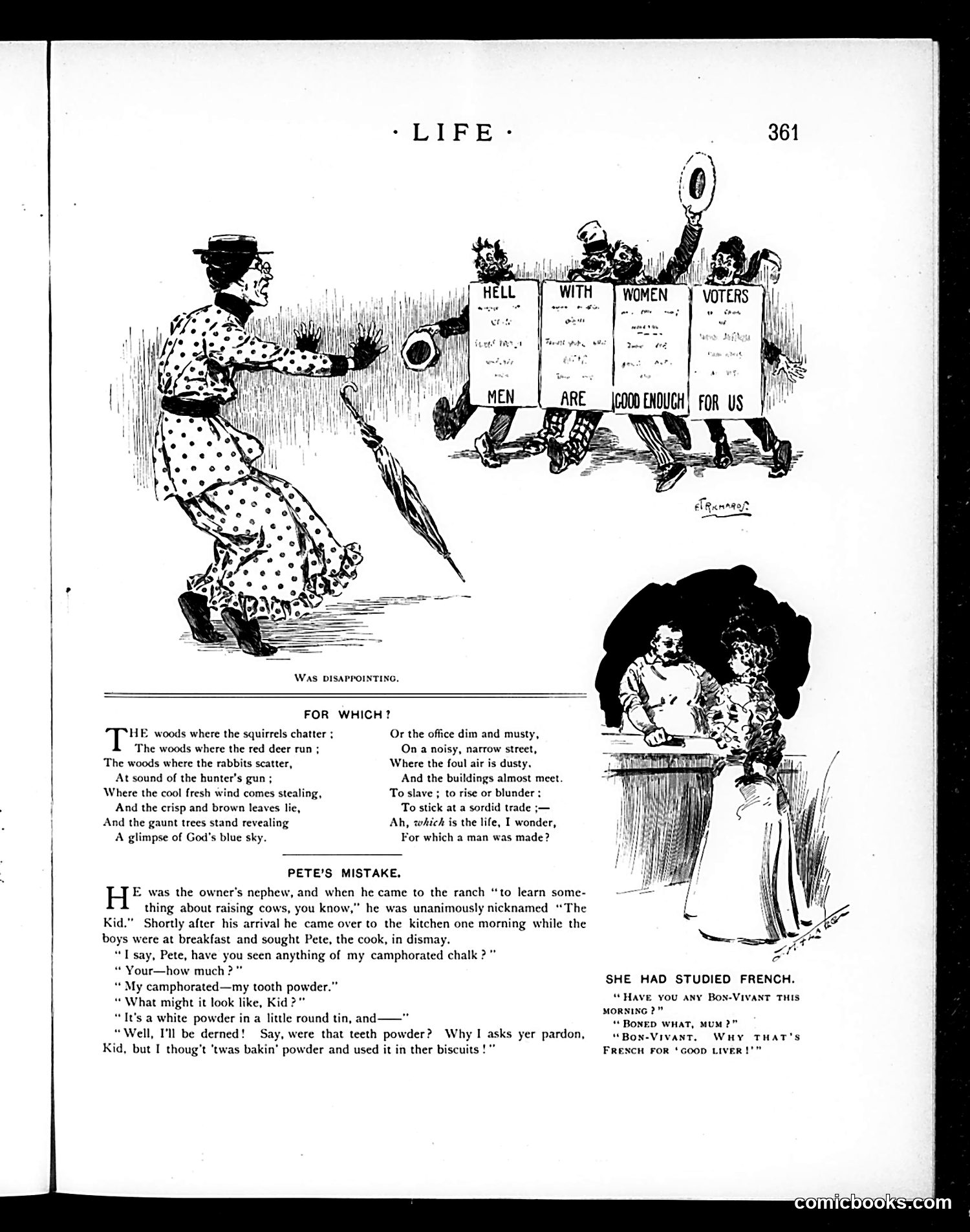
This page contains three separate humorous pieces: **Top Cartoon**: A woman juggler tosses hats at suffragists holding signs reading "HELL WITH MEN," "ARE WOMEN," "GOOD ENOUGH," "VOTERS FOR US." This mocks early women's suffrage activism, portraying female voters as chaotic and disorganized—a common anti-suffrage satire tactic of the era. **"For Which?" Poem**: Contrasts natural, rural life with urban industrial drudgery, questioning which existence humans were "made" for. This reflects early 20th-century nostalgia for preindustrial life amid rapid urbanization. **Two Comic Anecdotes**: - "Pete's Mistake" jokes about a ranch cook confusing tooth powder with baking powder - "She Had Studied French" ridicules a woman's pretentious misuse of the French phrase "bon vivant" (good liver) as if it were a food item The lower sketches mock social pretension and linguistic ignorance, while the suffrage cartoon expresses political opposition to women's voting rights.
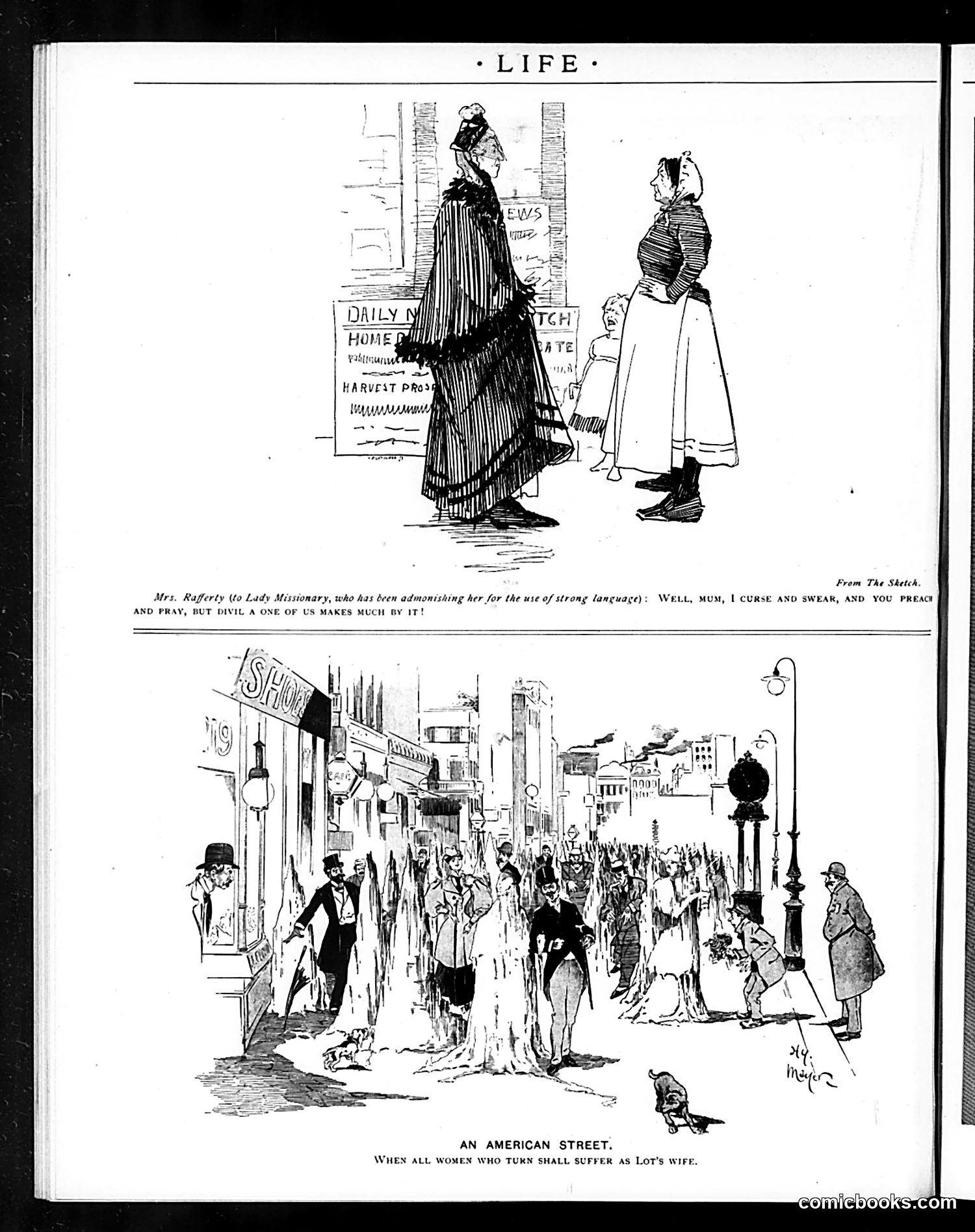
**Top cartoon:** A working-class Irish woman (Mrs. Rafferty) deflects a preachy lady missionary's moral criticism about cursing. Rafferty's retort—that both she and the missionary pray, but neither profits from virtue—mocks hypocrisy and class-based moralizing. The satire suggests wealthy religious women condemn the poor's behavior while achieving no moral superiority. **Bottom cartoon:** Titled "An American Street," it depicts a crowded urban scene with the caption referencing Lot's wife (biblical figure turned to salt for looking back). This appears to critique women's public visibility or behavior in modern American cities, likely satirizing either women's newfound freedom in public spaces or anxieties about changing gender roles—suggesting women "turning" (perhaps toward independence or modern behavior) will face punishment. Both cartoons use religious and moral frameworks ironically to critique social hypocrisy and gender-related social anxieties.
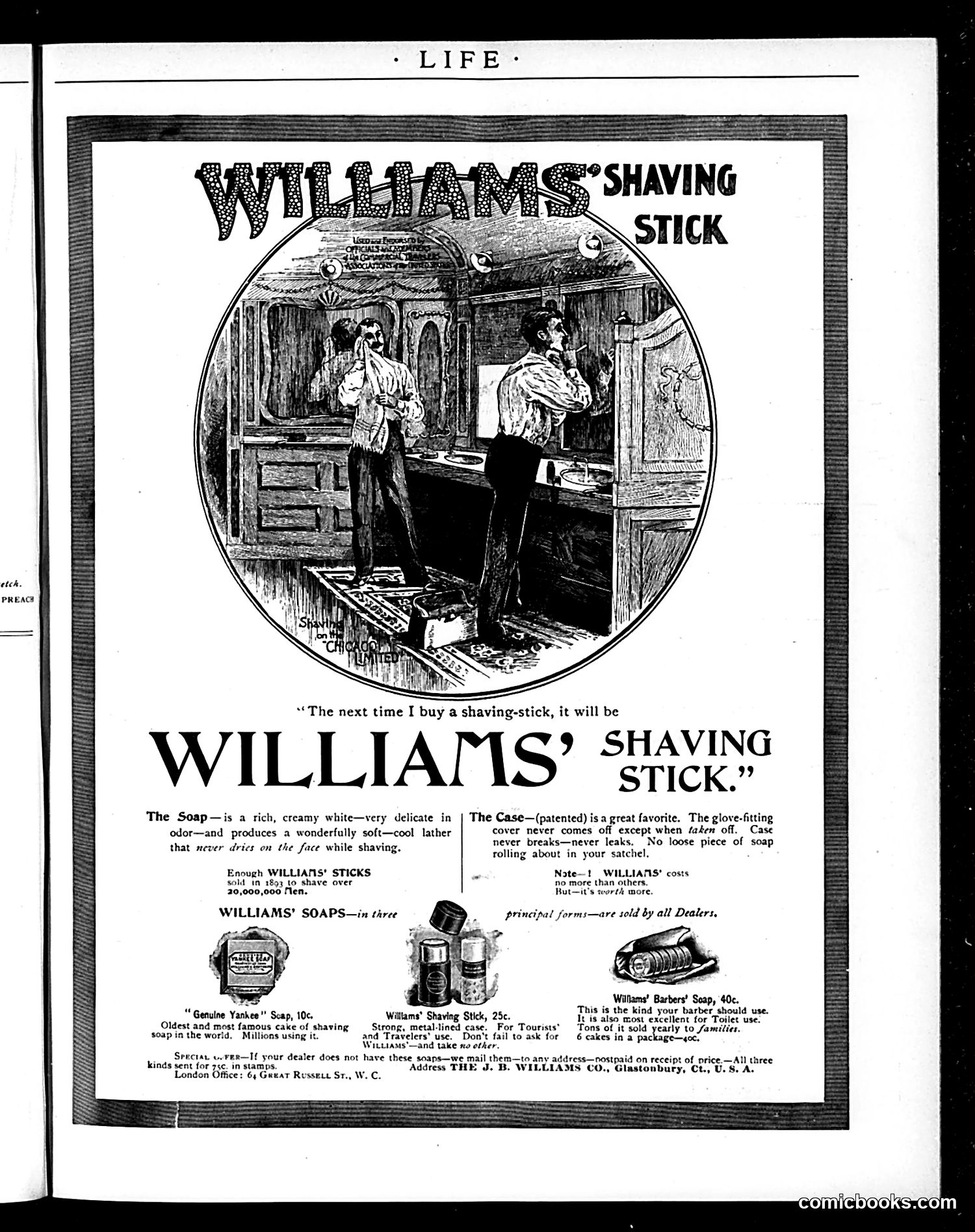
This is primarily a **product advertisement**, not political satire. It promotes Williams' brand shaving products to early 20th-century men. The circular illustration shows a barbershop scene where a man, having used Williams' shaving stick, confidently declares he'll buy it again. The advertisement emphasizes practical benefits: the soap won't dry on the face during shaving, the patented metal case won't leak or break during travel, and the product costs no more than competitors while being "worth more." The ad lists three Williams soap products at different price points (10¢ to 40¢) and includes testimonial language typical of the era. The phrase "Genuine Yankee Soap" appeals to American pride. There is **no political cartoon or satire** on this page—it's straightforward commercial advertising from Life magazine's revenue stream, using period-appropriate marketing rhetoric about product quality and reliability.
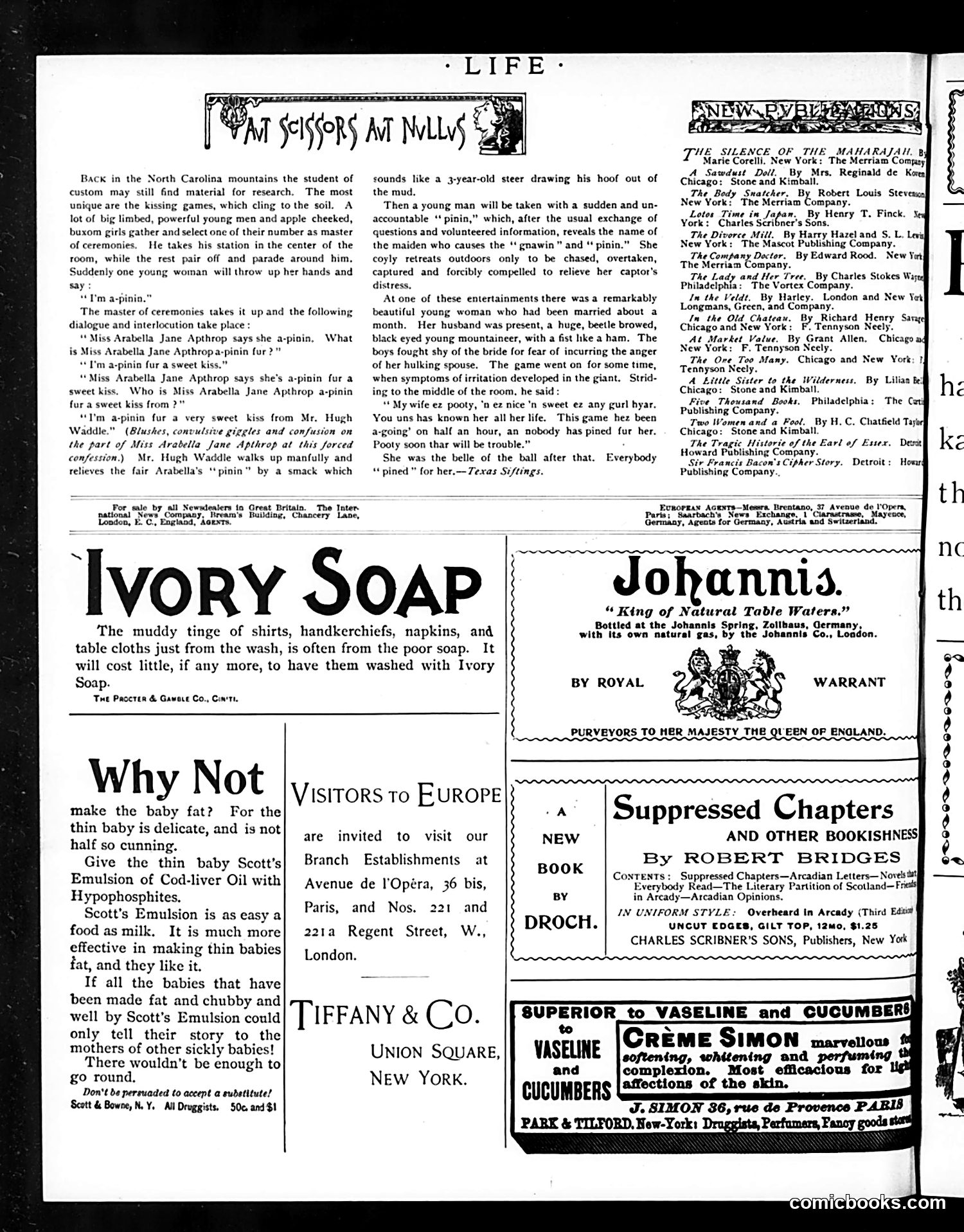
This article describes an Appalachian kissing game from North Carolina mountains. A "master of ceremonies" oversees young unmarried couples who parade around while one person (usually a woman) declares they're "pining" (yearning). Through ritual dialogue, the group reveals who she pines for, then she's chased outdoors and "forcibly compelled" to be kissed. The humor culminates when a newlywed bride is avoided by bashful suitors out of fear of her large, intimidating husband. The husband then dramatically declares his wife deserves attention too, essentially demanding someone participate in the kissing game with her. She then becomes the belle of the ball. The satire gently mocks rural courtship customs as quaint and performative—a collision between genuine desire and strict social ritual, with masculine pride and jealousy driving the final comedic reversal. The piece presents Appalachian culture as colorfully exotic to urban readers.
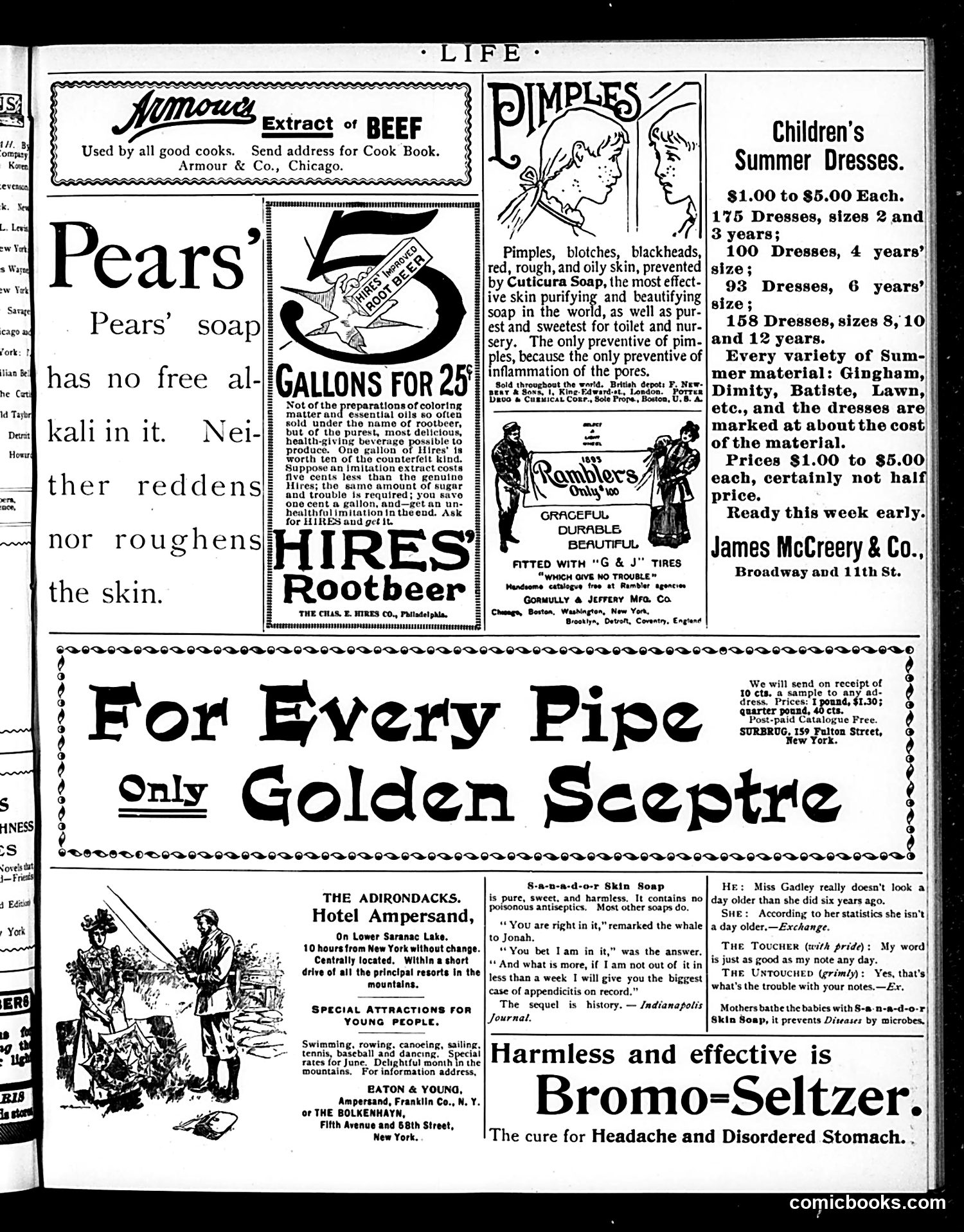
This is primarily an **advertising page** from Life magazine, with minimal editorial content. The main items are product advertisements typical of early 1900s America: **Notable ads include:** - Pears' soap (claiming gentleness on skin) - Hires' Rootbeer (emphasizing authenticity vs. imitations) - Children's summer dresses by James McCreery & Co. - Bromo-Seltzer (headache remedy) - The Adirondacks resort **The only cartoon-like content** appears to be small **joke exchanges** at the bottom (about Miss Gadley's age, a whale and Jonah, and someone's IOUs), which are brief, disconnected humor pieces rather than political satire. **Context for modern readers:** This reflects an era when Life functioned as a humor and lifestyle magazine mixing editorial cartoons with extensive advertising. The ads reveal period concerns (skin impurities, "imitation" products) and leisure activities (mountain resorts). There is no significant political satire visible on this particular page.
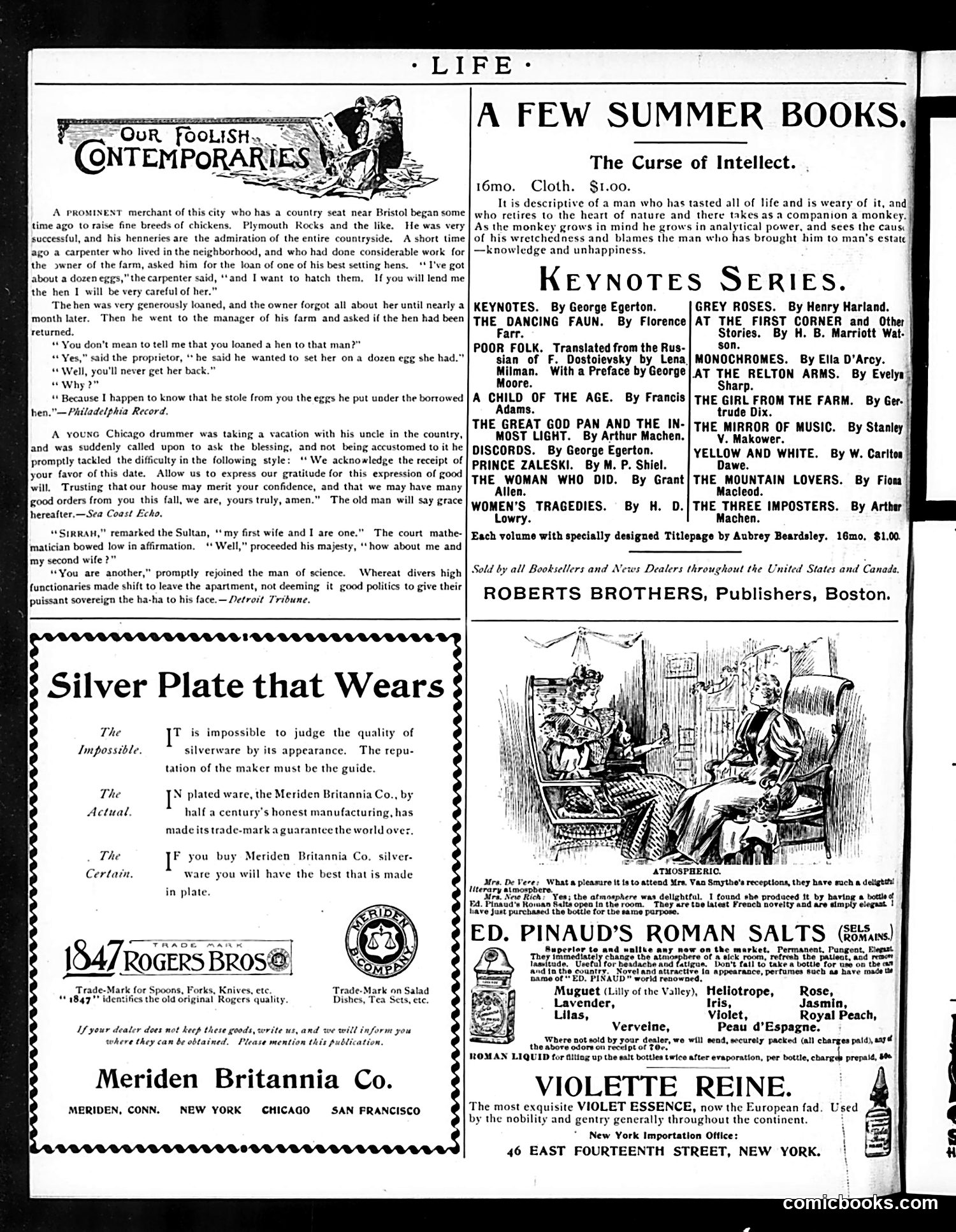
This page features three brief humorous anecdotes mocking human foolishness: 1. **The Stolen Eggs Story**: A country gentleman lends his prize hen to a carpenter for breeding. The farm manager reveals the carpenter had stolen eggs to place under the borrowed hen—a con exploiting the owner's generosity. 2. **The Drummer's Prayer**: A young Chicago salesman, unfamiliar with saying grace, delivers a blessing in business-letter jargon ("We acknowledge receipt of your favor..."), treating prayer like commercial correspondence. The joke satirizes American commercial culture overtaking traditional manners. 3. **The Sultan's Mathematician**: A sultan's court scholar uses logical wordplay to escape execution after making an impertinent joke—satire on clever wit surviving tyranny. These anecdotes mock greed, cultural vulgarity, and the hazards of power dynamics. The page also contains silverware advertising, typical of *Life* magazine's commercial content.
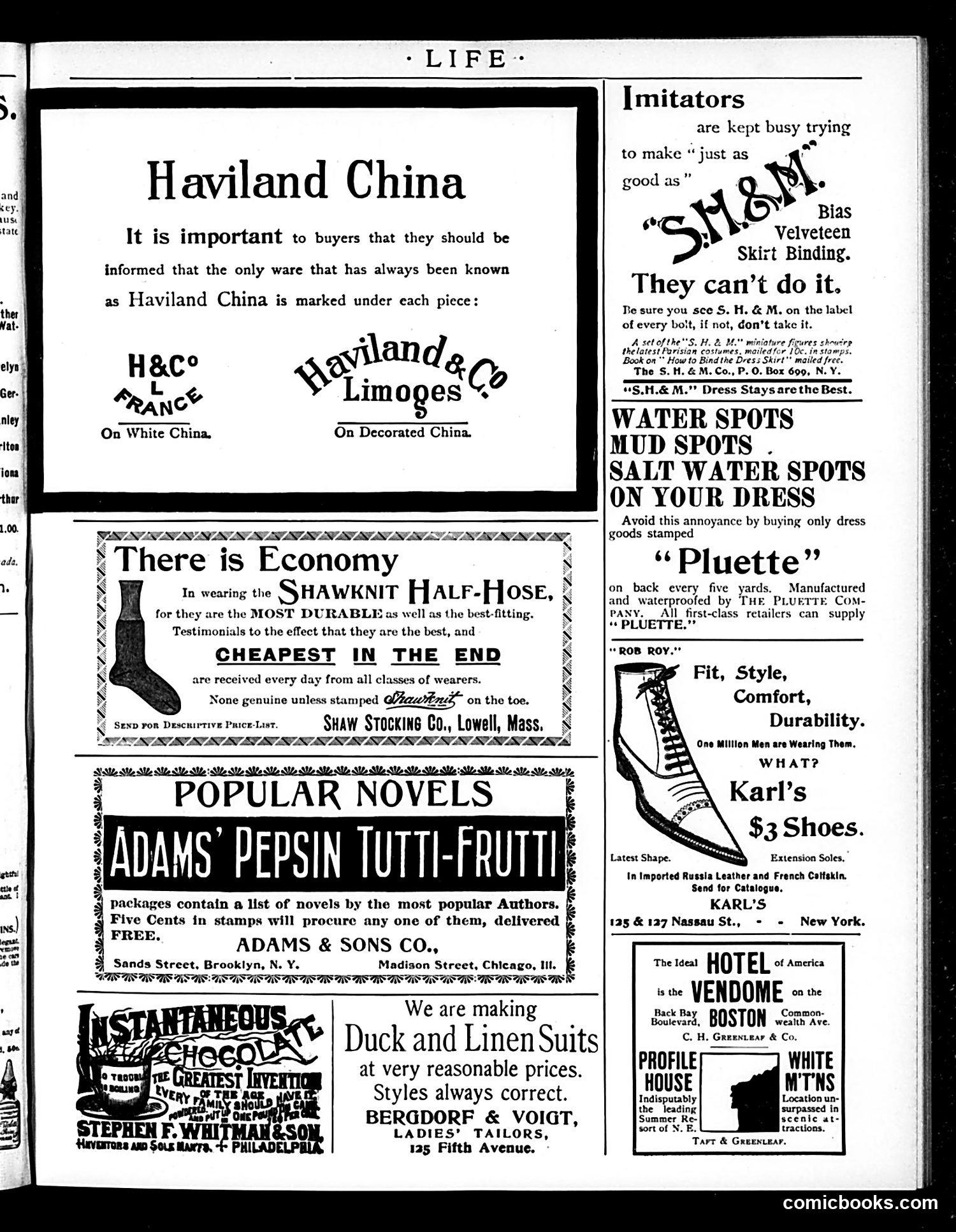
This is primarily a **commercial advertising page** rather than a satirical cartoon. However, the upper right section contains product advertising with a humorous pitch: The **S.H. & M. advertisement** for dress stays (corset-like undergarments) mocks competitors trying to imitate their product. The text "They can't do it" is the selling point—claiming inferior imitators cannot match the original's quality. This reflects **early 1900s consumer culture**, where brand authenticity and name-recognition were marketing tools against cheaper knockoffs. Similarly, the **Haviland China advertisement** emphasizes that genuine pieces are marked with the maker's signature, warning buyers to verify authenticity against fakes. The rest of the page contains typical period advertisements for shoes (Karl's), novels (Adams' Pepsin Tutti-Frutti), stockings, chocolate, and hotels—all competing for consumer attention with claims of superiority, durability, and value. The humor is implicit: these advertisements acknowledge a thriving **counterfeit/imitation market**, suggesting manufacturers were locked in constant battle against cheap copies.
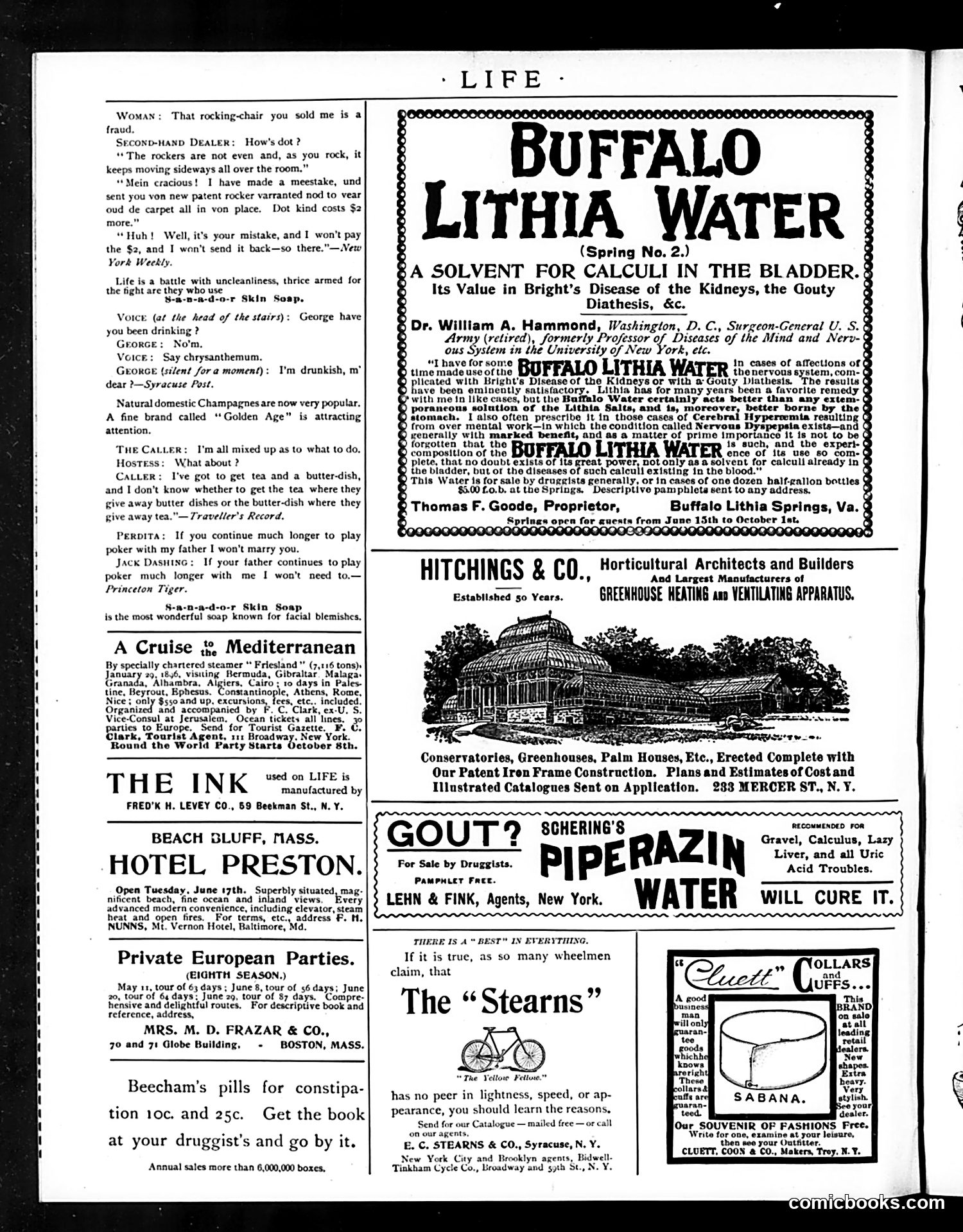
This page is primarily **advertising**, not satirical editorial content. The dominant feature is a large advertisement for Buffalo Lithia Water, endorsed by Dr. William A. Hammond, a prominent Civil War-era physician and former Surgeon-General of the U.S. Army. The small comic snippets at the top are brief humor pieces typical of Life magazine's format—they include a joke about a defective rocking chair sold by a second-hand dealer, and a gag about someone being drunk (the "chrysanthemum" test). These are disconnected one-liners rather than unified satirical cartoons. The rest of the page contains travel advertisements (Mediterranean cruises, European tours), patent medicine ads (Beecham's Pills, Sanarador Skin Soap, Piperazin Water for gout), and hotel promotions. The medical advertisements reflect the era's common practice of endorsing dubious patent remedies with physicians' testimonials—a now-discredited marketing approach.