
Life, 1895-05-30 · page 9 of 22
Life — May 30, 1895 — page 9: what you’re looking at
What you’re looking at
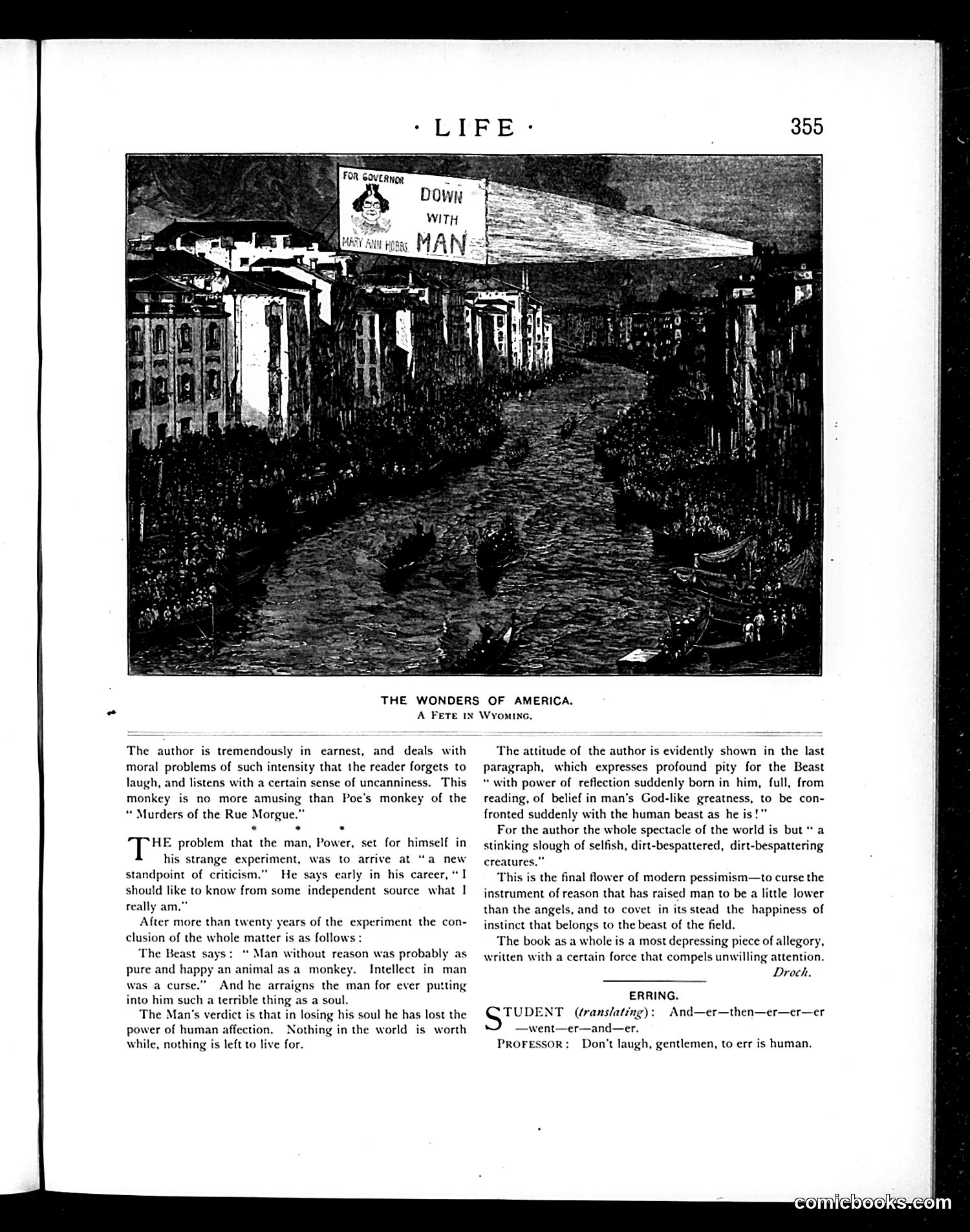
The photograph shows a street scene from a Wyoming fete (fair/festival) with a political banner reading "DOWN WITH MAN" and appearing to reference a governor candidate named "EAST ANN PERRY." The accompanying article critiques an author (unnamed in this excerpt) whose work "The Murders of the Morgue" presents an extremely pessimistic philosophy: that man is inherently a selfish, bestial creature lacking reason or human affection. The text argues this represents "modern pessimism," where reason has degraded humans below angels, stripping them of dignity. The satirical point appears to be mocking the author's misanthropy—his belief that mankind deserves contempt—by juxtaposing it with the photograph's populist political sentiment ("Down with Man"). The ironic message: even ordinary people at a county fair express anti-human sentiments matching the author's philosophy.
📄 Transcribed text from this page (OCR, searchable)
Machine-transcribed from the original scan — historical spelling and the odd misread are preserved.
THE WONDERS OF AMERICA. A Fete 1x Wyominc, The author is tremendously in earnest, and deals with moral problems of such intensity that the reader forgets to laugh, and listens with a certain sense of uncanniness. This monkey is no more amusing than Poe's monkey of the “ Murders of the Rue Morgue.” HE problem that the man, Power, set for himself in his strange experiment, was to arrive at “a new standpoint of cri * He says early in his career, “1 should like to know from some independent source what | really am.” After more than twenty years of the experiment the con- clusion of the whole matter is as follows : The Beast say: Man without reason was probably as pure and happ: animal as a monkey. Intellect in man was a curse.” And he arraigns the man for ever putting into him such a terrible thing as a soul. The Man's verdict is that in losing his soul he has lost the power of human affection. Nothing in the world is worth while, nothing is left to live for. The attitude of the author is evidently shown in the last paragraph, which expresses profound pity for the Beast “with power of reflection suddenly born in him, full, from reading, of belief in man’s God-like greatness, to be con- fronted suddenly with the human beast as he is!” For the author the whole spectacle of the world is but “a stinking slough of selfish, dirt-bespattered, dirt-bespattering creatures.” This is the final lower of modern pessimism—to curse the instrument of reason that has raised man to be a little lower than the angels, and to covet in its stead the happiness of instinct that belongs to the beast of the field. The book as a whole is a most depressing piece of allegory, written with a certain force that compels unwilling attention. Droch. ERRING. TUDENT (translating): —went—er—and—er. PROFESSOR: Don’t laugh, gentlemen, to err is human. And—er—then—er—er—er