
Life, 1895-05-30 · page 8 of 22
Life — May 30, 1895 — page 8: what you’re looking at
What you’re looking at
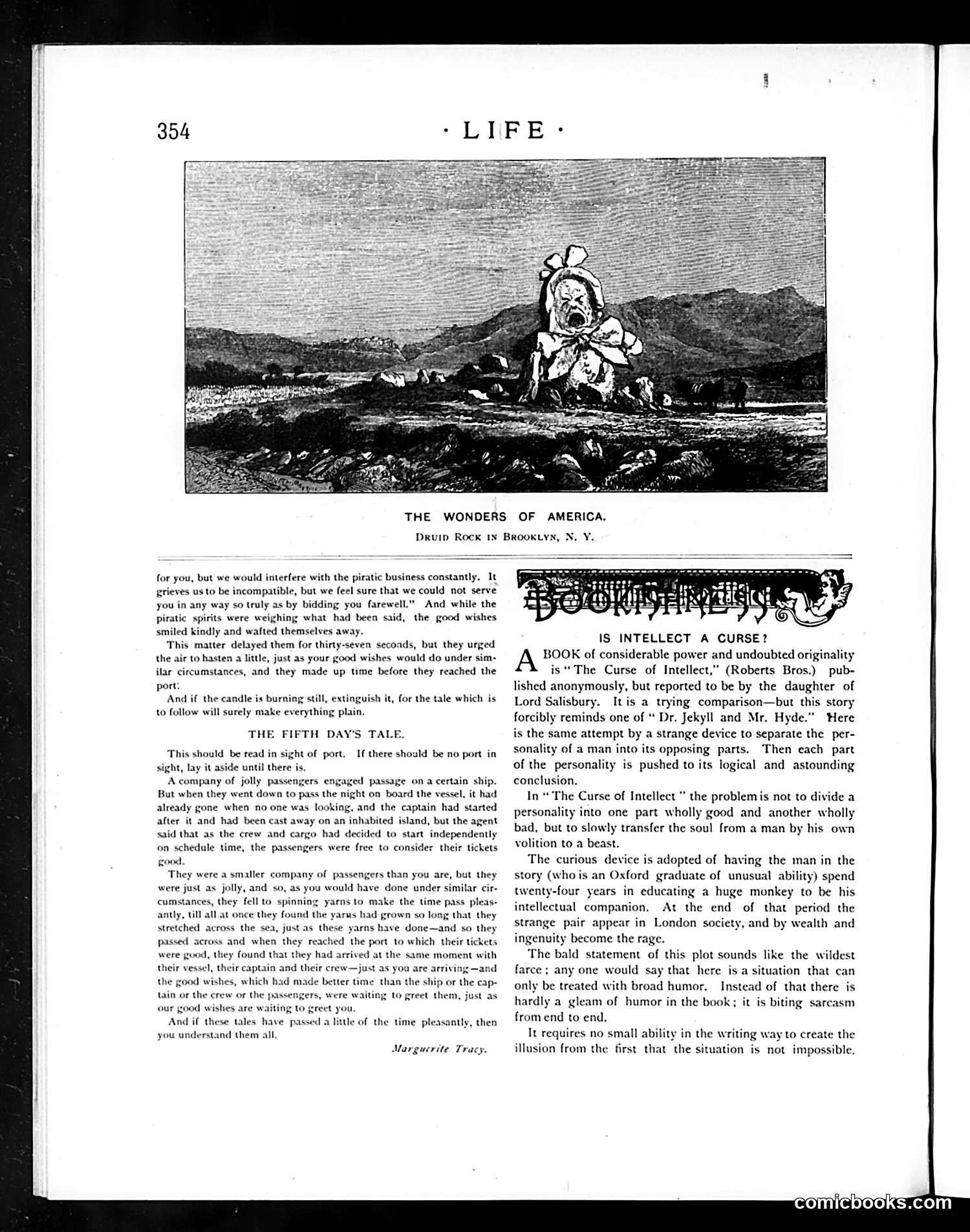
**The Image**: Shows a crude giant figure (appears to be a caricatured Native American or "savage") standing in a landscape labeled "Druid Rock in Brooklyn, N.Y." This is satirizing the notion that Brooklyn contains ancient "wonders" comparable to natural monuments. **The Text Content**: The page contains two unrelated pieces: 1. A ship captain's story ("The Fifth Day's Tale") about passengers passing time at sea 2. A book review of "The Curse of Intellect" (Roberts Bros.), critiquing a story about an Oxford graduate whose personality splits into good and evil halves **The Satire**: The cartoon mocks American claims of having natural/historical "wonders" by presenting an absurd Brooklyn rock formation as if it were comparable to genuine archaeological sites. The humor lies in the obvious mundanity of the location juxtaposed with grandiose titling.
📄 Transcribed text from this page (OCR, searchable)
Machine-transcribed from the original scan — historical spelling and the odd misread are preserved.
for you, but we would interfere with the piratic business constantly, It grieves us to be incompatible, but we feel sure that we could not serve you in any way so truly as by bidding you farewell.” And while the piratic spirits were weighing what had been said, the good wishes smiled kindly and wafted themselves away. This matter delayed them for thirty-seven seconds, but they urged the air to hasten a little, just as your good wishes would do under sim- ilar circumstances, and they made up time before they reached the port: And if the candle is burning still, extinguish it, for the tale which is to follow will surely make everything plain. THE FIFTH DAY'S TALE, This should be read in sight of port. sight, lay it aside until there is. ‘A company of jolly passen; ngaged passage on a certain ship. But when they went down to pass the night on board the vessel, it had already gone when no one was looking, and the captain had started after it and had been cast away on an inhabited island, but the agent said that as the crew and cargo had decided to start independently on schedule time, the passengers were free to consider their tickets od. They were a smaller company of passengers than you are, but they were just as jolly, and so, as you would have done under similar ci cumstances, they fell to spinning yarns to make the time pass pleas- If there should be no port in antly, till all at once they found the yarns had grown so long that they stretched across the sea, just as these yarns have done—and so they passed across and when they reached the port to which their tickets were good, they found that they had arrived at the same moment with their vessel, their captain and their crew—just as you are arriving —and the good wishes, which had made better time than the ship or the cap- tain or the crew or the passengers, were waiting to greet them, just as our good wishes are w z lo greet you. And if these tales have passed a little of the time pleasantly, then you understand them all Marguerite Tracy IS INTELLECT A CURSE? A BOOK of considerable power and undoubted originality is**The Curse of Intellect,” (Roberts Bros.) pub- lished anonymously, but reported to be by the daughter of Lord Salisbury. It is a trying comparison—but this story forcibly reminds one of “ Dr. Jekyll and Mr. Hyde.” Here is the same attempt by a strange device to separate the per- sonality of a man into its opposing parts. Then each part of the personality is pushed to its logical and astounding conclusion, In “ The Curse of Intellect " the problem is not to divide a personality into one part wholly good and another wholly bad, but to slowly transfer the soul from a man by his own volition to a beast. The curious device is adopted of having the man in the story (who is an Oxford graduate of unusual ability) spend twenty-four years in educating a huge monkey to be his intellectual companion, At the end of that period the strange pair appear in London society, and by wealth and ingenuity become the rage. The bald statement of this plot sounds like the wildest farce ; any one would say that here is a situation that can only be treated with broad humor. Instead of that there is hardly a gleam of humor in the book; it is biting sarcasm from end to end. It requires no small ability in the writing way to create the illusion from the first that the situation is not impossible.