
Life, 1895-05-30 · page 6 of 22
Life — May 30, 1895 — page 6: what you’re looking at
What you’re looking at
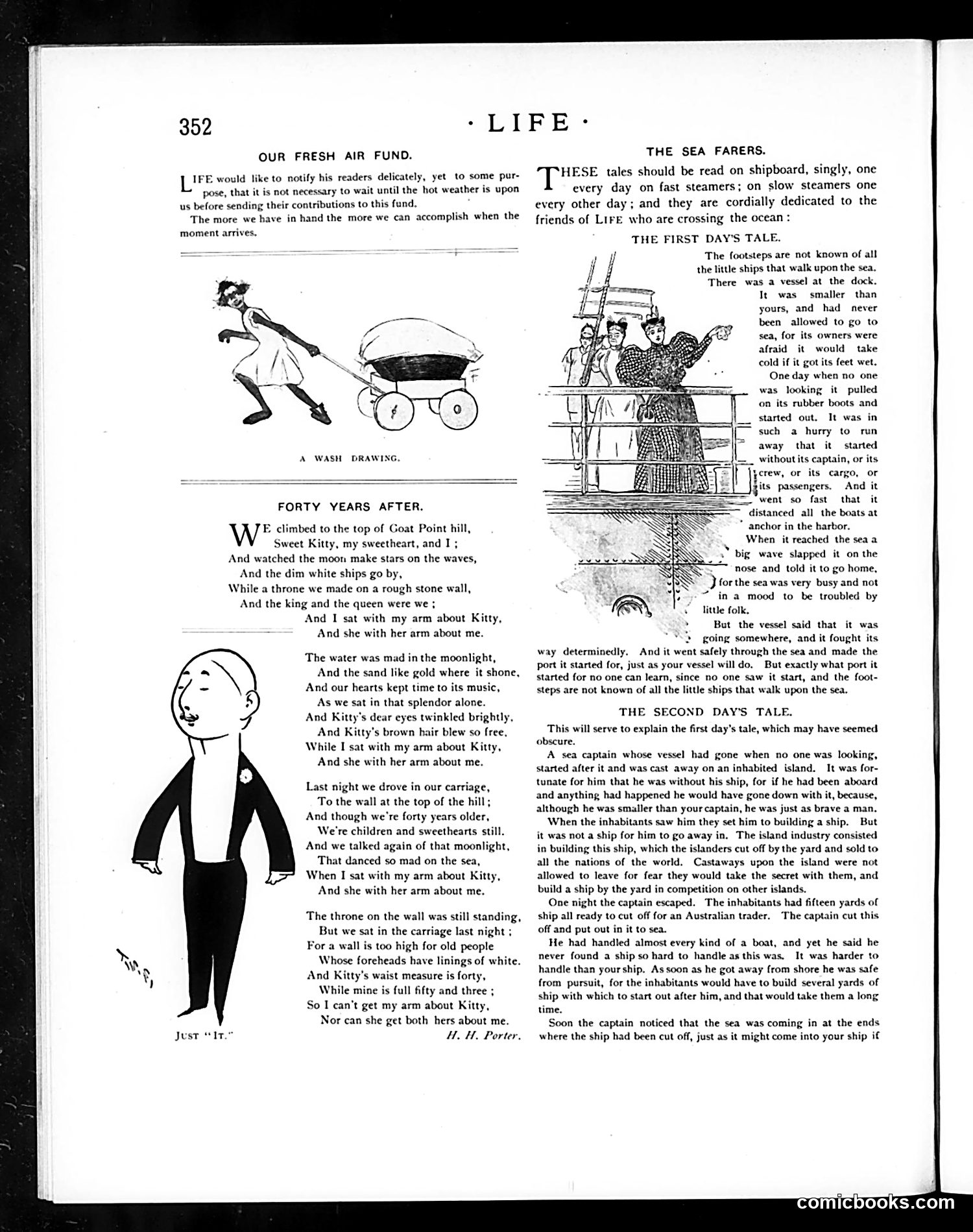
This page contains three distinct pieces: **"Our Fresh Air Fund"** (top left): A brief fundraising notice encouraging readers to contribute to provide fresh air experiences for those unable to afford them—a charitable cause. **"A Wash Drawing"** (center left): A simple cartoon sketch of a figure pulling a baby carriage, labeled as a "wash drawing" (a pen-and-ink technique). **"Forty Years After"** (left): A sentimental poem by H.H. Porter about romantic nostalgia, accompanied by an illustration of a man in formal dress reflecting on past romance with "Kitty." The poem employs typical Victorian sentimentality about lost youth and love. **"The Sea Farers"** (right): A serialized fictional tale about sea voyages and shipbuilding, with accompanying illustrations. This appears to be serialized fiction for entertainment. The page primarily features literary and artistic content rather than political satire.
📄 Transcribed text from this page (OCR, searchable)
Machine-transcribed from the original scan — historical spelling and the odd misread are preserved.
352 OUR FRESH AIR FUND. IFE would like to notify his readers delicately, yet. to some pur- pose, that it is not necessary to wait until the hot weather is upon us before sending their contributions to this fund. ‘The more we have in hand the more we can accomplish when the moment arrives. A WASH DRAWING. FORTY YEARS AFTER. E climbed to the top of Goat Point hill, Sweet Kitty, my sweetheart, and I ; And watched the moon make stars on the waves, And the dim white ships go by, While a throne we made on a rough stone wall, And the king and the queen were we ; And I sat with my arm about Kitty, And she with her arm about me. The water was mad in the moonlight, And the sand like gold where it shone, And our hearts kept time to its music, As we sat in that splendor alone. And Kitty's dear eyes twinkled brightly, And Kitty's brown hair blew so free, While I sat with my arm about Kitty, And she with her arm about me. Last night we drove in our carriage, To the wall at the top of the hill ; And though we're forty years older, We're children and sweethearts still. And we talked again of that moonlight, That danced so mad on the sea When I sat with my arm about Kitty, And she with her arm about me. The throne on the wall was still standing, But we sat in the carriage last night ; For a wall is too high for old people Whose foreheads have linings of white. And Kitty’s waist measure is forty, While mine is full fifty and three ; So I can’t get my arm about Kitty, Nor can she get both hers about me. Just “It.” H. H. Porter, - LIFE: THE SEA FARERS. SP HESE tales should be read on shipboard, singly, one every day on fast steamers; on slow steamers one every other day; and they are cordially dedicated to the friends of LIFE who are crossing the ocean : THE FIRST DAY'S TALE. The footsteps are not known of all the little ships that walk upon the sea, There was a vessel at the dock. Tt was smaller than yours, and had never been allowed to go to sea, for its owners were afraid it’ would take cold if it got its feet wet. One day when no one was looking it pulled on its rubber boots and started out. It was in such a hurry to run away that it started without its captain, or its yerew, or its cargo, or zits passengers, And it S—— went so fast that it distanced all the boats at * anchor in the harbor. When it reached the sea a .* big wave slapped it on the =~ nose and told it to go home, } for the sea was very busy and not “in a mood to be troubled by little folk, But the vessel said that it was going somewhere, and it fought its way determinedly. And it went safely through the sea and made the port it started for, just as your vessel will do, But exactly what port it started for no one can learn, since no one saw it start, and the foot- steps are not known of all the little ships that walk upon the sea. THE SECOND DAY'S TALE. This will serve to explain the first day’s tale, which may have seemed obscure. A sea captain whose vessel had gone when no one was looking, started after it and was cast away on an inhabited island. It was for- tunate for him that he was without his ship, for if he had been aboard and anything had happened he would have gone down with it, because, although he was smaller than your captain, he was just as brave a man. ‘When the inhabitants saw him they set him to building a ship. But it was not a ship for him to go away in, The island industry consisted in building this ship, which the islanders cut off by the yard and sold to all the nations of the world. Castaways upon the island were not allowed to leave for fear they would take the secret with them, and build a ship by the yard in competition on other islands. One night the captain escaped. The inhabitants had fifteen yards of ship all ready to cut off for an Australian trader. The captain cut this off and put out in it to sea. He had handled almost every kind of a boat, and yet he said he never found a ship so hard to handle as this was. It was harder to handle than your ship. As soon as he got away from shore he was safe from pursuit, for the inhabitants would have to build several yards of ship with which to start out after him, and that would take them a long time. Soon the captain noticed that the sea was coming in at the ends where the ship had been cut off, just as it might come into your ship if Comicbooks.com