
Life, 1895-05-30 · page 7 of 22
Life — May 30, 1895 — page 7: what you’re looking at
What you’re looking at
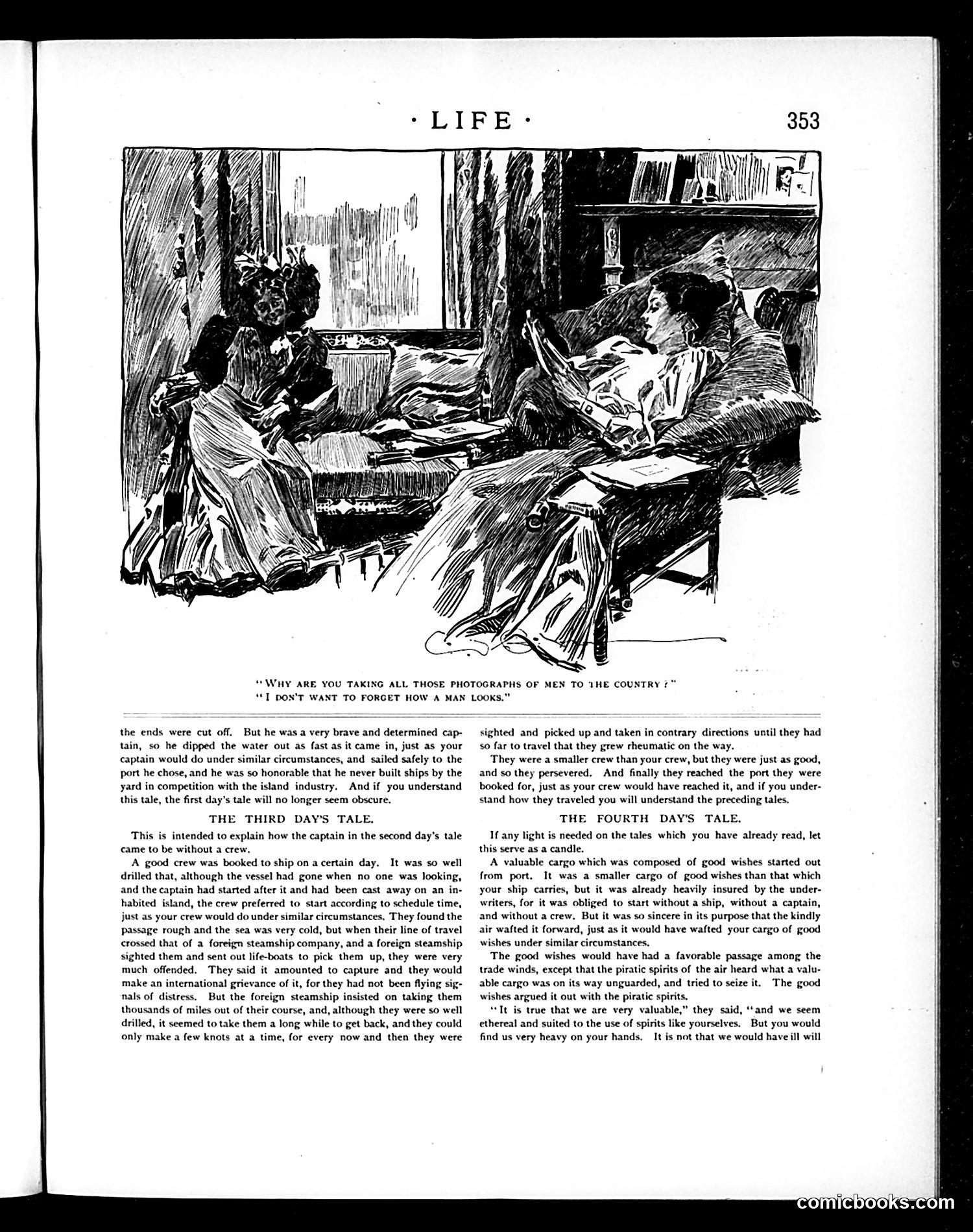
This page from *Life* magazine features a single-panel cartoon captioned: "Why are you taking all those photographs of men to the country? / I don't want to forget how a man looks." The cartoon depicts women in what appears to be early 20th-century dress examining or exchanging photographs of men. The satire likely comments on gender dynamics of the era—possibly mocking women's perceived obsession with men's appearances, or conversely, suggesting women are preparing for men's absence (perhaps due to war or travel). The accompanying text discusses maritime tales, but the cartoon's humor relies on the tension between women's documented interest in masculine appearance and contemporary attitudes about female behavior and propriety.
📄 Transcribed text from this page (OCR, searchable)
Machine-transcribed from the original scan — historical spelling and the odd misread are preserved.
‘WHY ARE YOU TAKING ALL THOSE PHOTOGRAPHS OF MEN TO 1HE COUNTRY 7“ “*] DON'T WANT TO FORGET HOW A MAN LOOKS,” the ends were cut off, But he was a very brave and determined cap- tain, so he dipped the water out as fast as it came in, just as your captain would do under similar circumstances, and sailed safely to the port he chose, and he was so honorable that he never built ships by the yard in competition with the island industry. And if you understand this tale, the first day's tale will no longer seem obscure. THE THIRD DAY'S TALE, This is intended to explain how the captain in the second day's tale came to be without a crew, A good crew was booked to ship on a certain day. It was so well drilled that, although the vessel had gone when no one was looking, and the captain had started after it and had been cast away on an in- habited island, the crew preferred to start according to schedule time, just as your crew would do under similar circumstances, They found the passage rough and the sea was very cold, but when their line of travel crossed that of a foreign steamship company, and a foreign steamship sighted them and sent out life-boats to pick them up, they were very much offended. They said it amounted to capture and they would make an international grievance of it, for they had not been flying sig- nals of distress. But the foreign steamship insisted on taking them thousands of miles out of their course, and, although they were so well drilled, it seemed to take them a long while to get back, and they could only make a few knots at a time, for every now and then they were sighted and picked up and taken in contrary directions until they had so far to travel that they grew rheumatic on the way. ‘They were a smaller crew than your crew, but they were just as good, and so they persevered. And finally they reached the port they were booked for, just as your crew would have reached it, and if you under- stand how they traveled you will understand the preceding tales. THE FOURTH DAY'S TALE, If any light is needed on the tales which you have already read, let this serve as a candle. A valuable cargo which was composed of good wishes started out from port. It was a smaller cargo of good wishes than that which your ship carries, but it was already heavily insured by the under- writers, for it was obliged to start without a ship, without a captain, and without a crew. But it was so sincere in its purpose that the kindly air wafted it forward, just as it would have wafted your cargo of good wishes under similar circumstances. The good wishes would have had a favorable passage among the trade winds, except that the piratic spirits of the air heard what a valu- able cargo was on its way unguarded, and tried to seize it. The good wishes argued it out with the piratic spirits. “It is true that we are very valuable,” they said, “and we seem ethereal and suited to the use of spirits like yourselves. But you would find us very heavy on your hands. It is not that we would have ill will