
A complete issue · 16 pages · 1895
Life — January 31, 1895
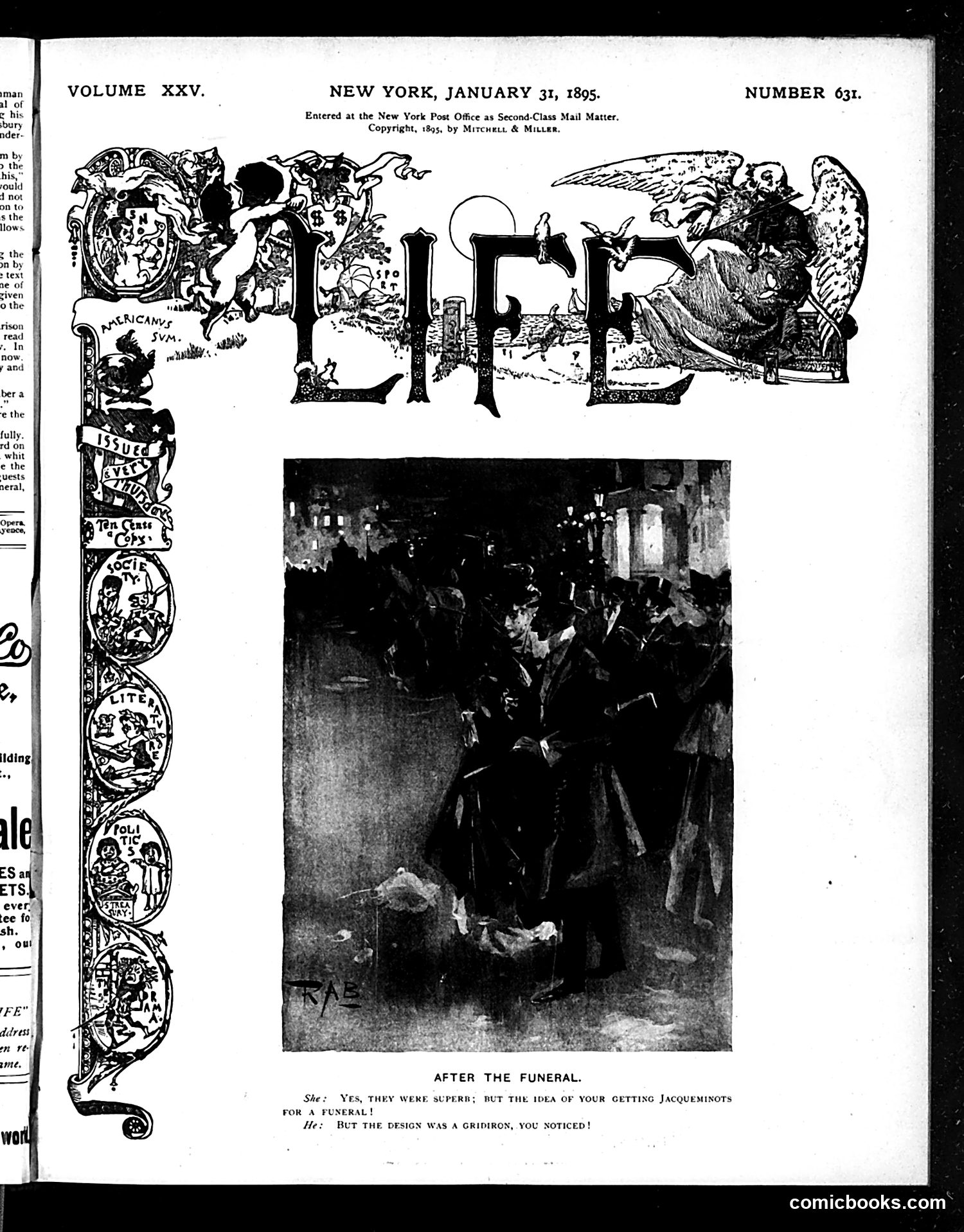
This page features a satirical cartoon about a funeral scene. The dialogue indicates social commentary on funeral customs: a woman remarks that the proceedings "were superb" but questions "the idea of your getting Jacqueminots for a funeral," while a man responds "But the design was a gribbon, you noticed!" The humor appears to target Victorian-era funeral etiquette and the absurdity of elaborate floral arrangements and decorative choices for such somber occasions. "Jacqueminots" likely refers to a specific rose variety popular in that period, suggesting the cartoon mocks the priorities of mourners who focus on ostentatious details rather than genuine grief. The ornate left margin is typical of Life's design aesthetic from this era.
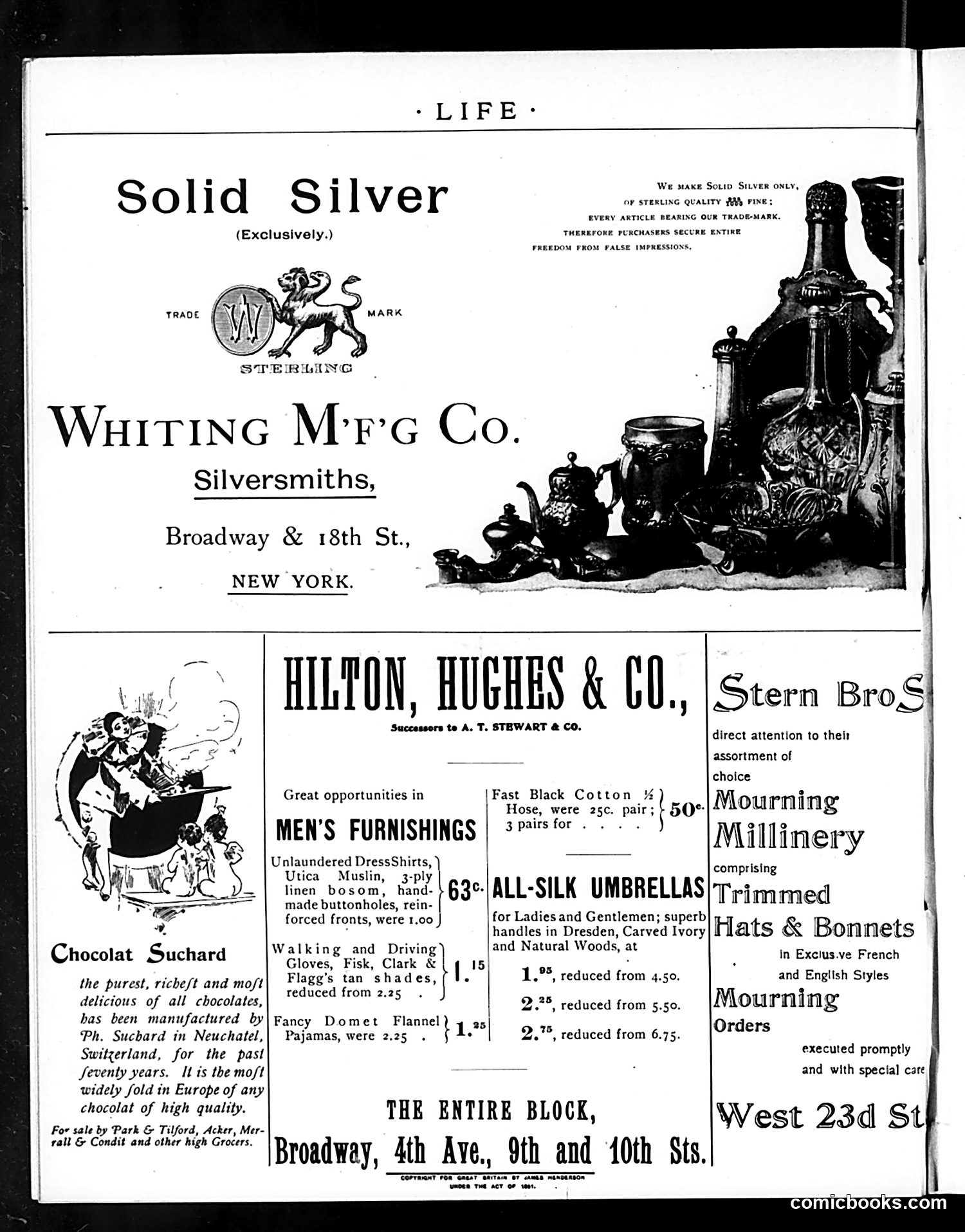
This page is primarily **advertising**, not satirical content. It features commercial notices for: - **Whiting M'f'g Co.** (sterling silver goods) - **Hilton, Hughes & Co.** (men's furnishings and umbrellas) - **Stern Bros.** (mourning millinery) - **Chocolate Suchard** (Swiss chocolate) The only illustration with potential satirical intent appears in the **Chocolate Suchard ad**: a cartoon showing a rotund, cherubic figure surrounded by children or cupids. This is typical Victorian advertising imagery meant to convey indulgence and luxury rather than political satire. The "Mourning Millinery" ads suggest this Life issue dates to a period following a notable death, possibly a public figure, though the specific context remains unclear from this page alone.
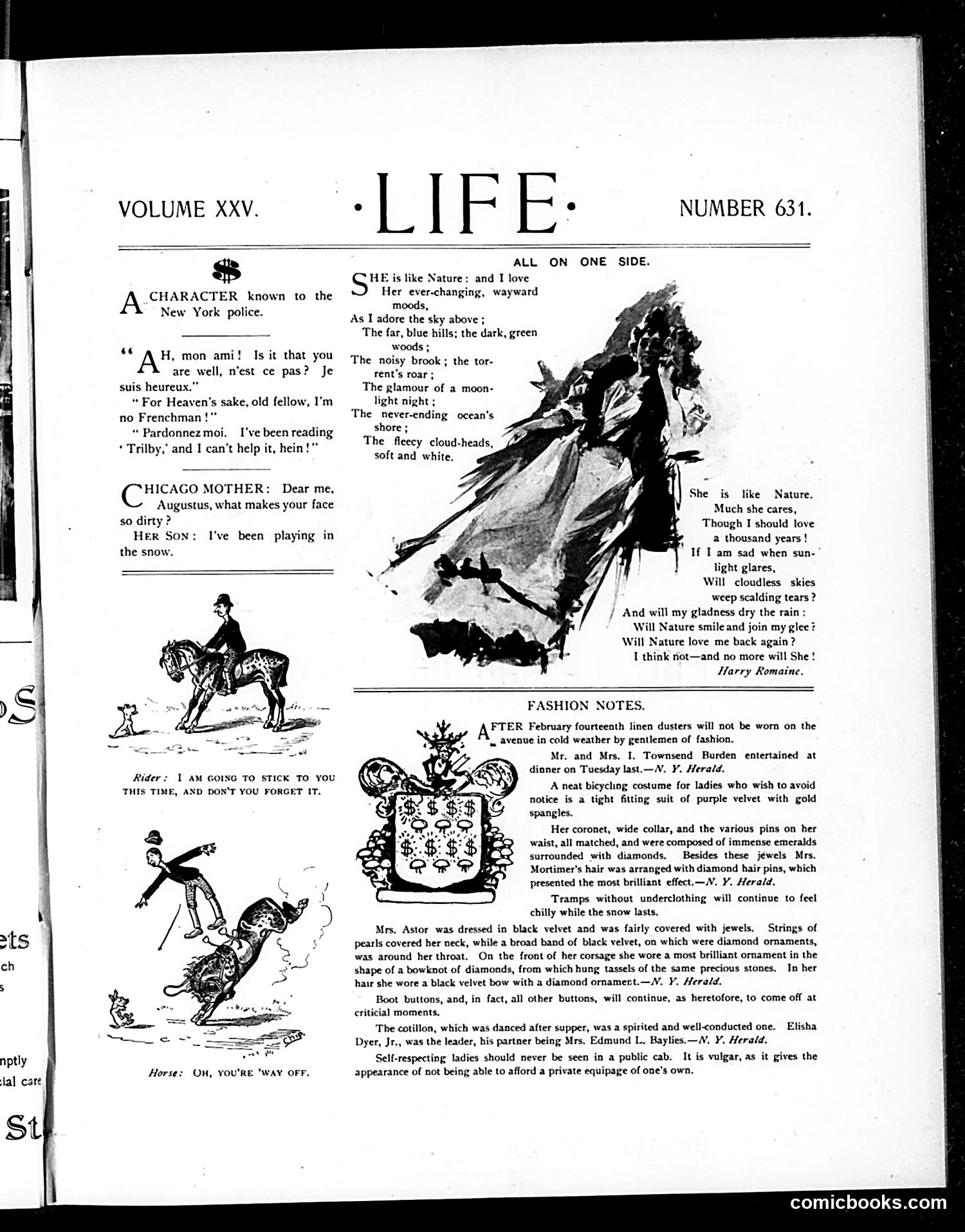
This page contains three distinct sections: **"A Character Known to the New York Police"** presents a brief dialogue joke about a Frenchman unfamiliar with English literature, particularly *Trilby*. **"All on One Side"** is a poem celebrating Nature's constancy and beauty, paired with an atmospheric illustration of a woman in flowing garments amid natural scenery. The poem's theme—Nature as a dependable, caring force—complements the romantic imagery. **"Fashion Notes"** reports on recent society events and fashion trends among the wealthy, including details about Mrs. Astor's jewelry and Mrs. Burden's dinner party. The section discusses fashionable winter wear and social conventions regarding ladies' transportation. The page's humor and content target an educated, affluent readership familiar with high society gossip and literary references.
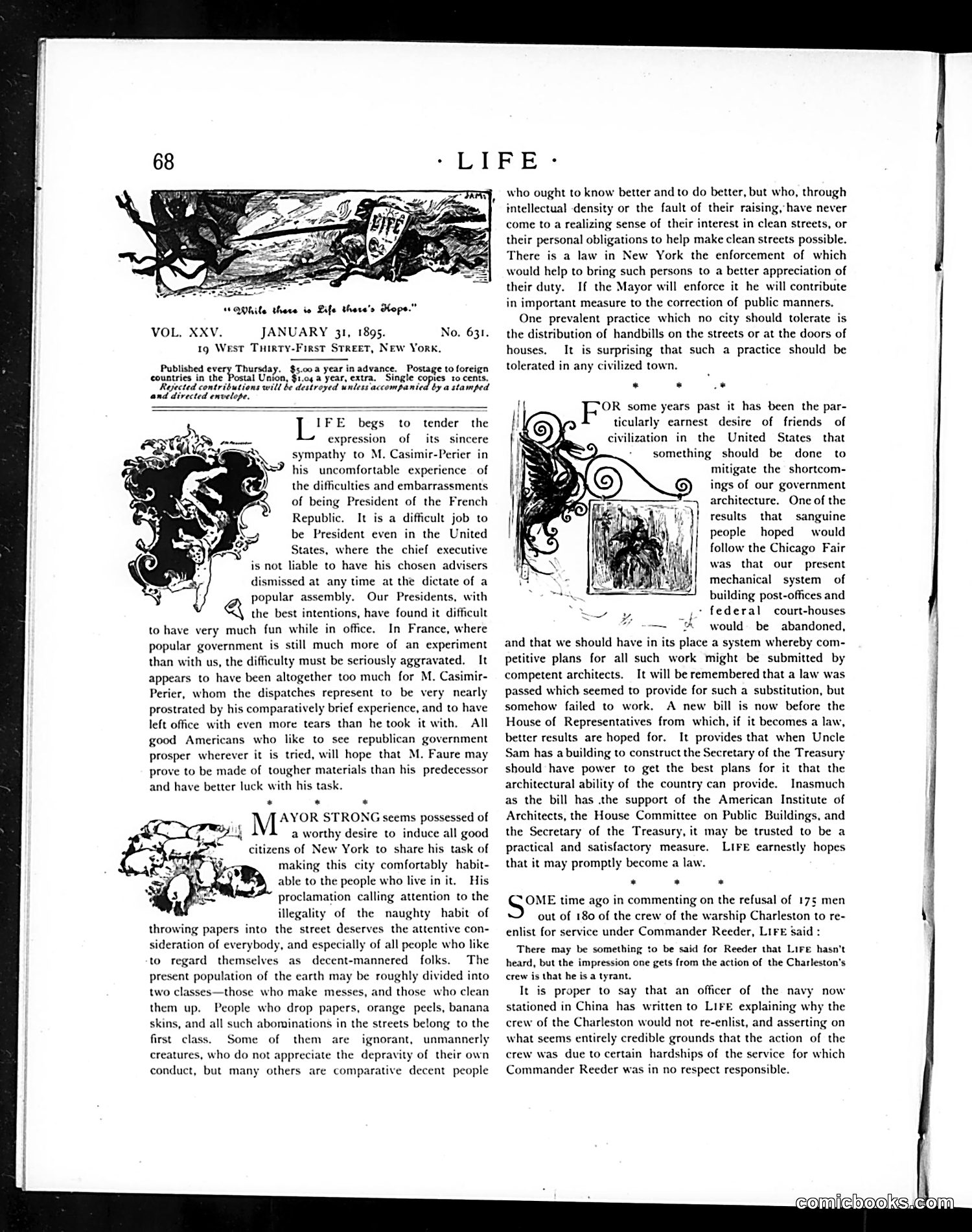
This page contains editorial commentary rather than political cartoons. The decorative mastheads and initial letters feature ornamental designs typical of the era, but the substantive content addresses three distinct issues: **Street Cleanliness**: The magazine criticizes New Yorkers who litter, arguing that enforcement of existing laws would improve public sanitation. **M. Casimir-Perier (French President)**: The text expresses sympathy for the difficulties facing France's new president, contrasting his challenges with those of American presidents. **U.S. Government Architecture**: The editors discuss a bill enabling competitive architectural plans for federal buildings, hoping this will improve design quality over the previous system. **Navy Recruitment (Charleston)**: The final section addresses claims about crew refusals to re-enlist, defending Commander Reeder against accusations of misconduct.
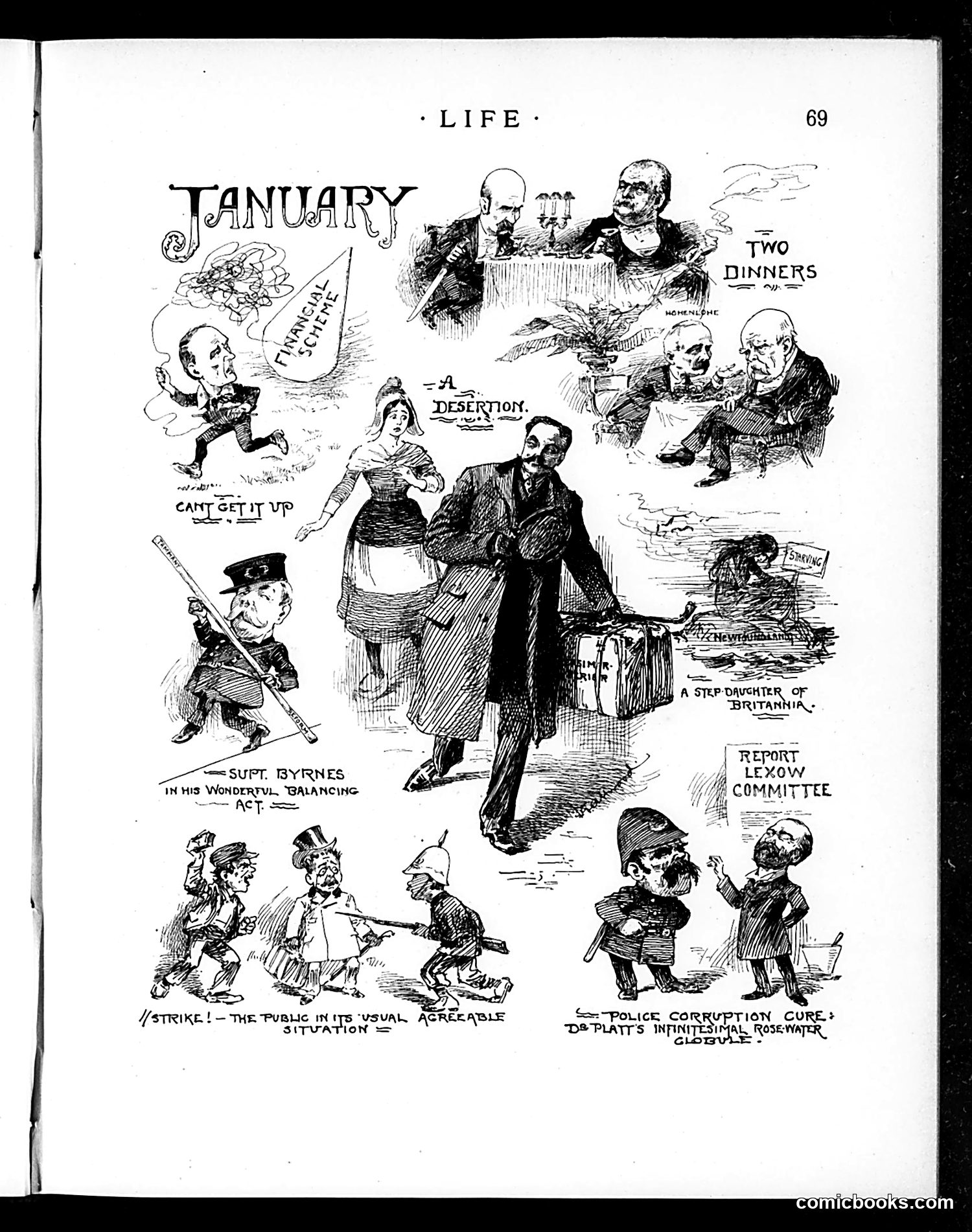
This page presents satirical commentary on January political events through multiple vignettes: **"Can't Get It Up"** mocks a politician struggling with a failed initiative. **"Two Dinners"** appears to satirize competing political figures or factions. **"A Desertion"** and **"A Step Daughter of Britannia"** likely reference political defections or Anglo-American relations issues. **"Supt. Byrnes in His Wonderful Balancing Act"** ridicules a superintendent's precarious political position. **"Strike!"** comments on labor unrest and public disorder. The **"Report Lexow Committee"** references the Lexow Committee investigation into police corruption. **"Police Corruption Cure"** suggests satirical doubt about reforming institutional malfeasance, referencing Dr. Platt's proposed solutions. The cartoons employ exaggerated caricature typical of the era's political satire, targeting bureaucratic incompetence and corruption.
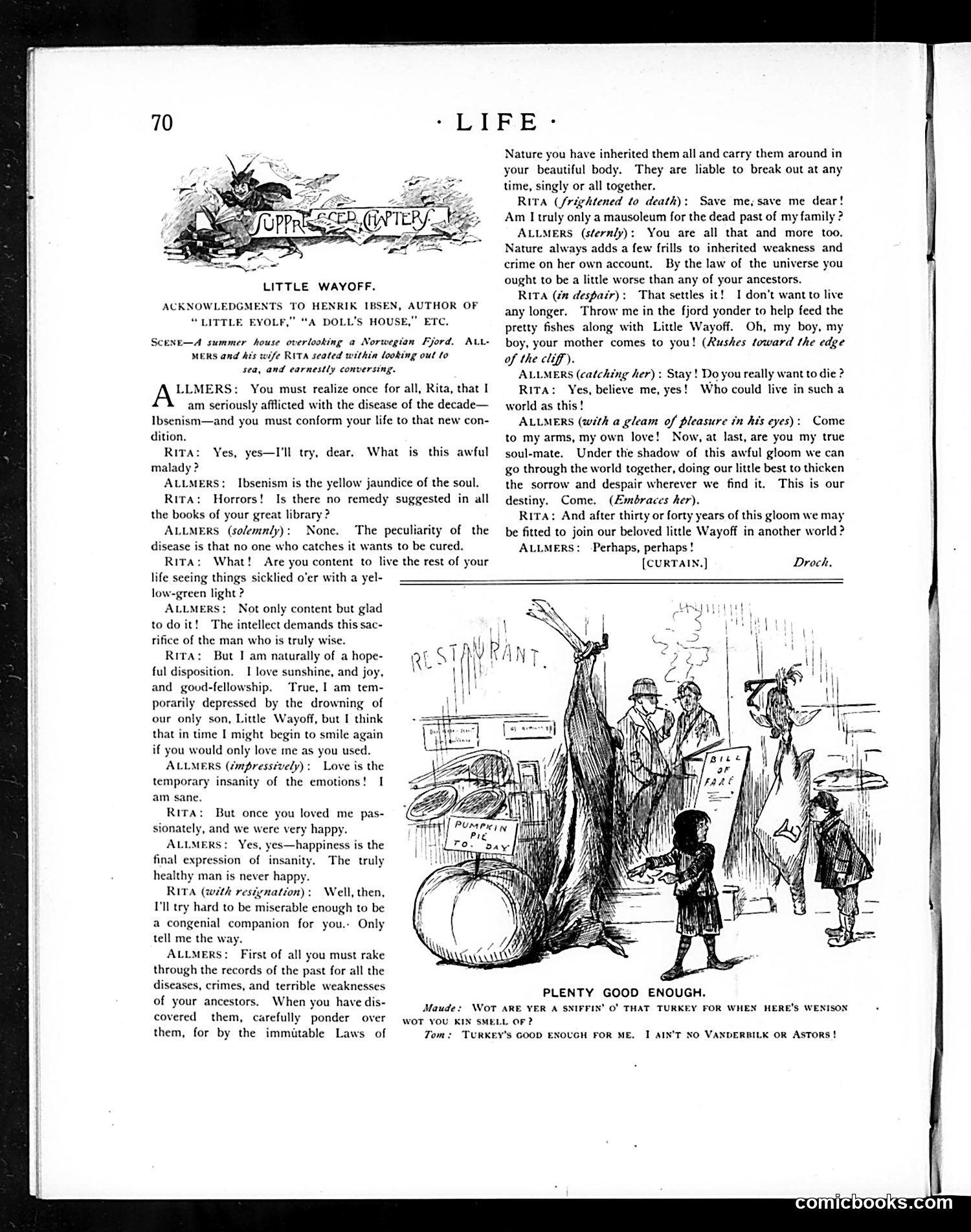
This page contains two elements: **Left side:** A theatrical scene from Henrik Ibsen's "Little Wayoff," showing a dialogue between characters Allmers and Rita debating life's meaning and inherited family curses. This appears to be literary commentary rather than political satire. **Right side cartoon:** Titled "Plenty Good Enough," depicts a street scene where a boy (Tom) stands near a restaurant trash bin and a well-dressed man (Mande). The caption jokes about turkey scraps being suitable food for working-class people, with Tom asserting he's "not so Vanderbilt or Astor"—a reference to wealthy industrialist families. The satire targets class inequality and attitudes toward poverty during the Gilded Age.
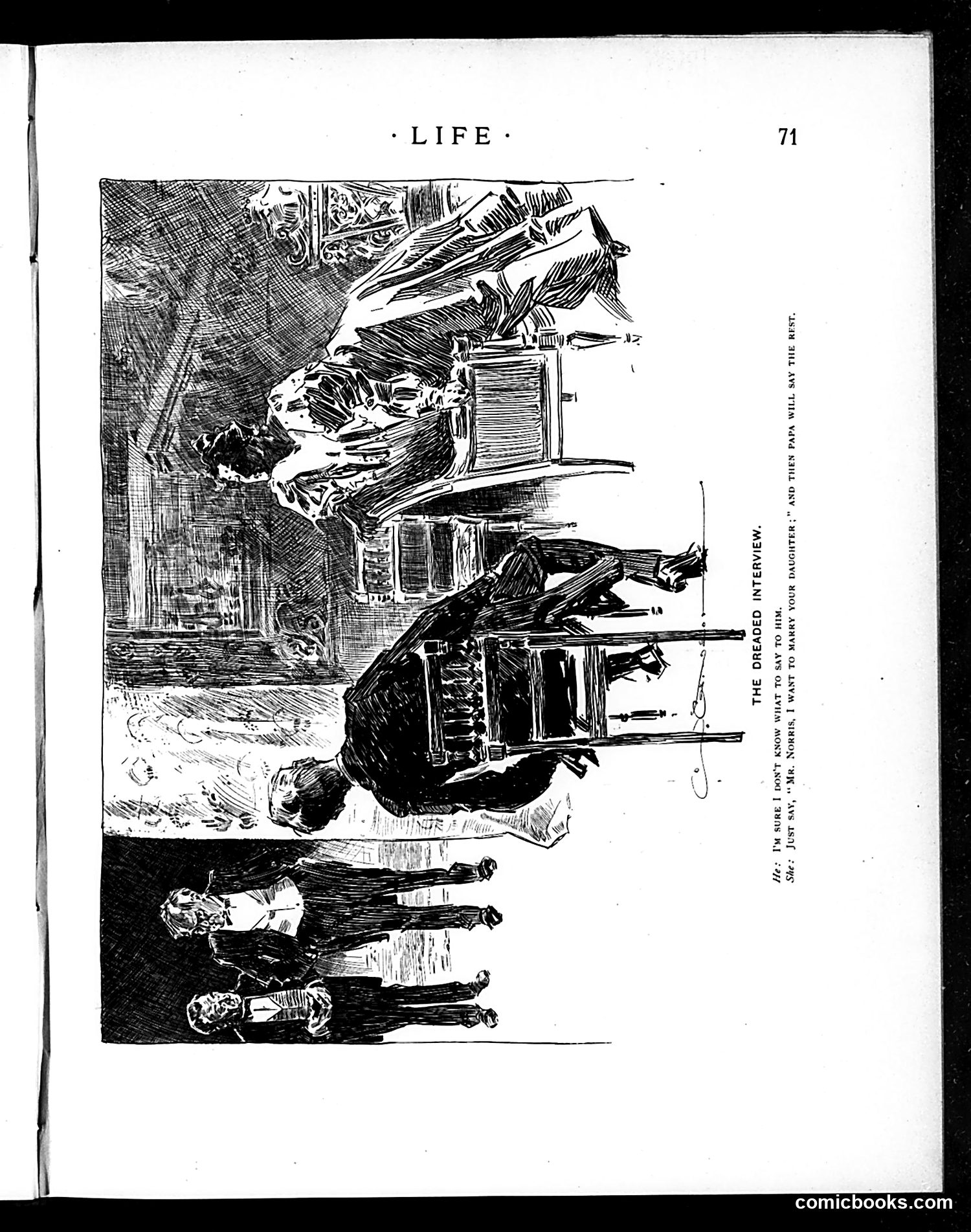
This page from *Life* magazine features "The Dreaded Interview," a satirical illustration about a formal social interaction. The image shows what appears to be a Victorian-era interior scene with multiple figures in period dress engaged in conversation or social interaction. The caption indicates this is satirizing formal Victorian social conventions, particularly the awkwardness of structured "interviews" or formal meetings in polite society. The detailed cross-hatching and dramatic positioning of the figures emphasizes the tension and discomfort of the situation. Without being able to identify specific individuals in the caricatures or having additional context about which social/political figures are being referenced, I cannot definitively explain the particular targets of this satire beyond noting that *Life* typically used such scenes to mock rigid social etiquette and the formality of upper-class interactions of the era.
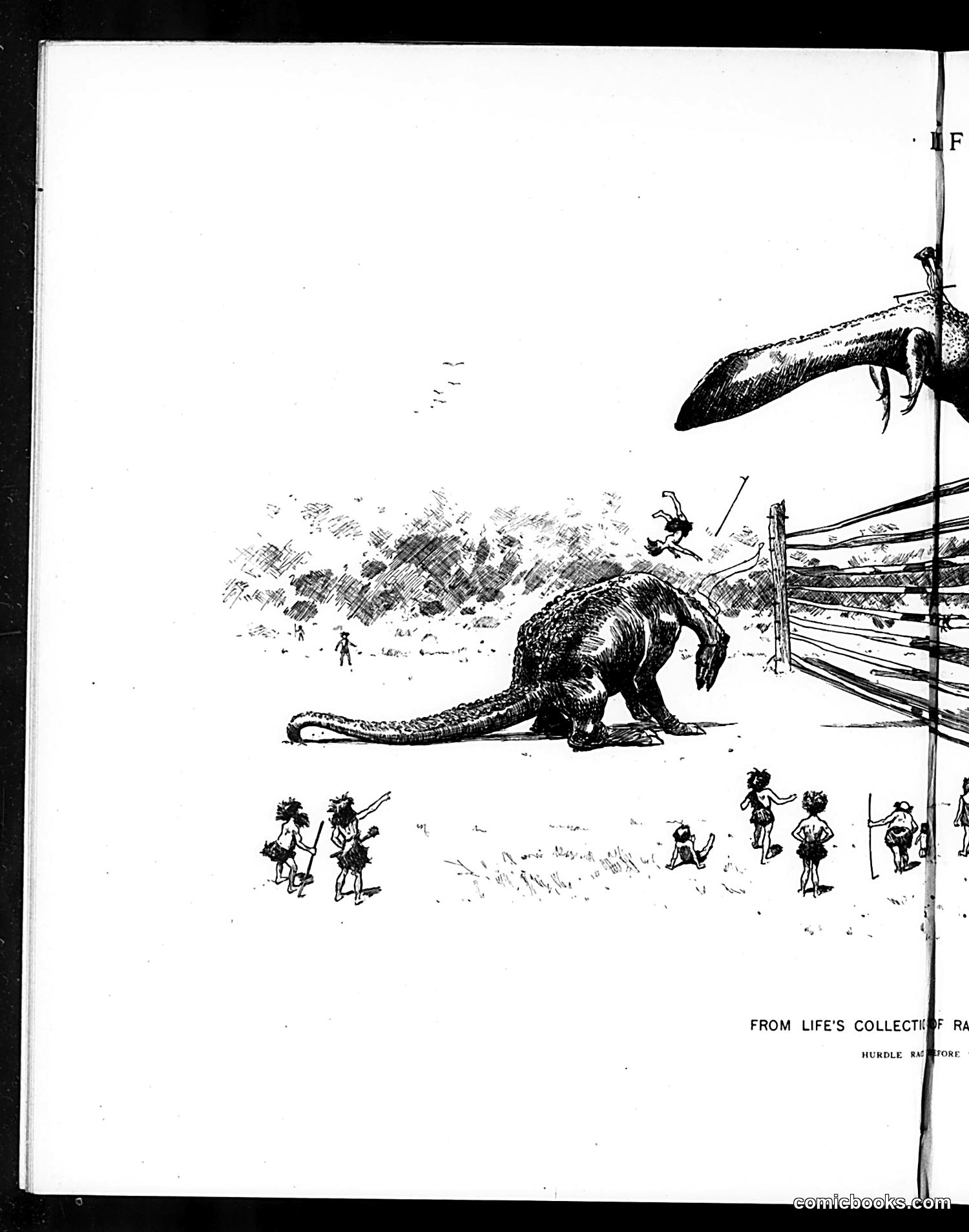
This is a satirical illustration titled "Hurdle Race" from *Life* magazine's collection. The cartoon depicts a large dinosaur (likely a brontosaurus or similar prehistoric creature) in an absurd "race" scenario, with the dinosaur attempting to jump over a standard wooden ranch fence—clearly an impossible task given the creature's massive size and body structure. Small human figures stand around observing the spectacle. The satire appears to mock futile or absurd endeavors—the joke being that entry into a "race" with such an obviously unsuitable participant is ridiculous. This could be commentary on flawed competition, mismatched abilities, or attempting the impossible. The humorous juxtaposition of the enormous prehistoric beast against everyday ranch infrastructure creates the comedic effect. The specific contemporary reference remains unclear from the image alone.
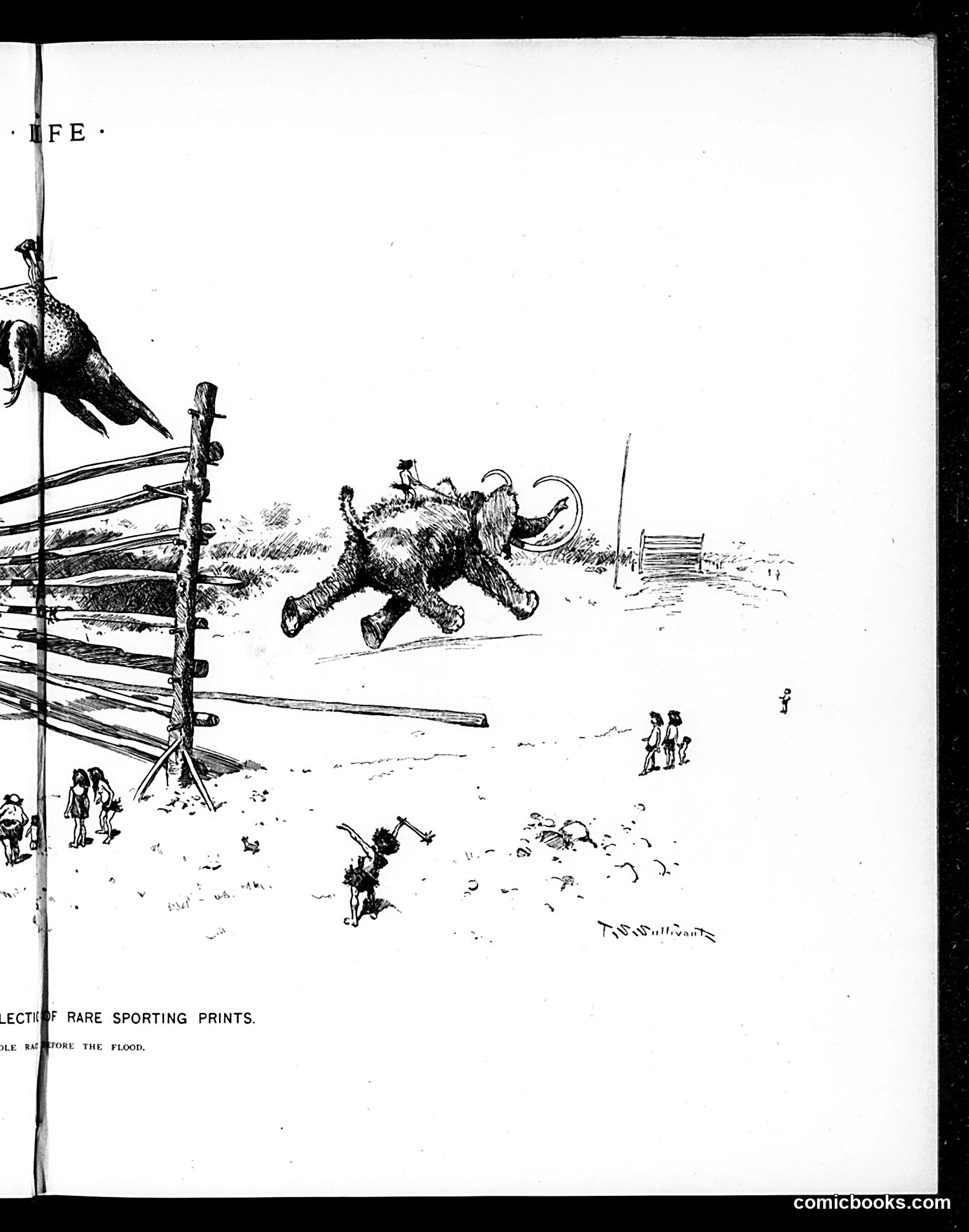
This appears to be a sporting print from Life magazine showing a comedic hunting or farm scene. The page header reads "COLLECTION OF RARE SPORTING PRINTS" with a subtitle "POLE BEFORE THE FLOOD." The illustration depicts what appears to be a mammoth or prehistoric elephant with large curved tusks running through a rural landscape. Small human figures and dogs are scattered across the scene, seemingly hunting or fleeing from the creature. A wooden fence and gate are visible on the left. The satire likely plays on the anachronism of modern sporting activities (hunting, farming) contrasted with a prehistoric animal, creating absurdist humor. The "before the flood" reference suggests a Noah's Ark or pre-deluge timeline joke. Without additional context about the specific issue date, the exact satirical target remains unclear, though it appears to be humorous sporting commentary typical of Life magazine's style.
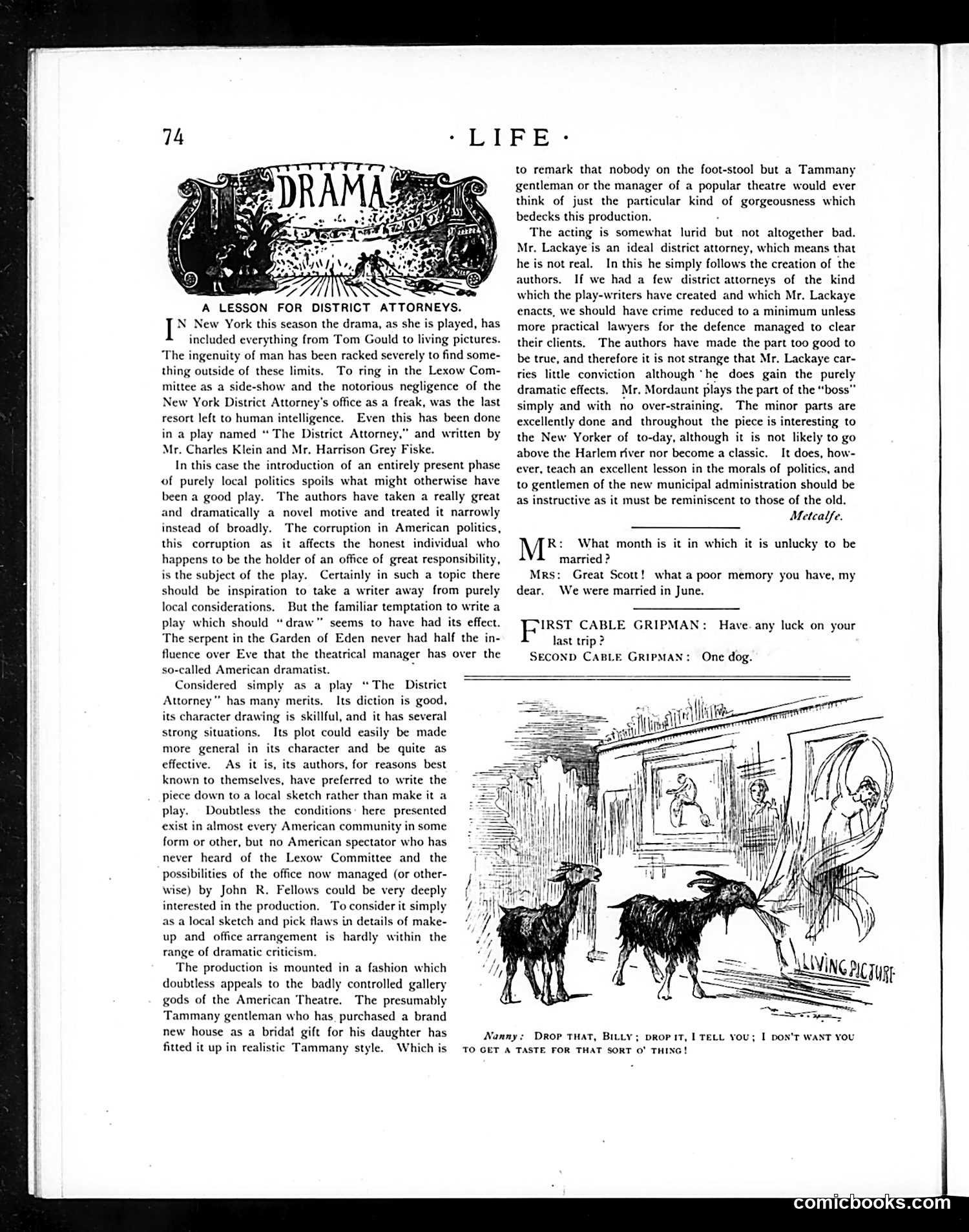
This page reviews "The District Attorney," a theatrical play by Charles Klein and Harrison Grey Fiske. The review praises the work as a novel treatment of political corruption affecting honest office-holders—a timely progressive-era theme. The cartoon at bottom depicts a domestic scene with dogs and a "living picture" (theatrical tableau) in the background. The caption reveals a joke about tastes: one dog warns another not to eat something, saying "I don't want you to get a taste for that sort of thing!" The sidebar humor includes brief exchanges about unlucky marriage months and cable gripmans' work experiences. These are disconnected jokes rather than unified satire. The page primarily serves as entertainment and cultural commentary for early 20th-century American readers.
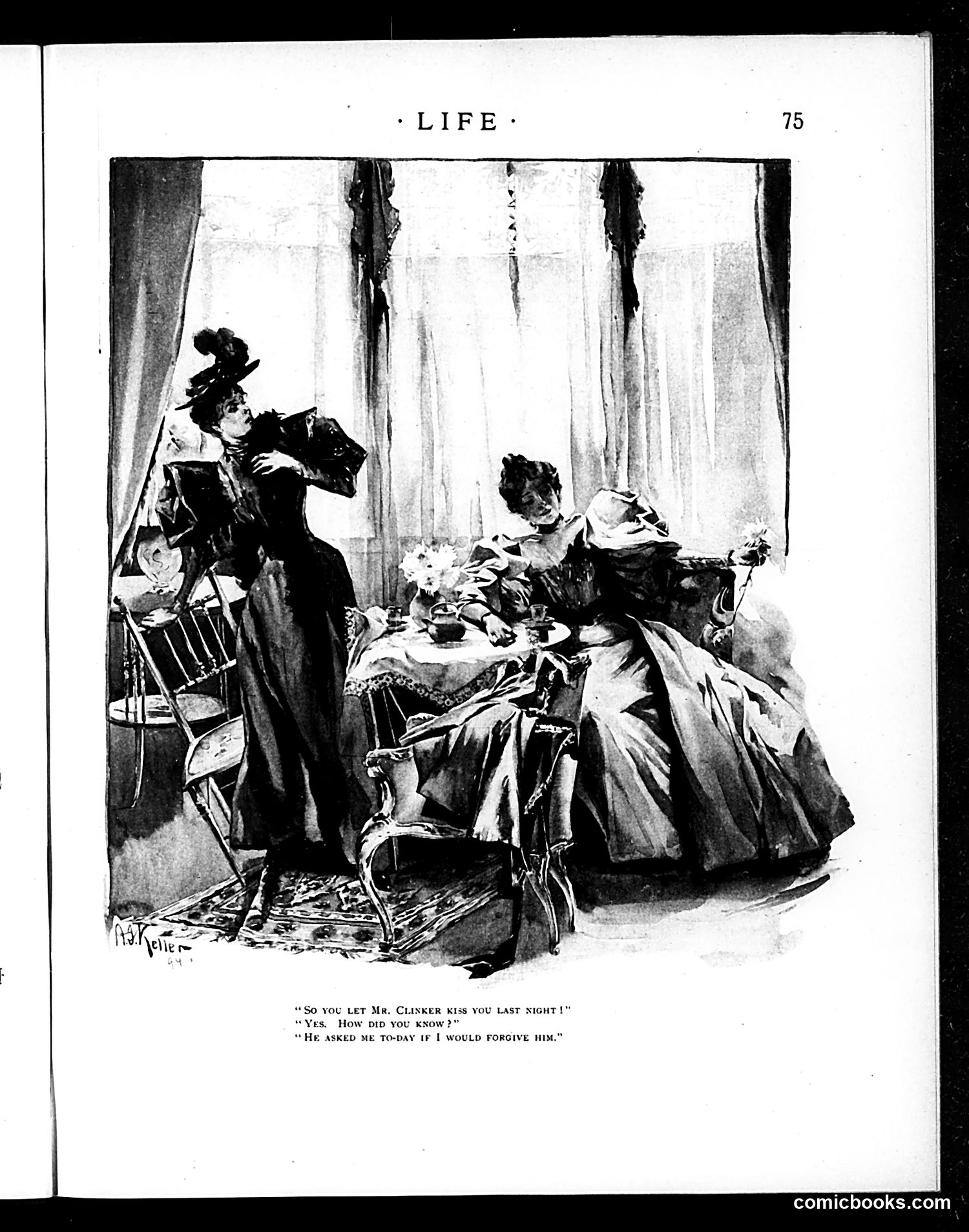
This is a domestic comedy illustration depicting a scene between what appears to be an upper-class couple in an elegant interior. The dialogue reads: "So you let Mr. Clikker kiss you last night!" "Yes. How did you know?" "He asked me to-day if I would forgive him." The humor relies on a social double standard: the wife admits to allowing another man's kiss, but the real transgression—in the husband's eyes—is that Mr. Clikker had the audacity to ask *him* for forgiveness rather than the wife. The joke satirizes masculine pride and the notion that a husband's honor is injured through his wife's behavior, reflecting early 20th-century attitudes about gender relations and propriety among the wealthy.
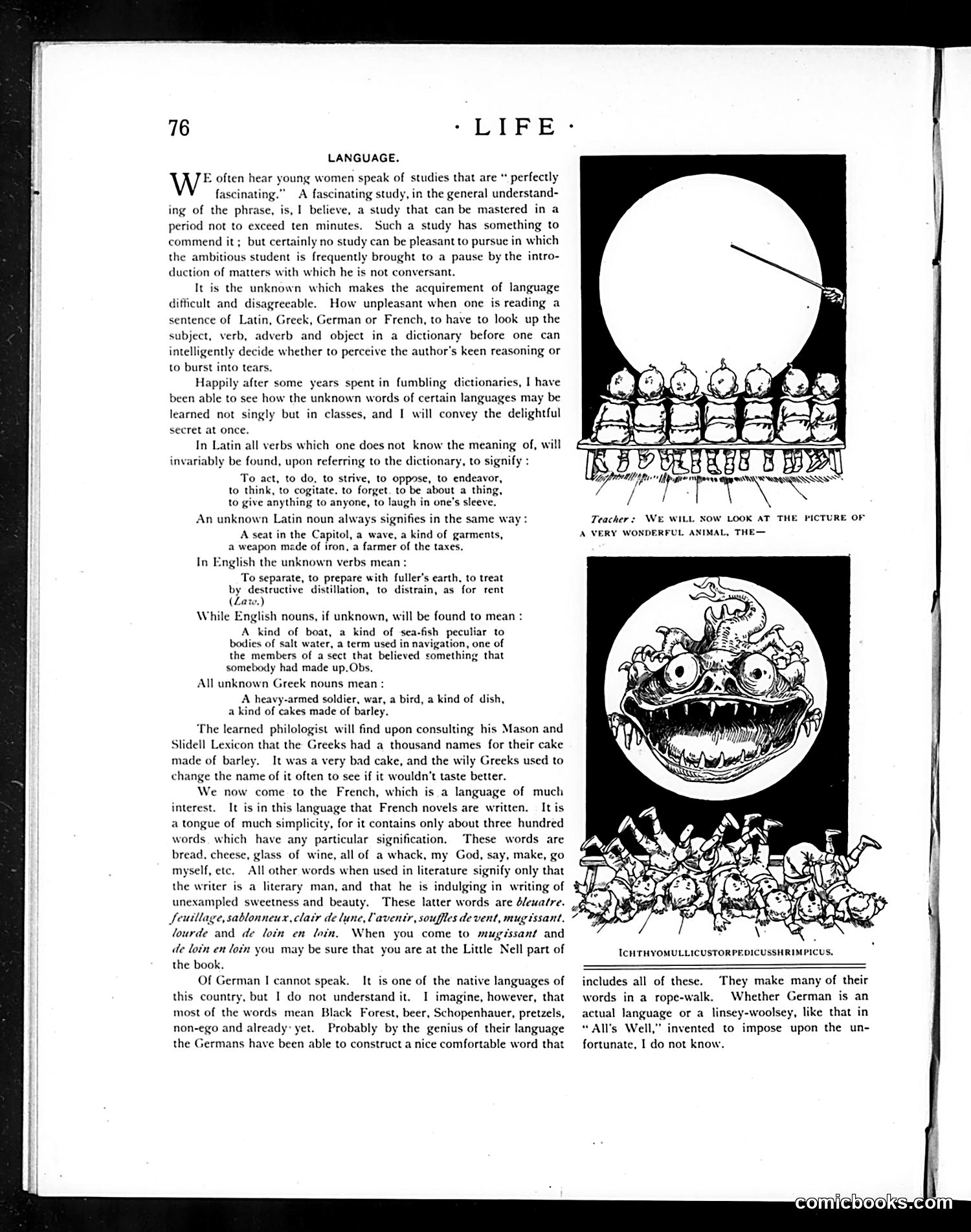
This is a humorous essay on foreign language study, illustrated with two comic drawings. The **top illustration** shows a classroom scene where a teacher points to an image of an unseen animal, beginning "We will now look at the picture of a very wonderful animal, the—" The creature's name is given as "Ichthyomullicustorpedicusshrimpicus," an absurdly long, invented compound word mocking how difficult and convoluted foreign language vocabulary can become. The **bottom illustration** depicts a grotesque, monster-like creature with large teeth and wild features, surrounded by smaller figures—likely representing the confusion and frustration of language learners confronting incomprehensible foreign words. The essay's satire targets the difficulty of studying foreign languages by suggesting that unknown words in Latin, Greek, English, French, and German invariably translate to predictable, often ridiculous meanings. It mocks both overly complex vocabulary and the pretentious literary affectation of French writers using obscure words like "mugissant" and "sablonneux" purely for effect. The overall joke: language learning is absurdly tedious, and foreign words often seem deliberately designed to confuse students.
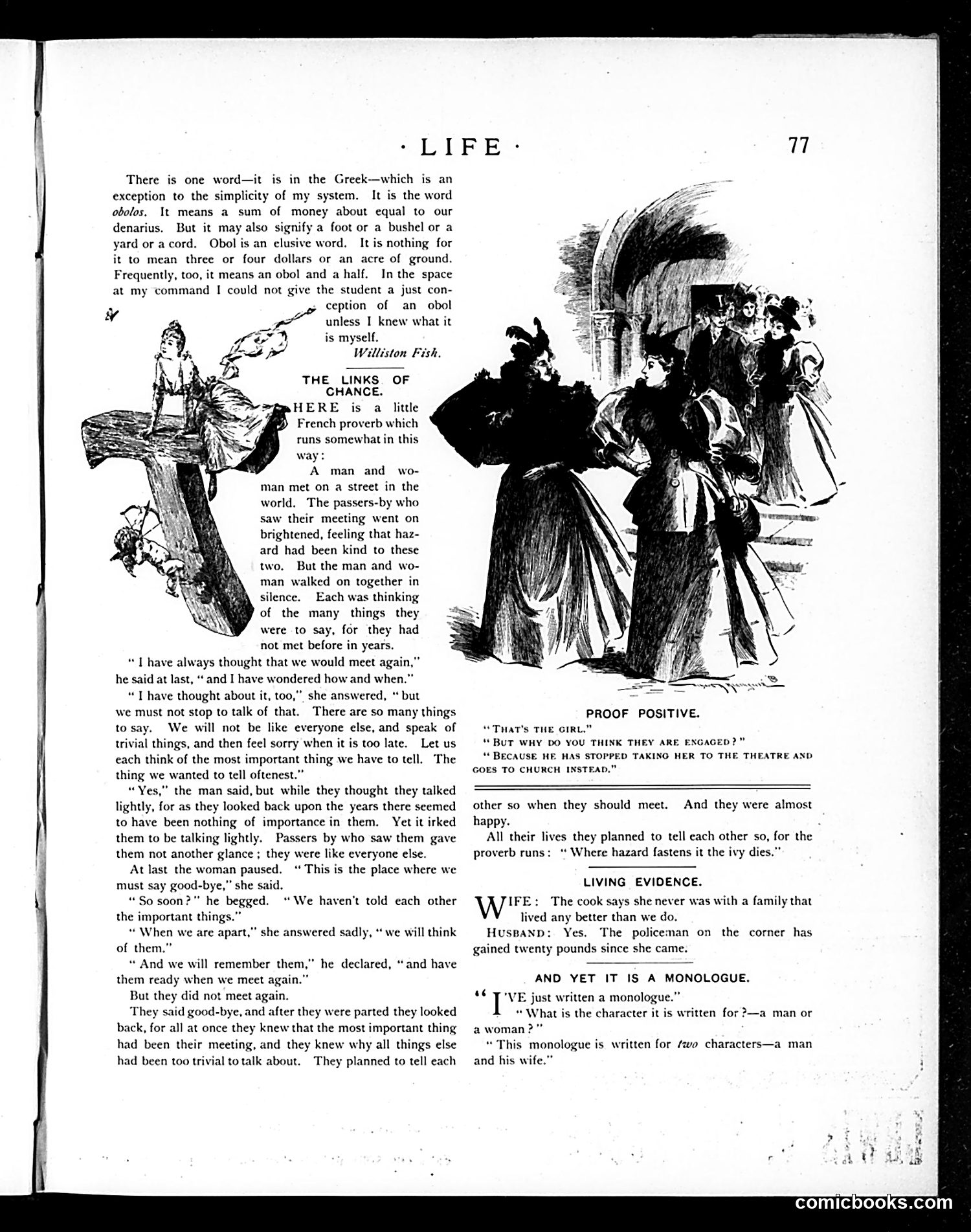
This page contains three separate satirical pieces typical of Life magazine's humor: **"The Links of Chance"** (main story with illustration): A sentimental narrative about a man and woman who reunite after years but fail to communicate meaningfully. The satire targets human nature—they plan to discuss "important things" but realize too late that the meeting itself was what mattered. It's a gentle critique of missed connections and overthinking. **"Proof Positive"** (small cartoon): A joke about engagement indicators. The humor relies on inverting expectations: the couple appears engaged because he's *stopped* taking her to theater and now goes to church—suggesting courtship has ended and marriage-like routine has begun. **"Living Evidence"** and **"And Yet It Is A Monologue"** (brief humor items): Quick jokes about a cook's effect on a policeman's weight, and wordplay about a "monologue" written for two characters—poking fun at pretentious or contradictory writing. The page reflects early 20th-century Life magazine's blend of literary satire and domestic humor targeting middle-class social conventions.
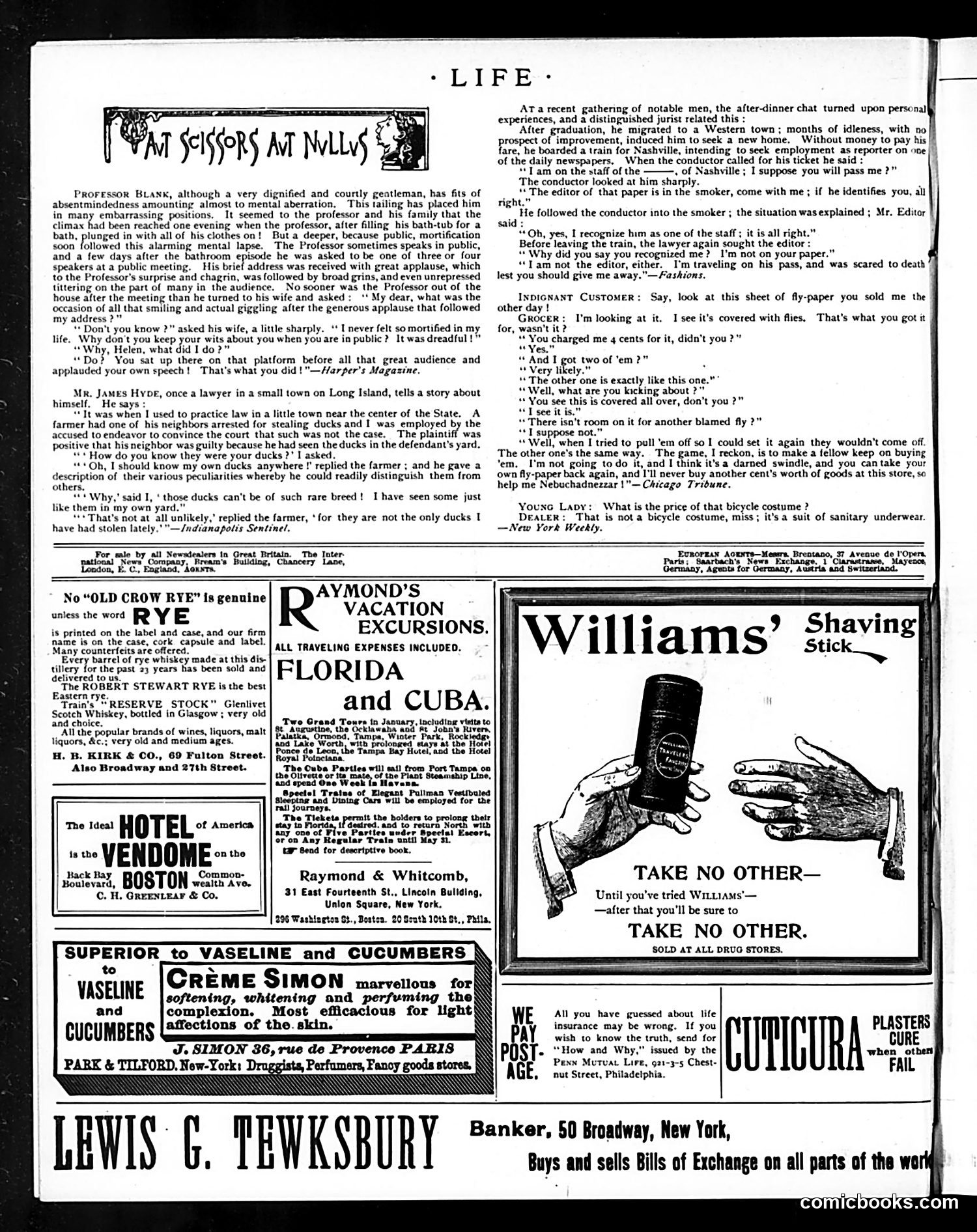
This page contains three separate humorous anecdotes rather than a political cartoon: 1. **Professor Blank's Absent-Mindedness**: A dignity-conscious academic absentmindedly takes a bath fully clothed, then mortifies himself publicly by applauding his own speech at a meeting—the audience's laughter stems from this ridiculous self-congratulation. 2. **The Stolen Ducks Story**: A lawyer cross-examines a farmer claiming theft. The farmer describes his ducks' peculiarities so specifically that the lawyer sardonically notes such rare ducks must be common—he's seen similar ones in his own yard. The implication: the farmer had stolen *other people's* ducks previously. 3. **The Train Pass Fraud**: A jobless graduate boards a train claiming to be a newspaper staff member. The conductor verifies this with a stranger in the smoker who, fearing exposure of his own fraudulent travel pass, corroborates the lie. Both are con artists. These are light satirical sketches mocking human folly—absent-mindedness, farm theft, and railway fraud—typical of *Life* magazine's genteel humor for educated readers.
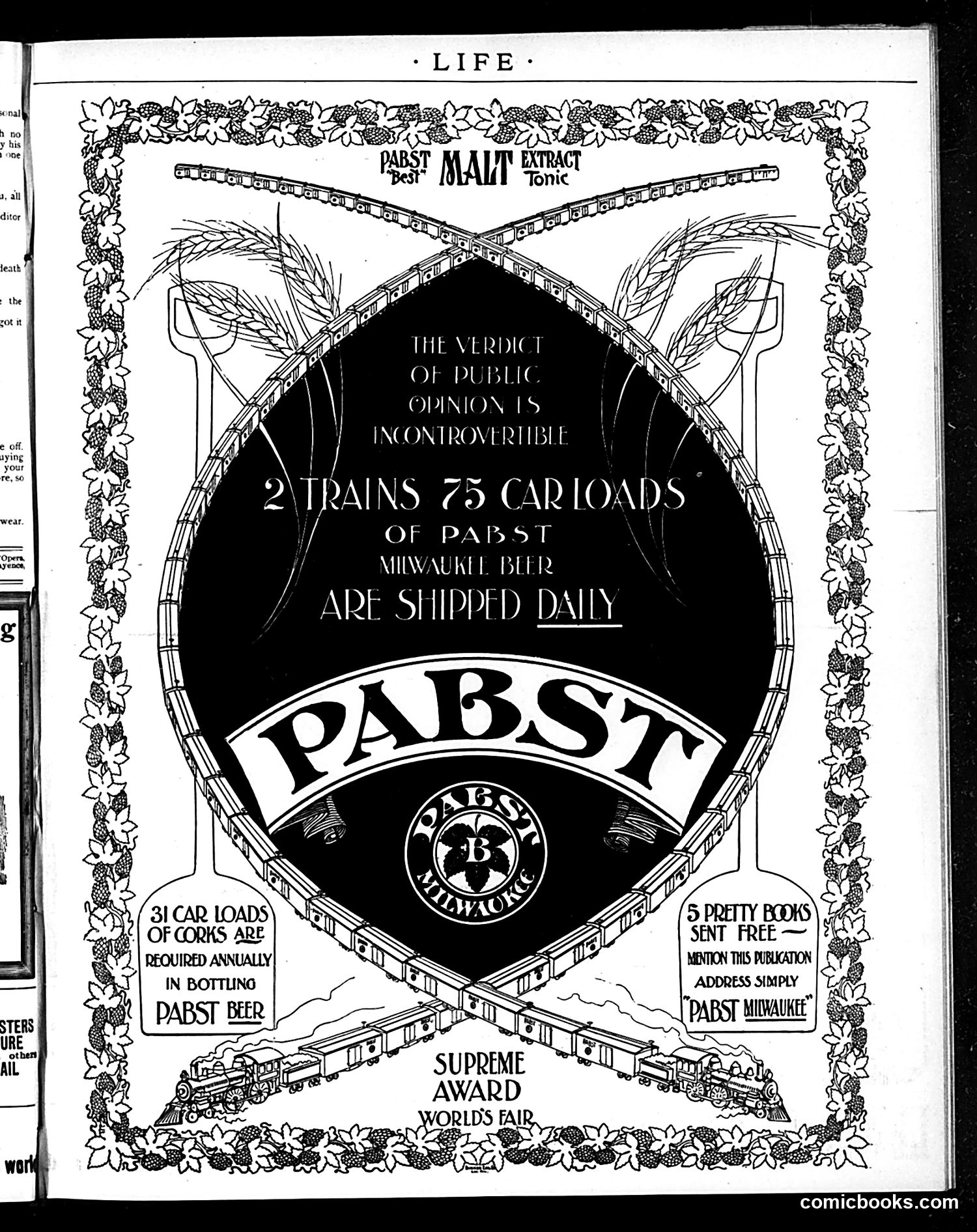
This is primarily a **Pabst beer advertisement**, not political satire. The page uses a decorative beer-label design featuring a large shield with wheat stalks and railroad imagery. The ad makes a commercial claim: "The verdict of public opinion is incontrovertible—2 trains, 75 car loads of Pabst Milwaukee Beer are shipped daily." This asserts that massive daily shipments prove the beer's popularity and quality through volume alone. Additional sales points include references to cork requirements for bottling and a promotional offer of "5 pretty books sent free" to readers who mention the publication. The "Supreme Award World's Fair" notation suggests this advertisement ran after Pabst won recognition at a world's fair, using that credential to boost credibility. It's straightforward product marketing rather than satirical commentary.
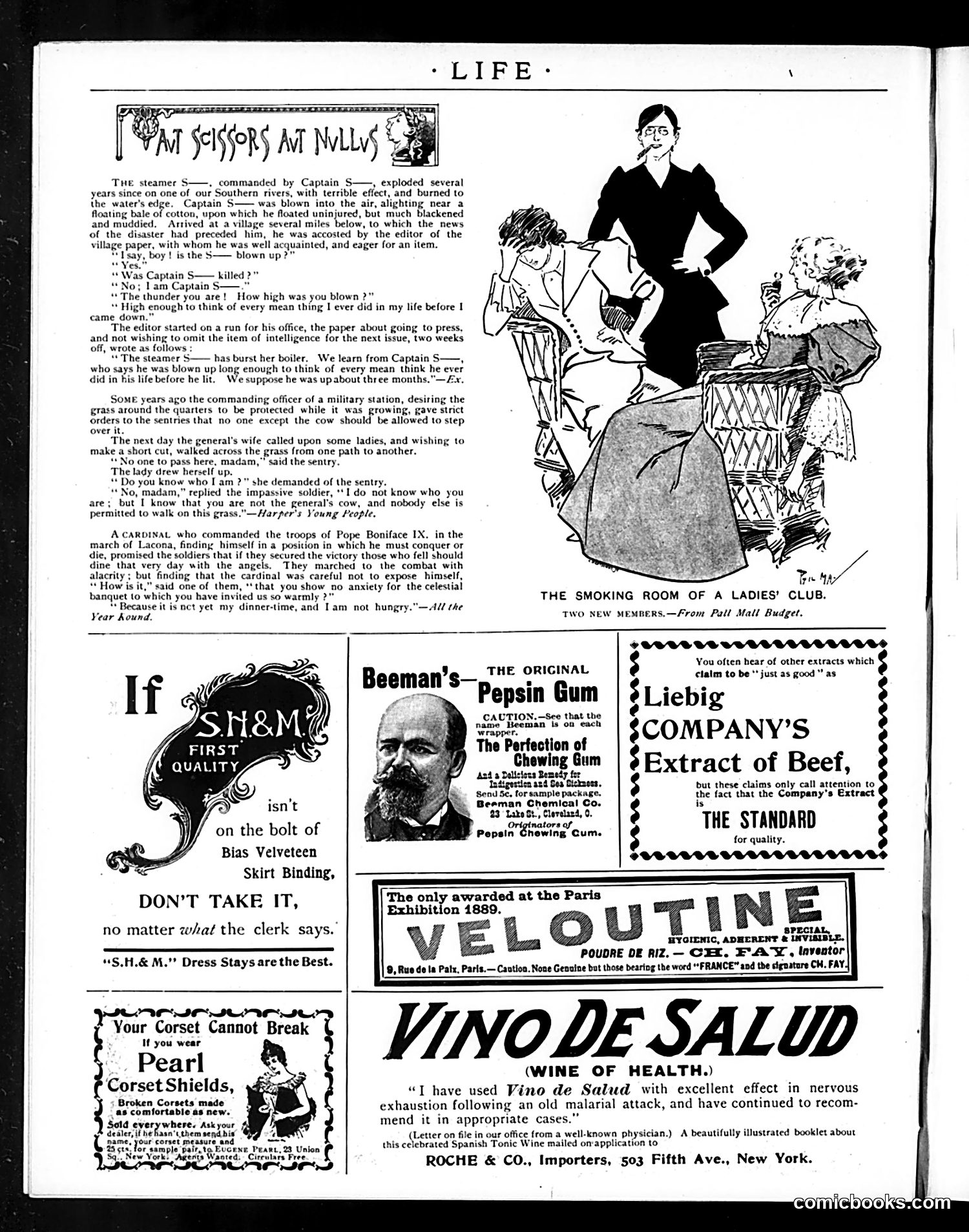
This page contains several humorous anecdotes typical of late-19th-century American satirical journalism: **Main cartoons/stories:** 1. **"Am Scissors at Nullus"** - A series of short jokes poking fun at American life, including a steamboat explosion story where a captain is blown so high he has time to reflect on his sins, and a military sentry who refuses passage to the general's wife, recognizing only the general's cow as exempt. 2. **Illustration** - "The Smoking Room of a Ladies' Club" shows two new female club members, satirizing the then-novel phenomenon of women's social organizations. The humor relies on wordplay, ironic reversals of social hierarchy (a sentry defying a general's wife; soldiers promised heavenly rewards by a cowardly cardinal), and gentle mocking of contemporary American society. **Advertisements** dominate the lower half—for corsets, chewing gum, beef extract, and "Vino de Salud" (patent medicine)—typical of period magazines mixing editorial content with commercial pitches.