
Life, 1895-01-31 · page 12 of 16
Life — January 31, 1895 — page 12: what you’re looking at
What you’re looking at
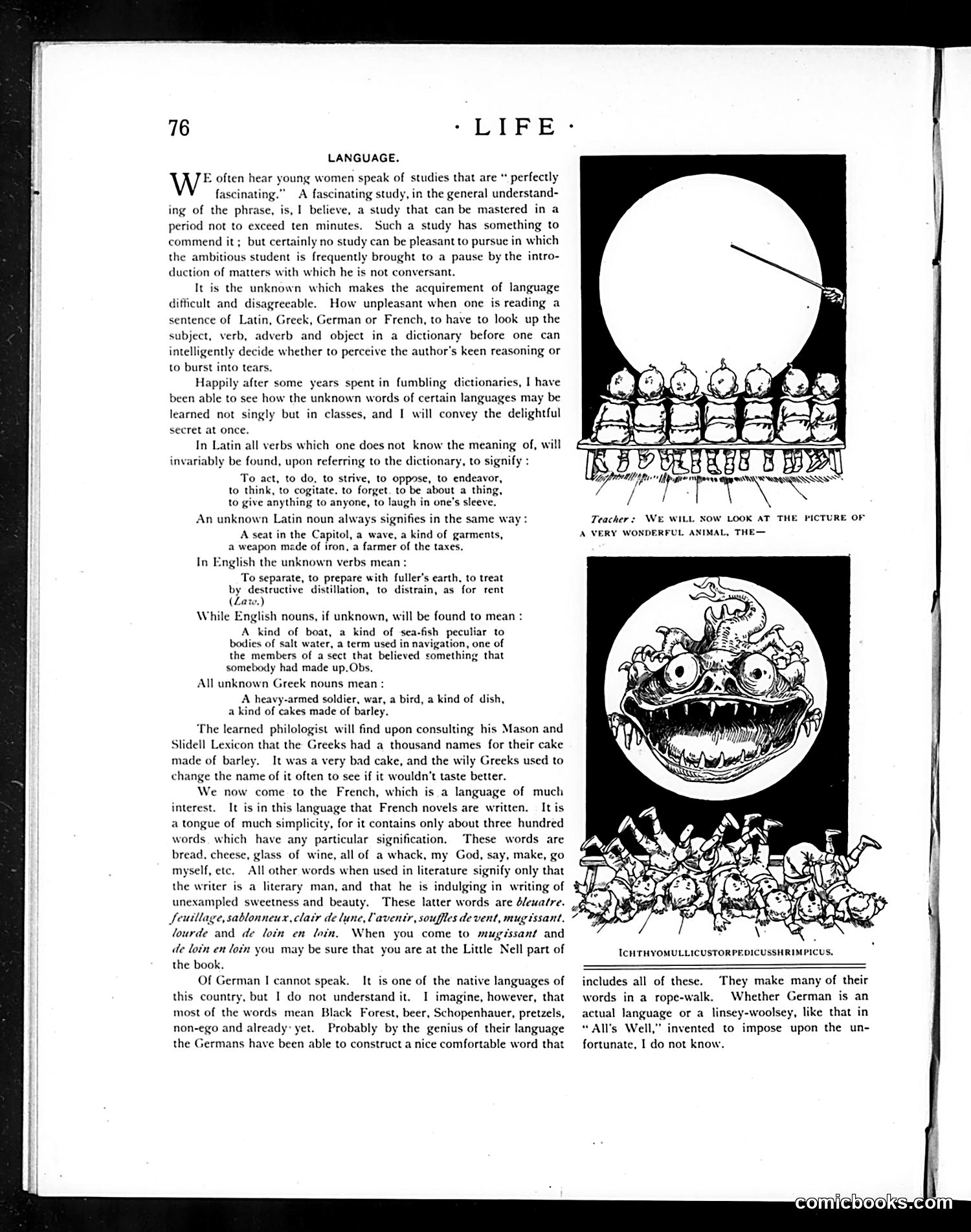
This is a humorous essay on foreign language study, illustrated with two comic drawings. The **top illustration** shows a classroom scene where a teacher points to an image of an unseen animal, beginning "We will now look at the picture of a very wonderful animal, the—" The creature's name is given as "Ichthyomullicustorpedicusshrimpicus," an absurdly long, invented compound word mocking how difficult and convoluted foreign language vocabulary can become. The **bottom illustration** depicts a grotesque, monster-like creature with large teeth and wild features, surrounded by smaller figures—likely representing the confusion and frustration of language learners confronting incomprehensible foreign words. The essay's satire targets the difficulty of studying foreign languages by suggesting that unknown words in Latin, Greek, English, French, and German invariably translate to predictable, often ridiculous meanings. It mocks both overly complex vocabulary and the pretentious literary affectation of French writers using obscure words like "mugissant" and "sablonneux" purely for effect. The overall joke: language learning is absurdly tedious, and foreign words often seem deliberately designed to confuse students.
📄 Transcribed text from this page (OCR, searchable)
Machine-transcribed from the original scan — historical spelling and the odd misread are preserved.
76 - LIFE: LANGUAGE. W often hear young women speak of studies that are “ perfectly fascinating. ‘ascinating study, in the general understand- ing of the phrase, is, 1 believe, a study that can be mastered in a period not to exceed ten minutes. Such a study has something to commend it; but certainly no study can be pleasant to pursue in which the ambitious student is frequently brought to a pause by the intro- duction of matters with which he is not conversant. It is the unknown which makes the acquirement of language difficult and disagreeable. How unpleasant when one is reading a sentence of Latin, Greek, German or French, to have to look up the subject, verb, adverb and object in a dictionary before one can intelligently decide whether to perceive the author's keen reasoning or to burst into tears, Happily after some years spent in fumbling dictionaries, I have been able to see how the unknown words of certain languages may be learned not singly but in classes, and I will convey the delightful secret at once. In Latin all verbs which one does not know the meaning of, will invariably be found, upon referring to the dictionary, to signify : To act, to do, to strive, to oppose, to endeavor, to think, to cogitate. to forget. to be about a thing, to give anything to anyone, to laugh in one’s sleeve. An unknown Latin noun always signifies in the same way : A seat in the Capitol, a wave, a kind of garments, a weapon made of iron, a farmer of the taxes. In English the unknown verbs mean: To separate, to prepare with fuller’s earth, to treat by destructive distillation, to distrain, as for rent (Law.) While English nouns, if unknown, will be found to mean : A kind of boat, a kind of sea-fish peculiar to bodies of salt water, a term used in navigation, one of the members of a sect that believed something that somebody had made up.Obs. All unknown Greek nouns mean : A heavy-armed soldier, war, a bird, a kind of dish, a kind of cakes made of barley. The learned philologist will find upon consulting his Mason and Slidell Lexicon that the Greeks had a thousand names for their cake made of barley, It was a very bad cake, and the wily Greeks used to change the name of it often to see if it wouldn’t taste better. We now come to the French, which is a language of much interest. It is in this language that French novels are written. Itis a tongue of much simplicity, for it contains only about three hundred words which have any particular signification, These words are bread, cheese, glass of wine, all of a whack, my God, say, make, go myself, etc. All other words when used in literature signify only that the writer is a literary man, and that he is indulging in writing of unexampled sweetness and beauty. These latter words are d/euatre. Seuillage, sablonneux, clair de lune, Cavenir, souffies de vent, mugissant. lourde and de loin en loin. When you come to mugissant and de loin en loin you may be sure that you are at the Little Nell part of the book. Of German I cannot speak. It is one of the native languages of this country, but I do not understand it. I imagine, however, that most of the words mean Black Forest, beer, Schopenhauer, pretzels, non-ego and already: yet. Probably by the genius of their language the Germans have been able to construct a nice comfortable word that i Teacher: \WE WILL NOW LOOK AT THE PICTURE OF A VERY WONDERFUL ANIMAL, THE— ICHTHYOMULLICUSTORPEDICUSSHRIMPIC includes all of the: They make many of their words in a rope-walk. Whether German is an actual language or a linsey-woolsey, like that in “All's Well,” invented to impose upon the un- fortunate, I do not know.