
Life, 1895-01-31 · page 4 of 16
Life — January 31, 1895 — page 4: what you’re looking at
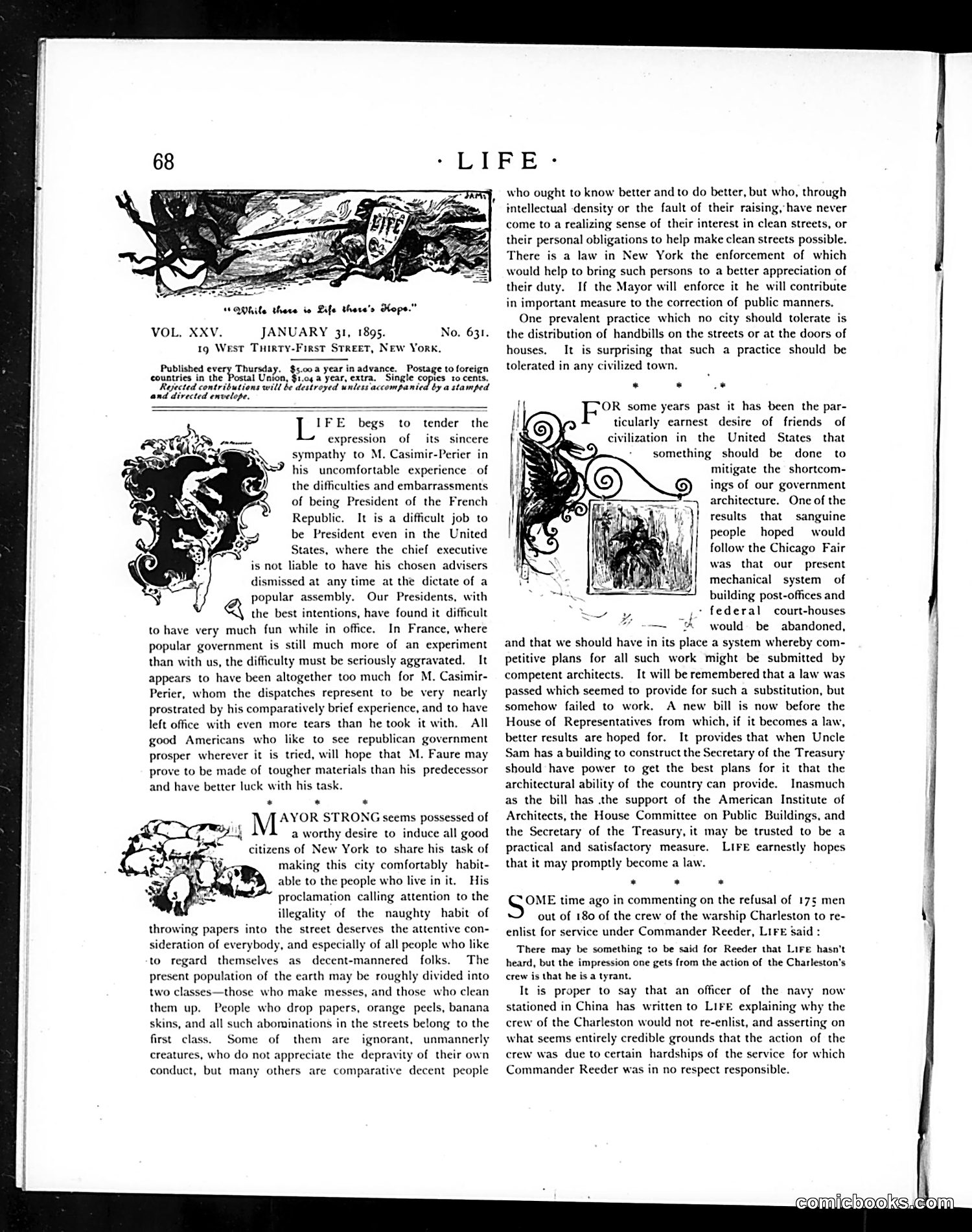
What you’re looking at
This page contains editorial commentary rather than political cartoons. The decorative mastheads and initial letters feature ornamental designs typical of the era, but the substantive content addresses three distinct issues: **Street Cleanliness**: The magazine criticizes New Yorkers who litter, arguing that enforcement of existing laws would improve public sanitation. **M. Casimir-Perier (French President)**: The text expresses sympathy for the difficulties facing France's new president, contrasting his challenges with those of American presidents. **U.S. Government Architecture**: The editors discuss a bill enabling competitive architectural plans for federal buildings, hoping this will improve design quality over the previous system. **Navy Recruitment (Charleston)**: The final section addresses claims about crew refusals to re-enlist, defending Commander Reeder against accusations of misconduct.
📄 Transcribed text from this page (OCR, searchable)
Machine-transcribed from the original scan — historical spelling and the odd misread are preserved.
* LIFE: “OQVhile there io Life there’s Hope.” JANUARY 31, 1895. Pinst STREET, New York. VOL, XXV. 1g West Tiurty. No, 631. Published every Thursday. $5.00 a year in advance. Postage to foreign countries in the Postal Union, $1.04 a year, extra. Single copies to cents, Rejected contributions will be destroyed unless accompanied by a stamped and directed envelope. IFE begs to the expression of ncere sympathy to M. Casimir-Perier in his uncomfortable experience of the difficulties and embarrassments of being President of the French Republic. It is a difficult job to tender be President even in the United States, where the chief executive is not liable to have his chosen advisers dismissed at any time at the dictate of a popular assembly. Our Presidents, with the best intentions have found it difficult to have very much fun while in office. In France, where popular government is still much more of an experiment than with us, the difficulty must be seriously aggravated, It appears to have been altogether too much for M. Casimir- Perier, whom the dispatches represent to be very nearly prostrated by his comparatively brief experience, and to ha left office with even more tears than he took it with, All good Americans who like to see republican government prosper wherever it is tried, will hope that M. Faure may prove to be made of tougher materials than his predecessor and have better luck with his task. * . AYOR STRONG seems possessed of a worthy desire to induce all good citizens of New York to share his task of making this city comfortably habit- able to the people who live in it. His proclamation calling attention to the illegality of the naughty habit of throwing papers into the street deserves the attentive con- sideration of everybody, and especially of all people who like to regard themselves as decent-mannered folks. The present population of the earth may be roughly divided into two classes—those who make messes, and those who clean them up. People who drop papers, orange peels, banana skins, and all such abominations in the streets belong to the first class. Some of them ignorant, unmannerly creatures, who do not appreciate the depravity of their own conduct, but many others are comparative decent people are who ought to know better and to do better, but who, through intellectual density or the fault of their raising, have never come to a realizing sense of their interest in clean streets, or their personal obligations to help make clean strects possible. There is a law in New York the enforcement of which would help to bring such persons to a better appreciation of their duty. If the Mayor will enforce it he will contribute in important measure to the correction of public manners. One prevalent practice which no city should tolerate is the distribution of handbills on the streets or at the doors of houses. It is surprising that such a practice should be tolerated in any civilized town. * * * OR some years past it has been the par- ticularly earnest desire of friends of ivilization in the United States that something should be done to mitigate the shortcom- ings of our government architecture, One of the results that sanguine people hoped would follow the Chicago Fair was that our present mechanical system of building post-offices and - federal court-houses would be abandoned, and that we should have in its place a system whereby com- petitive plans for all such work might be submitted by competent architects. It will be remembered that a law was passed which seemed to provide for such a substitution, but somehow failed to work, A new bill is now before the House of Representatives from which, if it becomes a law, better results are hoped for. It provides that when Uncle Sam has a building to construct the Secretary of the Treasury should have power to get the best plans for it that the architectural ability of the country can provide. Inasmuch as the bill has the support of the American Institute of Architects, the House Committee on Public Buildings, and the Secretary of the Treasury, it may be trusted to be a practical and satisfactory measure. LIFE earnestly hopes that it may promptly become a law. * * * ~ OME time ago in commenting on the refusal of 175 men out of 180 of the crew of the warship Charleston to re- enlist for service under Commander Reeder, LiFe Said : There may be something to be said for Reeder that LiFe hasn't heard, but the impression one gets from the action of the Charleston's crew is that he is a tyrant. It is proper to say that an officer of the navy now stationed in China has written to LiFe explaining why the crew of the Charleston would not re-enlist, and asserting on what seems entirely credible grounds that the action of the crew was due to certain hardships of the service for which Commander Reeder was in no respect responsible.