
Life, 1895-01-31 · page 10 of 16
Life — January 31, 1895 — page 10: what you’re looking at
What you’re looking at
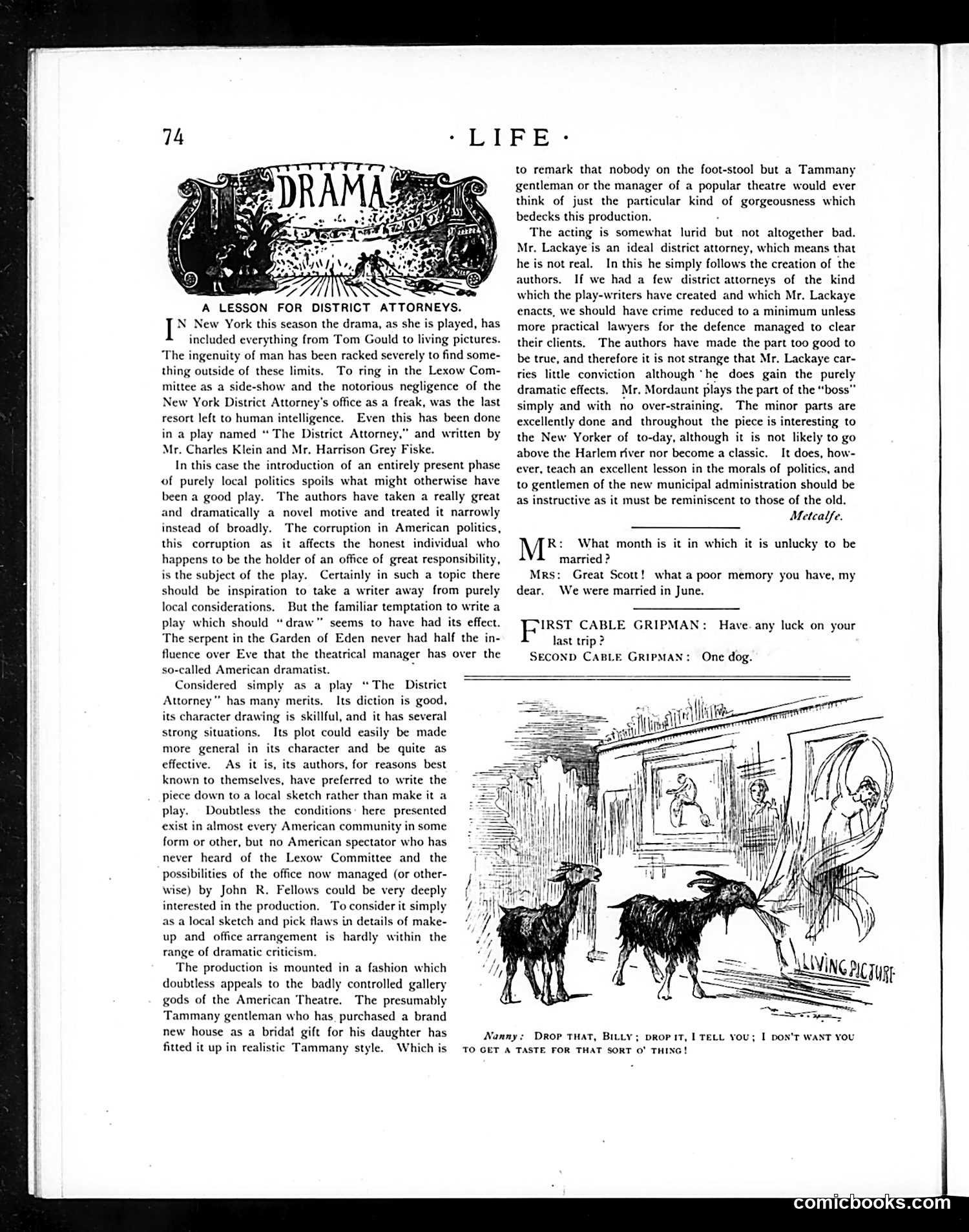
This page reviews "The District Attorney," a theatrical play by Charles Klein and Harrison Grey Fiske. The review praises the work as a novel treatment of political corruption affecting honest office-holders—a timely progressive-era theme. The cartoon at bottom depicts a domestic scene with dogs and a "living picture" (theatrical tableau) in the background. The caption reveals a joke about tastes: one dog warns another not to eat something, saying "I don't want you to get a taste for that sort of thing!" The sidebar humor includes brief exchanges about unlucky marriage months and cable gripmans' work experiences. These are disconnected jokes rather than unified satire. The page primarily serves as entertainment and cultural commentary for early 20th-century American readers.
📄 Transcribed text from this page (OCR, searchable)
Machine-transcribed from the original scan — historical spelling and the odd misread are preserved.
*LIFE-: A LESSON FOR DISTRICT ATTORNEYS. [* New York this season the drama, as she is played, has included everything from Tom Gould to living pictures. The ingenuity of man has been racked severely to find some- thing outside of these limits. To ring in the Lexow Com- mittee as a side-show and the notorious negligence of the New York District Attorney's office as a freak, was the last resort left to human intelligence. Even this has been done in a play named “ The District Attorney,” and written by Mr. Charles Klein and Mr. Harrison Grey Fiske. In this case the introduction of an entirely present phase of purely local politics spoils what might otherwise have been a good play. The authors have taken a really great and dramatically a novel motive and treated it narrowly instead of broadly. The corruption in American politics, this corruption as it affects the honest individual who happens to be the holder of an office of great responsibility, is the subject of the play. Certainly in such a topic there should be inspiration to take a writer away from purely local considerations. But the familiar temptation to write a "seems to have had its effect. play which should “draw The serpent in the Garden of Eden never had half the in- fluence over Eve that the theatrical manager has over the so-called American drama’ . to remark that nobody on the foot-stool but a Tammany gentleman or the manager of a popular theatre would ever think of just the particular kind of gorgeousness which bedecks this production. : The acting is somewhat lurid but not altogether bad. Mr. Lackaye is an ideal district attorney, which means that he is not real. In this he simply follows the creation of the authors. If we had a few district attorneys of the kind which the play-writers have created and which Mr. Lackaye enacts, we should have crime reduced to a minimum unless more practical lawyers for the defence managed to clear their clients. The authors have made the part too good to be true, and therefore it is not strange that Mr. Lackaye car- ries little conviction although ‘he does gain the purely dramatic effects. Mr. Mordaunt plays the part of the “boss” simply and with no over-straining. The minor parts are excellently done and throughout the piece is interesting to the New Yorker of to-day, although it is not likely to go above the Harlem river nor become a classic. It does, how- ever, teach an excellent lesson in the morals of politics, and to gentlemen of the new municipal administration should be as instructive as it must be reminiscent to those of the old. Metcalfe. R: What month is it in which it is unlucky to be married ? Great Scott! what a poor memory you have, my We were married in June. MRs: dear. IRST CABLE GRIPMAN: last trip ? SECOND CABLE GRIPMAN: Have. any luck on your One dog. Considered simply as a play “The District Attorney" has many merits, Its diction is good, its character drawing is skillful, and it has several strong situations. Its plot could easily be made more general in its character and be quite as effective. As it its authors, for reasons best known to themselves, have preferred to write the piece down to a local sketch rather than make it a play. Doubtless the conditions: here presented exist in almost every American community in some form or other, but no American spectator who has never heard of the Lexow Committee and the possibilities of the office now managed (or other- wise) by John R. Fellows could be very deeply interested in the production. To consider it simply as a local sketch and pick flaws in details of make- up and office arrangement is hardly within the range of dramatic criticism. The production is mounted in a fashion which doubtless appeals to the badly controlled gallery gods of the American Theatre. The presumably Tammany gentleman who has. purchased a brand new house as a bridat gift for his daughter has fitted it up in realistic Tammany style. Which is Nanny: ‘TO GET A TASTE FOR THAT SORT 0' THING! Ligh a RAVING Dice Drop THAT, BiLLy ; pRoP it, | TELL you; I poON'T WANT You