
Life, 1895-01-31 · page 13 of 16
Life — January 31, 1895 — page 13: what you’re looking at
What you’re looking at
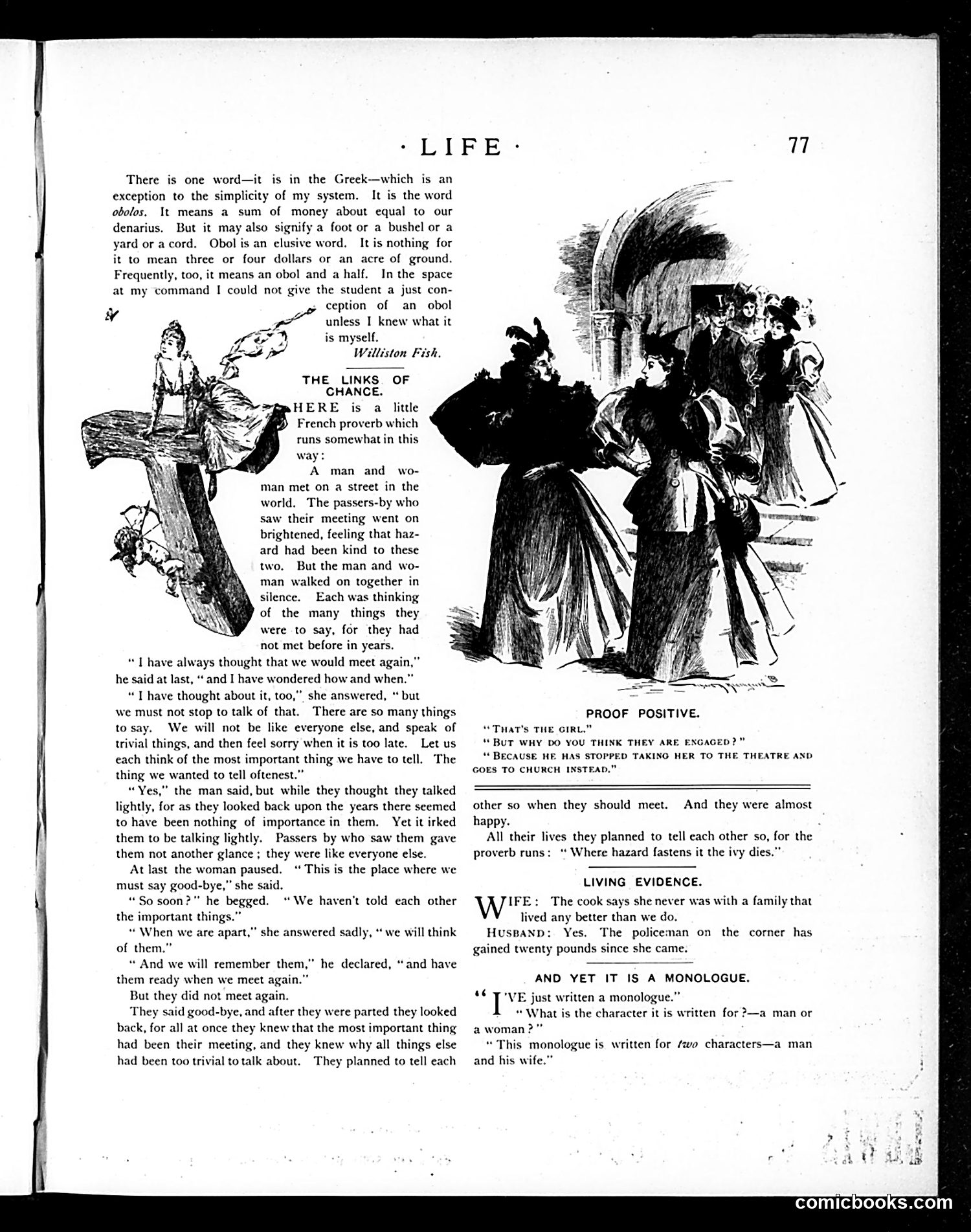
This page contains three separate satirical pieces typical of Life magazine's humor: **"The Links of Chance"** (main story with illustration): A sentimental narrative about a man and woman who reunite after years but fail to communicate meaningfully. The satire targets human nature—they plan to discuss "important things" but realize too late that the meeting itself was what mattered. It's a gentle critique of missed connections and overthinking. **"Proof Positive"** (small cartoon): A joke about engagement indicators. The humor relies on inverting expectations: the couple appears engaged because he's *stopped* taking her to theater and now goes to church—suggesting courtship has ended and marriage-like routine has begun. **"Living Evidence"** and **"And Yet It Is A Monologue"** (brief humor items): Quick jokes about a cook's effect on a policeman's weight, and wordplay about a "monologue" written for two characters—poking fun at pretentious or contradictory writing. The page reflects early 20th-century Life magazine's blend of literary satire and domestic humor targeting middle-class social conventions.
📄 Transcribed text from this page (OCR, searchable)
Machine-transcribed from the original scan — historical spelling and the odd misread are preserved.
> LIFE: There is one word—it is in the Greek—which is an exception to the simplicity of my system. It is the word obolos, It means a sum of money about equal to our denarius. But it may also signify a foot or a bushel or a yard or accord. Obol is an elusive word. It is nothing for it to mean three or four dollars or an acre of ground. Frequently, too, it means an obol and a half. In the space at my command I could not give the student a just con- ¥ pe ception of an obol ae unless I knew what it is myself. Williston Fish. THE LINKS OF CHANCE. HERE is a _ little D French proverb which runs somewhat in this way: A man and man met on a street in the world. The passers-by who saw their meeting went on brightened, feeling that haz- ard had been kind to these two, But the man and wo- man walked on together in silence. Each was thinking of the many things they were to say, for they had not met before in years. “ Lhave always thought that we would meet again,” he said at last, “and I have wondered how and when.” “ T have thought about it, too,” she answered, * but we must not stop to talk of that. There are so many things to say. We will not be like everyone else, and speak of trivial things, and then feel sorry when it is too late. Let us each think of the most important thing we have to tell. The thing we wanted to tell oftenest.”” “Yes,” the man said, but while they thought they talked lightly, for as they looked back upon the years there seemed to have been nothing of importance in them, Ye ed them to be talking lightly. Passers by who saw them gave them not another glance ; they were like everyone else. At last the woman paused. “ This is the place where we must say good-bye,” she said. “So soon?” he begged. the important things. “ When we are apart,” she answered sadly, “ we will think of them,” “ And we will remember them,” he declared, “and have them ready when we meet again. But they did not meet again. They said good-bye, and after they were parted they looked back, for all at once they knew that the most important thing had been their meeting, and they knew why all things else had been too trivial totalk about. They planned to tell each wo- “We haven't told each other 71 PROOF POSITIVE. “THAT'S THE GIRL.” “BUT WHY DO YOU THINK THEY ARE ENGAGED?” “ BECAUSE HE HAS STOPPED TAKING HER TO THE THEATRE AND. GOES TO CHURCH INSTEAD.” other so when they should meet. happy. All their lives they planned to tell each other so, for the proverb runs: ‘ Where hazard fastens it the ivy dies.” And they were almost LIVING EVIDENCE. IFE: The cook says she never was with a family that lived any better than we do. HusBanD: Yes. The policeman on the corner has gained twenty pounds since she came. se I just written a monologue.” What is the character it is written for ?—a man or a woman?" “This monologue is written for “vo characters—a man and his wife.” AND YET IT IS A MONOLOGUE. comicbooks.com