
A complete issue · 16 pages · 1894
Life — December 6, 1894
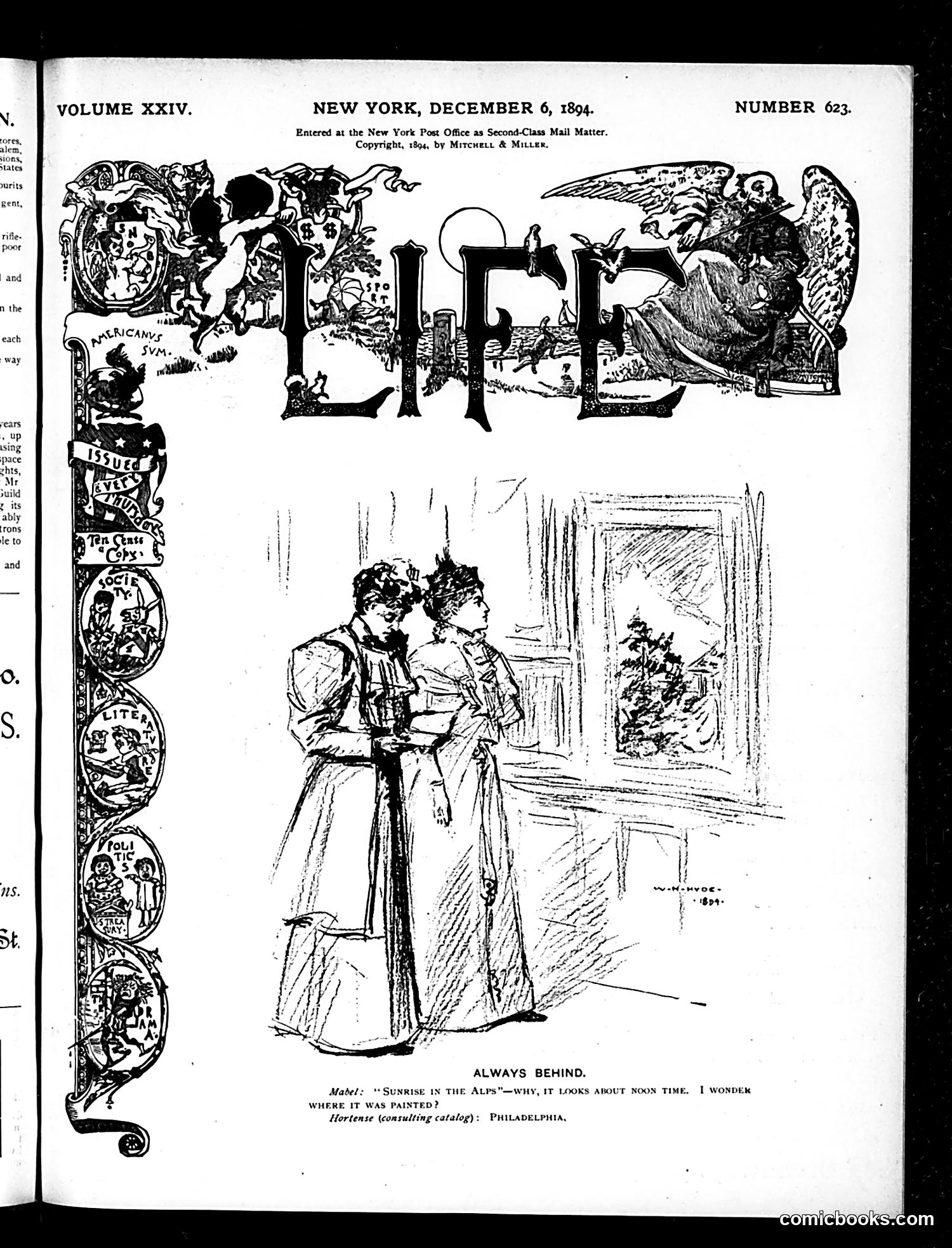
This cartoon from *Life* magazine (December 6, 1894) uses the caption "Always Behind" to make a joke about punctuality or timeliness. The illustration shows two fashionable women examining a painting titled "Sunrise in the Alps," with one woman (identified as "Maket") asking where it was painted. The other woman, identified as "Horizont" (consulting catalog) from Philadelphia, responds that it's from Philadelphia. The humor appears to derive from the contrast between the painting's subject (an Alpine sunrise) and its origin (Philadelphia), or possibly from "Horizont" always being late or behind in some way. Without additional context about 1894 Philadelphia society or the artist, the specific satirical target remains unclear, though the joke involves fashionable society's pretensions regarding art.
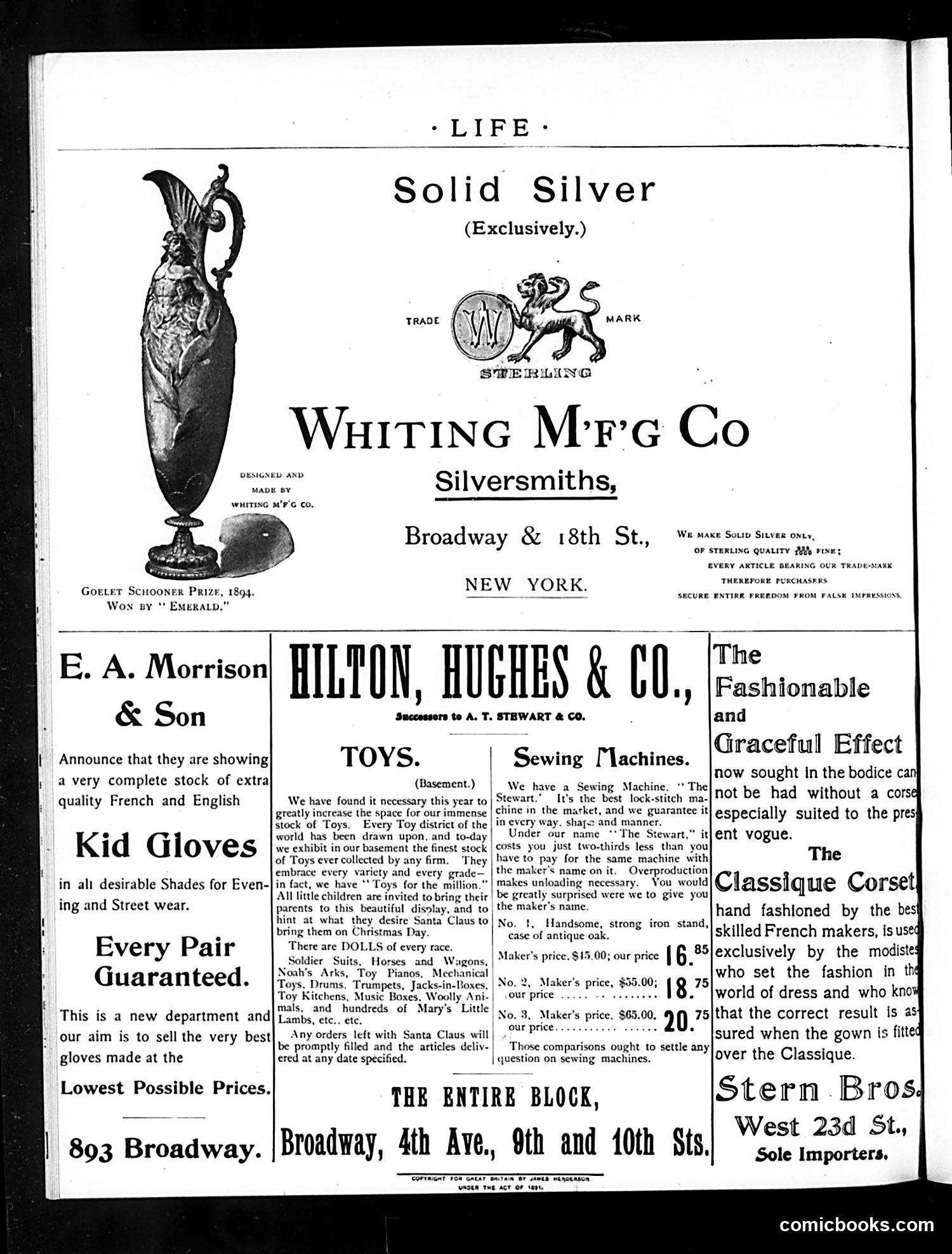
This page is **primarily advertising**, not editorial content or satire. It contains four commercial advertisements: 1. **Whiting M'FG Co** - A sterling silver manufacturer showcasing a decorative goblet prize 2. **E.A. Morrison & Son** - Advertising kid gloves at 893 Broadway 3. **Hilton, Hughes & Co** - Advertising toys and sewing machines across a large storefront block 4. **Stern Bros** - Promoting "The Classique Corset" as a French fashion item The page reflects late 19th or early 20th-century New York retail culture, showcasing luxury goods (silver, imported corsets) and mass-market items (toys, gloves). There are no political cartoons or satirical commentary visible—this is a straightforward commercial section typical of period magazines that relied heavily on advertising revenue.
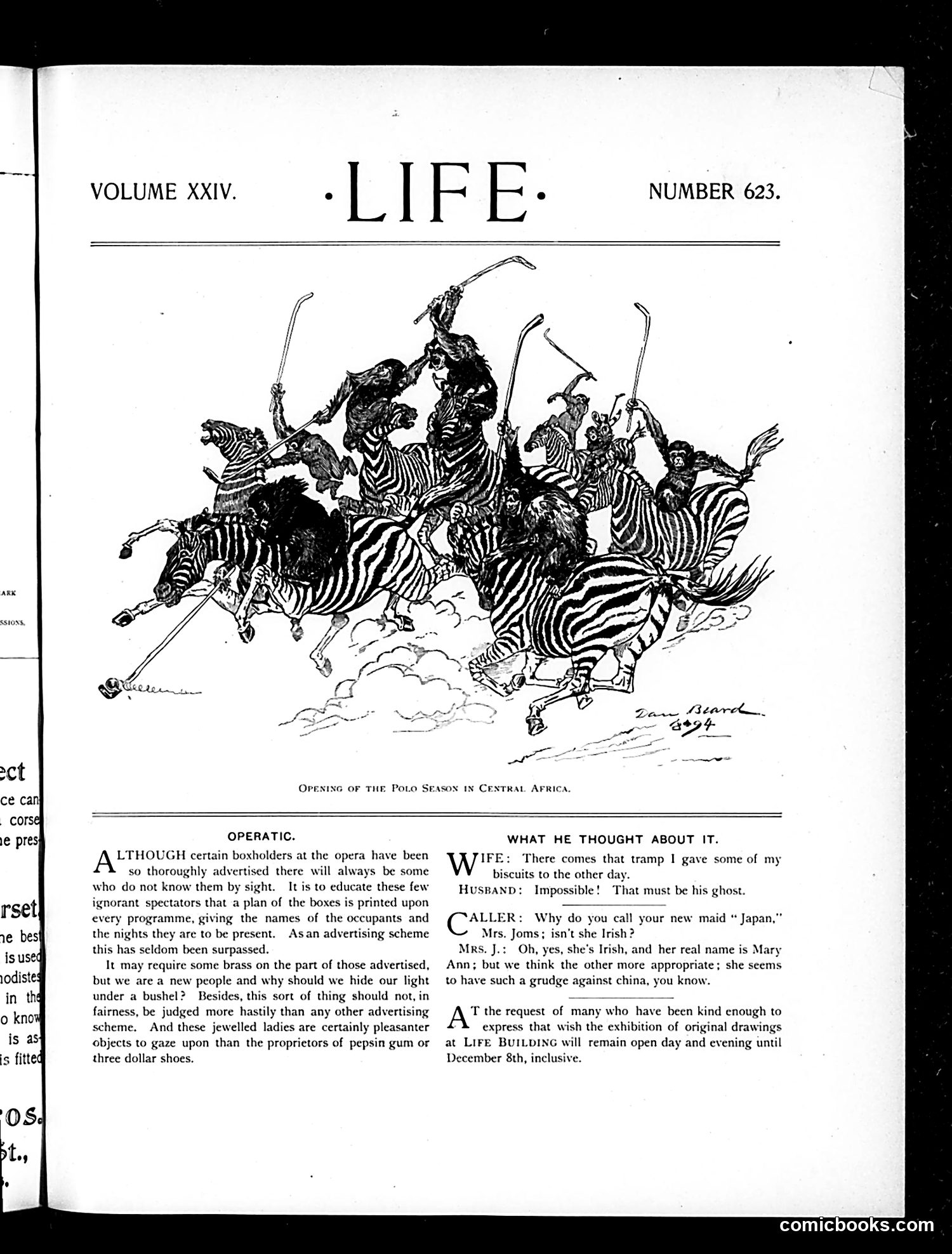
The main illustration depicts zebras mounted by human riders wielding weapons, captioned "Opening of the Polo Season in Central Africa." This is visual satire combining two incongruous elements: the fashionable sport of polo (played by wealthy Europeans on horses) with African zebras and what appear to be caricatured African riders. The satire likely mocks either: (1) colonial-era perceptions of Africa as wild and uncivilized, or (2) the absurdity of transplanting European leisure activities to Africa. The text sections below discuss opera advertising schemes and include a domestic humor exchange about a new Irish maid named "Japan." The joke's full impact depends on early 1900s attitudes toward colonialism and racial stereotyping that modern readers would find offensive.
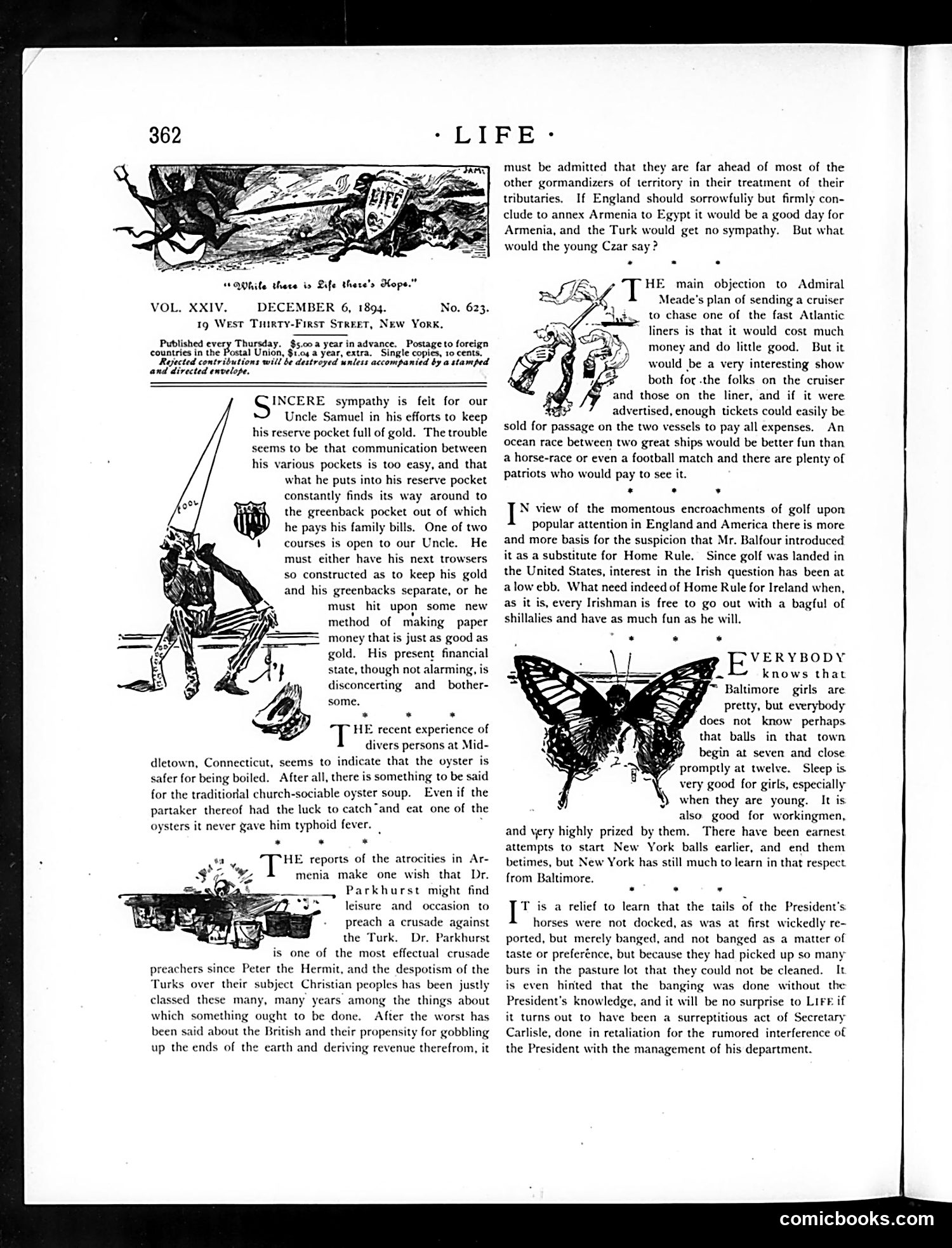
The page contains three separate satirical pieces: 1. **"Uncle Samuel's Gold Reserve"** (left cartoon): Depicts Uncle Sam as a grasshopper/cricket, struggling to guard his depleted treasury while money leaks from his pockets. This mocks the U.S. government's financial instability and chronic difficulty maintaining adequate gold reserves during the 1890s economic crisis. 2. **Atlantic Liner Racing**: Text discusses Admiral Meade's proposal for a transatlantic ship race to prove American maritime superiority—dismissed as expensive spectacle. 3. **Baltimore Balls/Social Commentary**: Critiques Baltimore's social scene and mentions golf's recent American popularity, suggesting it's replacing traditional activities. 4. **Presidential Horses' Tails**: References a recent scandal where President Cleveland's horses' tails were docked without authorization—satirizing bureaucratic overreach and Secretary Carlisle's involvement.
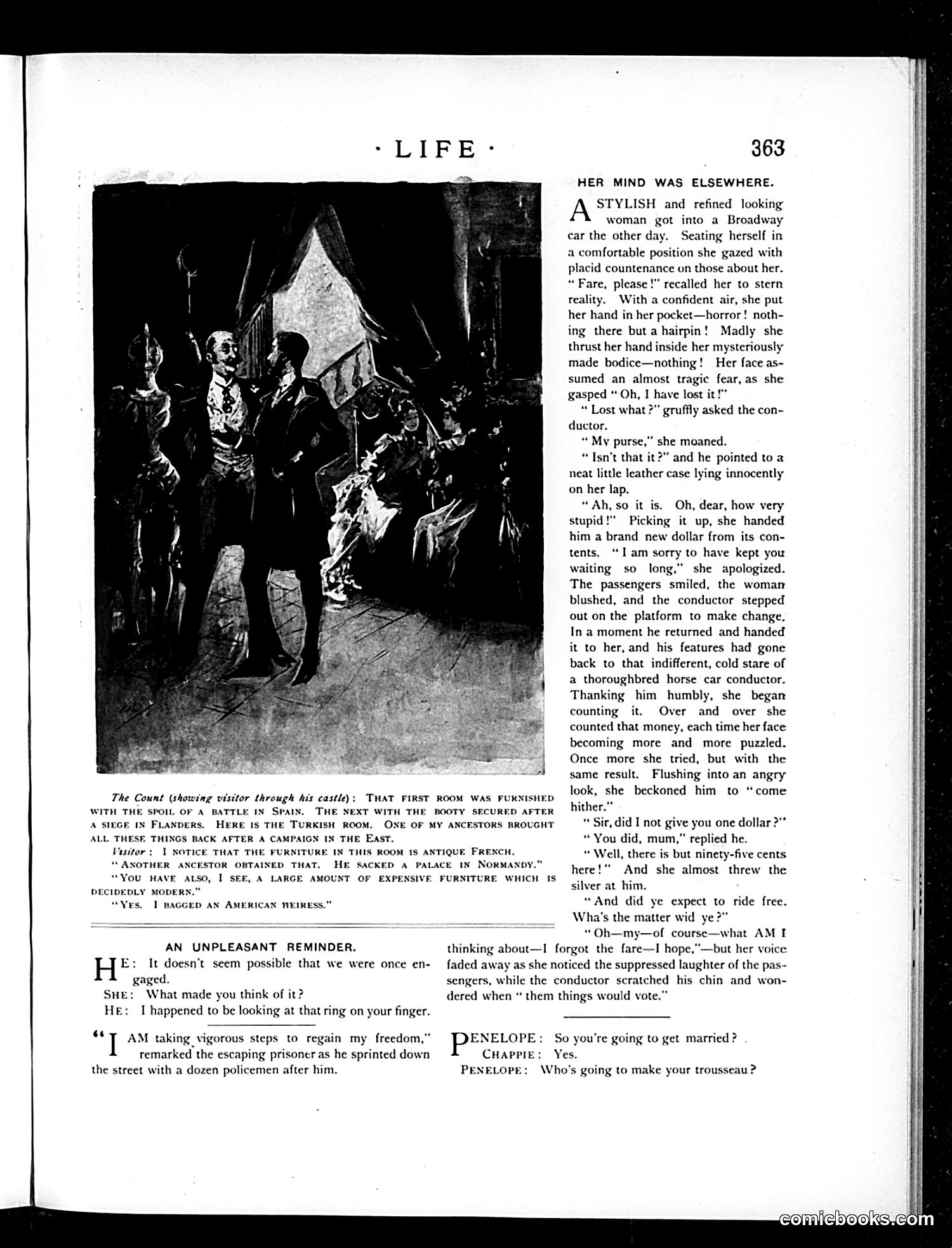
The main illustration depicts a theatrical or comedic scene inside what appears to be a streetcar or train car. The caption references "The Count (showing sister through his castle)" and mentions furniture from Spain, Flanders, and the Turkish room—suggesting satire of European aristocratic pretension. The surrounding text contains humorous vignettes about everyday social situations: a woman's embarrassment over losing her purse on public transit, a conductor's indifferent response, and a final exchange between "Penelope" and "Chappie" about marriage and domesticity. The satire targets middle-class anxieties about social embarrassment, urban transportation encounters, and romantic expectations—common themes in early 20th-century American humor magazines aimed at affluent readers.
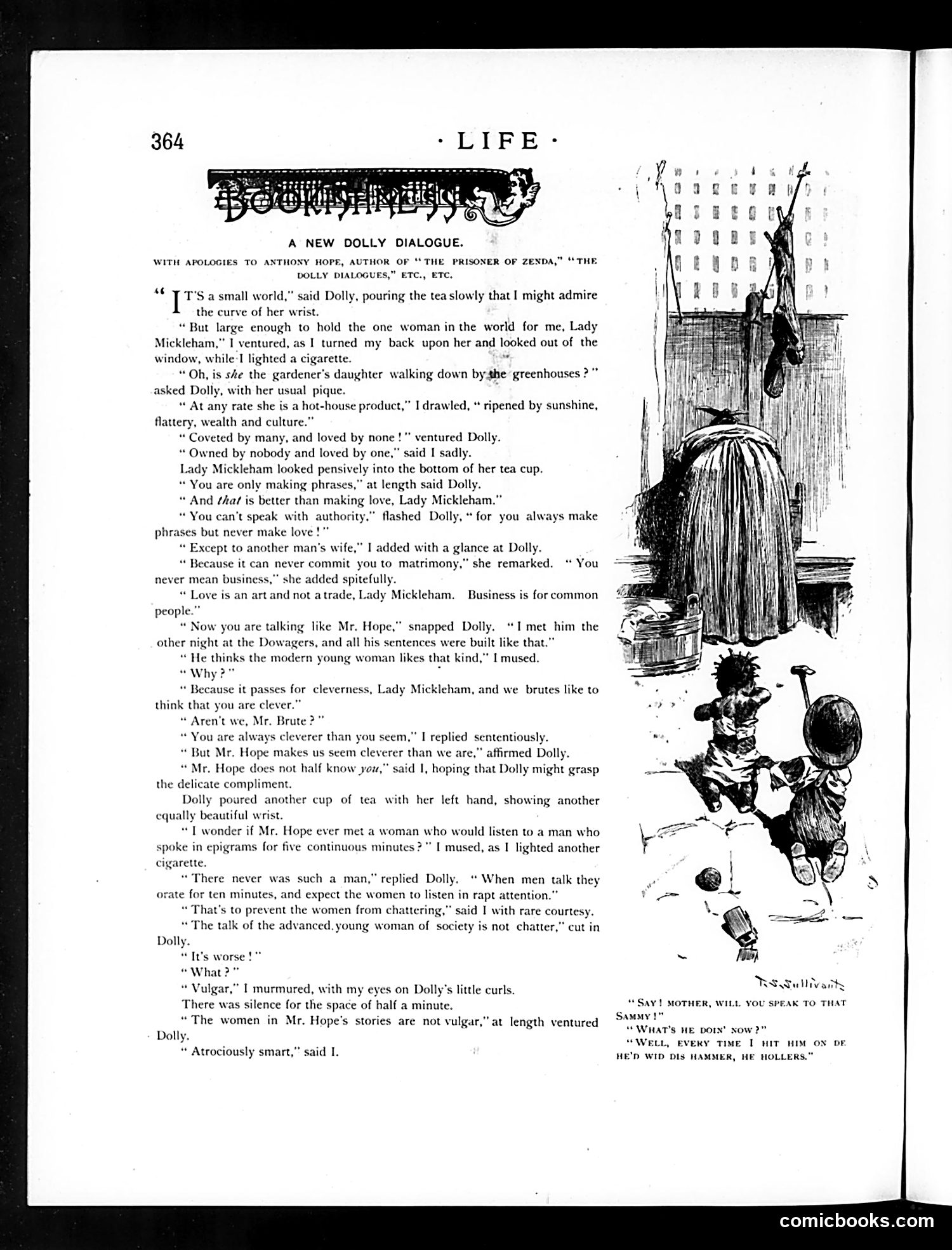
This satirical dialogue features **Dolly** (a regular character in Life magazine's social commentary) discussing modern courtship and gender dynamics with a male narrator. The conversation mocks **Anthony Hope** (author of "The Prisoner of Zenda"), suggesting his romantic narratives don't reflect reality. The satire targets: - **Modern young women's attitudes toward love and marriage** as transactional rather than romantic - **Men who speak in clever epigrams** (like Mr. Hope), which women find pretentious rather than charming - **Class dynamics**: Dolly represents the sophisticated woman unimpressed by intellectual posturing The accompanying illustration shows children playing, likely emphasizing the satirist's point that such romantic idealism belongs to childhood, not adult society. The humor derives from Dolly's frank, cynical observations about relationships in Gilded Age society.
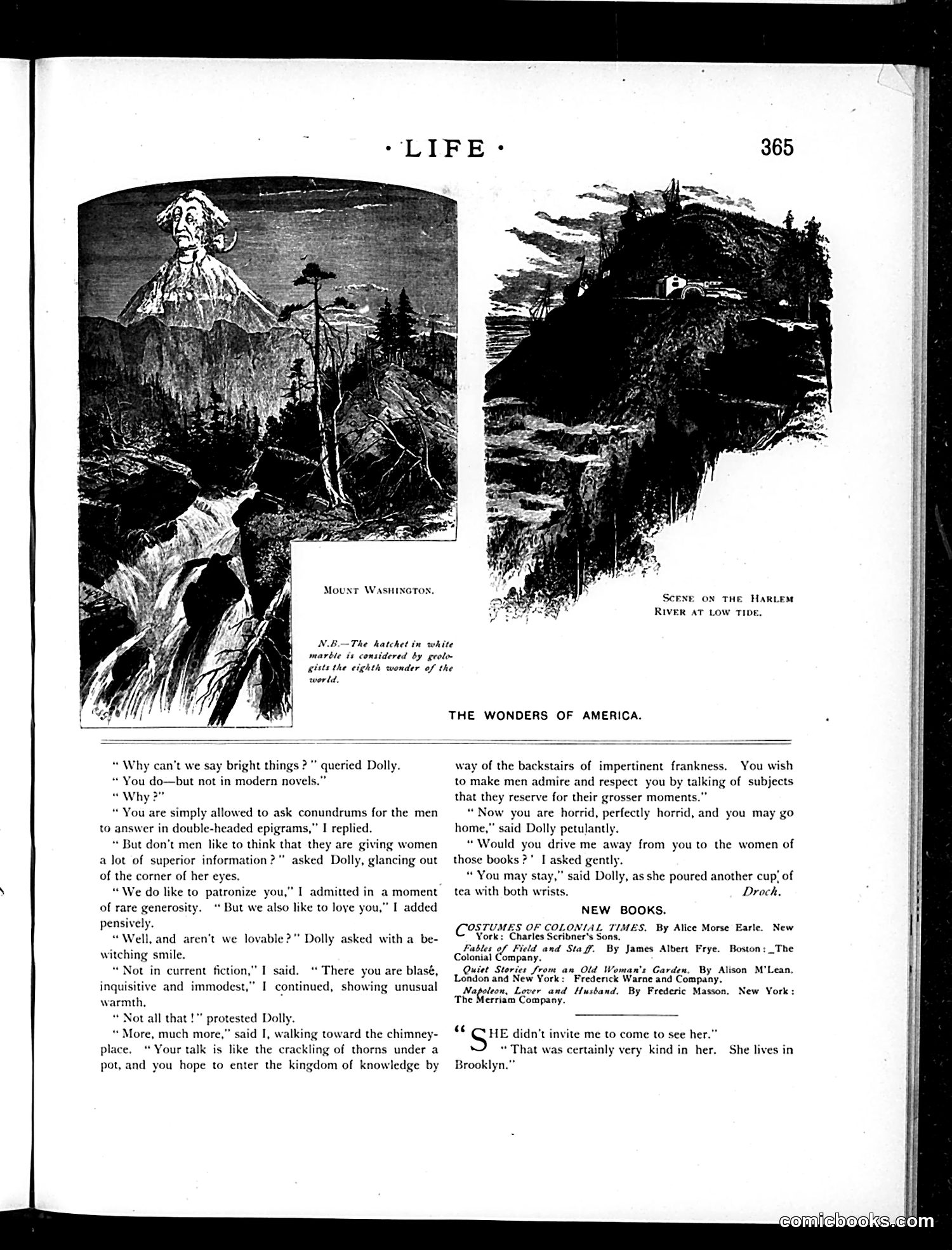
This page features two landscape illustrations labeled "Mount Washington" and "Scene on the Harlem River at Low Tide," presented under the heading "The Wonders of America." The left image depicts Mount Washington with a ghostly white face looming above the landscape, while the right shows the Harlem River. The satire appears to mock American boosterism about natural wonders. The accompanying text snippet suggests the humor lies in contrasting grandiose claims about America's scenic beauty with mundane or underwhelming reality—particularly the Harlem River reference, which likely refers to an actual New York waterway rather than a pristine natural wonder. The exaggerated face on Mount Washington reinforces this ironic tone.
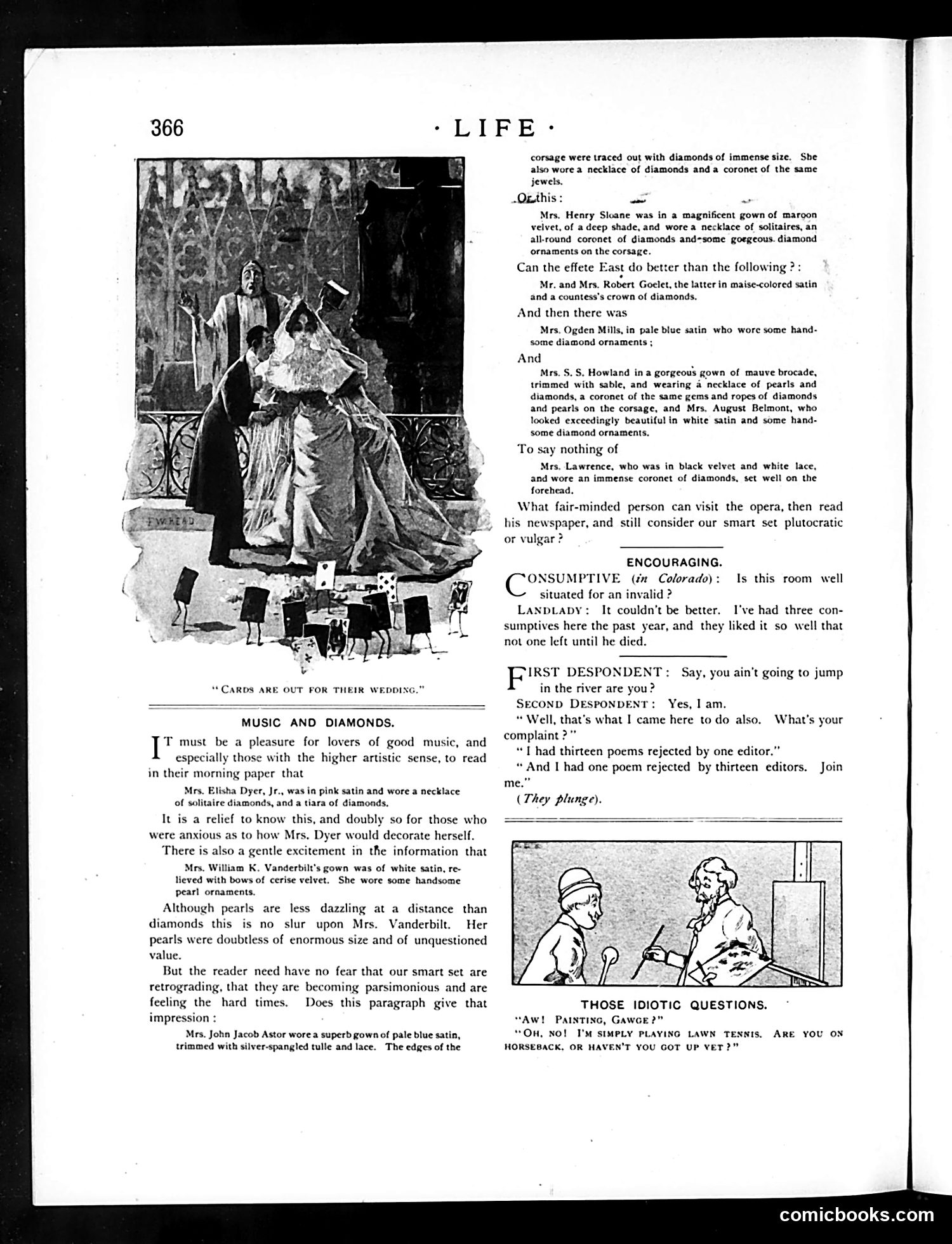
This page satirizes high society's obsession with expensive jewelry and opera attendance. The main article "Music and Diamonds" mocks wealthy women who display elaborate diamond corsages, necklaces, and tiaras at the opera—suggesting their primary interest is fashion display rather than appreciating music. The article lists specific socialites (Mrs. Elisha Dyer, Mrs. Vanderbilt, Mrs. John Jacob Astor) and their jewelry, implying that attending opera has become less about artistic merit and more about conspicuous consumption among the elite. The bottom cartoon "Those Idiotic Questions" jokes about tennis etiquette, with one player accusingly asking if his opponent is "painting, gawds!"—mocking pretentious sporting affectations. The overall message critiques American upper-class vanity and superficiality.
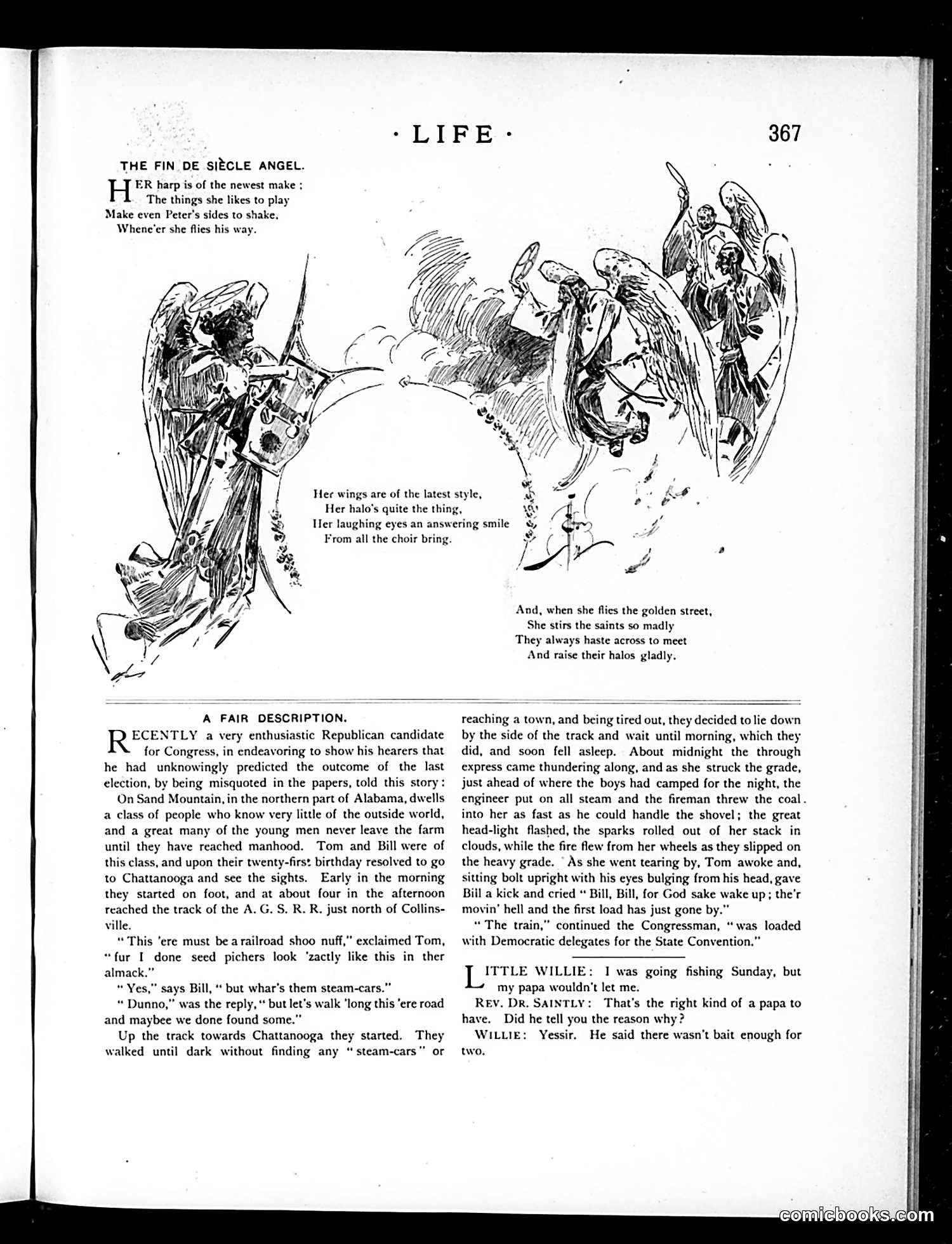
**Top Section - "The Fin de Siècle Angel":** This is a whimsical illustrated poem about a modern angel playing a harp. The satire mocks contemporary "latest style" fashions and the pretentiousness of 1890s society, with the angel described as stirring "the saints so madly" and raising "their halos gladly." It's gentle social satire on fin-de-siècle affectation. **Bottom Section - "A Fair Description":** This story satirizes a Republican congressional candidate who accidentally predicted the election outcome while being misquoted in newspapers. The narrative follows two boys, Tom and Bill, discovering a railroad and hobo life. The humor derives from political miscommunication and the ironic consequences of media misrepresentation—a common Life magazine target. The brief dialogue at page's end ("Little Willie") appears to be filler humor.
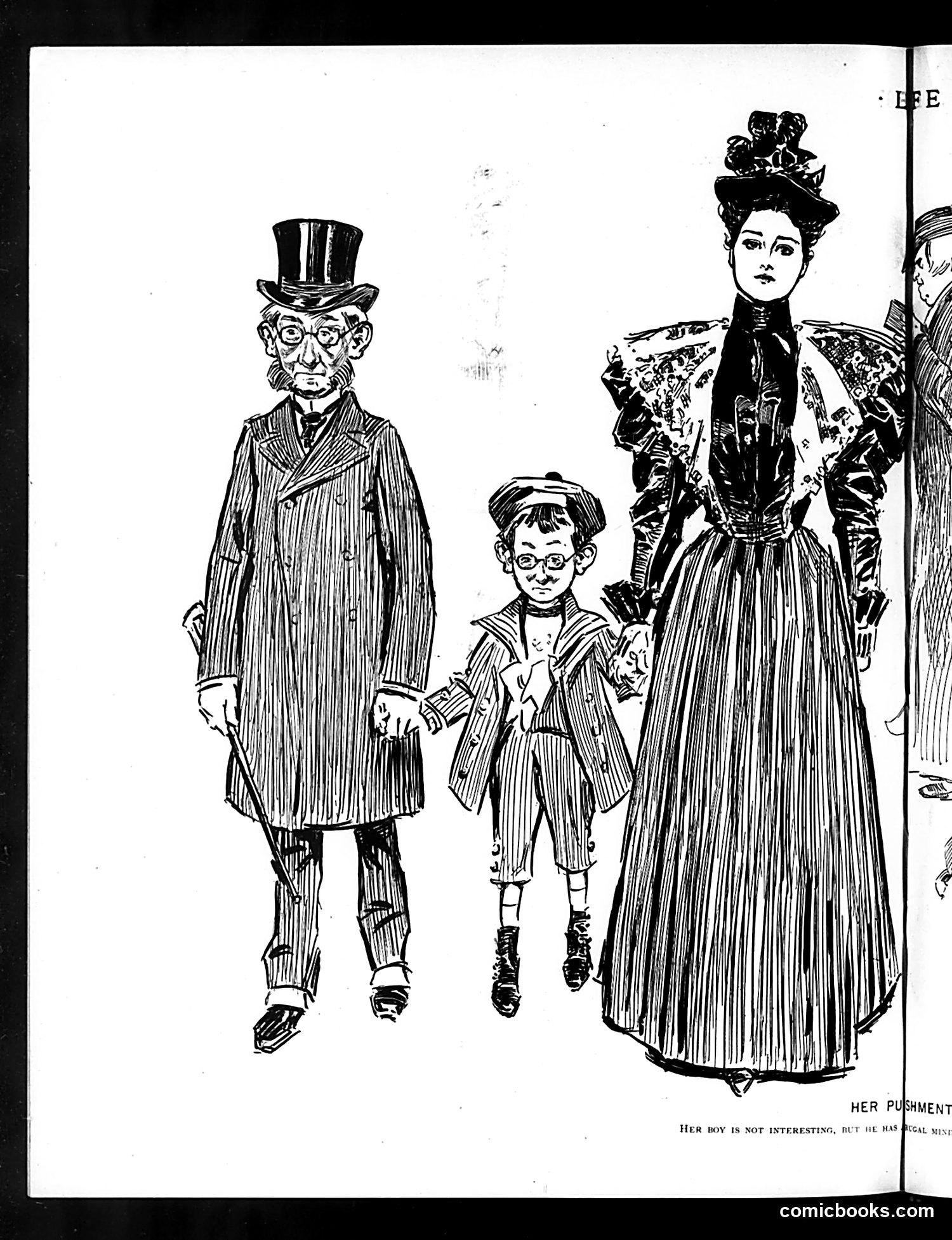
This appears to be a satirical illustration about parental discipline and child-rearing. The image shows three figures: a thin, stern-faced man in a top hat and formal coat, a small boy between them holding hands, and an elegantly dressed woman in an ornate jacket and long skirt. The visible caption reads "HER PUNISHMENT" and partially: "HER BOY IS NOT INTERESTING, BUT HE HAS [LEGAL MUST—]" (text cut off). The satire likely critiques upper-class parenting or marital dynamics of the early 20th century—possibly mocking how wealthy parents controlled or punished children, or how a woman's "punishment" involves maintaining an uninteresting child. The exaggerated formality and facial expressions emphasize the stiffness and lack of warmth in such relationships. Without the complete caption, the specific social target remains partially unclear.
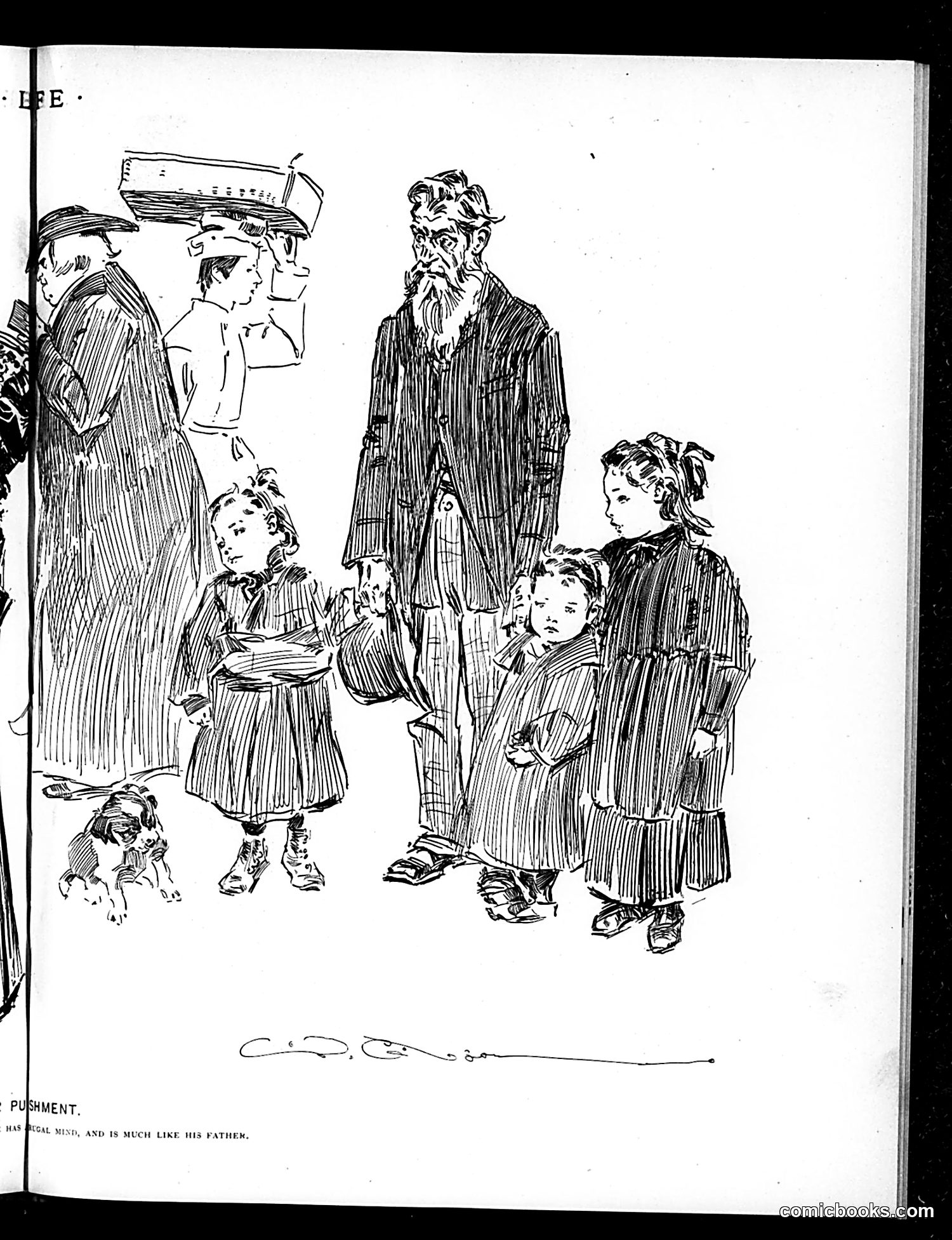
This page contains a sketch-style cartoon depicting a family group—an older bearded man, two women, and two children, with a small dog. The visible text fragment reads "HAS A LOGICAL MIND, AND IS MUCH LIKE HIS FATHER," suggesting character commentary or satire about inherited traits. The page header indicates this is from "LIFE" and appears to be titled "PUNISHMENT," though the full context is cut off. The style and clothing suggest late 19th or early 20th century. Without the complete caption or surrounding text, the specific satirical target remains unclear. The drawing appears to mock family dynamics or perhaps hereditary characteristics—possibly social commentary on class, behavior, or family resemblance—but the precise historical reference or political point cannot be determined from the visible portion alone.
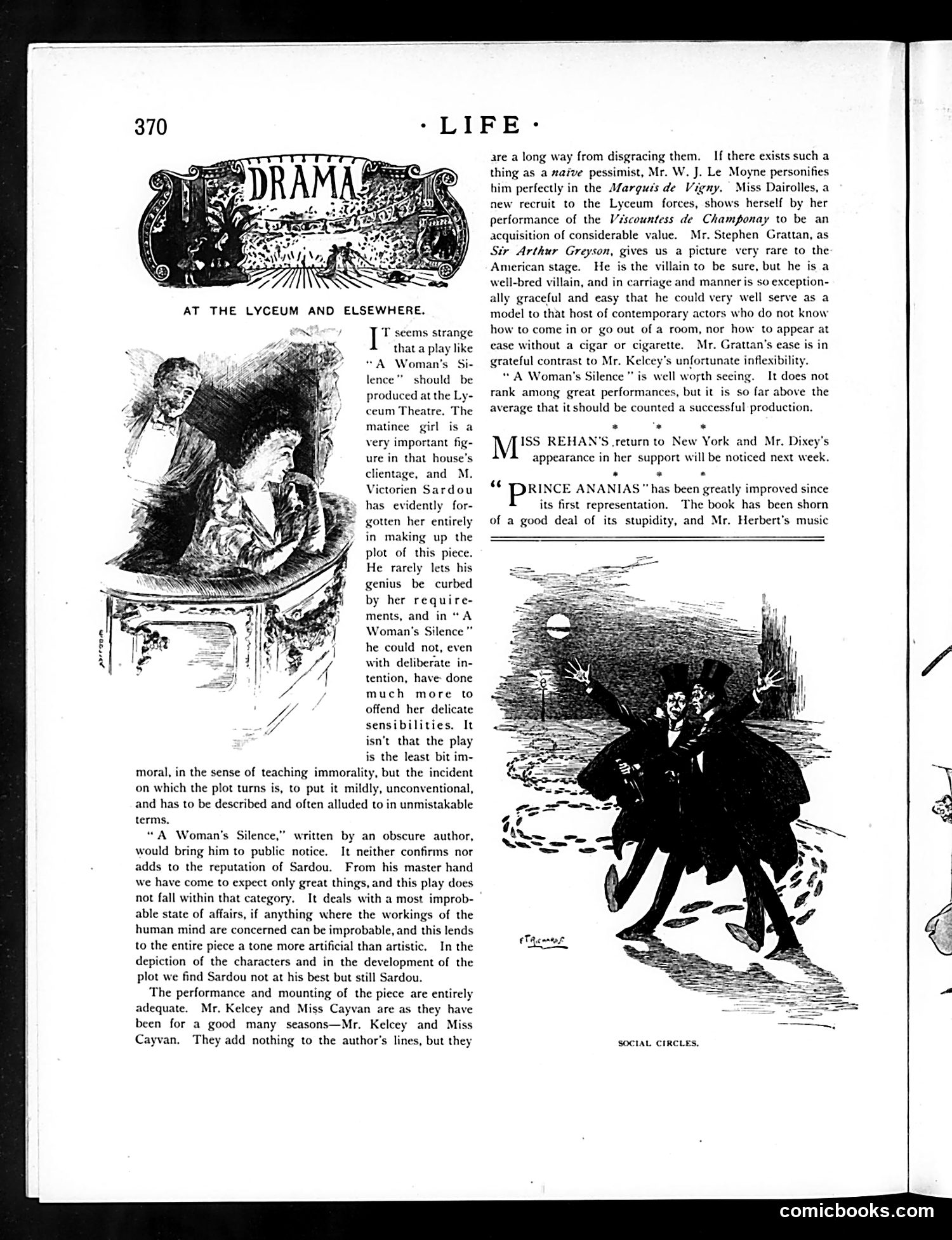
This is a theater review section covering Broadway productions at the Lyceum Theatre. The text critiques Victorien Sardou's play "A Woman's Silence," noting it contains morally unconventional content that may offend the theater's primary matinee audience—young women. The review acknowledges the play deals with improper subjects discussed in "unmistakable terms," making it poorly suited to its venue's clientele, though the writing itself isn't immoral per se. The accompanying illustrations appear to be theatrical sketches: one showing an actress in period costume (likely from the production), and another labeled "SOCIAL CIRCLES" depicting figures in what appears to be a comedic or satirical scene. The page also briefly mentions upcoming performances by actress Ada Rehan and a revision of "Prince Ananias." Overall, this represents typical late-19th-century theater criticism balancing artistic merit against social propriety.
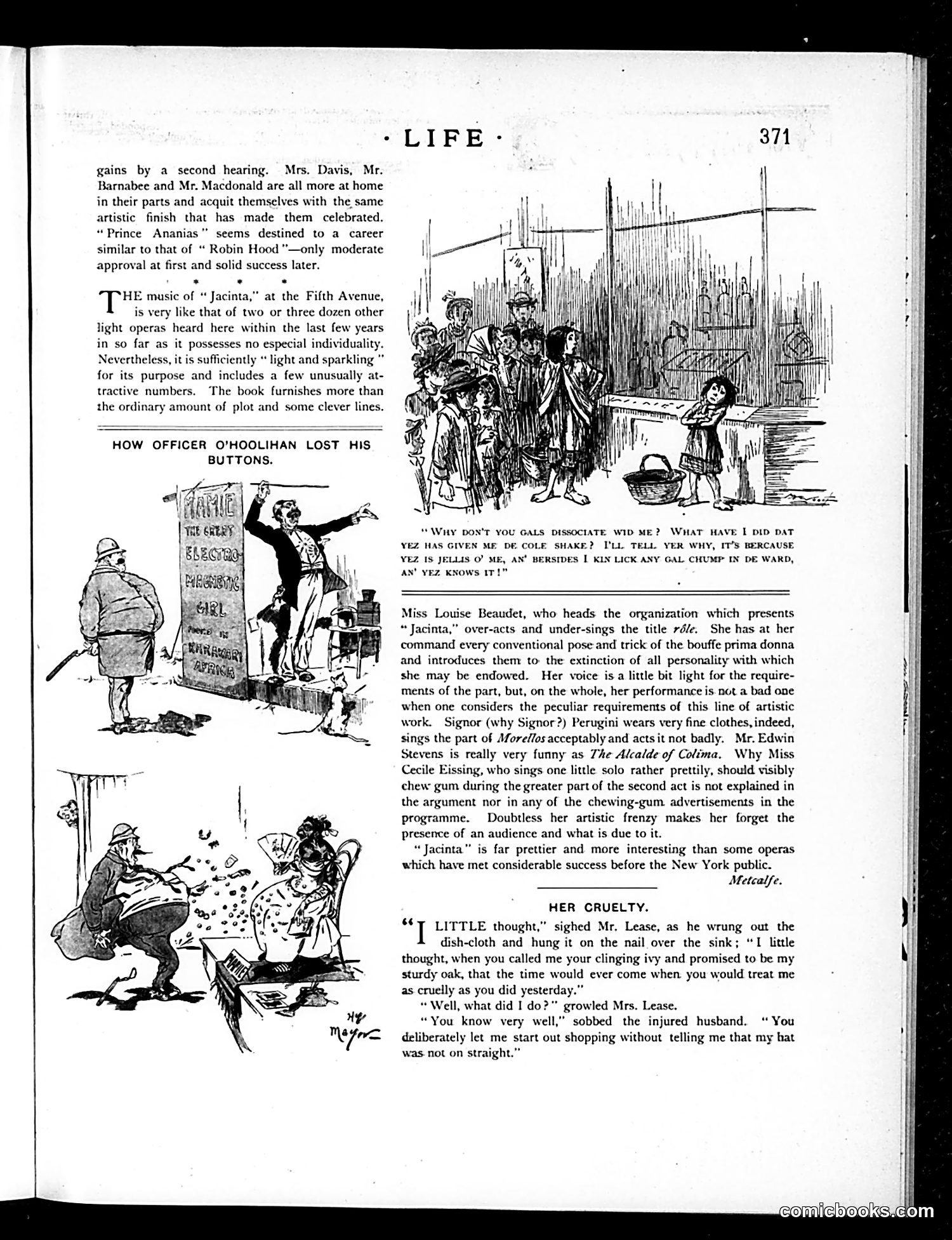
This page contains two distinct comedic pieces: **"How Officer O'Hoolihan Lost His Buttons"** depicts Irish-American police officer stereotypes through exaggerated dialect humor. The cartoons show an officer losing buttons in various embarrassing situations while speaking in heavy Irish brogue. The dialogue parodies working-class romantic disputes, reflecting early 1900s ethnic caricature common in American humor magazines. **"Her Cruelty"** is domestic satire mocking the "New Woman" movement. A henpecked husband complains his wife committed a minor cruelty by not straightening his hat before letting him leave for shopping—trivial compared to his promised devotion ("clinging ivy" / "sturdy oak"). The joke satirizes both emasculated husbands and women's growing social independence, suggesting role reversals were comedic fodder for contemporary readers worried about changing gender dynamics. Both pieces employ exaggeration and stereotype for comedic effect typical of early 20th-century Life magazine.
This page from *Life* magazine (appears to be early 1900s based on style) contains several short humorous anecdotes rather than traditional political cartoons: 1. **Mark Twain story**: A satirical tale about a formerly enslaved girl who finds money during a religious revival, humorously illustrating the tension between spiritual conversion and material temptation. 2. **Courtroom joke**: Mocks lawyers by having a witness say a man looked "intelligent" rather than resembling any lawyer—a jab at lawyers' perceived lack of intelligence. 3. **Nevada soap mine**: Humorously exaggerates Nevada's natural soap deposits, with a citizen fantasizing about creating a national "washing" operation and changing the state motto to "While there's life there's soap." 4. **Pension office bureaucracy**: Satirizes rigid governmental red tape—a widow's pension certificate is rejected because it's dated three days after her pension was technically due, despite proving she was alive. The page primarily satirizes American institutional absurdities (legal, governmental, social conventions) rather than specific political figures.
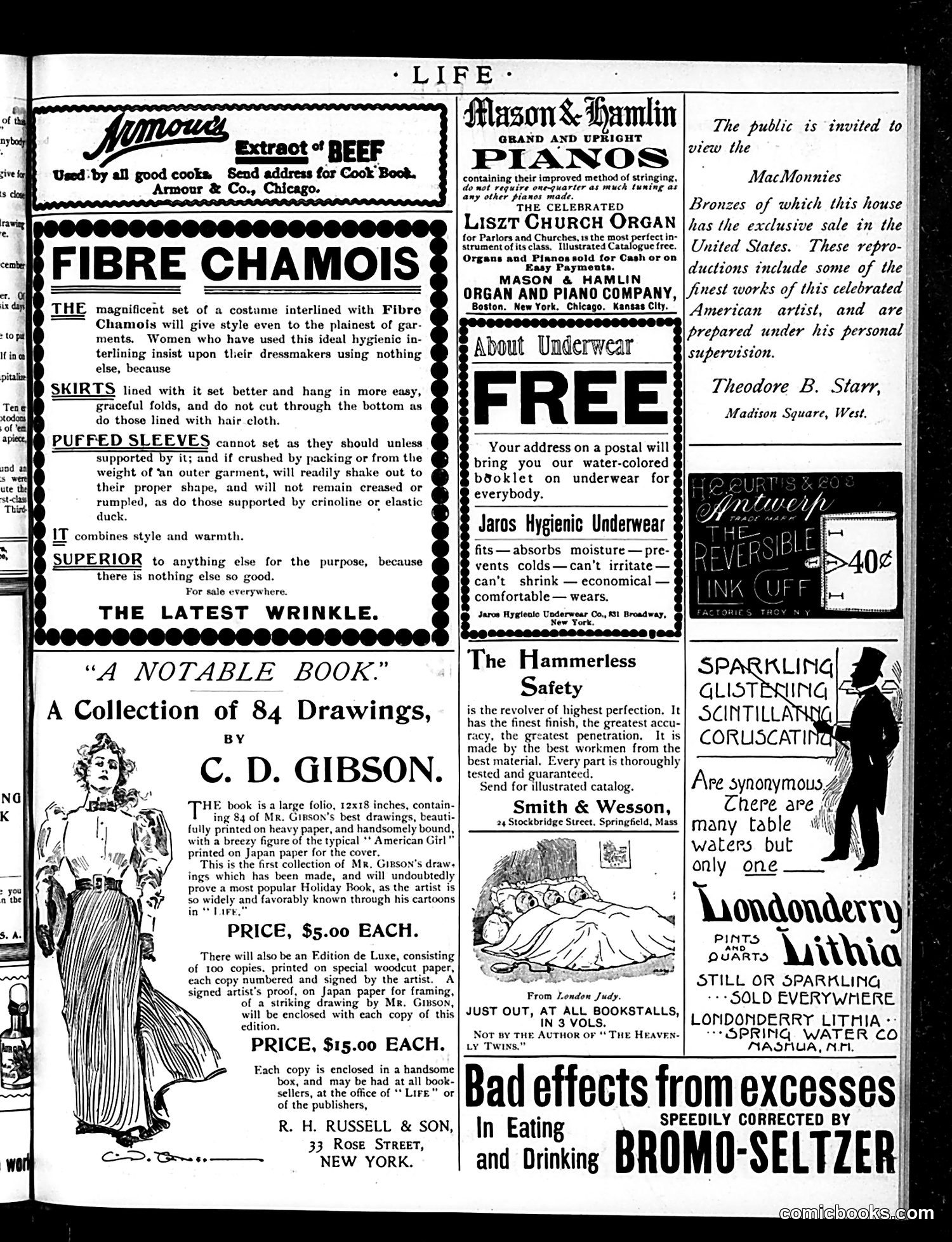
This page is primarily **advertising**, typical of early 20th-century magazines. The notable content includes: **C.D. Gibson Book Advertisement**: Promotes a collection of 84 drawings by C.D. Gibson, famous illustrator of the "Gibson Girl"—an idealized image of the modern American woman that dominated popular culture. The cover features this iconic feminine type. **Product Advertisements**: The page showcases period consumer goods—Fibre Chamois fabric (for women's clothing construction), Mason & Hamlin pianos, Jaros Hygienic Underwear, Smith & Wesson revolvers, and Bromo-Seltzer (a digestive remedy). **Minor Cartoon**: A small illustration at right shows a silhouetted man with text about "Londonderry Lithia" water, making a joke about table waters—one is notably "Londonderry." **Social Context**: The emphasis on women's fashion, hygiene products, and the Gibson Girl reflects turn-of-century anxieties about modern femininity and consumer culture. The prominence of patent medicines (Bromo-Seltzer) reflects pre-FDA regulation era marketing. This is a **commercial page** rather than satirical content.
This page contains several humorous anecdotes typical of *Life* magazine's satirical style, plus advertisements. The cartoons/jokes target: 1. **Frontier masculinity** — A Missouri man refuses to travel without his gun despite assurances of safety, satirizing frontier paranoia and superstition about fate. 2. **Rural hypocrisy** — A dying farmer admits he never remarried not from devotion to his first wife, but because marriage exhausted him—mocking rural sentimentality and false propriety. 3. **Jewish merchant shrewdness** — A Hebrew trader negotiates hard, ultimately rejecting a "gift" (suspenders) unless the seller endorses his promissory note, stereotyping Jewish business acumen as ruthless. 4. **Medical ignorance** — A poor woman misunderstands "sluggish liver," thinking actual slugs inhabit her organ, mocking working-class medical illiteracy. 5. **Southern gentleman pretension** — A judge finds whiskey served in a glass insufficiently generous, implying Southern hospitality expectations are absurdly excessive. 6. **Marriage satire** — A professor claims mastering his wife's and mother-in-law's "tongues" (moods/nagging) exceeds learning foreign languages. The advertisements promote California vacations, corsets, and Bermuda tourism.