
Life, 1894-12-06 · page 12 of 16
Life — December 6, 1894 — page 12: what you’re looking at
What you’re looking at
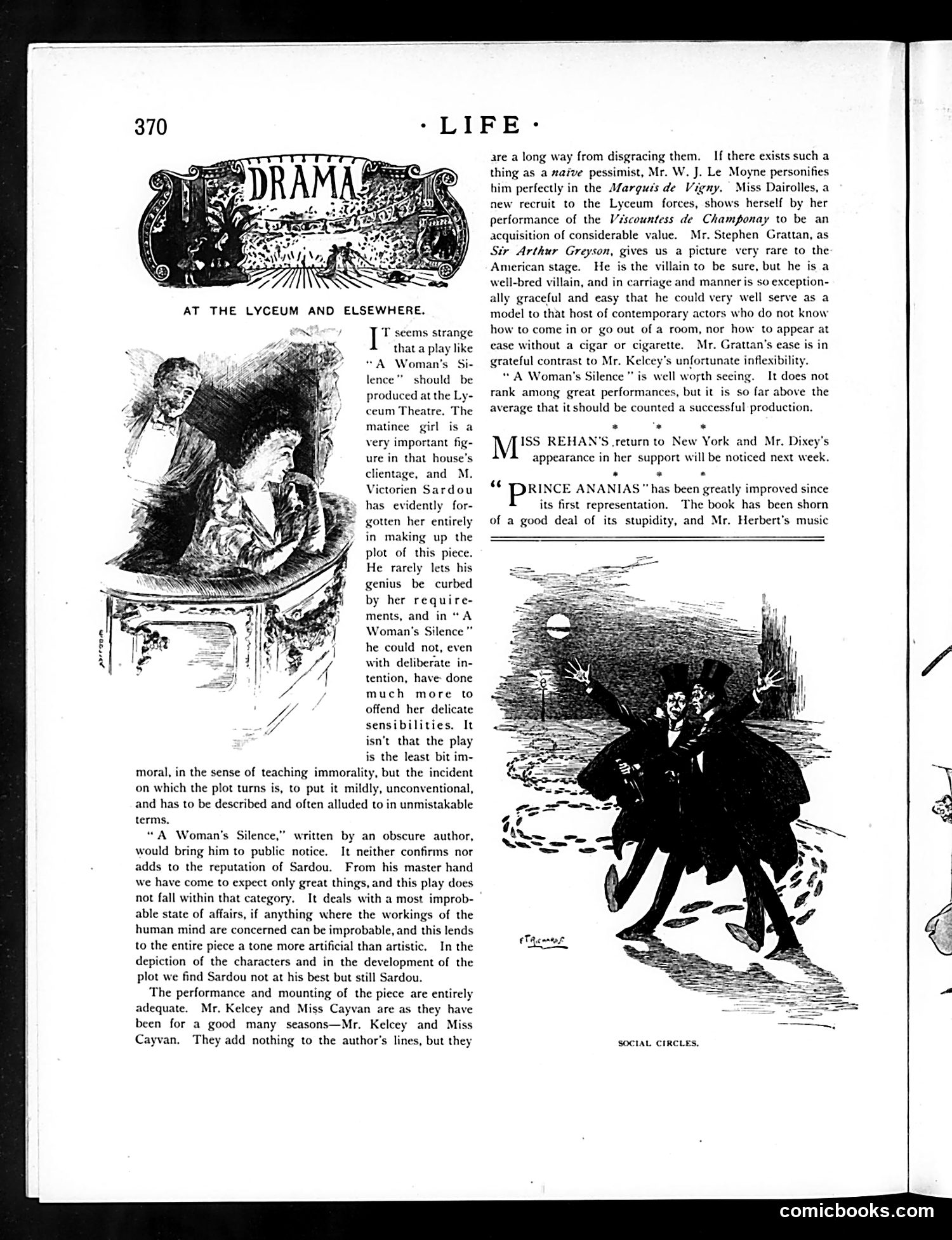
This is a theater review section covering Broadway productions at the Lyceum Theatre. The text critiques Victorien Sardou's play "A Woman's Silence," noting it contains morally unconventional content that may offend the theater's primary matinee audience—young women. The review acknowledges the play deals with improper subjects discussed in "unmistakable terms," making it poorly suited to its venue's clientele, though the writing itself isn't immoral per se. The accompanying illustrations appear to be theatrical sketches: one showing an actress in period costume (likely from the production), and another labeled "SOCIAL CIRCLES" depicting figures in what appears to be a comedic or satirical scene. The page also briefly mentions upcoming performances by actress Ada Rehan and a revision of "Prince Ananias." Overall, this represents typical late-19th-century theater criticism balancing artistic merit against social propriety.
📄 Transcribed text from this page (OCR, searchable)
Machine-transcribed from the original scan — historical spelling and the odd misread are preserved.
* LIFE: AT THE LYCEUM AND ELSEWHERE. T seems strange that a play like “A Woman's Si- lence” should be produced at the Ly- ceum Theatre. The matinee girl is a very important fig- ure in that house’s clientage, and M. Victorien Sardou has evidently for- gotten her entirely in making up the plot of this piece. He rarely lets his genius be curbed by her require- ments, and in “A Woman's Silence” he could not, even with deliberate in- tention, have done much more to offend her delicate sensibilities. It isn’t that the play is the least bit im- moral, in the sense of teaching immorality, but the incident on which the plot turns is, to put it mildly, unconventional, and has to be described and often alluded to in unmistakable terms, “A Woman's Silence,” written by an obscure author, would bring him to public notice. It neither confirms nor adds to the reputation of Sardou. From his master hand we have come to expect only great things, and this play does not fall within that category. It deals with a most improb- able state of affairs, if anything where the workings of the human mind are concerned can be improbable, and this lends to the entire piece a tone more artificial than artistic. In the depiction of the characters and in the development of the plot we find Sardou not at his best but still Sardou. The performance and mounting of the piece are entirely adequate. Mr. Kelcey and Miss Cayvan are as they have been for a good many seasons—Mr. Kelcey and Miss Cayvan, They add nothing to the author's lines, but they are a long way from disgracing them. If there exists such a thing as a naive pessimist, Mr. W. J. Le Moyne personifies him perfectly in the Afargut’s de Vigny. Miss Dairolles, a new recruit to the Lyceum forces, shows herself by her performance of the Vescountess de Champonay to be an acquisition of considerable value. Mr. Stephen Grattan, as Str Arthur Greyson, gives us a picture very rare to the American stage. He is the villain to be sure, but he is a well-bred villain, and in carriage and manner is so exception- ally graceful and easy that he could very well serve as a model to that host of contemporary actors who do not know how to come in or go out of a room, nor how to appear at ease without a cigar or cigarette. Mr. Grattan’s ease is in grateful contrast to Mr. Kelcey’s unfortunate inflexibility. * A Woman's Silence " is well worth seeing. It does not rank among great performances, but it is so far above the average that itshould be counted a successful production, * * * ISS REHAN’S return to New York and Mr. Dixey’s appearance in her support will be noticed next week. §€ PRINCE ANANIAS “has been greatly improved since its first representation. The book has been shorn of a good deal of its stupidity, and Mr. Herbert's music SOCIAL CIRCLES. comicbooks.com