
Life, 1894-12-06 · page 6 of 16
Life — December 6, 1894 — page 6: what you’re looking at
What you’re looking at
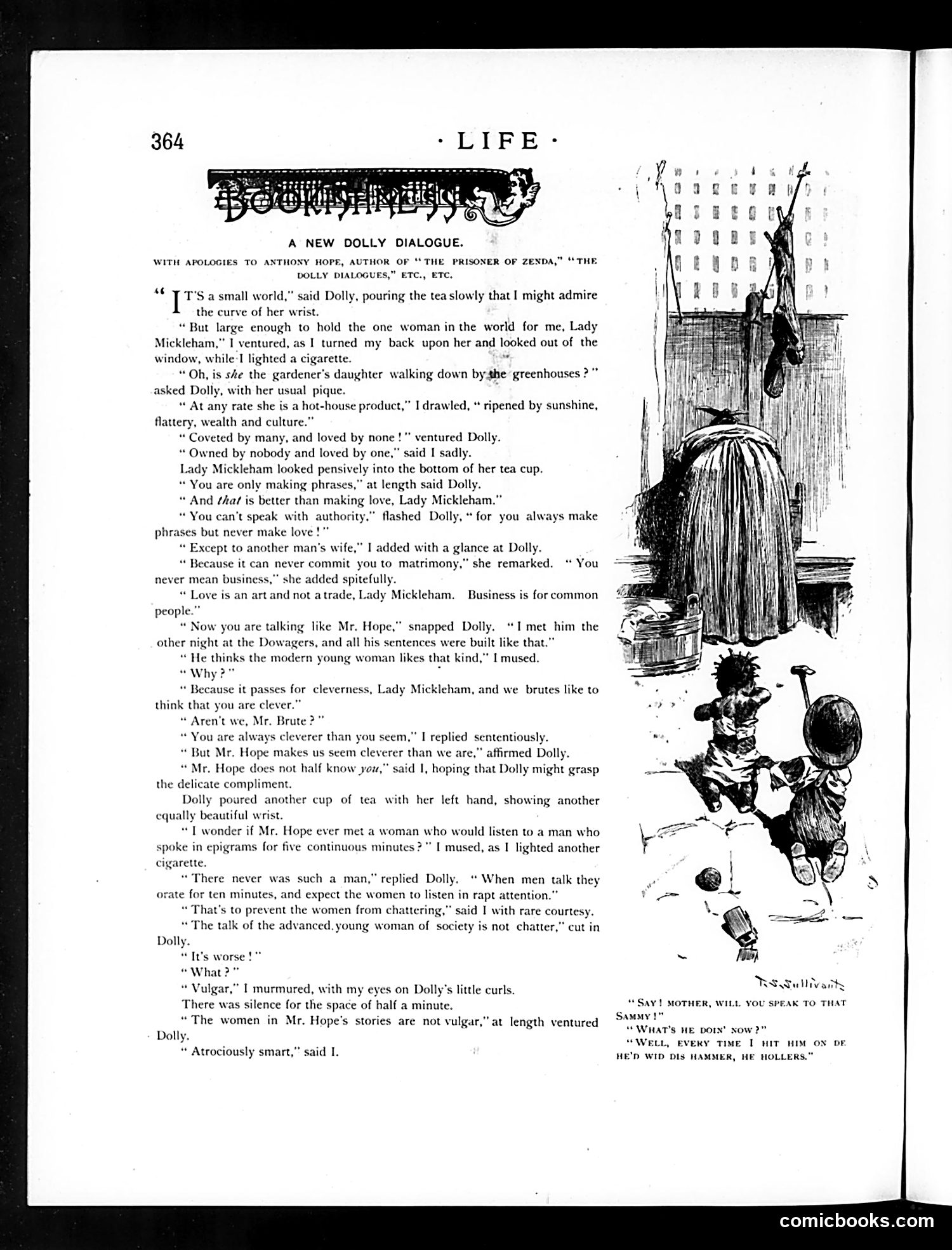
This satirical dialogue features **Dolly** (a regular character in Life magazine's social commentary) discussing modern courtship and gender dynamics with a male narrator. The conversation mocks **Anthony Hope** (author of "The Prisoner of Zenda"), suggesting his romantic narratives don't reflect reality. The satire targets: - **Modern young women's attitudes toward love and marriage** as transactional rather than romantic - **Men who speak in clever epigrams** (like Mr. Hope), which women find pretentious rather than charming - **Class dynamics**: Dolly represents the sophisticated woman unimpressed by intellectual posturing The accompanying illustration shows children playing, likely emphasizing the satirist's point that such romantic idealism belongs to childhood, not adult society. The humor derives from Dolly's frank, cynical observations about relationships in Gilded Age society.
📄 Transcribed text from this page (OCR, searchable)
Machine-transcribed from the original scan — historical spelling and the odd misread are preserved.
A NEW DOLLY DIALOGUE. WITH APOLOGIES TO ANTHONY HOPE, AUTHOR OF “THE PRISONER OF ZENDA,” “THE DOLLY DIALOGUES,” ETC., ETC. ‘© 7 T'S a small world,” said Dolly, pouring the tea slowly that | might admire the curve of her wrist. “ But large enough to hold the one woman in the world for me, Lady Mickleham,” I ventured, as I turned my back upon her and looked out of the window, while:I lighted a cigarette. "i “Oh, is she the gardener’s daughter walking down bythe greenhouses ? ” asked Dolly, with her usual pique. 5 “ At any rate she is a hot-house product,” I drawled, “ ripened by sunshine, flattery, wealth and culture.” “ Coveted by many, and loved by none!" ventured Dolly. “ Owned by nobody and loved by one,” said I sadly. Lady Mickleham looked pensively into the bottom of her tea cup. “ You are only making phra: at length said Dolly. “ And ¢hat is better than making love, Lady Mickleham.” “ You can’t speak with authority,” flashed Dolly, * for you always make phrases but never make love !" “ Except to another man’s wife,” I added with a glance at Dolly. “ Because it can never commit you to matrimony,” she remarked. “ You never mean business,” she added spitefully. “ Love is an art and not a trade, Lady Mickleham. Business is for common people.” ow you are talking like Mr. Hope,” snapped Dolly. “I met him the other night at the Dowagers, and all his sentences were built like that.” “ He thinks the modern young woman likes that kind,” I mused. “Why ? . “ Because it passes for cleverness, Lady Mickleham, and we brutes like to think that you are clever.” “ Aren't we, Mr. Brute?” “ You are always cleverer than you seem,” I replied sententiously. “But Mr, Hope makes us seem cleverer than we are,” affirmed Dolly. “ Mr. Hope does not half know you,” said 1, hoping that Dolly might grasp the delicate compliment. Dolly poured another cup of tea with her left hand, showing another equally beautiful wrist. “ | wonder if Mr. Hope ever met a woman who would listen to a man who spoke in epigrams for five continuous minutes?” I mused, as I lighted another cigarette. “There never was such a man,” replied Dolly, “ When men talk they orate for ten minutes, and expect the women to listen in rapt attention.” “ That's to prevent the women from chattering,” said I with rare courtesy. “ The talk of the advanced. young woman of society is not chatter,” cut in Dolly. “T's wor: “What?” “Vulgar,” I murmured, with my eyes ‘s little curls. There was silence for the space of half a minute. “The women in Mr. Hope’s stories are not vulgar,” at length ventured Dolly. “ Atrociously smart,” said I. “Say! MOTHER, WILL YOU SPEAK TO THAT Samay!" “ WHAT'S HE DOIN’ Now ?” “WELL, EVERY TIME [HIT HIM ON DE HE'D WID DIS HAMMER, HE HOLLERS.” comicbooks.com