
A complete issue · 18 pages · 1894
Life — October 11, 1894
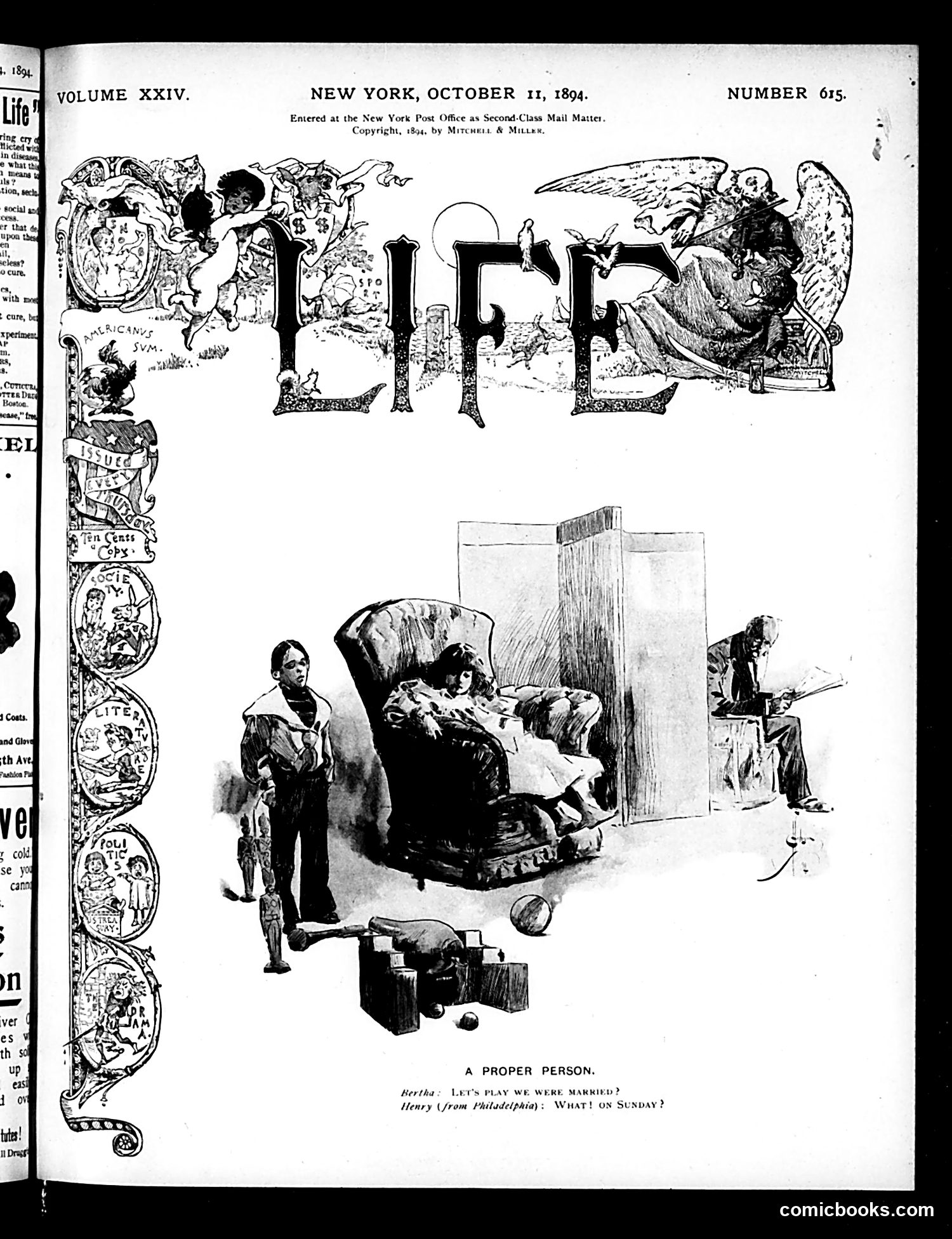
This cartoon satirizes marriage expectations and propriety among the wealthy. The caption features dialogue between Bertha and Henry (from Philadelphia), where Bertha proposes: "Let's play we were married!" Henry responds: "What! On Sunday?" The joke relies on Victorian-era social conventions: the implication that married couples engaging in intimate relations on Sunday would violate religious propriety. Henry's shocked objection to even *pretending* to be married on the Sabbath satirizes how rigidly upper-class Americans policed their behavior according to religious rules—even in private play between children or young people. The cartoon mocks the excessive formality and constraint of "proper" behavior in Gilded Age society.
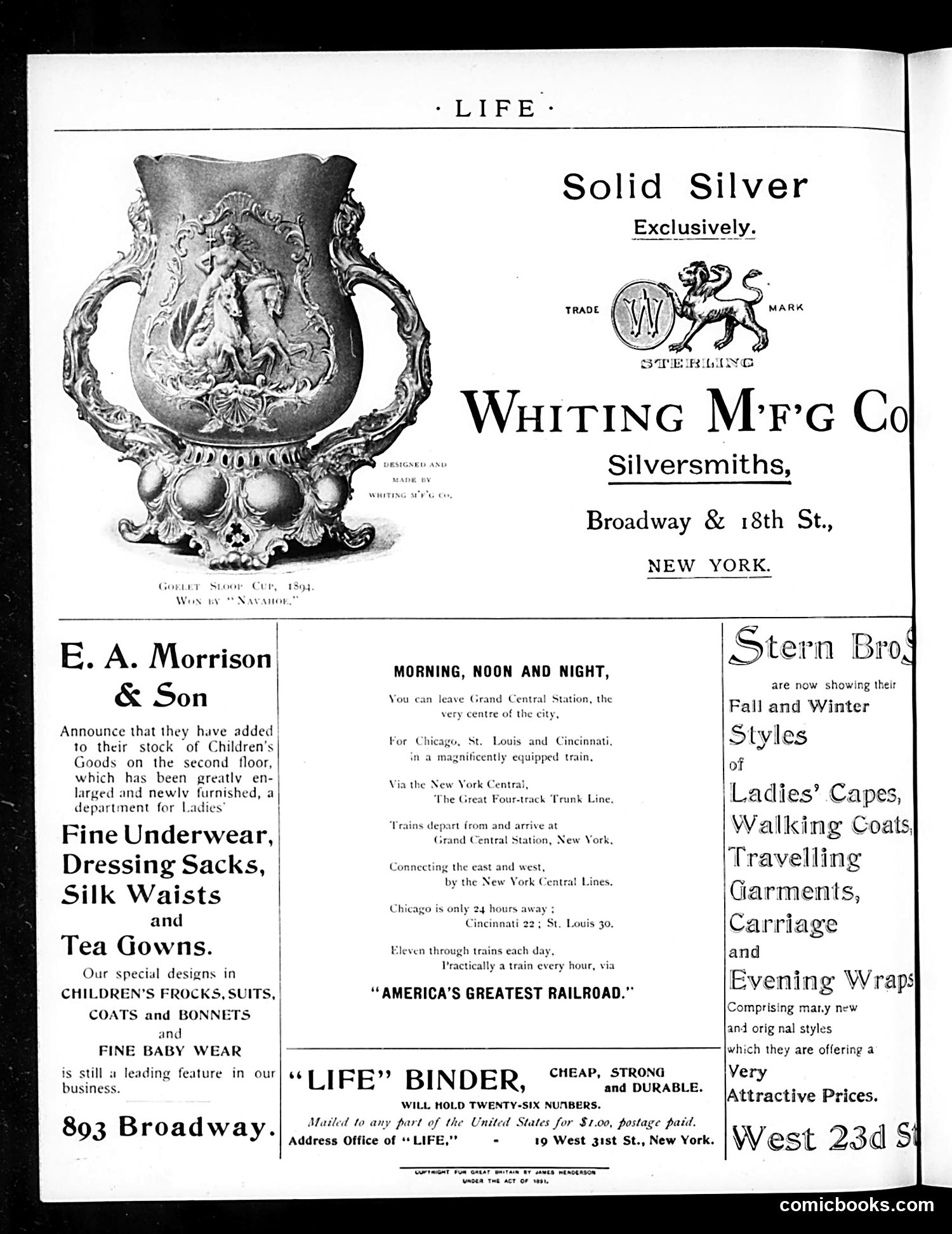
This page is **primarily advertising**, not political satire. It contains four commercial advertisements from late 19th-century New York: 1. **Whiting Mfg Co** (center-top): A silversmith advertising solid silver goods, featuring an ornate cup won by "Navaroe" 2. **E.A. Morrison & Son** (left): Children's clothing and fine baby wear at 893 Broadway 3. **New York Central Railroad** (center): Promoting train service to Chicago, St. Louis, and Cincinnati—"America's Greatest Railroad" 4. **Stern Bros** (right): Department store advertising fall/winter ladies' fashion items The page also advertises a "Life Binder" for collecting magazine issues. There is **no political cartoon or satirical content** visible here—this is a standard commercial page from *Life* magazine's advertising section.
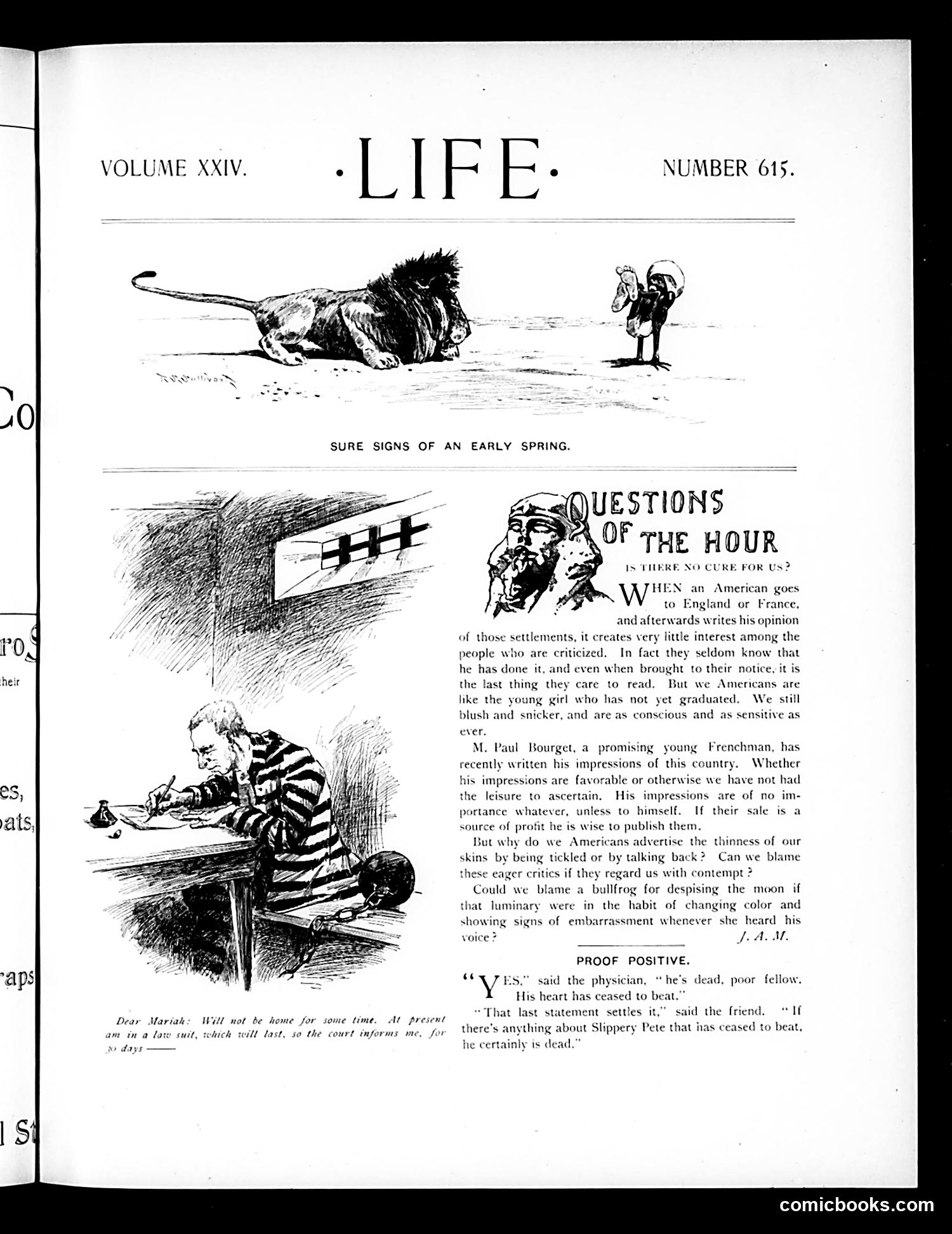
**Top Cartoon:** "Sure Signs of an Early Spring" shows a large dog shaking off winter mud while a small figure (likely a child) watches. This is straightforward visual humor about seasonal change and messy pets. **Main Article:** "Questions of the Hour—Is There No Cure for Us?" discusses American tourists abroad, particularly referencing M. Paul Bourget's recent critical writings about America. The satire targets Americans' defensive reactions to foreign criticism, suggesting Americans are embarrassed by perceived rudeness or cultural shortcomings when traveling in Europe. The piece humorously compares this self-consciousness to a young girl blushing after misbehavior. **Bottom Section:** "Proof Positive" is a brief comic dialogue about a deceased man named "Slippery Pete," playing on dark humor about confirmation of death.
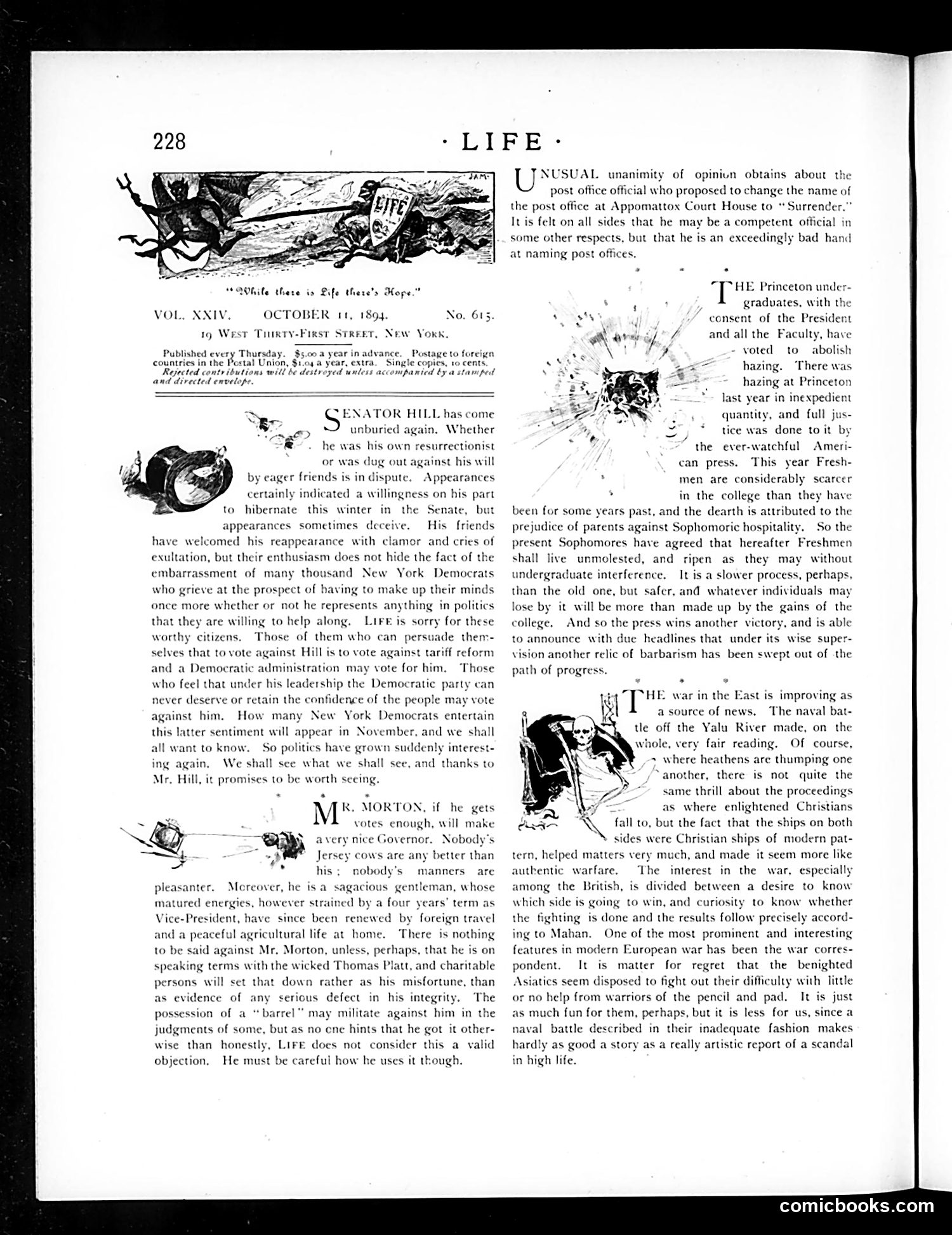
The page contains three editorial sections with accompanying illustrations rather than a single unified cartoon. **Top cartoon**: Shows a chaotic creature labeled "LIFE" - satirizing the magazine itself or life's unpredictability. **Main content**: Three separate political commentaries: 1. **Senator Hill**: Criticized for his inconsistent political positions and ambitions, portrayed as unreliable despite Democratic Party support. 2. **Mr. Morton**: Praised as a potential gubernatorial candidate, described as having good manners and agricultural experience, though questioned about past Vice-Presidential service. 3. **The war in the East**: Discussion of the Yalu River naval battle (likely Sino-Japanese War, 1894-95), criticizing inadequate war reporting from that theater. The page exemplifies *Life*'s format of mixing political satire with contemporary news commentary.
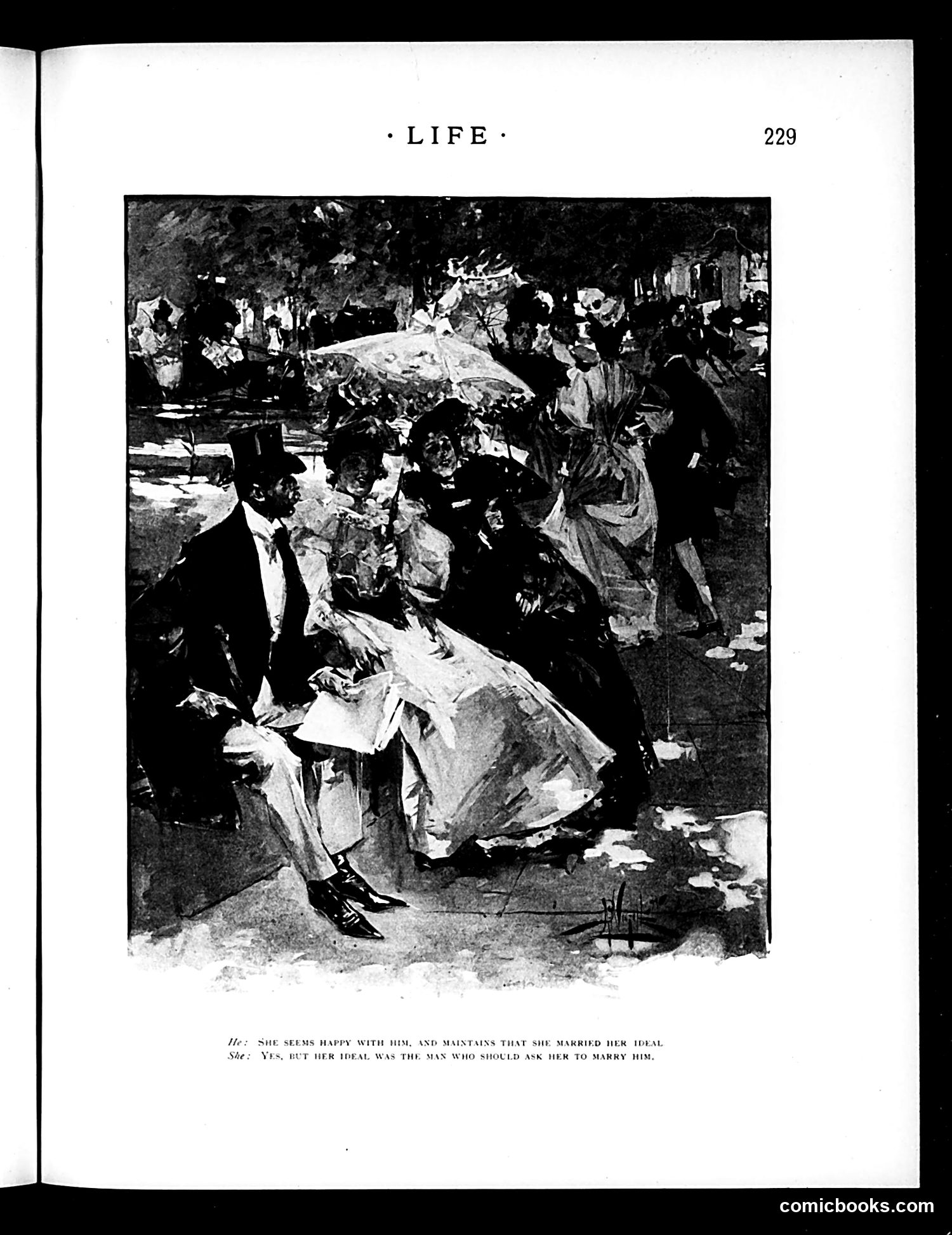
This page from *Life* magazine (page 229) depicts a social scene at what appears to be a park or public garden gathering. The caption reads: "He: SHE SEEMS HAPPY WITH HIM, AND MAINTAINS THAT SHE MARRIED HER IDEAL. She: YES, BUT HER IDEAL WAS THE MAN WHO SHOULD ASK HER TO MARRY HIM." The satire targets romantic expectations and marriage customs, specifically critiquing women's passive role in courtship. The joke suggests the woman settled for whoever proposed, rather than marrying her genuine ideal partner. It mocks the limited agency women had—they could only accept proposals, not actively pursue their preferences. This reflects early 20th-century gender dynamics where marriage proposals were initiated exclusively by men, leaving women in a subordinate position despite their stated satisfaction.
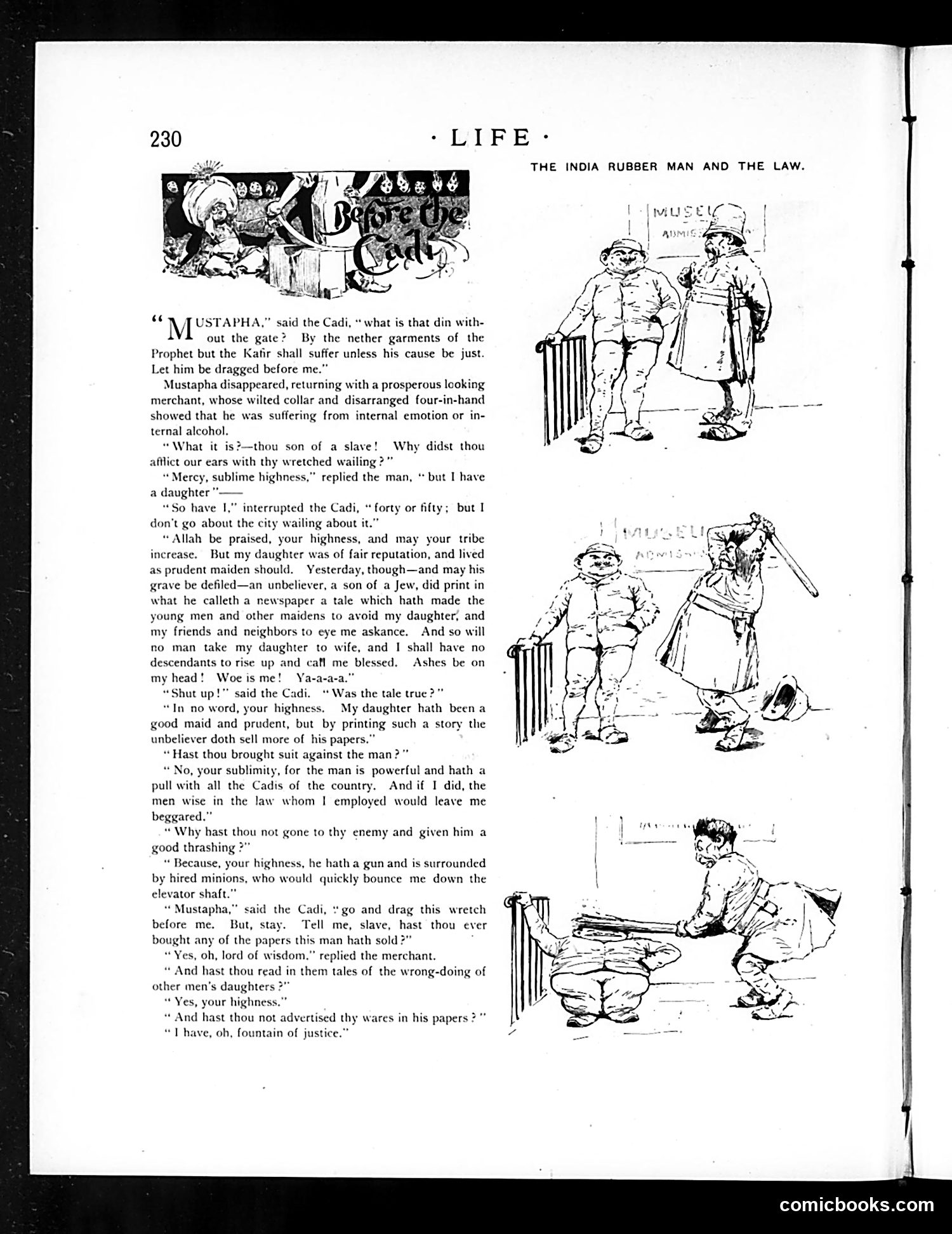
This satirical piece depicts a confrontation between a Cadi (Islamic judge) and a merchant described as an "India rubber man"—likely referring to someone whose morality is flexible or who bends rules. The narrative centers on the merchant's daughter being seduced and a subsequent lawsuit threat. The Cadi interrogates the merchant about his complicity, insinuating he lacks principles ("son of a slave," "wretched wailing"). The satire targets both characters: the merchant's hypocritical invocation of justice while admitting he advertises products deceptively, and the Cadi's performative outrage masking corruption (he admits the powerful defendant has connections preventing legal action). The joke exposes institutional and personal dishonesty across cultures regarding commerce and justice.
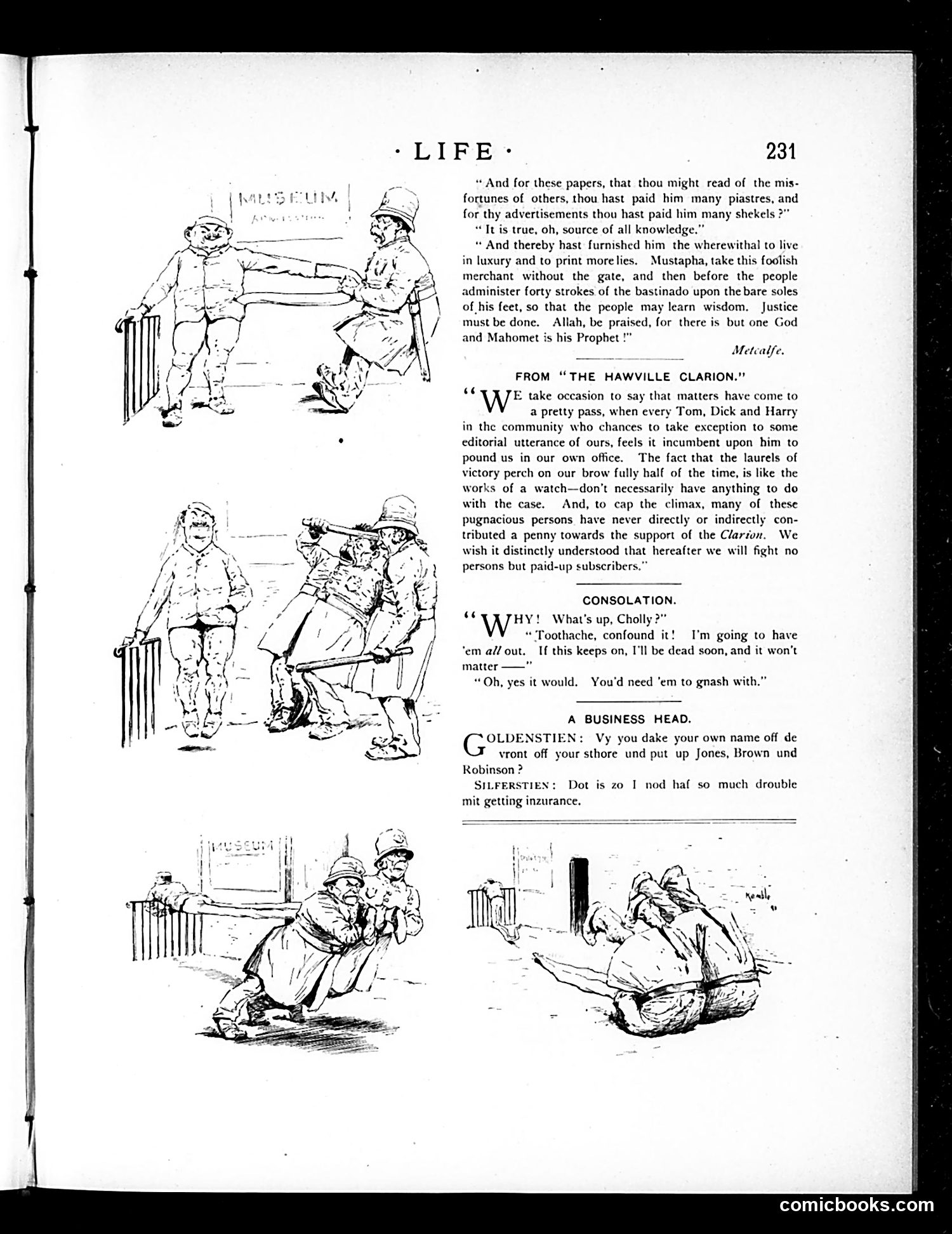
This page contains satirical sketches and brief humorous dialogues typical of Life's format. The top section quotes from "The Hawville Clarion," a fictional publication, mocking local newspapers that print trivial community gossip and expect free advertising from businesses. The "Consolation" dialogue jokes about dental problems, while "A Business Head" depicts a merchant named Silferstien explaining his business strategy to Goldenstien—likely using Jewish surnames for comedic effect, reflecting period stereotypes about merchants and commerce. The accompanying sketches show exaggerated physical comedy and character types common to early 20th-century American humor. Without publication date visible, the exact historical moment remains unclear, though the illustration style and typeface suggest early 1900s.
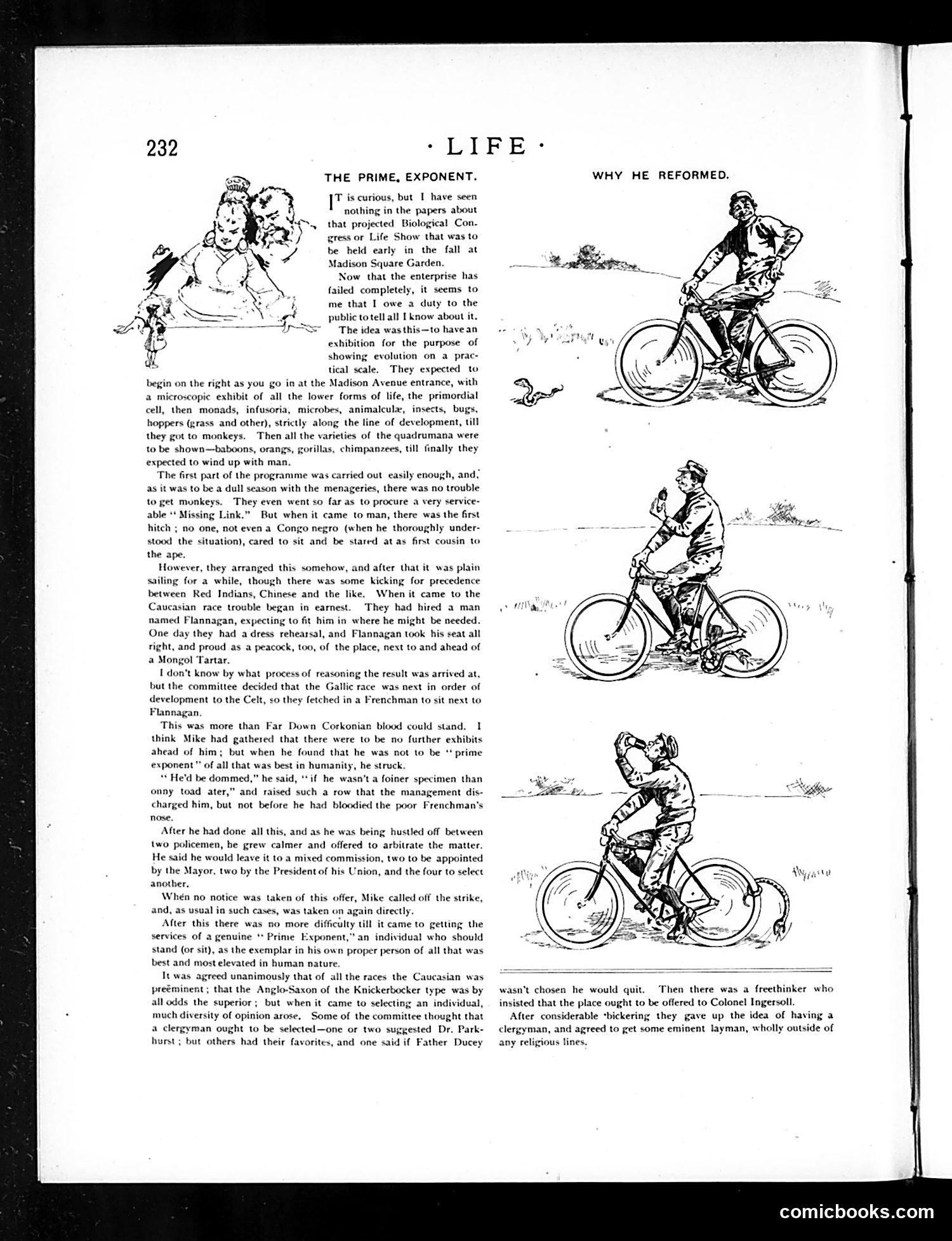
This page satirizes a failed "Biological Congress" exhibition planned for Madison Square Garden that was supposed to display evolution from lower life forms to humans. The text explains that organizers intended to feature primates progressing to humans, but encountered problems when selecting a human representative. The right-side illustrations show various figures on bicycles, apparently depicting different proposed candidates for representing "man" in the exhibit. The satire concerns the committee's difficulty finding someone they deemed sufficiently representative of human development and dignity. The text humorously recounts disputes over whether a Caucasian or Anglo-Saxon type should be selected, and mentions consideration of clergymen or other "elevated" persons. The bicycles may represent the candidates' varying social standings or abilities.
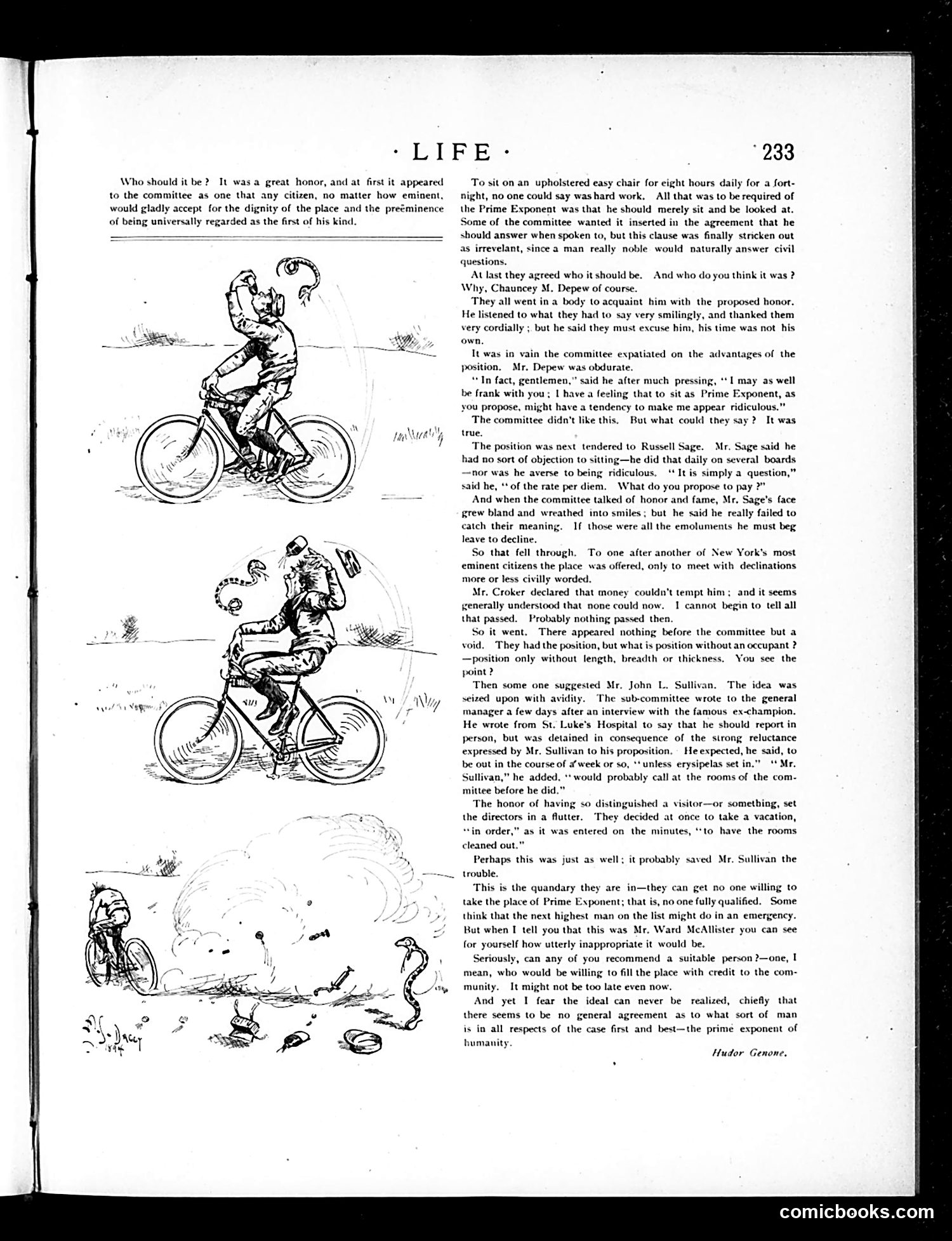
This page satirizes the search for someone to fill the honorific position of "Prime Exponent." The text describes a committee offering what they claim is a prestigious role, but reveal it to actually require sitting in an upholstered chair for eight hours daily—essentially a do-nothing job. The cartoons show cyclists in various states of chaos and accident, illustrating the candidates' reactions and the absurdity of the position. Referenced candidates include Chauncey M. Depew, Mr. Sage, and Mr. Croker (likely prominent New York figures of the era). The satire mocks both the committee's attempt to fill a meaningless role with prestige and the wealthy men's reluctance to accept even cushy, effortless positions—critiquing Gilded Age attitudes toward honor and compensation.
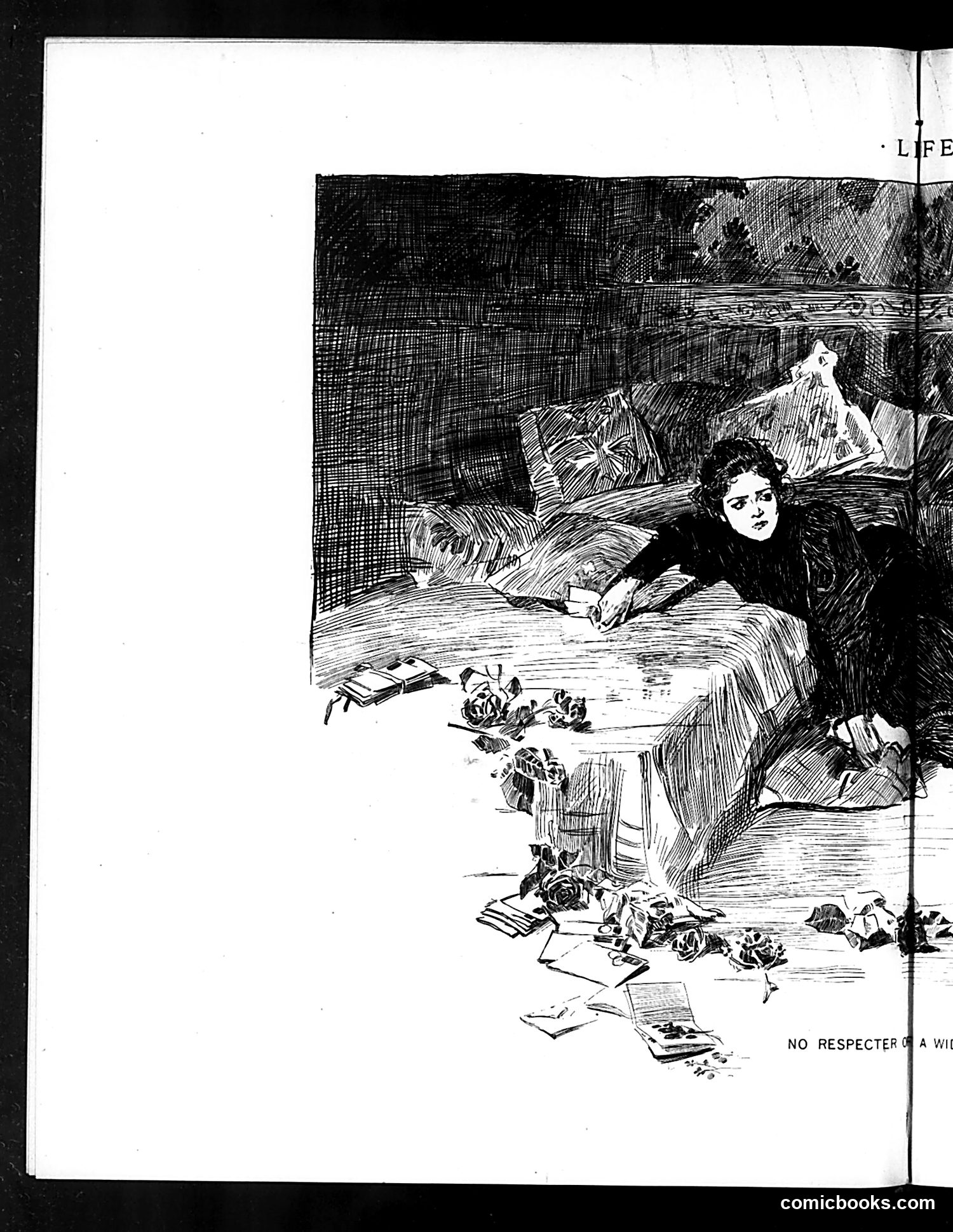
This illustration depicts a woman reclining on a bed surrounded by scattered letters and flowers. The caption "NO RESPECTER OF A WIT" suggests social commentary about gender dynamics or romantic rejection. The scene appears to satirize a witty or clever man (likely a writer or intellectual) being spurned or ignored by a woman despite his romantic gestures—the flowers and letters strewn about indicate failed courtship attempts. The woman's dismissive pose and expression suggest she is indifferent to his cleverness or charm. The humor lies in the ironic reversal: intelligence or wit, typically valued traits, prove ineffective in romantic pursuit. This reflects early 20th-century satirical commentary on changing gender relations and women's independence from male intellectual or romantic authority.
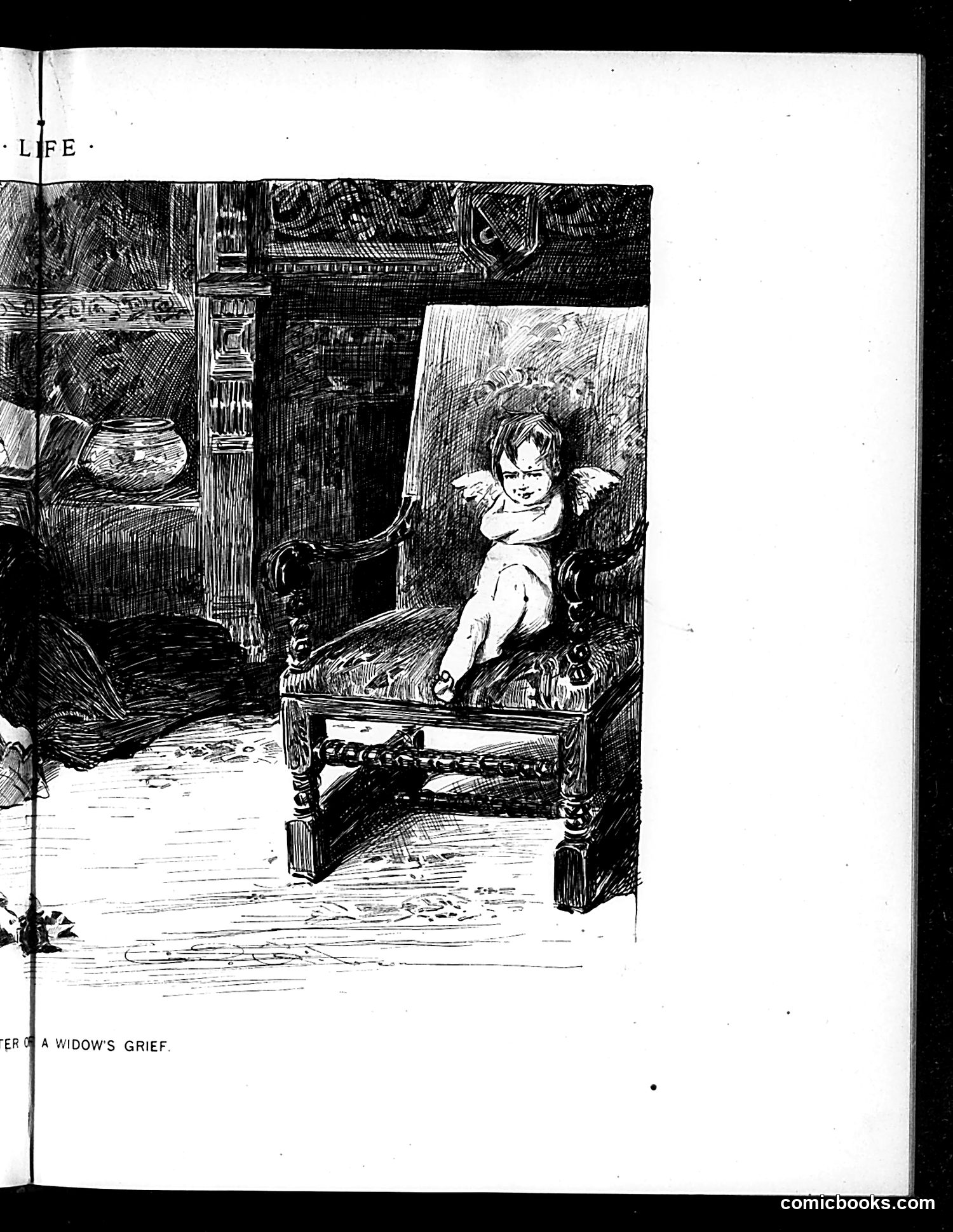
This is an engraving titled "A Widow's Grief" showing an angelic cherub or cupid figure sitting alone on an ornate chair in what appears to be a domestic interior. The cherub has wings and looks downward with a sorrowful expression, wrapped in draped fabric. The title suggests this depicts personified grief—likely the "widow" is represented by the cherub figure rather than a human woman. This appears to be sentimental or allegorical artwork rather than political satire. The emotional tone and classical artistic style emphasize melancholy and loss. Without additional context or byline visible, I cannot identify the artist or the specific occasion this may reference. The image represents the type of moralistic, emotionally evocative content Life magazine published alongside its satirical material.
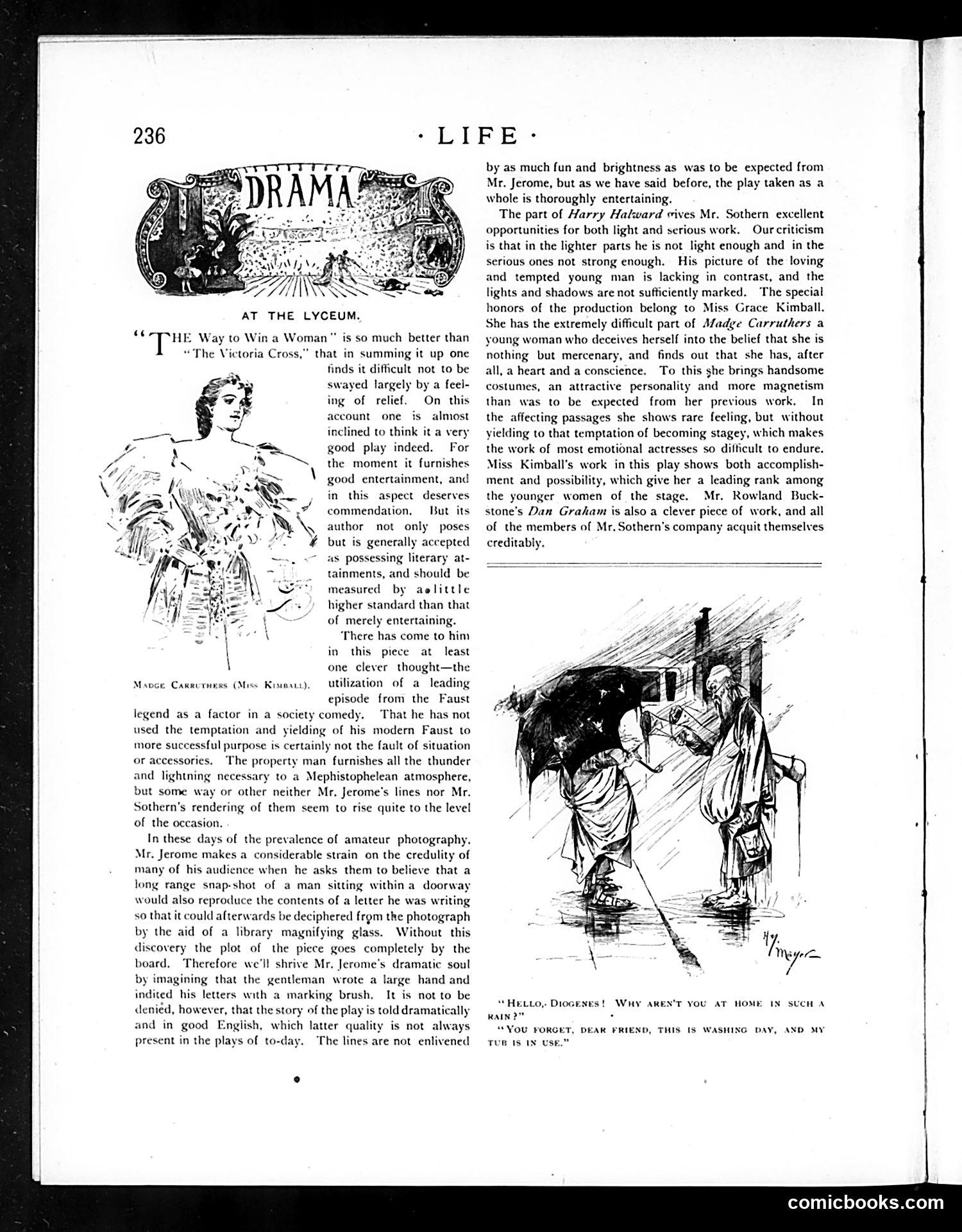
This is a theater review page from *Life* magazine critiquing the play "The Way to Win a Woman" at the Lyceum Theatre. The review discusses the production's strengths and weaknesses, praising actress Grace Kimball's performance as particularly noteworthy. The cartoon below illustrates a humorous domestic scene: a woman encounters a man in the rain and asks why he isn't home on washing day. His reply—that the tub is in use—is the joke's punchline, suggesting he's deliberately avoiding domestic duties by staying out. The review itself contains satire about the play's implausible plot device: a photograph supposedly capturing readable text from a letter viewed through a doorway, which the critic mocks as requiring the writer to have used a brush like a marking tool for such clarity to be possible. The page represents typical turn-of-century theatrical criticism combined with domestic humor common to *Life*'s satirical approach.
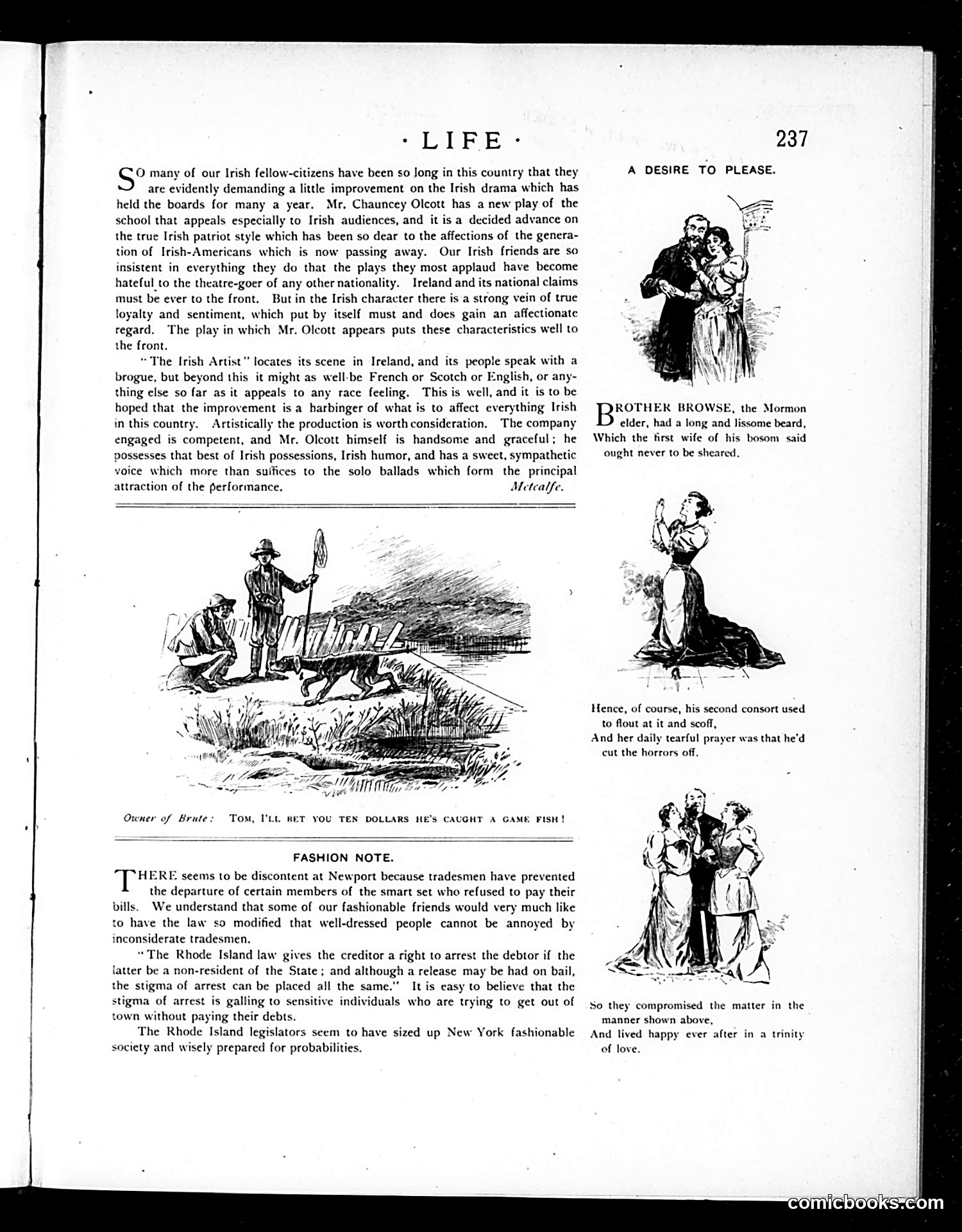
This page contains three distinct satirical pieces: **"The Irish Artist" Review**: Critiques Chauncey Olcott's new play favorably, noting Irish-American audiences' intense nationalism. The text praises the play for moving beyond heavy-handed patriotic drama toward more universal themes, while acknowledging Irish character's genuine appeal. **"Owner of Brute" Cartoon**: Shows a man offering to bet $10 that he's caught a game fish. The joke is unclear without fuller context, but likely plays on rural/rustic humor. **"A Desire to Please"**: A three-panel joke about "Brother Browse," a Mormon elder with a distinctive beard. His first wife loves it; his second wife hates it. The resolution: they compromise by shaving half the beard, allowing both wives satisfaction in their "trinity of love." This mocks Mormon polygamy as inherently absurd, turning the beard dispute into commentary on the impossibility of managing multiple spouses' conflicting desires. **"Fashion Note"**: Satirizes wealthy Newport society figures who avoid paying debts by fleeing Rhode Island, criticizing both their entitlement and Rhode Island's practical debtor-arrest laws targeting precisely such behavior.
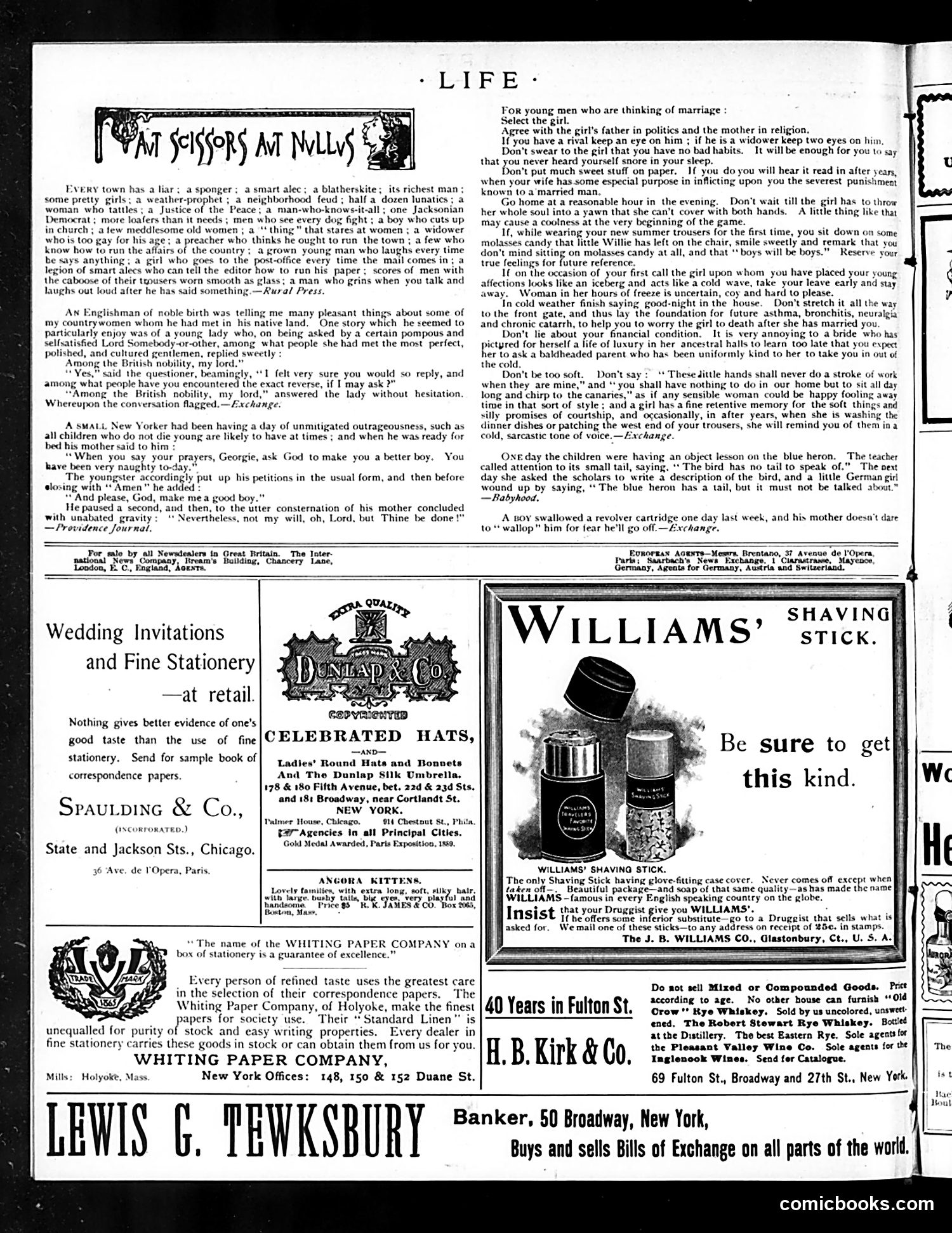
This page is primarily **humorous essays and social commentary** rather than political cartoons. The content consists of three satirical pieces targeting social behavior: 1. **"Bars at Nullys"** - A catalog of typical small-town characters (liars, spongers, busybodies), poking fun at rural American archetypes. 2. **British Nobility Anecdote** - A witty exchange where an English noblewoman deflates a pompous lord by comparing him unfavorably to his own social class, mocking aristocratic pretension. 3. **The Prayer Story** - A child innocently undermines his mother's religious instruction by adding "not my will, but Thine be done"—suggesting prayer shouldn't demand obedience, only God's will. 4. **Marriage Advice** - Tongue-in-cheek guidance for young men, satirizing dating conventions (managing rivals, emotional manipulation, tolerating a wife's coldness). The rest of the page contains **period advertisements** for stationery, hats, shaving products, and banking services—typical of early-20th-century magazines. The humor throughout targets pretension, social hypocrisy, and romantic/marital awkwardness.
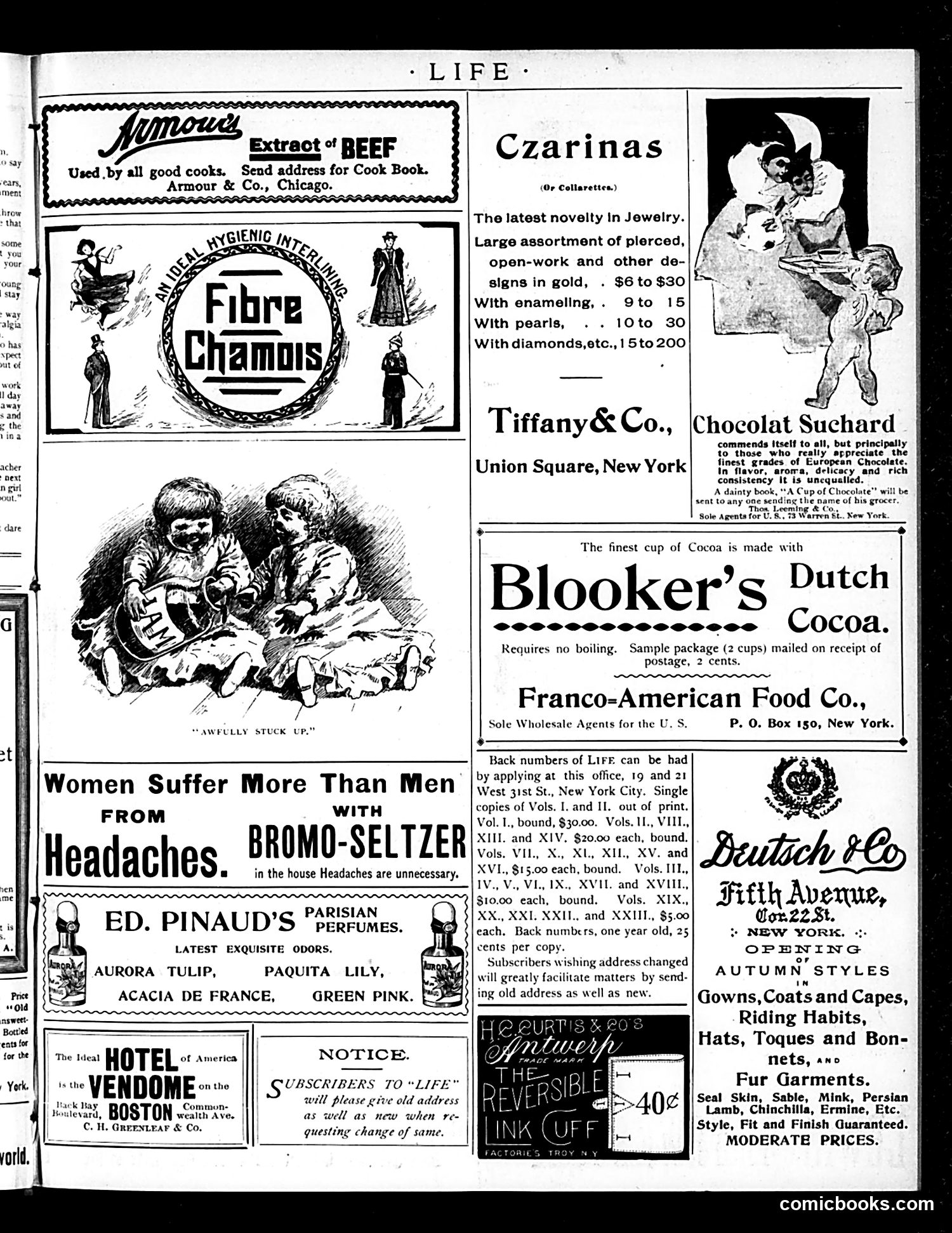
This is primarily an **advertising page** from an early American *Life* magazine (likely 1890s-1900s based on style). The one cartoon present—titled "Awfully Stuck Up"—shows two poorly-dressed children examining a fancy doll or toy, satirizing class pretension: children mimicking adult snobbery despite their own shabby circumstances. The bulk of the page comprises period advertisements for luxury goods (Tiffany jewelry, French perfumes, furs) and patent medicines (Bromo-Seltzer for "women's headaches," cocoa, beef extract). One ad notably claims "Women Suffer More Than Men FROM Headaches"—reflecting Victorian-era gender stereotypes about women's supposed delicacy and nervousness. The page includes subscription information for *Life* back issues and notices about address changes, suggesting this functioned as both satirical content and commercial vehicle. The advertising reveals what affluent Americans valued: European luxury items, remedies for modern ailments, and fashionable clothing.
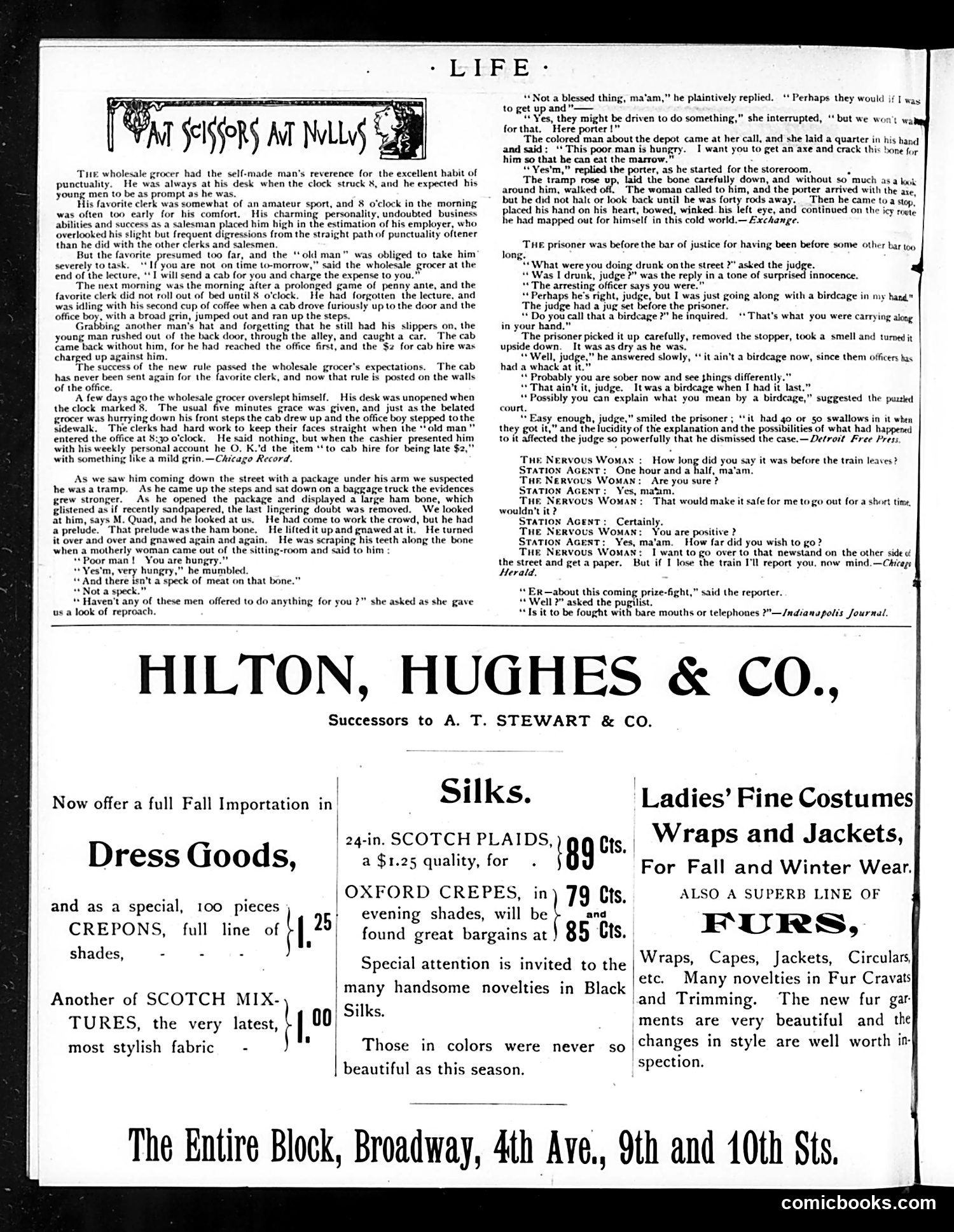
This page contains two separate satirical stories from *Life* magazine, a humorous publication popular in the late 1800s-early 1900s. **"At Scissors at Nullus"** presents two vignettes about discipline and hypocrisy: 1. A wholesale grocer threatens his habitually late favorite clerk with cab fare charges if he's tardy again. The clerk reforms immediately. The joke: when the grocer himself oversleeps, he must pay the same cab fare—humbling him before his employees who witness his hypocrisy. 2. A vagrant displays an obviously meatless ham bone to elicit sympathy from passersby. A well-meaning woman, disgusted by observers' indifference, generously gives a porter money to crack the bone for the "hungry" man—apparently missing that he's performing a con. Both stories satirize human nature: the arbitrary enforcement of rules and performative charity that rewards deception. The advertising below is for Hilton, Hughes & Co., a fabric and clothing merchant.
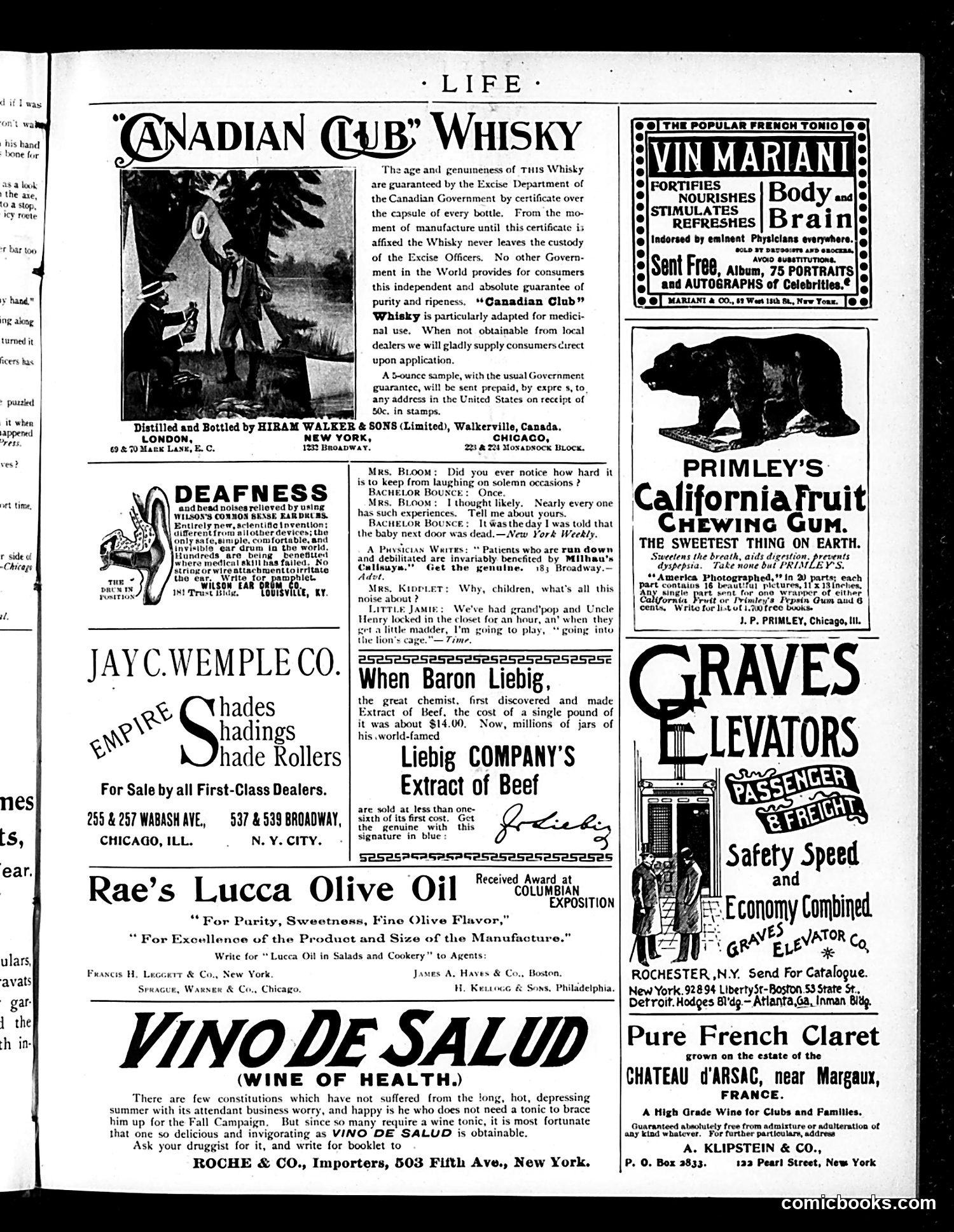
This page is primarily **advertising**, typical of early 20th-century magazines. The only editorial content is a brief dialogue joke about difficulty suppressing laughter at solemn occasions. The advertisements reflect period concerns and marketing strategies: - **Canadian Club Whisky** emphasizes government certification of purity—likely addressing widespread concern about adulterated spirits and patent medicines of dubious quality - **Liebig's Extract of Beef** references the famous chemist Baron Justus von Liebig, lending scientific credibility to a meat extract product marketed as nutritious - **Vino de Salud** ("Wine of Health") explicitly positions wine as medicinal—before FDA regulations restricted health claims - **Primley's Chewing Gum** and **Vin Mariani** (a cocaine-containing tonic) represent products marketed with health benefits that would later be regulated or banned The page reflects the pre-regulation era when manufacturers freely made curative claims for ordinary products, and when "purity" and "scientific backing" were key selling points in an unregulated marketplace.
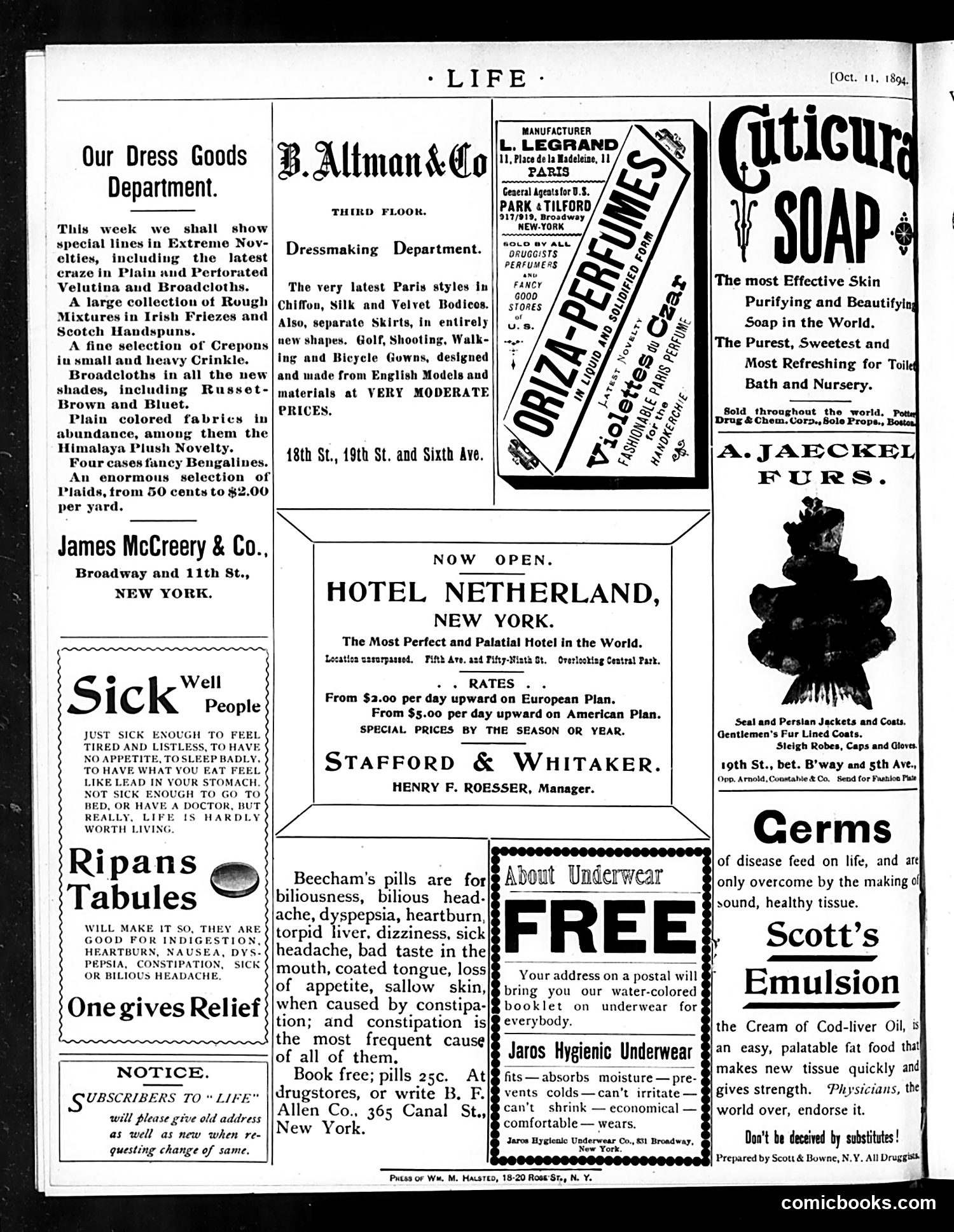
This is primarily an **advertising page** with no political cartoons or satirical content. The page showcases commercial advertisements typical of the 1890s, including: - **Department store ads** (B. Altman & Co., James McCreery & Co.) promoting dress goods and dressmaking services - **Patent medicine advertisements** (Ripans Tabules, Beecham's pills, Scott's Emulsion) featuring exaggerated health claims common to the era—promising cures for digestive ailments, constipation, and general vitality - **Hotel and luxury goods** (Hotel Netherland, A. Jaeckel Furs) - **Cuticura Soap** advertising itself as a skin purifier The only quasi-satirical element is the "Sick Well People" Ripans Tabules ad, which employs dark humor about people too ill to function but too well to seek medical care—a jab at hypochondria or patent medicine dependency. Overall, this reflects 1890s American consumer culture and the aggressive marketing of dubious remedies before FDA regulation.