
Life, 1894-10-11 · page 13 of 18
Life — October 11, 1894 — page 13: what you’re looking at
What you’re looking at
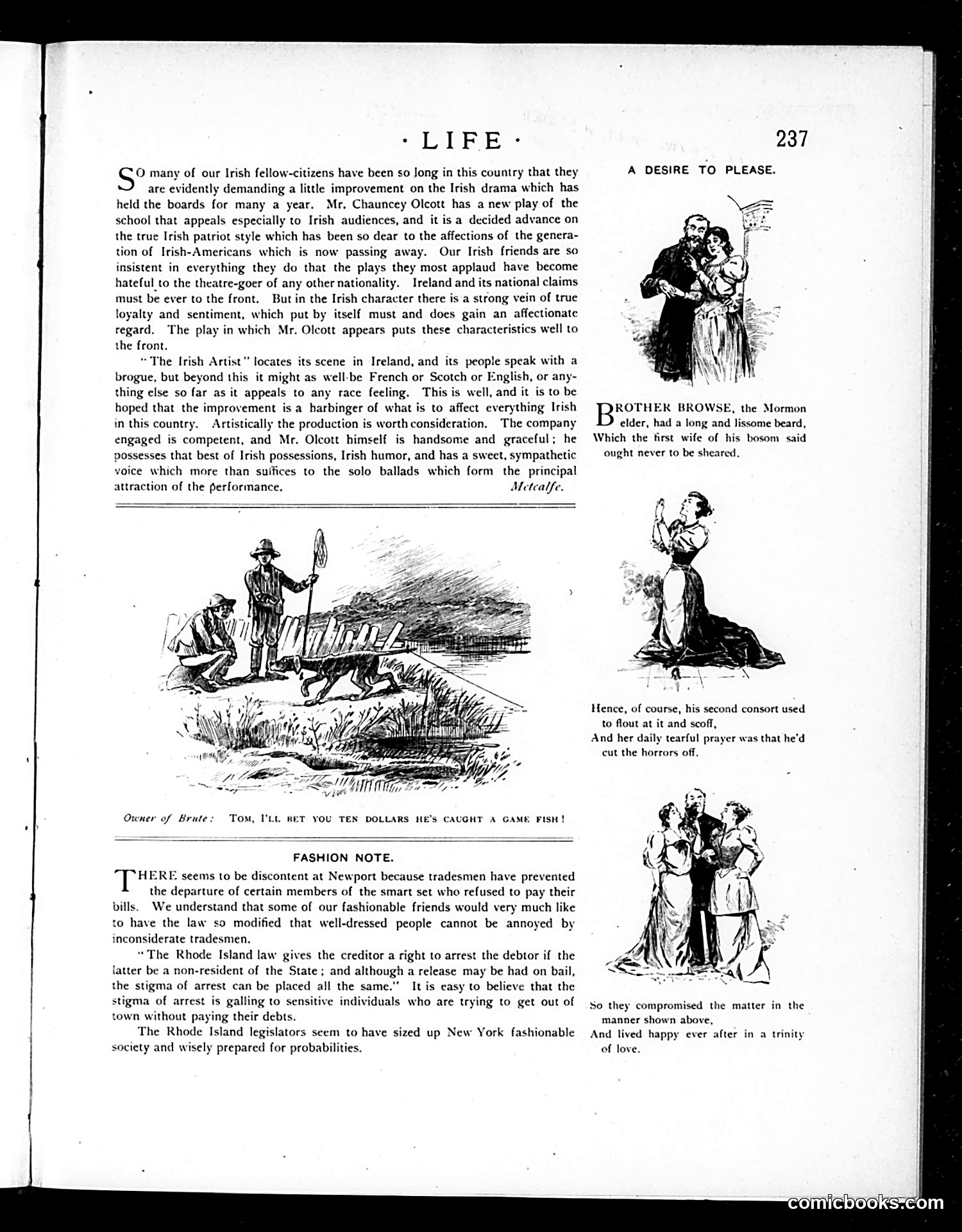
This page contains three distinct satirical pieces: **"The Irish Artist" Review**: Critiques Chauncey Olcott's new play favorably, noting Irish-American audiences' intense nationalism. The text praises the play for moving beyond heavy-handed patriotic drama toward more universal themes, while acknowledging Irish character's genuine appeal. **"Owner of Brute" Cartoon**: Shows a man offering to bet $10 that he's caught a game fish. The joke is unclear without fuller context, but likely plays on rural/rustic humor. **"A Desire to Please"**: A three-panel joke about "Brother Browse," a Mormon elder with a distinctive beard. His first wife loves it; his second wife hates it. The resolution: they compromise by shaving half the beard, allowing both wives satisfaction in their "trinity of love." This mocks Mormon polygamy as inherently absurd, turning the beard dispute into commentary on the impossibility of managing multiple spouses' conflicting desires. **"Fashion Note"**: Satirizes wealthy Newport society figures who avoid paying debts by fleeing Rhode Island, criticizing both their entitlement and Rhode Island's practical debtor-arrest laws targeting precisely such behavior.
📄 Transcribed text from this page (OCR, searchable)
Machine-transcribed from the original scan — historical spelling and the odd misread are preserved.
LIFE O many of our Irish fellow-citizens have been so Jong in this country that they are evidently demanding a little improvement on the Irish drama which has held the boards for many a year. Mr, Chauncey Olcott has a new play of the school that appeals especially to Irish audiences, and it isa decided advance on the true Irish patriot style which has been so dear to the affections of the genera- tion of Irish-Americans which is now passing away. Our Irish friends are so insistent in everything they do that the plays they most applaud have become hateful to the theatre-goer of any other nationality. Ireland and its national claims must be ever to the front. But in the Irish character there is a strong vein of true loyalty and sentiment, which put by itself must and does gain an affectionate regard. The play in which Mr. Olcott appears puts these characteristics well to the front. “The Irish Artist” locates its scene in Ireland, and its people speak with a brogue, but beyond this it might as well-be French or Scotch or English, or any- thing else so far as it appeals to any race feeling. This is well, and it is to be hoped that the improvement is a harbinger of what is to affect everything Irish in this country. Artistically the production is worth consideration. The company engaged is competent, and Mr. Olcott himself is handsome and graceful; he possesses that best of Irish possessions, Irish humor, and has a sweet, sympathetic voice which more than suffices to the solo ballads which form the principal attraction of the performance. Metcalfe. Owner of Brute: FASHION NOTE. HERE seems to be discontent at Newport because tradesmen have prevented the departure of certain members of the smart set who refused to pay their bills. We understand that some of our fashionable friends would very much like to have the law so modified that well-dressed people cannot be annoyed by inconsiderate tradesmen, “The Rhode Island law gives the creditor a right to arrest the debtor if the latter be a non-resident of the State; and although a release may be had on bail, the stigma of arrest can be placed all the same.” It is easy to believe that the stigma of arrest is galling to sensitive individuals who are trying to get out of town without paying their debts. The Rhode Island legislators seem to have sized up New York fashionable society and wisely prepared for probabilities. 237 A DESIRE To PLEASE. ROTHER BROWSE, the Mormon elder, had a long and lissome beard, Which the first wife of his bosom said ought never to be sheared, Hence, of course, his second consort used to flout at it and scoff, And her daily tearful prayei cut the horrors off. So they compromised the matter in the manner shown above, And lived happy ever after in a trinity of love.