
Life, 1894-10-11 · page 12 of 18
Life — October 11, 1894 — page 12: what you’re looking at
What you’re looking at
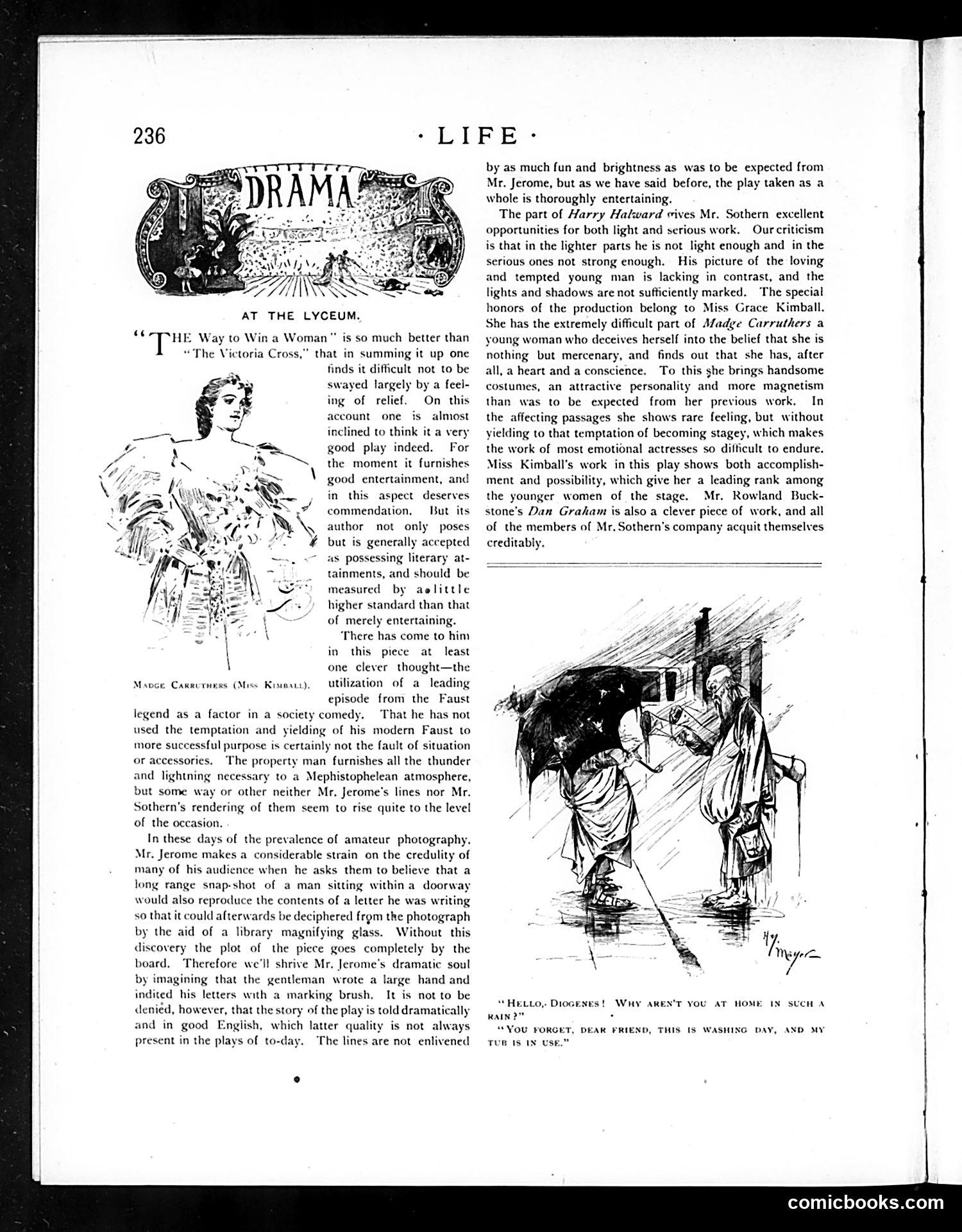
This is a theater review page from *Life* magazine critiquing the play "The Way to Win a Woman" at the Lyceum Theatre. The review discusses the production's strengths and weaknesses, praising actress Grace Kimball's performance as particularly noteworthy. The cartoon below illustrates a humorous domestic scene: a woman encounters a man in the rain and asks why he isn't home on washing day. His reply—that the tub is in use—is the joke's punchline, suggesting he's deliberately avoiding domestic duties by staying out. The review itself contains satire about the play's implausible plot device: a photograph supposedly capturing readable text from a letter viewed through a doorway, which the critic mocks as requiring the writer to have used a brush like a marking tool for such clarity to be possible. The page represents typical turn-of-century theatrical criticism combined with domestic humor common to *Life*'s satirical approach.
📄 Transcribed text from this page (OCR, searchable)
Machine-transcribed from the original scan — historical spelling and the odd misread are preserved.
LIFE Ey NS \ eS ace AT THE LYCEUM. Way to Win a Woman” is so much better than ‘The Victoria Cross,” that in summing it up one finds it difficult not to be swayed largely by a feel- ing of relief. On this account one is almost inclined to think it a very good play indeed. For the moment it furnishes good entertainment, and in this aspect deserves commendation. But its author not only poses but is generally accepted as possessing literary at- tainments, and should be measured by aelittle higher standard than that of merely entertaining. There has come to him in this piece at least one clever thought—the Mavce Caxactness (Miss Kisinau:), utilization of a leading episode from the Faust legend as a factor in a society comedy. ‘That he has not used the temptation and yielding of his modern Faust to more successful purpose is certainly not the fault of situation or accessories. The property man furnishes all the thunder and lightning necessary to a Mephistophelean atmosphere, but some or other neither Mr, Jerome’s lines nor Mr. Sothern’s rendering of them seem to rise quite to the level of the occasion. In these days of the prevalence of amateur photography, Mr. Jerome makes a considerable strain on the credulity of many of his audience when he asks them to believe that a long range snap-shot of a man sitting within a doorway would also reproduce the contents of a letter he was writing so that it could afterwards be deciphered from the photograph by the aid of a library magnifying glass. Without this discovery the plot of the piece goes completely by the board. Therefore we'll shrive Mr. Jerome's dramatic soul by imagining that the gentleman wrote a large hand and indited his letters with a marking brush, It is not to be deniéd, however, that the story of the play is told dramatically and in good English, which latter quality is not always present in the plays of to-day. The lines are not enlivened by as much fun and brightness as was to be expected from Mr. Jerome, but as we have said before, the play taken as a whole is thoroughly entertaining. The part of Harry Halward vives Mr. Sothern excellent opportunities for both light and serious work. Our criticism is that in the lighter parts he is not light enough and in the serious ones not strong enough. His picture of the loving and tempted young man is lacking in contrast, and the lights and shadows are not sufficiently marked. The special honors of the production belong to Miss Grace Kimball. She has the extremely difficult part of Afadge Carruthers a young woman who deceives herself into the belief that she is nothing but mercenary, and finds out that she has, after all, a heart and a conscience. To this she brings handsome costumes, an attractive personality and more magnetism than was to be expected from her previous work. In the affecting passages she shaws rare feeling, but without yielding to that temptation of becoming stagey, which makes the work of most emotional actresses so dilticult to endure. Miss Kimball's work in this play shows both accomplish- ment and possibility, which give her a leading rank among the younger women of the stage. Mr. Rowland Buck- stone's Dan Graham is also a clever piece of work, and all of the members of Mr. Sothern’s company acquit themselves creditably. Why aReN'T YoU AT HOME IN SUCH A DEAR FRIEND, THIS IS WASHING DAY, AND MY comicbooks.com