
A complete issue · 26 pages · 1893
Life — November 23, 1893
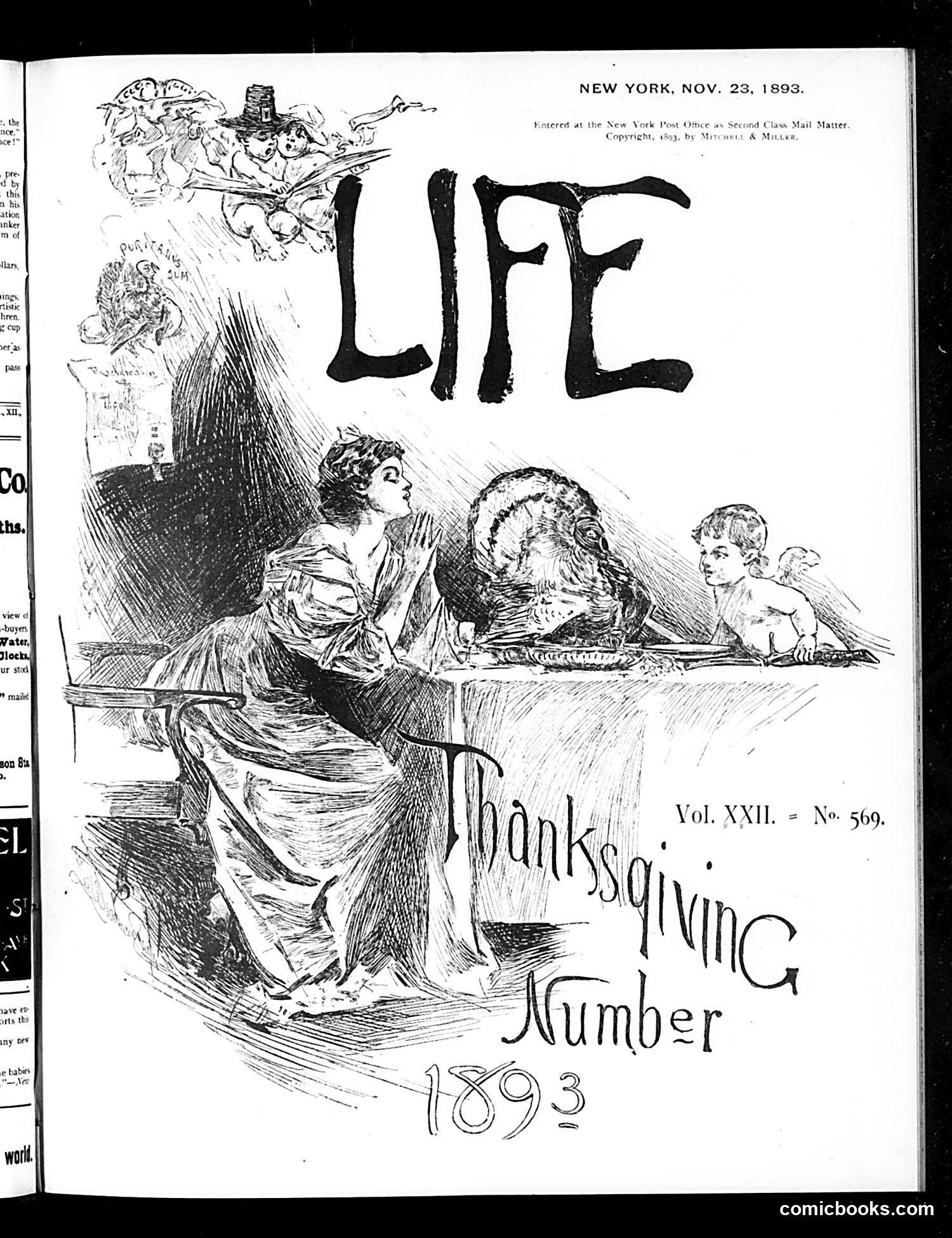
This is the cover of Life's Thanksgiving number for 1893. The central illustration shows a woman (personifying America or the home) seated at a table with cherubs/children, presenting a turkey—the traditional Thanksgiving symbol. The decorative header features Thanksgiving imagery: cornucopia, harvest abundance, and cherubs in a classical style typical of the era's allegorical art. The satire likely comments on American domestic prosperity or national bounty during this period, though without additional context from inside the magazine, the specific political message remains unclear. The ornamental typography and celebratory tone suggest this is straightforward holiday content rather than sharp political commentary—possibly just seasonal editorial decoration emphasizing themes of gratitude and American abundance.
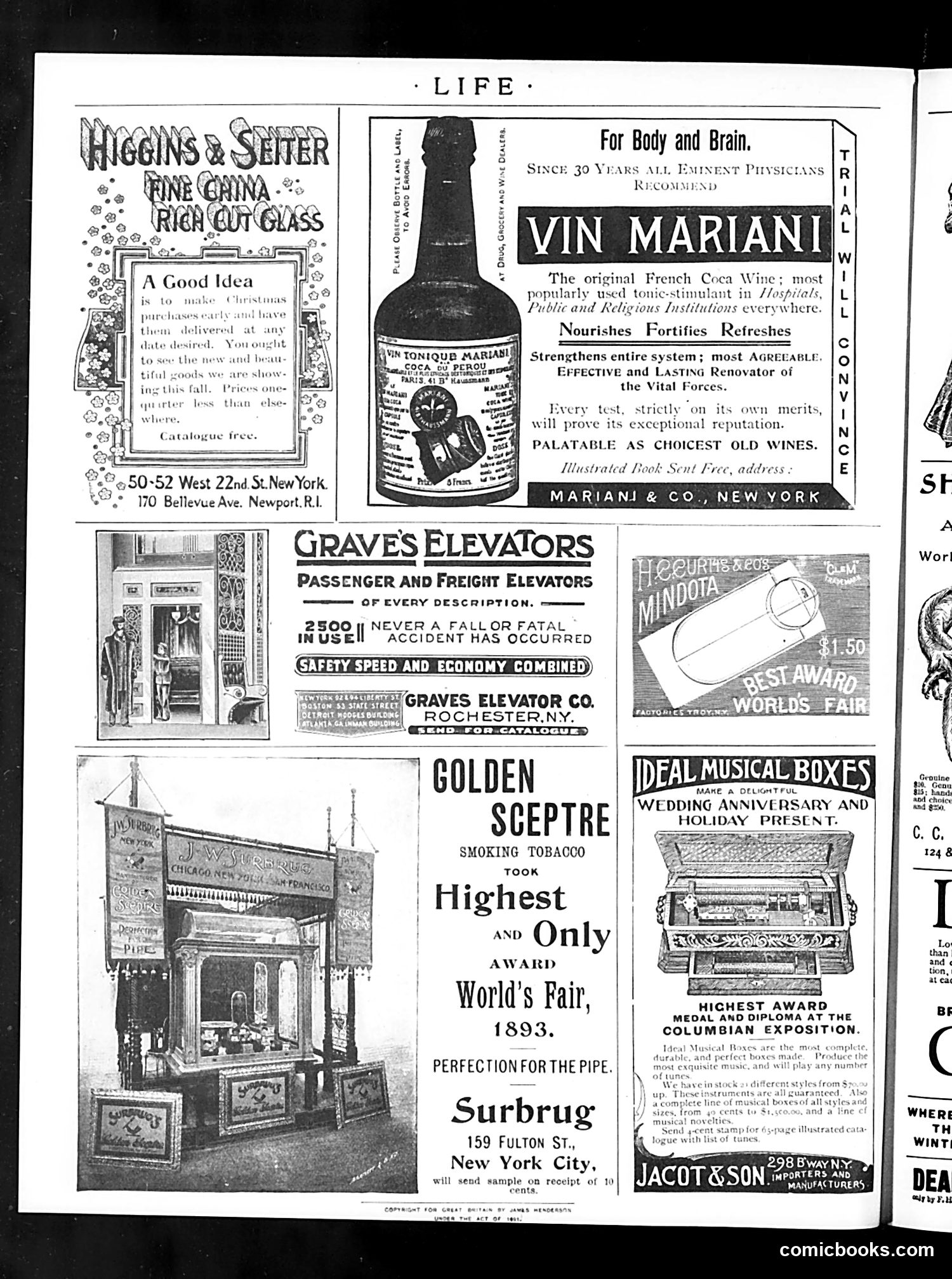
This page is **primarily advertising**, not satirical content. It contains four distinct advertisements: 1. **Higgins & Seiter** (top left): Fine china and glassware retailer promoting Christmas deliveries. 2. **Vin Mariani** (top right): A French coca wine marketed as medicinal, claiming endorsement from "eminent physicians" and suitable for "hospitals and religious institutions." 3. **Graves Elevators** (middle): Safety-focused elevator company claiming "never a fall or fatal accident has occurred." 4. **Golden Sceptre Tobacco** and **Ideal Musical Boxes** (bottom): Tobacco product claiming a World's Fair award, and music boxes marketed as holiday gifts. The page reflects late 19th-century consumer culture, including now-banned medical claims (wine as brain tonic) and unregulated product advertising typical of that era.
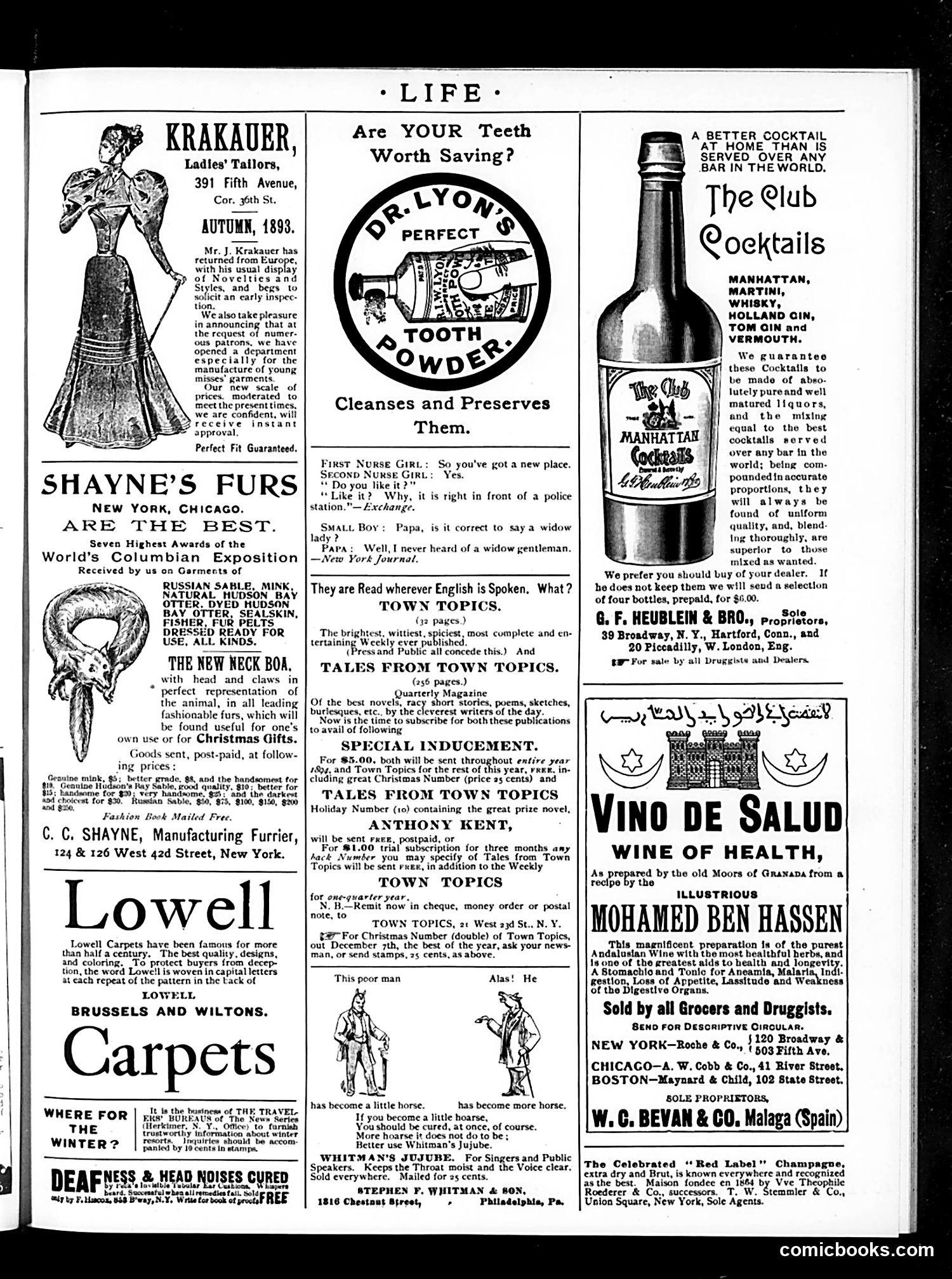
This page is **primarily advertising**, with one small cartoon at the bottom left. The cartoon labeled "This poor man" / "Alas! He" shows two figures and brief text about someone becoming "a little horse." This appears to be a **medical/health joke** common to the era, likely referencing a condition or ailment, possibly playing on the phrase "I'm hoarse" (losing one's voice). The parallel "has become more horse" suggests a before-and-after comparison of physical deterioration. The rest of the page consists of product advertisements typical of 1893: Krakauer fashions, Dr. Lyon's tooth powder, Club cocktails, Lowell carpets, and various patent medicines and tonics. These ads reflect late-Victorian consumer culture and the era's heavy marketing of questionable health products. The magazine's satirical purpose is unclear from this particular page.
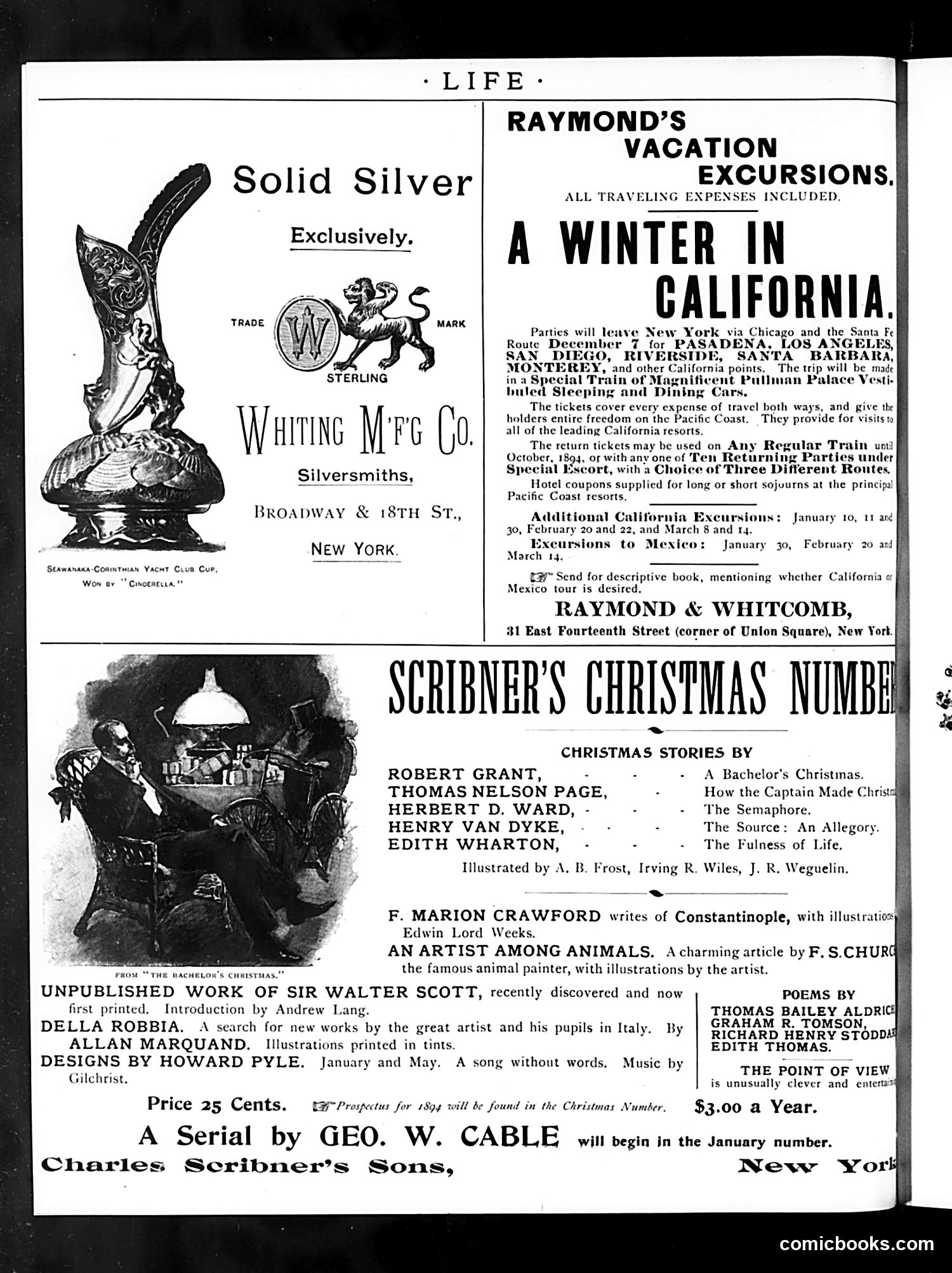
This page is primarily **advertising and editorial content** rather than political satire. The top left advertises Whiting Manufacturing Company's solid silver goods with a decorative yacht club trophy image. The right side promotes Raymond & Whitcomb's vacation excursions to California and Mexico, emphasizing luxury travel with sleeping cars and dining facilities. The lower half announces **Scribner's Christmas Number**, listing contributing authors (Robert Grant, Thomas Nelson Page, Herbert D. Ward, Henry Van Dyke, Edith Wharton) and illustrators. It mentions unpublished Walter Scott work and articles on Constantinople and animal painting. There is **no political cartoon or satirical content** visible on this page—it functions as a commercial and literary announcement section of Life magazine, priced at 25 cents.
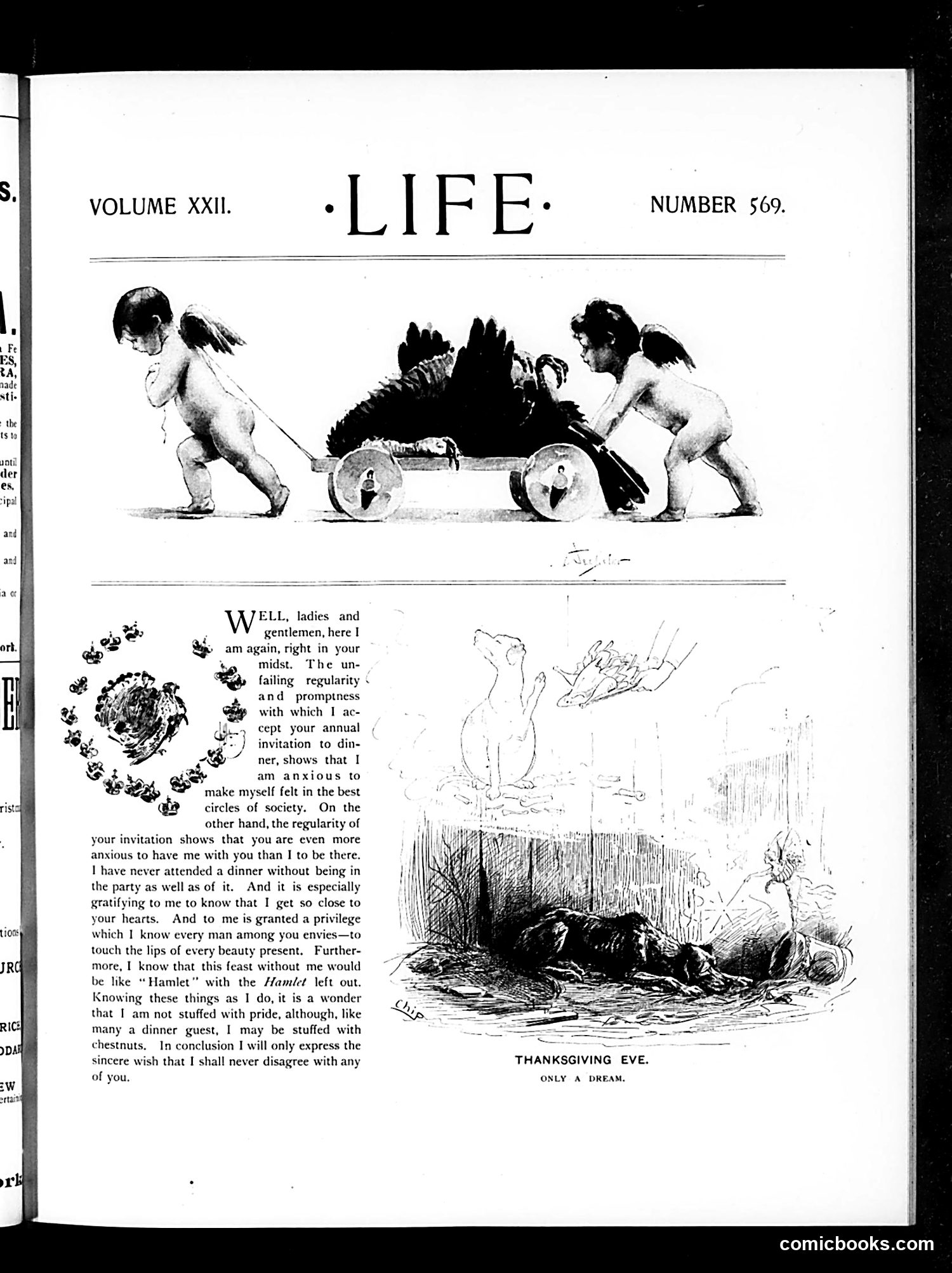
The top illustration depicts cherubic cupids operating a cart or wagon laden with what appears to be dark cargo—likely representing the commercialization of romantic sentiment around Valentine's Day or similar occasions. The lower illustration titled "THANKSGIVING EVE: ONLY A DREAM" shows a sleeping figure surrounded by food, with ethereal imagery suggesting a fantasy or nightmare vision. The accompanying text is a satirical dinner invitation acceptance, where the speaker expresses gratitude for social inclusion while humorously noting they attend dinners primarily for the food ("stuffed with chestnuts"). The satire mocks dinner etiquette and social pretense—the speaker claims to desire only the "privilege" of proximity to beauty, while really being motivated by appetite. This represents early 20th-century American satirical commentary on social hypocrisy and materialism.
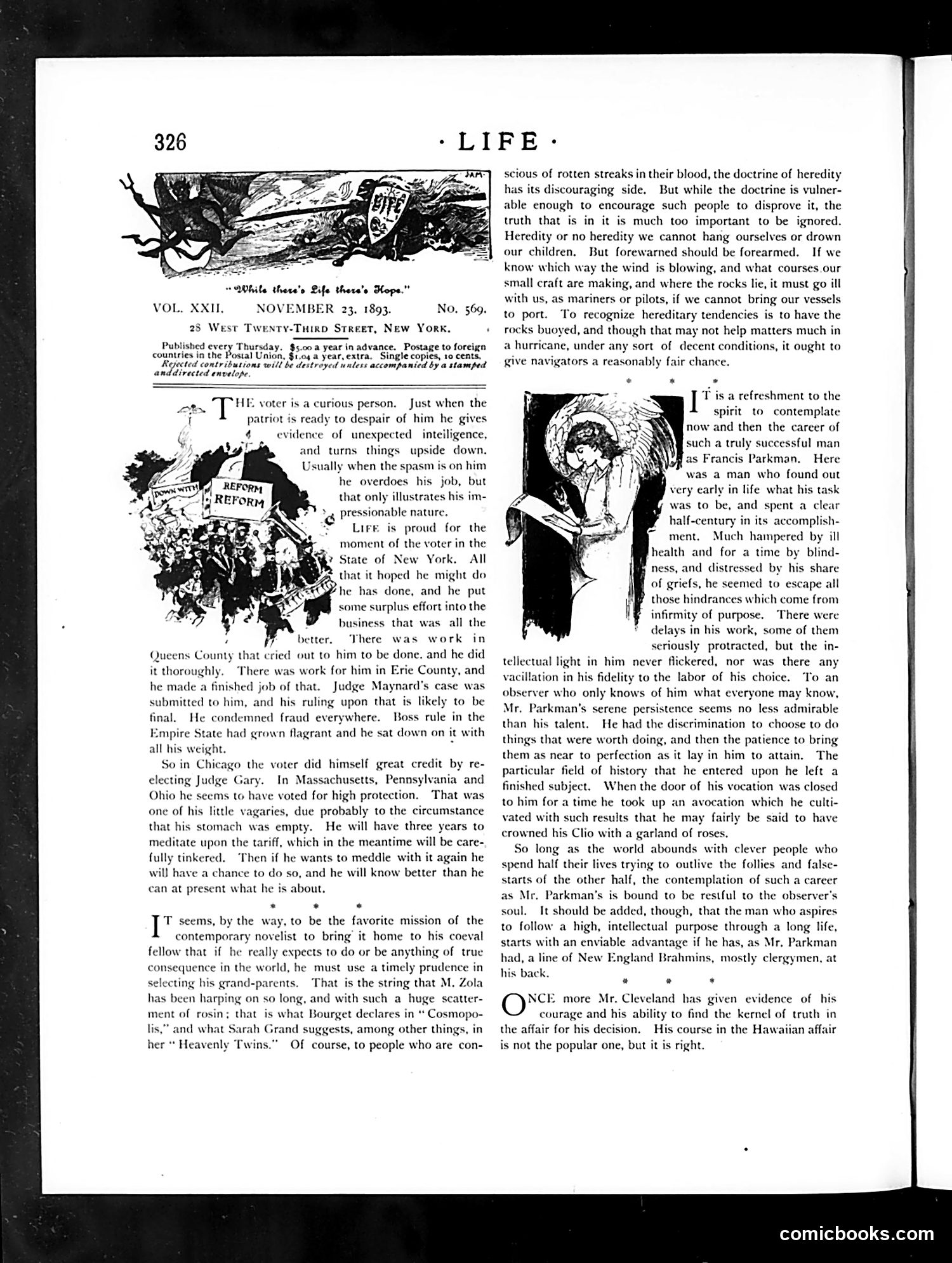
This page from *Life* magazine (November 23, 1893) contains two main elements: **Left cartoon:** A satirical illustration titled "While there's Life there's Hope" depicts a figure labeled "REFORM" being battered and trampled. This appears to critique the state of electoral reform efforts, showing reform as struggling or under attack—likely referencing contemporary political corruption or failed reform initiatives in New York and other states mentioned in the text. **Right section:** A biographical essay praising Francis Parkman, a historian noted for perseverance despite illness and blindness. The accompanying portrait illustrates this profile piece celebrating intellectual achievement and dedication to scholarly work. The page overall reflects *Life*'s dual mission: political satire on the left, cultural commentary on the right—typical of 1890s American satirical journalism.
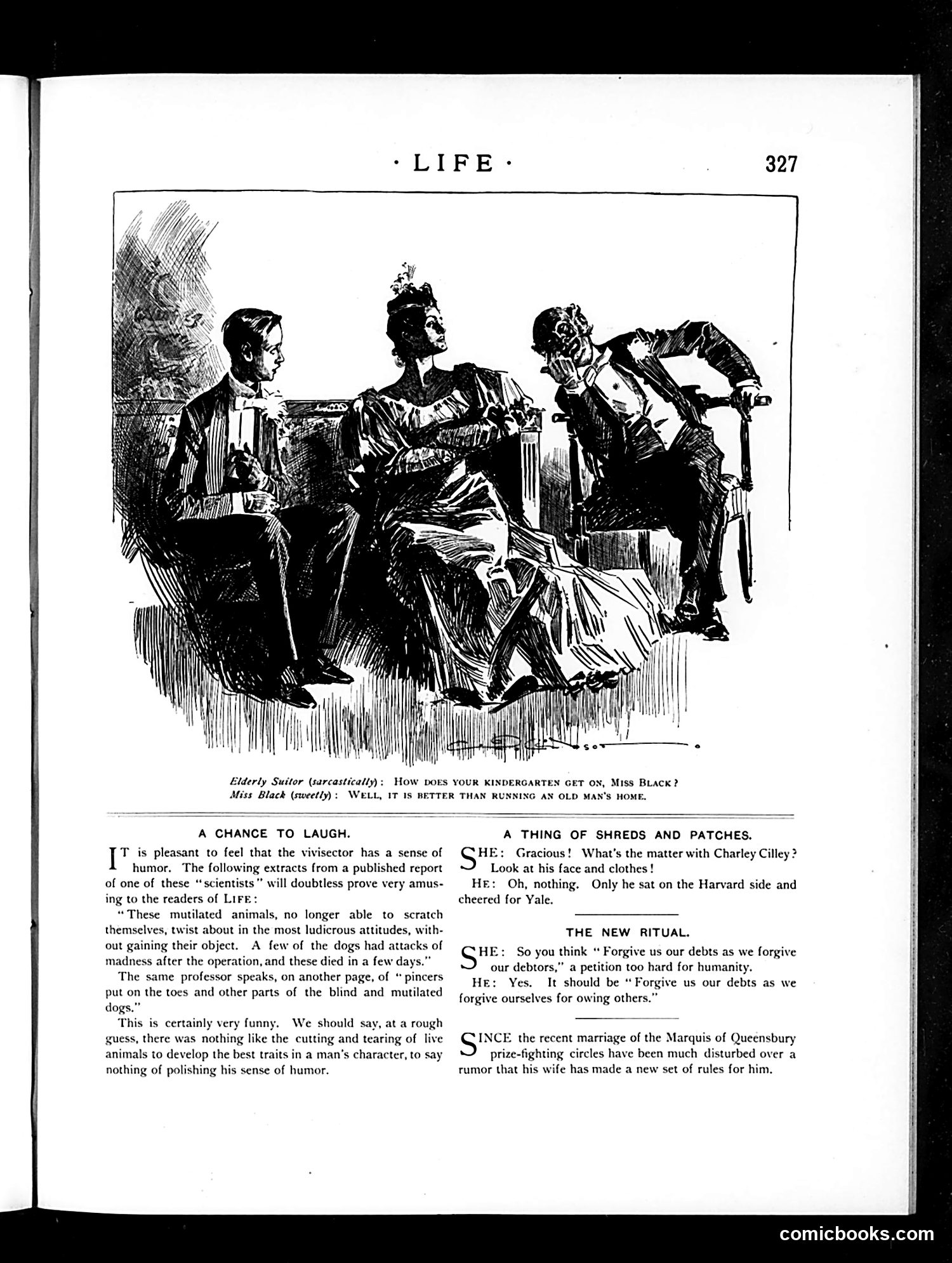
The main illustration depicts four well-dressed figures in conversation, likely satirizing upper-class social interactions. The page contains three separate brief comedic dialogues: 1. **"A Chance to Laugh"** discusses vivisection (animal experimentation), mocking scientists who mutilated animals to develop character traits in humans—absurdist satire on scientific justifications for cruelty. 2. **"A Thing of Shreds and Patches"** references someone named Charley Cilley appearing disheveled, likely a topical joke about a specific public figure. 3. **"The New Ritual"** jokes about modern marriage by referencing the Marquis of Queensberry and prize-fighting circles, suggesting his wife has imposed new rules on him—satirizing shifting marital power dynamics. These are typical of Life's light social commentary targeting contemporary manners and relationships.
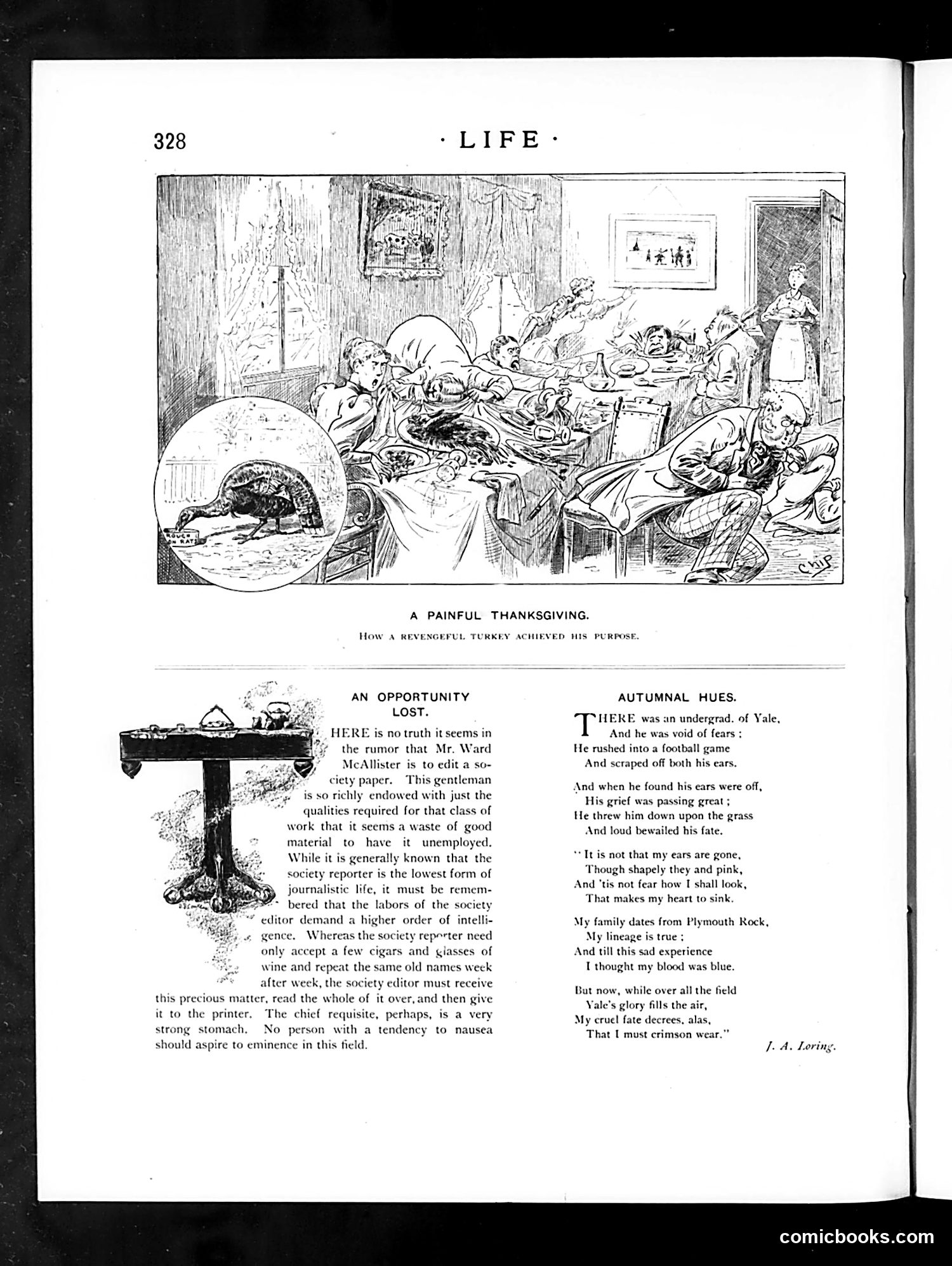
**Top Cartoon: "A Painful Thanksgiving"** Shows a turkey in an oven (circled inset) while a family feasts at a table laden with food. The caption reads "How a Revengeful Turkey Achieved His Purpose." The joke satirizes Thanksgiving dinner: the turkey achieves "revenge" by causing digestive distress to the diners who consumed it—a dark humor commentary on overindulgence during the holiday feast. **Bottom Section:** Two articles appear: "An Opportunity Lost" criticizes Mr. Ward McAllister's editorship of a society paper, arguing his talents are wasted on such trivial work. "Autumnal Hues" is a poem by J.A. Loring about a Yale student grieving lost ears from football, satirizing college sports injuries and masculine pride. The page combines visual and literary satire targeting social pretension and physical folly.
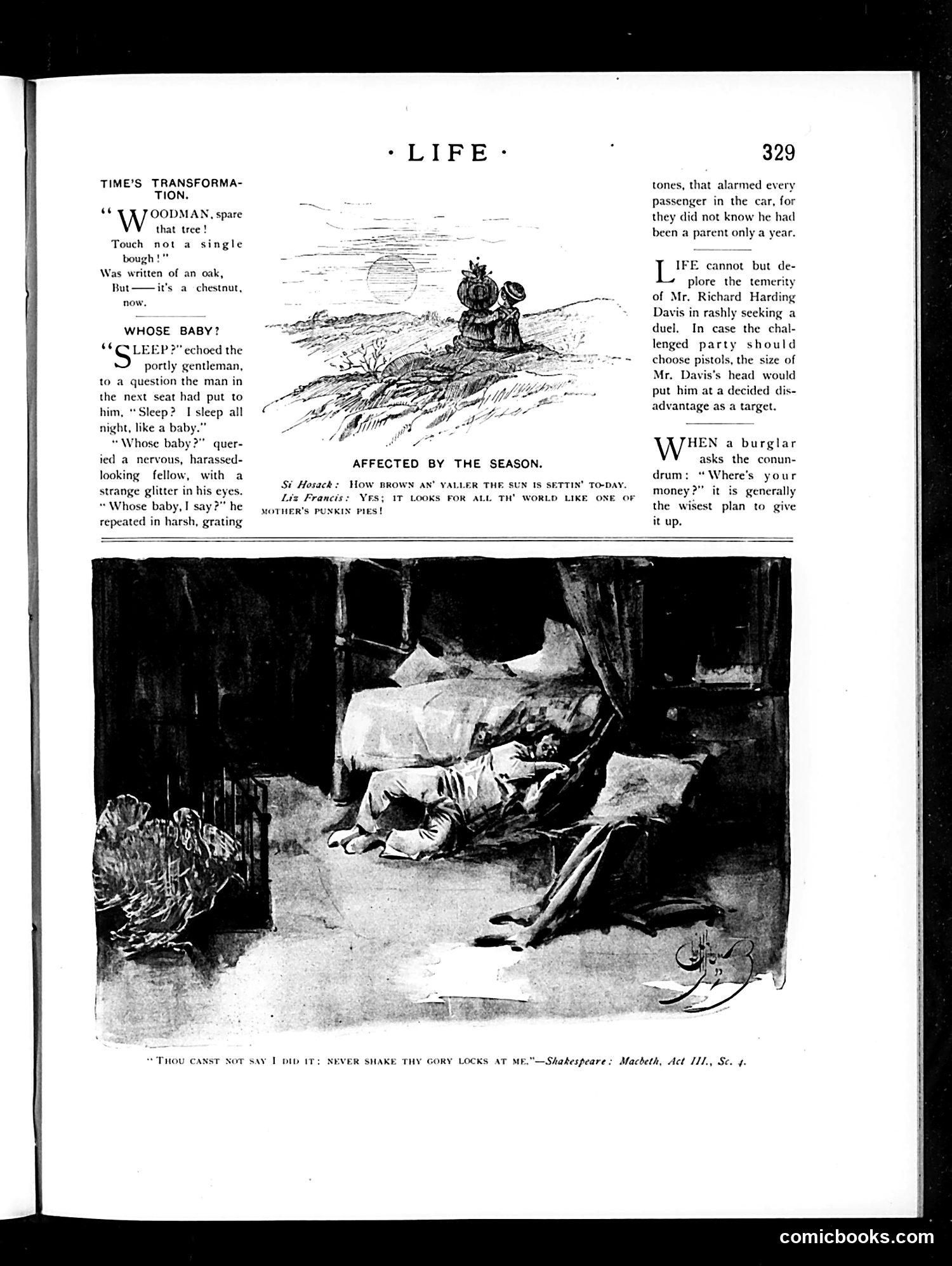
This page contains three distinct pieces of satirical content: 1. **"Time's Transformation"**: A poem mocking the impermanence of nature—a tree identified as an oak is revealed to be a chestnut. 2. **"Whose Baby?"**: A joke about mistaken parenthood, featuring a "nervous, harassed-looking fellow" confronted about a sleeping baby he doesn't recognize. 3. **"Affected by the Season"**: A sketch captioned with dialogue between Si Hosack and Lis Franley about hot weather and "mother's punkin pies"—rural humor about seasonal discomfort. 4. **Bottom photograph**: A dramatic scene illustrating a Shakespeare quote from *Macbeth* about guilt and conscience, showing a figure in distress. The page blends light social humor with literary reference, typical of *Life*'s early 20th-century satirical style.
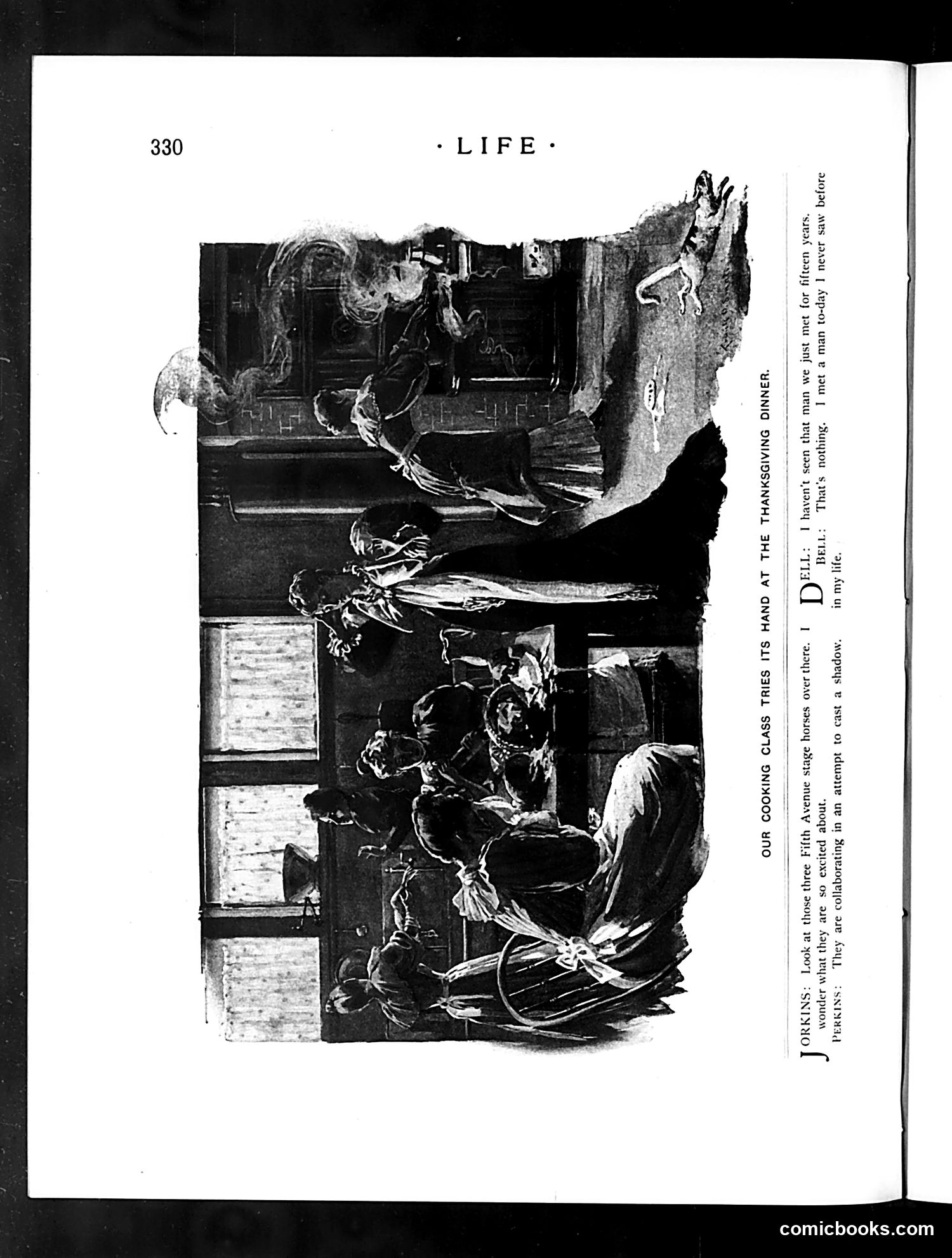
This page from *Life* magazine features an illustration titled "Our Cooking Class Tries Its Hand at the Thanksgiving Dinner," with a caption explaining the scene: "Look at these three Fifth Avenue brides over here. I haven't seen that man we just met in my life. That's nothing; I may have passed a shadow in my life." The cartoon satirizes wealthy Fifth Avenue women attempting to cook a Thanksgiving dinner, likely poking fun at the domestic incompetence of the upper class. The caption's fragmented, nonsensical dialogue suggests these society women are vapid or scattered. The humor derives from the contrast between their elevated social status and their inability to perform basic domestic tasks—a common satirical trope mocking the uselessness of the idle rich during this era.
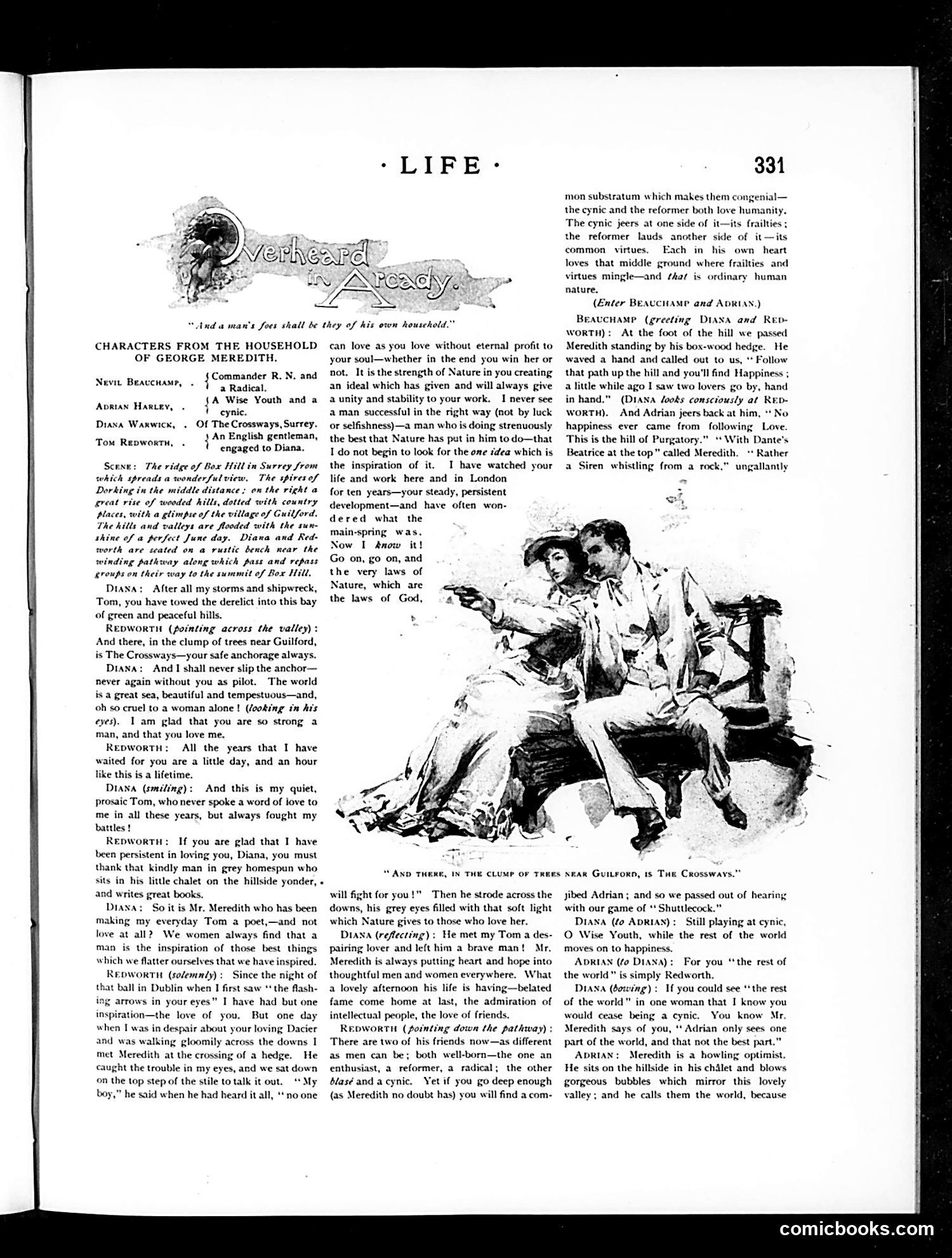
This page presents a dramatic scene from George Bernard Shaw's play "Overheard Already." The illustration depicts characters in an intimate moment — a man and woman in an embrace near a tree. The scene illustrates romantic dialogue between the characters Redworth and Diana, who discuss love, persistence, and commitment. The text shows Shaw's characteristic wit: Diana tells Redworth she'll never leave without him as "pilot," while Redworth declares his years of waiting prove his devotion. The scene satirizes Victorian romantic conventions through Shaw's sophisticated dialogue, where intellectual sparring accompanies emotional declarations. This appears to be a theater review or adaptation rather than political satire — it's literary commentary on Shaw's exploration of love, gender dynamics, and the tension between cynicism and genuine human connection.
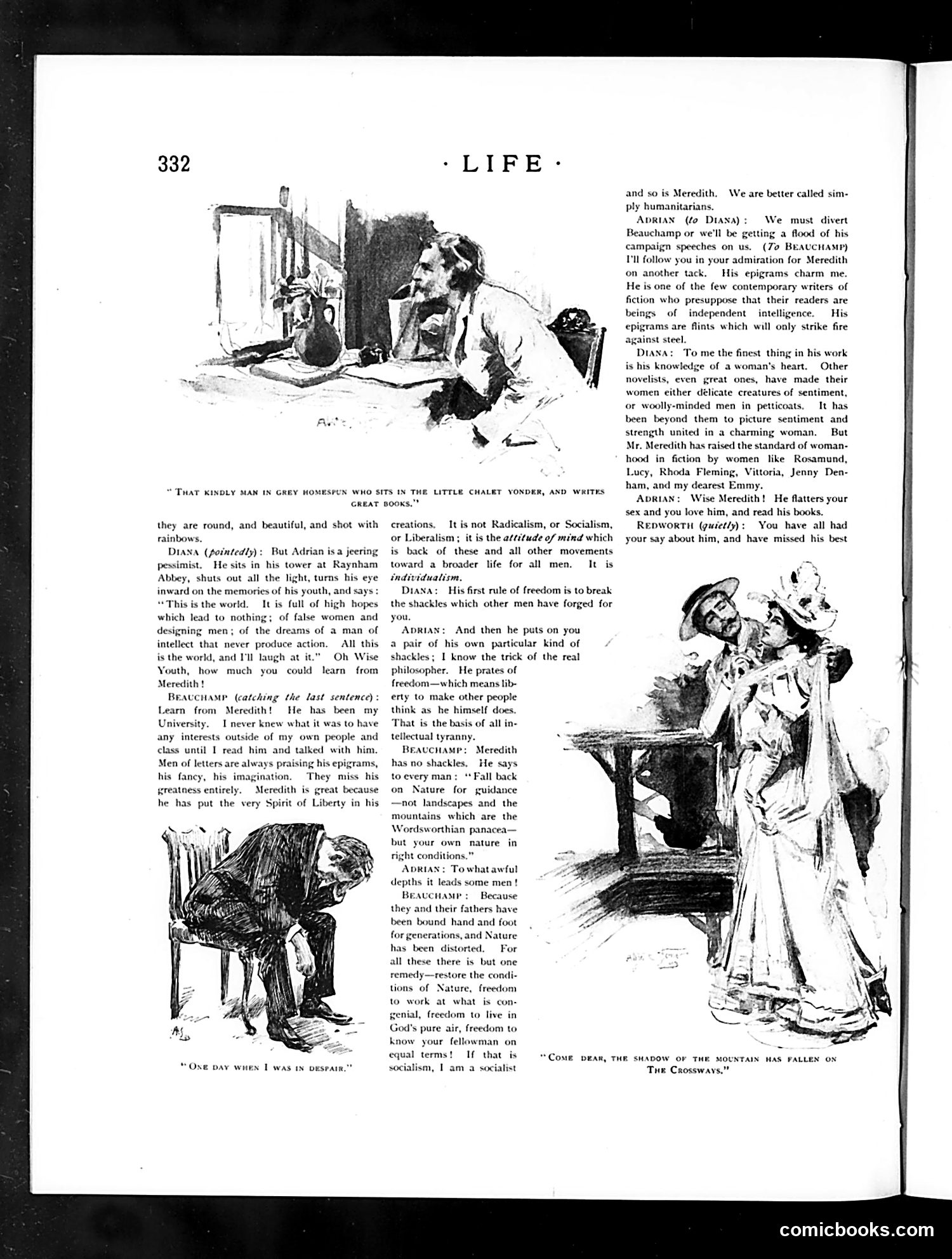
This page presents a literary dialogue debating the novelist **George Meredith** and his philosophical influence. The speakers—Adrian, Diana, and Beauchamp—represent different intellectual positions on individualism, freedom, and social reform. **The Satire's Point:** Beauchamp enthusiastically champions Meredith's "Spirit of Liberty" and individualism as the cure for social ills, advocating freedom to work, live in nature, and know fellowmen equally. Adrian cynically counters that Meredith merely trades one set of shackles for another—philosophers preach freedom while demanding others think as *they* do, constituting "intellectual tyranny." Diana adds that readers miss Meredith's true strength: his psychological portrayal of women combining sentiment and strength. **Context:** This reflects late-19th-century debates over Meredith's ideas and their real-world application. The cartoon mocks how reformers and philosophers can unconsciously impose new constraints while claiming liberation. The illustrations show contemplative male figures, emphasizing the cerebral, somewhat pretentious nature of the discussion.
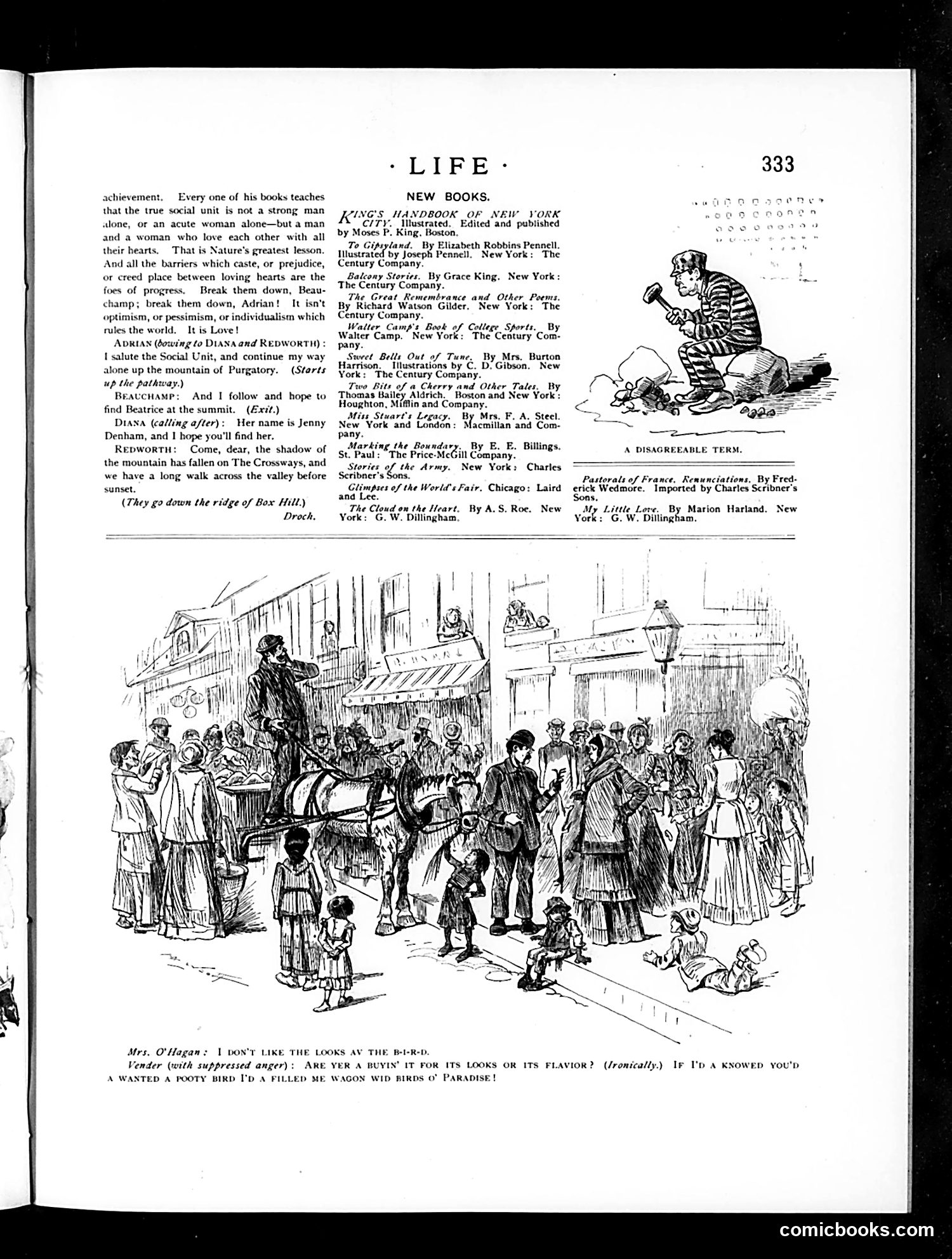
This page contains two distinct sections: **Upper portion:** Literary excerpts from what appears to be a serialized novel featuring characters Adrian, Diana, Beaucham, and Redworth debating "the social unit" and romantic relationships—themes typical of Victorian-era fiction. This is narrative content, not satire. **Lower portion:** A single-panel cartoon satirizing street vendors and customer complaints. Mrs. O'Hagan criticizes a vendor's bird (likely for sale as food) based on its appearance. The vendor sarcastically responds that if she wanted a "pretty bird," he would have filled a wagon with birds of paradise instead—implying she's being unreasonably picky about a practical purchase. The joke relies on the contrast between aesthetic expectations and practical value: the humor lies in the vendor's exasperated sarcasm about a customer prioritizing looks over quality or taste in foodstuffs. The page is primarily a book review section with one humorous illustration.
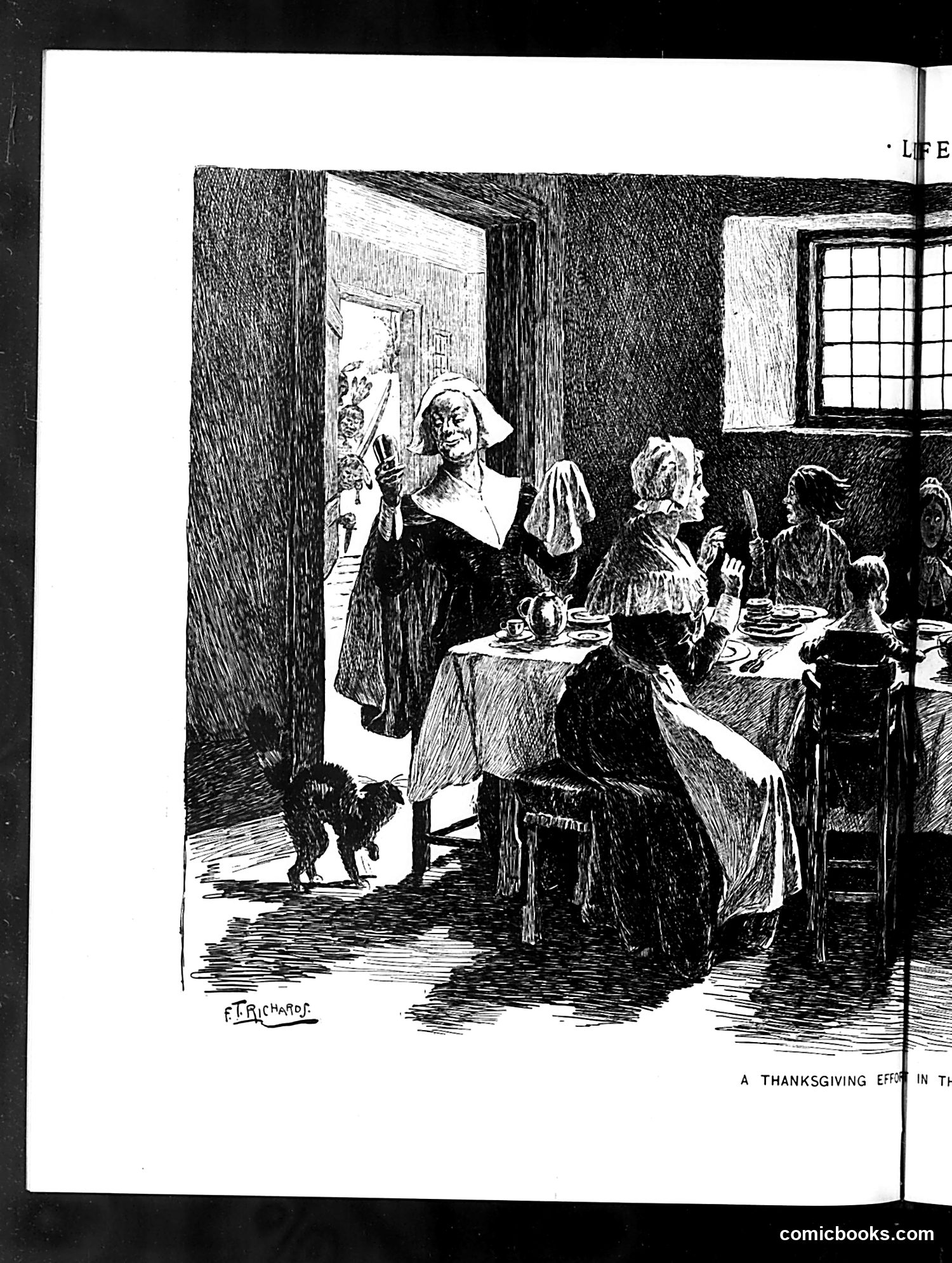
This satirical illustration depicts a domestic scene where a stern-faced woman in a white bonnet and dark dress stands in a doorway, while seated figures (appearing to be family members) gather around a table. A small dog enters from the left. The title "A Thanksgiving Effigy" suggests the central standing figure represents an unpopular or feared authority—likely a stern, domineering matriarch. The joke appears to mock rigid household hierarchies and domestic discipline during Thanksgiving, possibly satirizing overbearing mothers-in-law or strict domestic management. The family's subdued postures and the woman's commanding presence suggest they're intimidated by her authority. The cartoon plays on class and gender dynamics of the era, mocking both patriarchal and matriarchal control within the home.
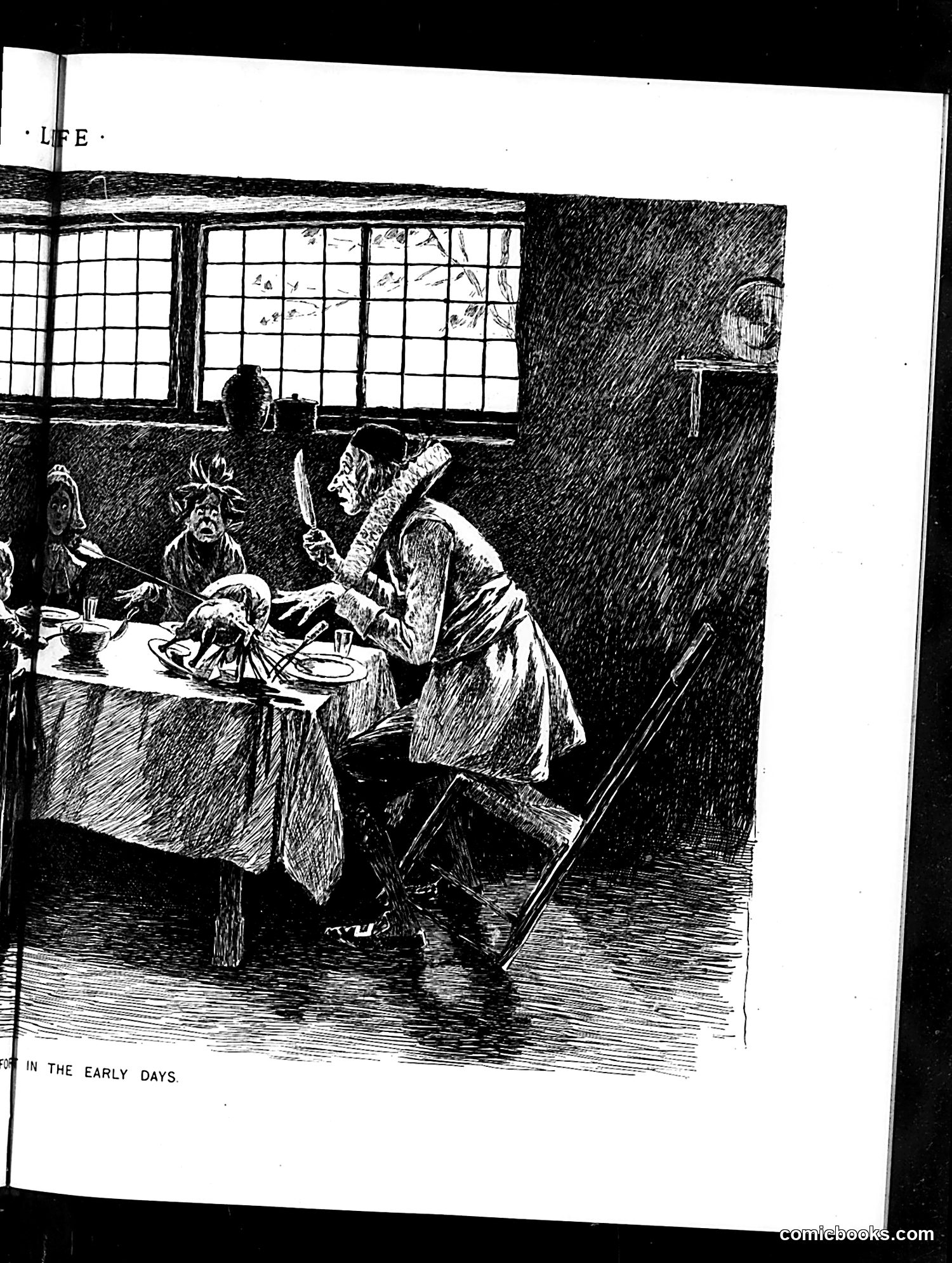
This is a satirical sketch depicting what appears to be a social gathering or meal scene in a modest interior. The caption "In the Early Days" suggests this is a historical commentary, likely contrasting past versus present conditions. The image shows figures in period dress seated around a table in a sparse room with gridded windows. The rough, sketchy style and the somewhat grotesque character depictions are typical of Life magazine's satirical approach to social commentary. Without clearer OCR text or additional context, the specific historical period referenced and the precise satirical point remain unclear. The sketch likely comments on social class, living conditions, or cultural practices of an earlier era, though the exact target of the satire cannot be definitively determined from the image alone.
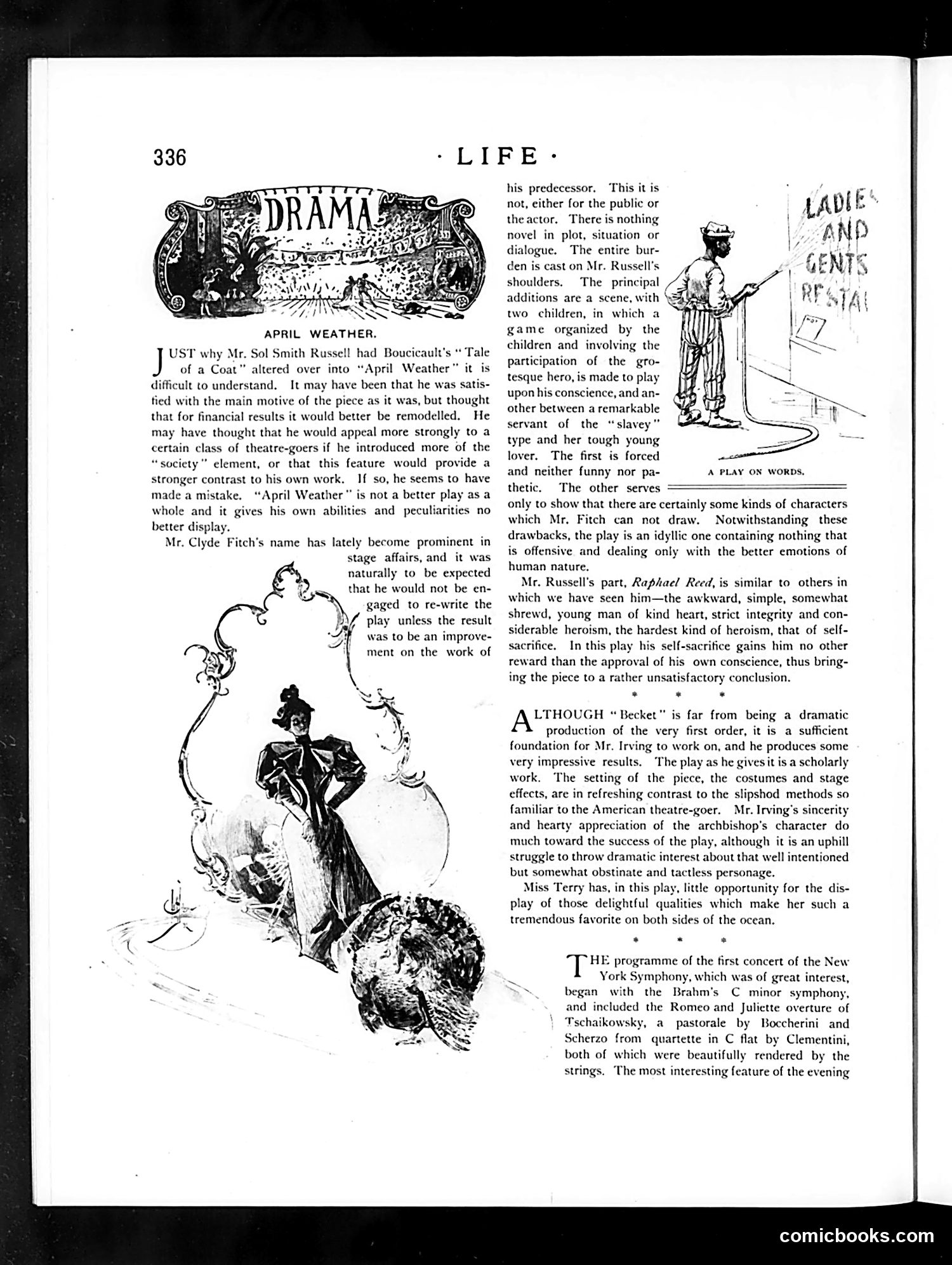
This page reviews theatrical productions of the era. The main text criticizes "April Weather," a reworked adaptation of Boucicault's play starring Sol Smith Russell—a popular comedian of the period. The critic argues playwright Clyde Fitch's revisions added nothing valuable, merely inserting "society element" scenes that don't serve the play, though Russell's performance (as the humble character Raphael Reed) remains earnest. The page also briefly reviews Henry Irving's "Becket," praising Irving's scholarly approach and staging while noting actress Ellen Terry has limited opportunities to display her talents. Finally, it covers the New York Symphony's inaugural concert, featuring Brahms and Tchaikovsky. The small illustration shows a woman posting a sign reading "LADIES AND GENTS RESTAI[N]"—likely satirizing theater audience behavior or venue management of the period, though the full joke isn't entirely clear from the visible portion.
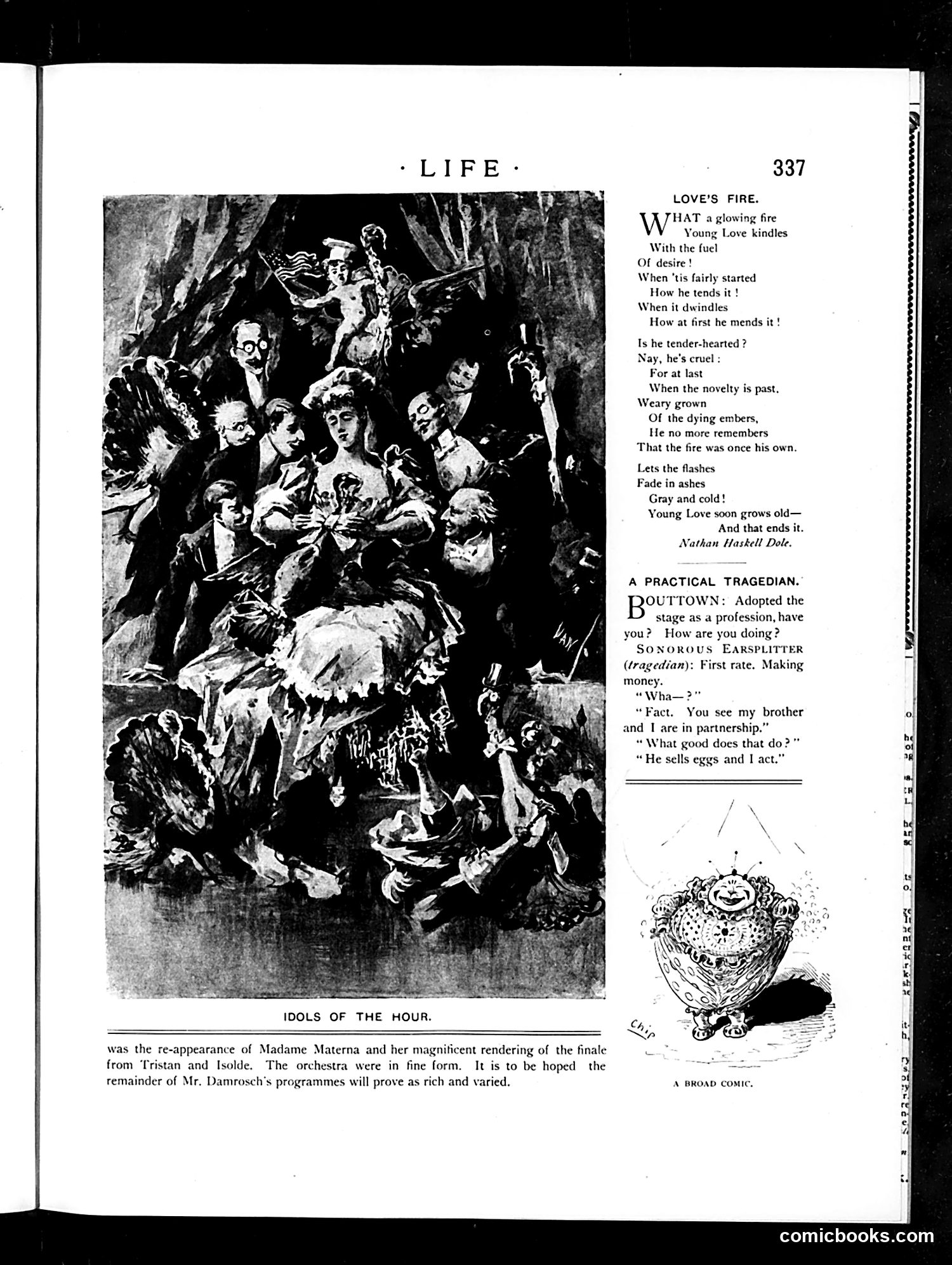
**"Love's Fire"** (left): A sentimental poem by Nathan Haskell Dole, paired with a classical artwork depicting cherubs and figures in romantic abandon. The poem uses fire as a metaphor for young love's intensity and inevitable decline—passion kindles easily but burns out when novelty fades, leaving only cold ashes. This reflects Victorian-era cynicism about romance's fleeting nature. **"A Practical Tragedian"** (right): A brief joke about an aspiring actor who claims success despite his acting career. The punchline: his brother sells eggs while he acts—implying the egg sales (not acting) actually generate their income. This satirizes struggling theatrical performers who must rely on other work to survive, mocking both the impracticality of stage careers and false claims of success. **"Idols of the Hour"** (bottom): A brief theater review praising soprano Madame Materna's performance in Wagner's *Tristan and Isolde* and conductor Damrosch's orchestra, suggesting their cultural prominence at the time.
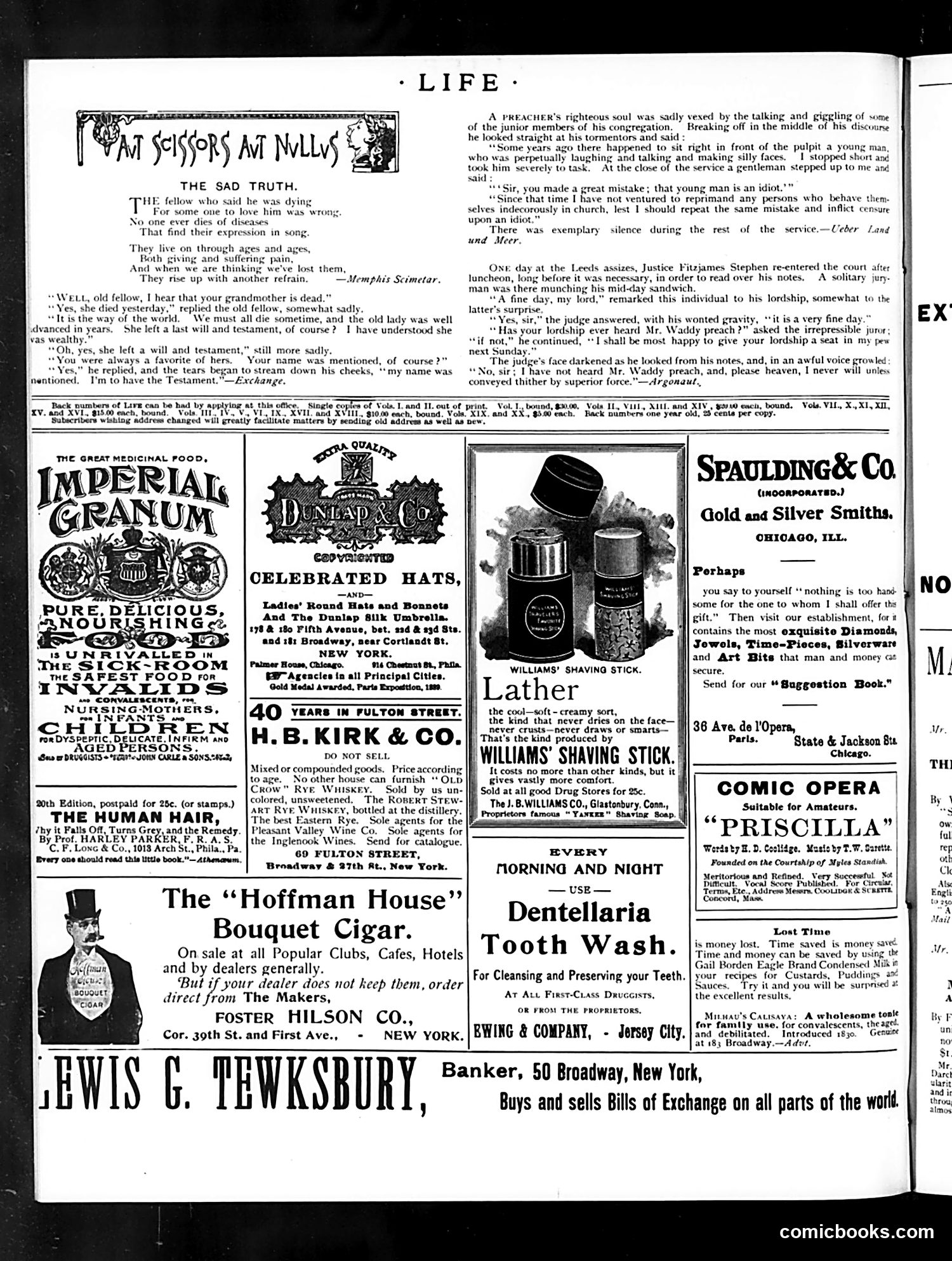
This page contains three humorous anecdotes satirizing human nature and social pretense, presented as "The Sad Truth." **The cartoons/stories mock:** 1. **Inheritance hypocrisy**: A man mourns his wealthy grandmother's death, but his "tears" flow only when learning he inherits her testament—revealing grief as transparent self-interest. 2. **Church discipline backfiring**: A preacher refrains from correcting disruptive congregants after being told the offender was "an idiot," implying that social embarrassment prevents correction of actual rudeness. 3. **Judicial awkwardness**: A juror presumes to invite a judge to church, forcing the judge into an uncomfortable social moment where rank and propriety clash. **The satire's point**: These brief stories expose the gap between social pretense and actual motivation—people claim noble feelings (grief, piety, respect) while acting from baser impulses (greed, fear, or ignorance of proper boundaries). The "sad truth" is human nature's fundamental selfishness masked by etiquette. The rest of the page comprises period advertisements for patent medicines, hats, cigars, and banking services—typical of *Life* magazine's mixed editorial and commercial format.
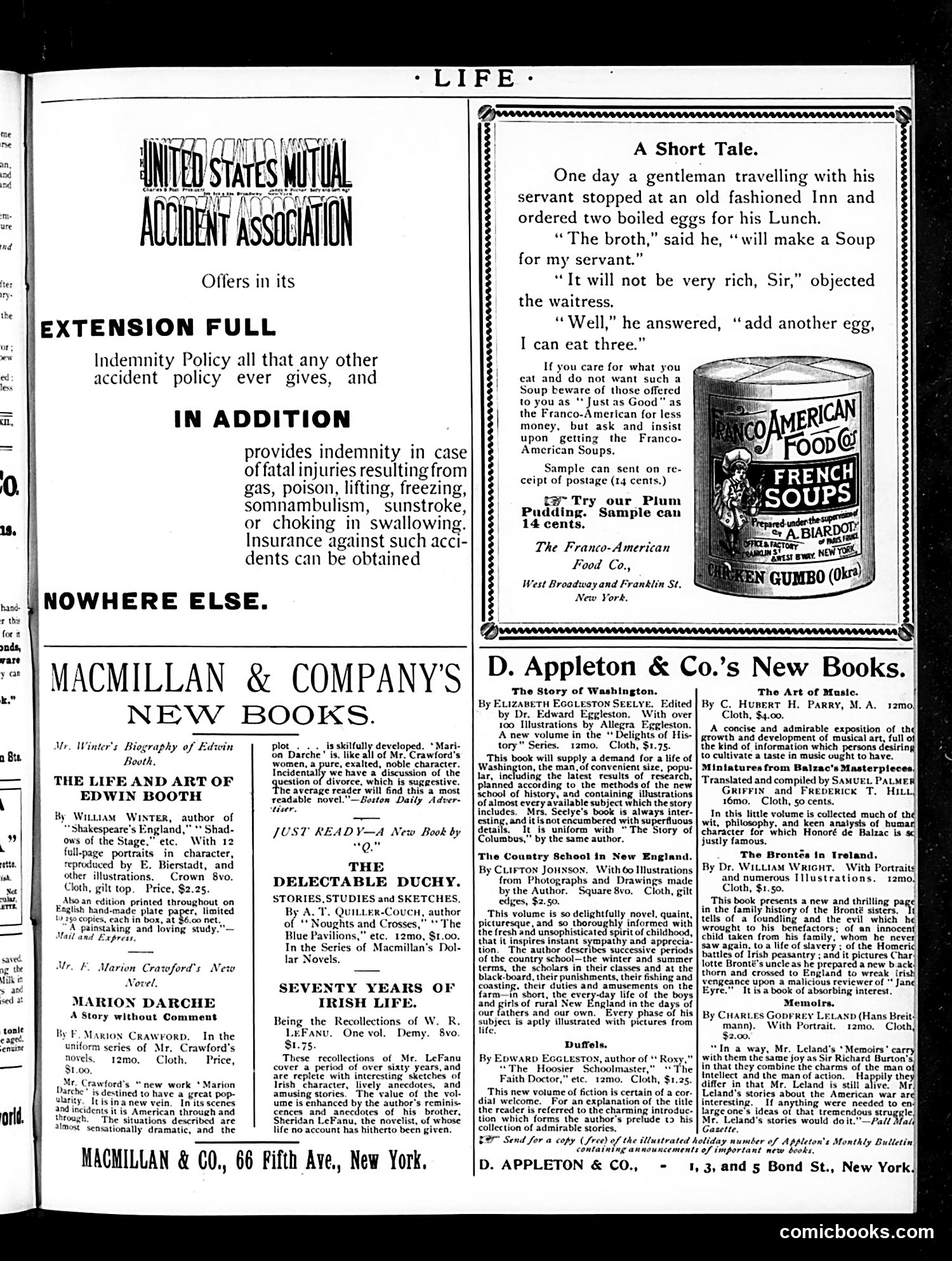
This page is primarily **advertising and book announcements** rather than political satire or cartoons. The main content includes: 1. **Insurance advertisement** (top left): United States Mutual Accident Association promoting their "Extension Full Indemnity Policy" with unusually broad coverage including gas poisoning, freezing, and choking. 2. **Franco-American Foods advertisement** (right): Features a humorous short anecdote about a stingy gentleman ordering boiled eggs, with the punchline that he can eat three eggs instead of making weak broth for his servant. This promotes Franco-American soups as superior to cheap imitations. 3. **Book announcements** (bottom): Macmillan & Company and D. Appleton & Co. advertisements for new titles, including works on Edwin Booth, Irish life recollections, and a biography of Washington. There is **no political cartoon or satirical commentary** visible. The page reflects late 19th-century commercial publishing and consumer goods marketing.
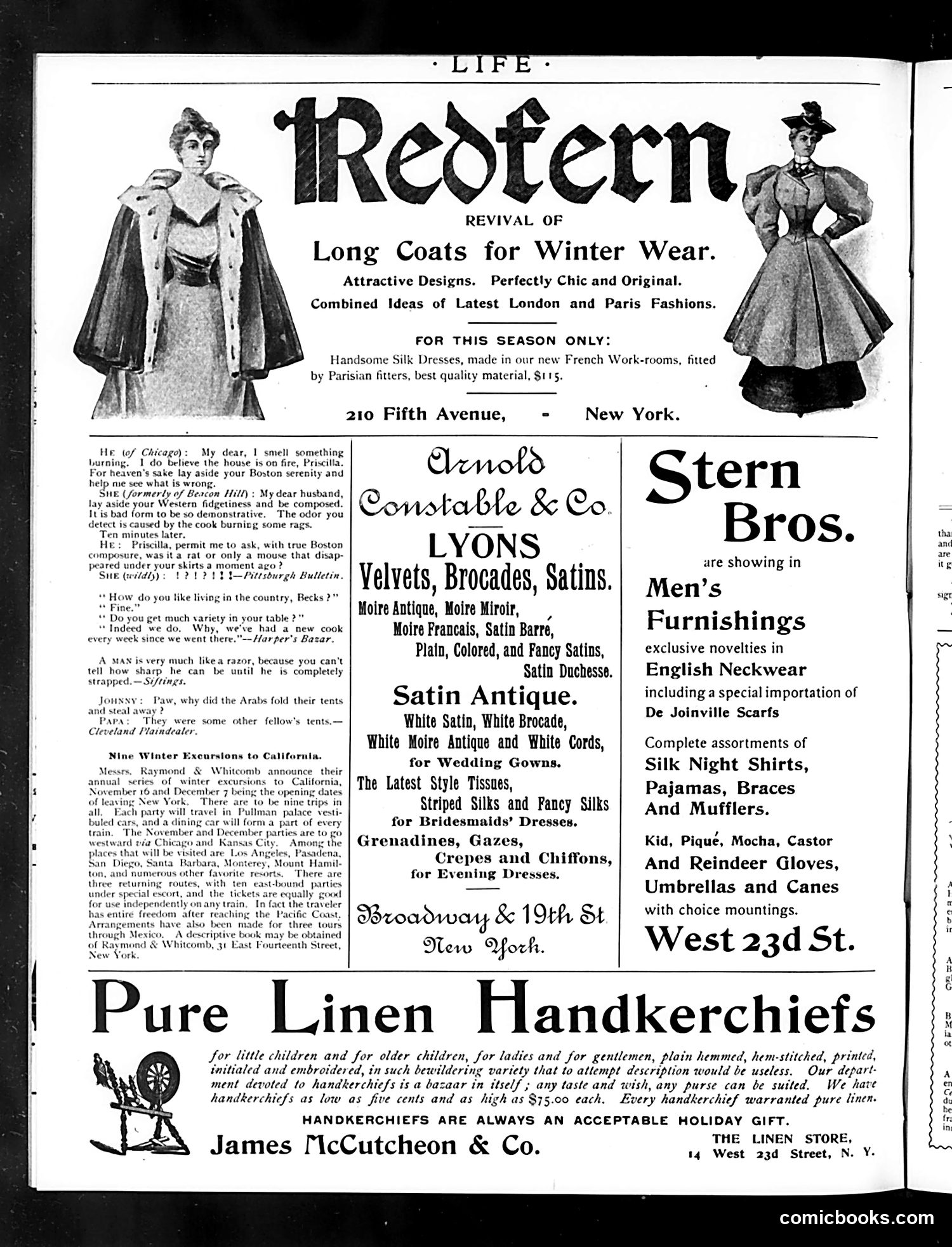
This is primarily an **advertising page**, not a satirical cartoon page. The bulk of the content consists of period advertisements for fashionable goods (long coats, fabrics, men's furnishings, handkerchiefs). However, the page includes several **brief humorous sketches** at top-left that satirize **regional American social differences**: 1. **Chicago vs. Boston manners**: A man from Chicago panics about a house fire with Western emotional directness, while his Boston-born wife responds with rigid "Boston composure" and refuses to be demonstrative—even about a rat near her skirts. 2. **Servant instability**: A joke about constantly changing cooks when living in the country, implying rural domestic help was unreliable. 3. **Masculine/feminine logic**: Jokes contrasting male and female reasoning (men like razors needing "stropping"; Arabs stealing tents). The satire targets **regional stereotypes**—particularly Eastern Establishment reserve versus Western earnestness—and the social pretensions of newly wealthy Chicagoans adopting Boston manners. This reflects turn-of-century American class and regional anxiety.
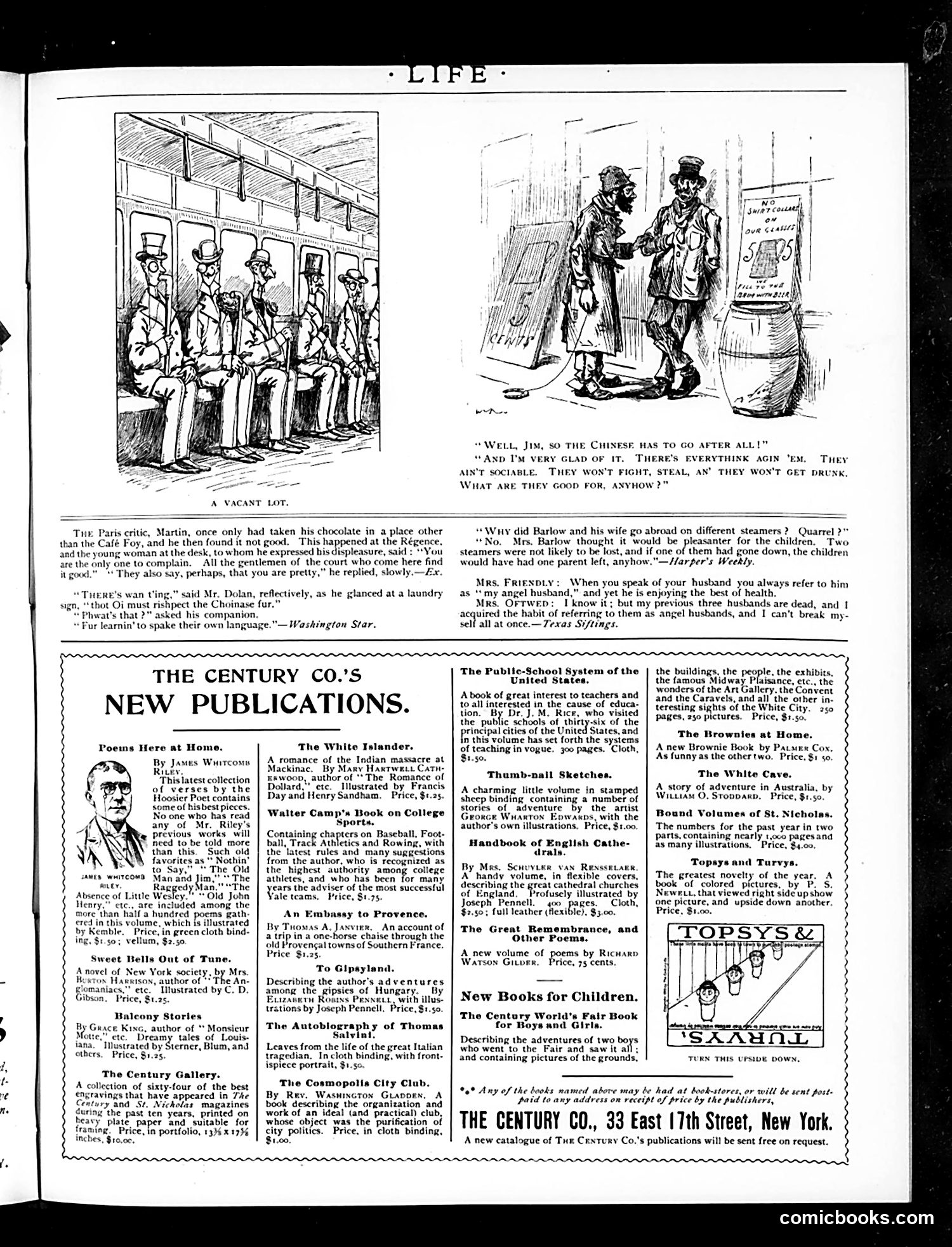
This page contains two satirical cartoons targeting late-19th-century social attitudes: **"A Vacant Lot"** (left): Shows well-dressed men in top hats sitting idle. The joke critiques Chinese immigrants, presenting a character's complaint that Chinese laborers "ain't sociable" and "won't fight, steal, an' they won't get drunk"—implying these were the only "uses" the speaker could recognize. The satire mocks xenophobic stereotypes and the speaker's inability to value honest work. **Right cartoon**: Addresses class anxieties about steamship travel. A man ironically justifies his wife traveling separately by claiming it's "pleasanter for the children"—if one steamer sinks, at least one parent survives. The joke satirizes both paranoia about maritime safety and the wealthy's casual attitude toward risk. Both cartoons use humor to critique contemporary prejudices: racism against Chinese workers and class-based anxieties among the affluent. The remainder is publisher advertisements for books.
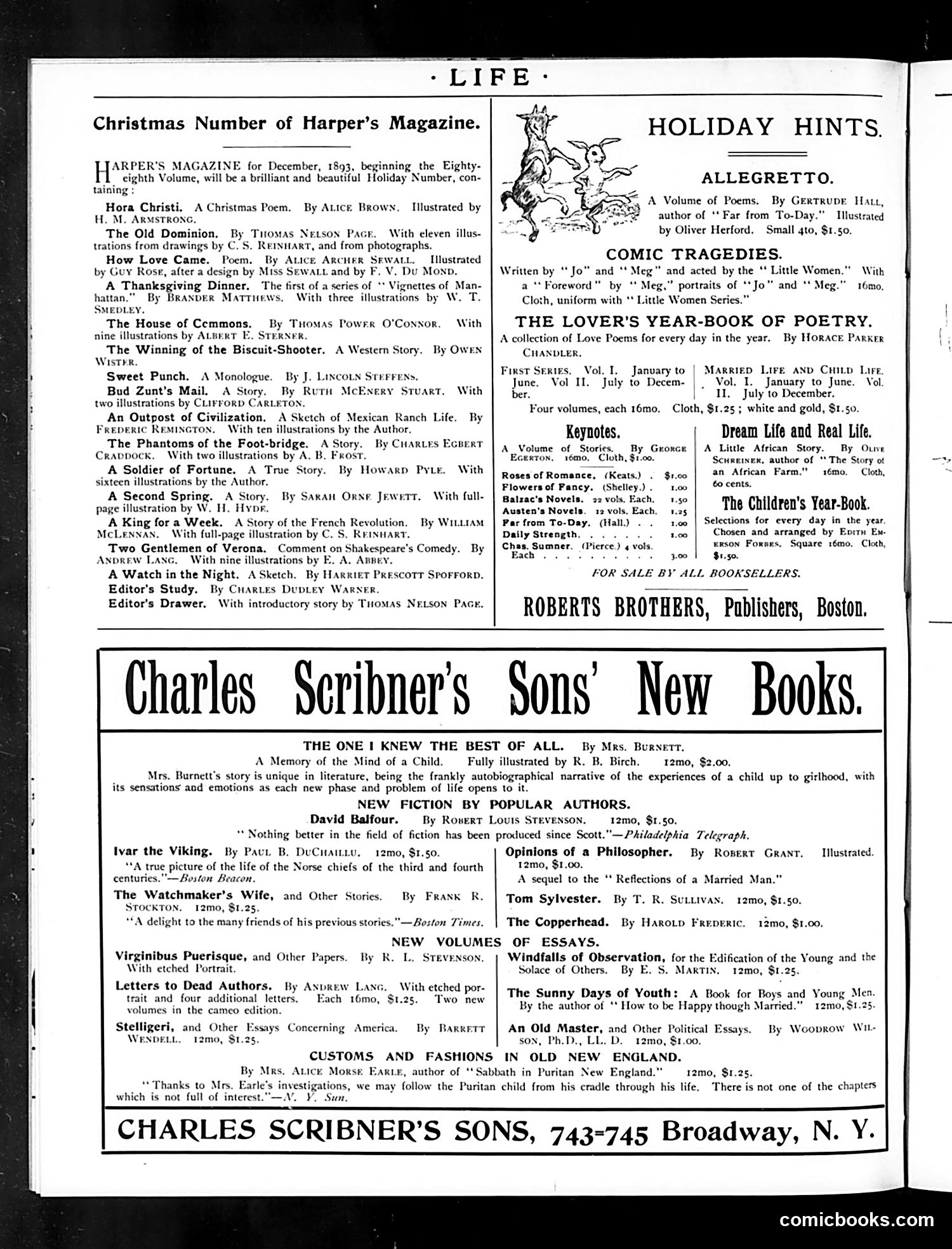
This is primarily a **book advertisement and literary supplement page** from Life magazine's Christmas 1893 issue, not a political cartoon page. The page announces **Harper's Magazine's December holiday number** and advertises new books from **Charles Scribner's Sons publisher**. Featured titles include Robert Louis Stevenson's *David Balfour*, works by popular authors like Owen Wister and Sarah Orne Jewett, and Frances Hodgson Burnett's autobiography *The One I Knew the Best of All*. The small **illustration at top** shows cherubs or putti (decorative holiday figures), typical of 1890s Christmas advertising aesthetics. The content reflects late-Victorian literary culture: emphasis on narrative poetry, essays, and serialized fiction across genteel magazines. The prices ($1-2) and cloth binding descriptions indicate books marketed to affluent readers. This represents American publishing's holiday promotional strategy during the Gilded Age. There is no satirical political content on this page.
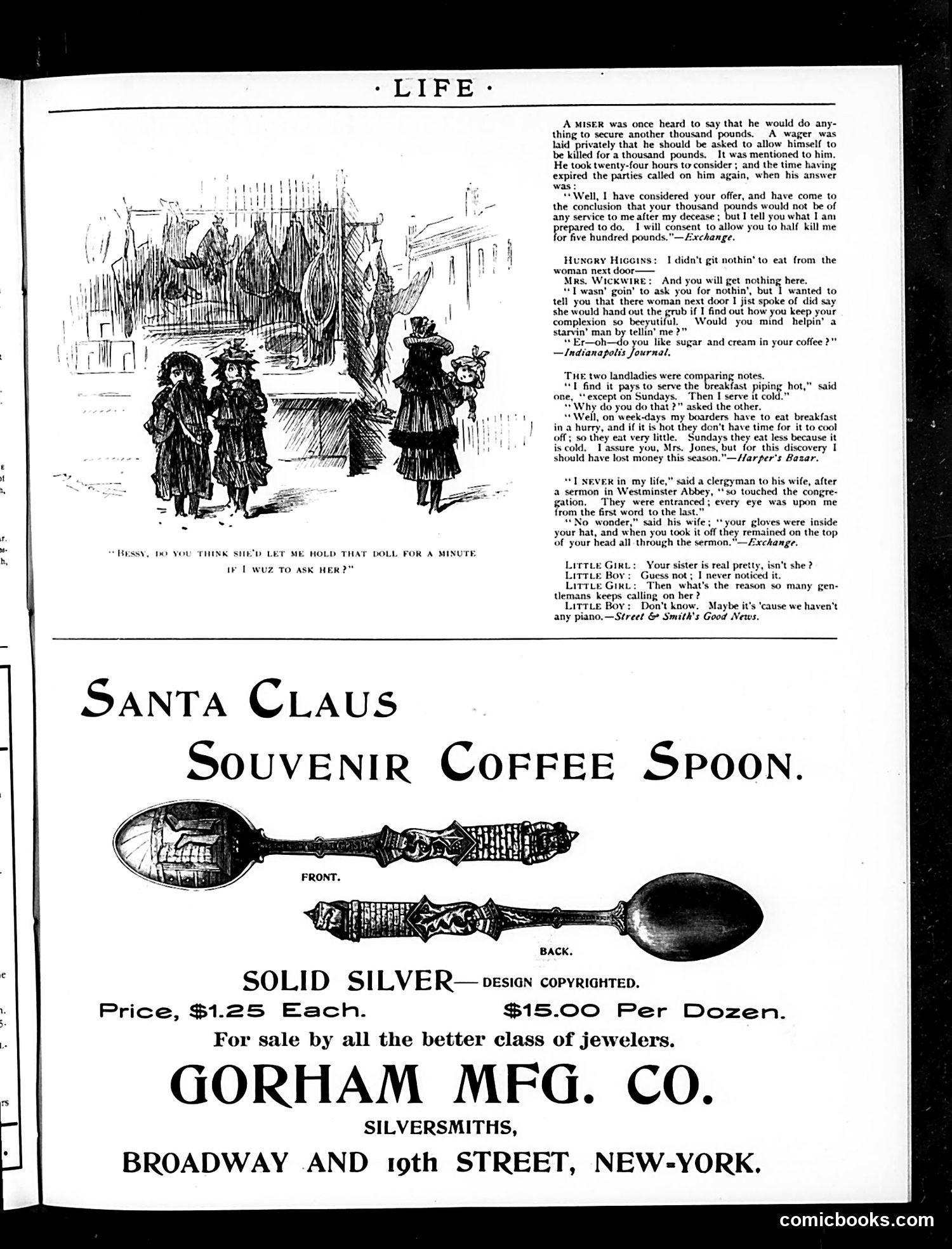
This page combines satirical humor with advertising. The upper section features five brief comic anecdotes mocking human foibles: a miser's absurd negotiation about his own death, a beggar's transparent flattery seeking food advice, landladies' cynical breakfast-serving strategy to minimize boarder consumption, a pompous clergyman's embarrassment over forgotten gloves, and a boy's innocent revelation that his sister attracts gentlemen callers only because the family lacks a piano (implying she has no other accomplishments). The cartoon illustration shows urban street children, likely depicting working-class or poor youth in period dress. The lower half is a full advertisement for Gorham Manufacturing Company's "Santa Claus Souvenir Coffee Spoon"—solid silver at $1.25 each, marketed to "the better class of jewelers" in New York. The spoon features Santa Claus imagery on both front and back. The page is primarily advertising-driven, using the humor section as filler content typical of early Life magazine's format.
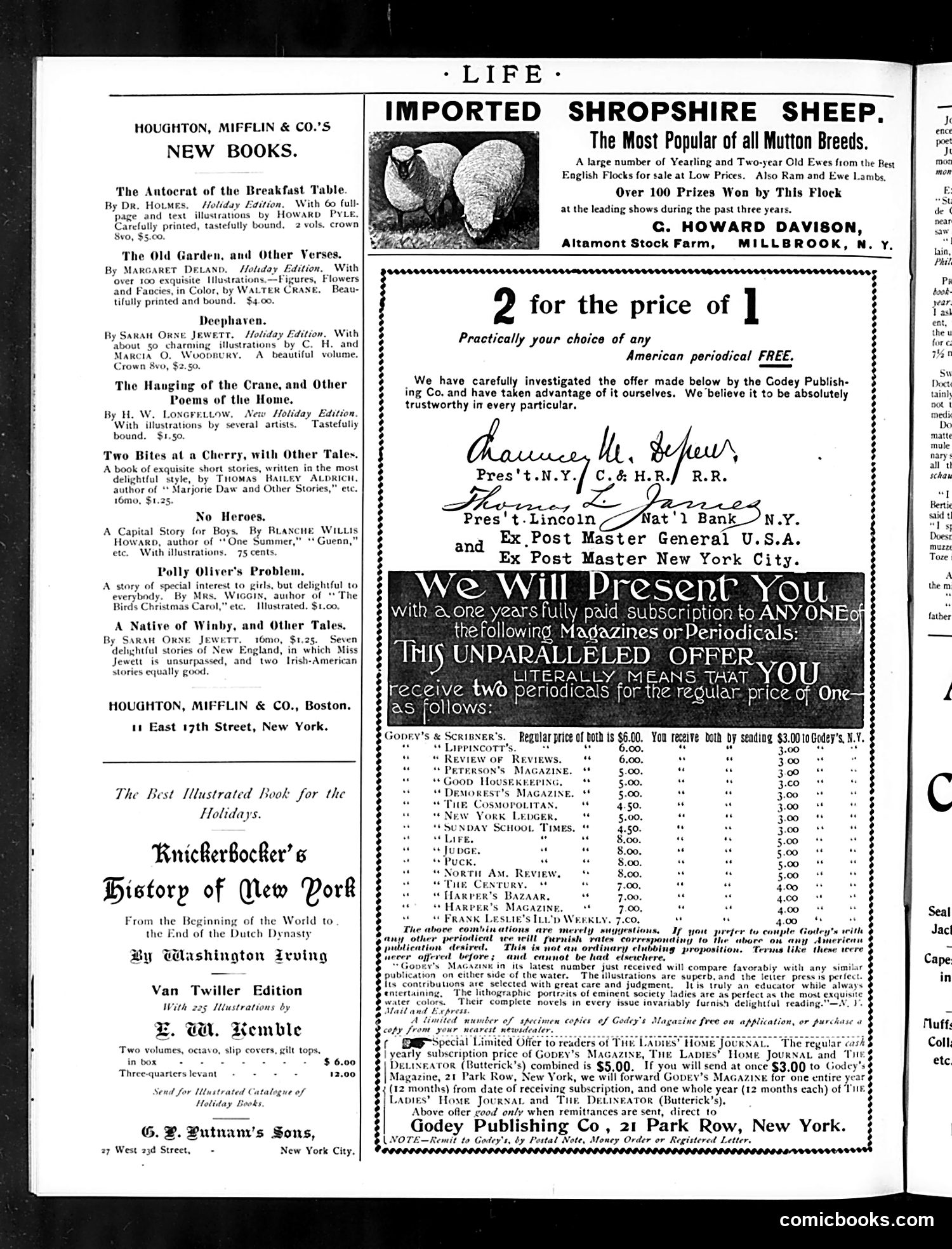
This page is primarily **advertising and book promotion**, not political satire or commentary. The visible content includes: - **Publisher advertisements** from Houghton, Mifflin & Co. and G.B. Putnam's Sons promoting holiday books, including classic titles like Washington Irving's *Knickerbocker's History of New York* - **A sheep breeding advertisement** for imported Shropshire sheep from C. Howard Davison's farm in Millbrook, NY—standard agricultural marketing - **A major magazine subscription offer** from Godey Publishing Co., promising "2 for the price of 1"—allowing readers to receive two periodicals (Harper's, Peterson's Magazine, Delineator, etc.) for the price of one yearly subscription There is **no cartoon or political satire** visible on this page. It represents typical late-19th/early-20th century *Life* magazine content: literary promotion, agricultural commerce, and subscription offers targeting middle-class readers.
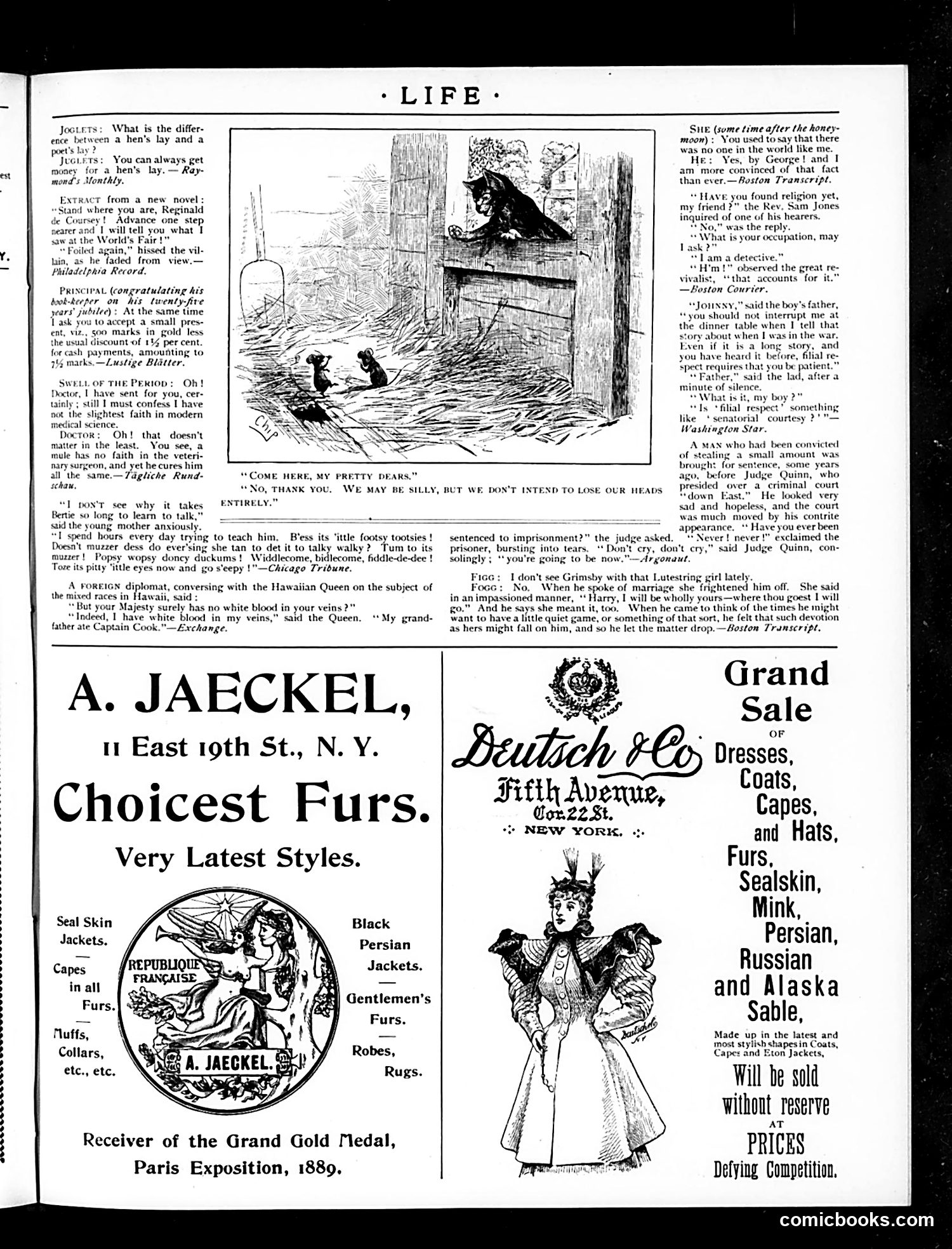
This page from *Life* magazine contains primarily **short humorous anecdotes and advertisements** rather than political cartoons. The cartoon illustration shows a street scene with figures, accompanying the joke "Come here, my pretty dears / No, thank you. We may be silly, but we don't intend to lose our heads entirely." The text pieces are brief jokes about everyday life: a principal miscalculating an employee's bonus (satirizing poor arithmetic), a doctor's confidence despite lacking faith, a conversation with a detective-minister, and family dinner etiquette. One anecdote references Judge Quinn sentencing a thief—likely a contemporary legal figure, though unclear without additional context. The Hawaiian Queen reference appears to joke about colonial anxieties regarding racial mixture. Most humor targets domestic social conventions, male behavior, and professional incompetence rather than specific political figures. The page is dominated by **fur merchant advertisements** for A. Jaeckel and Deutsch & Co, typical of this era's magazine content.
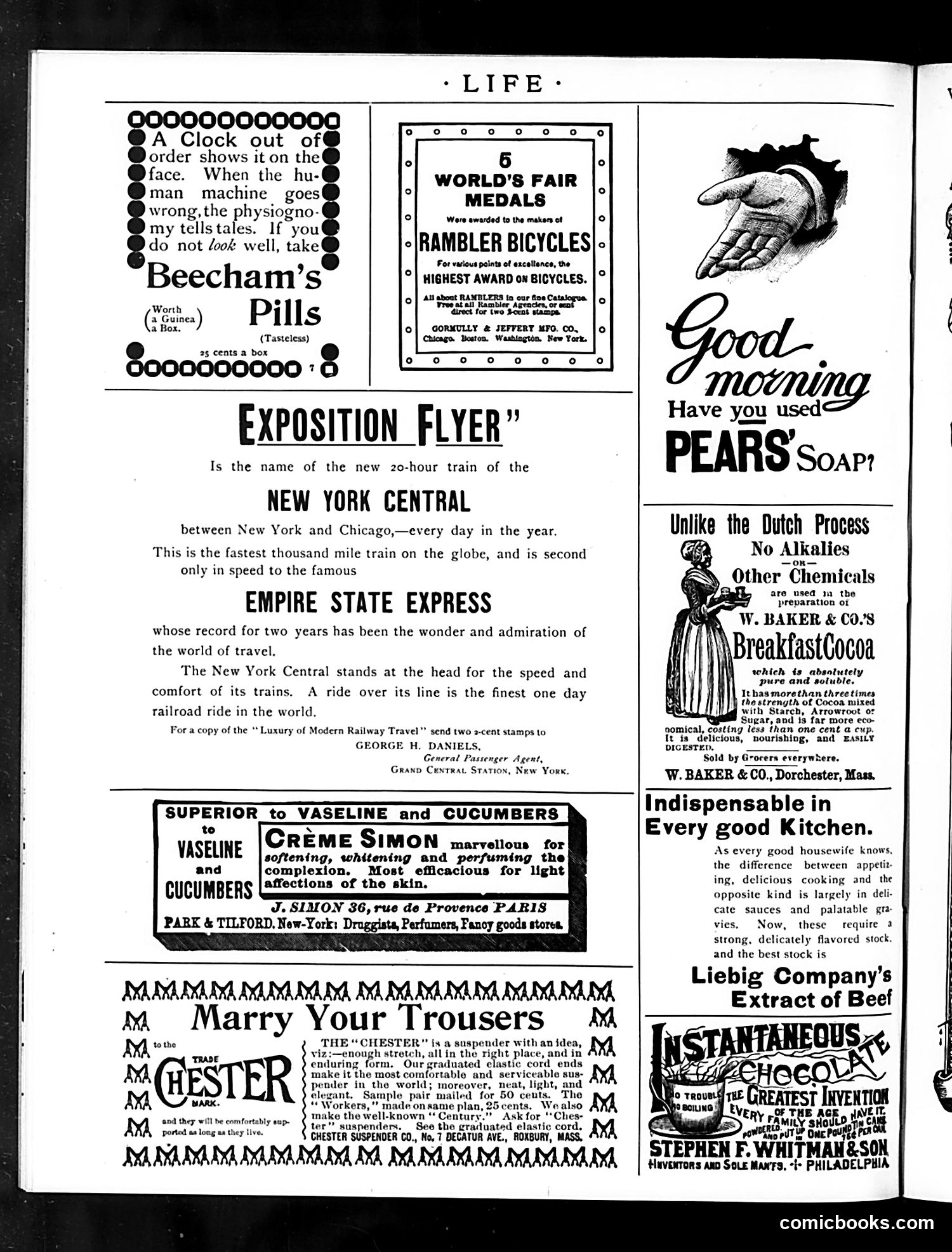
This page is primarily **advertising**, not editorial content or political satire. It's a collection of late 19th/early 20th-century product advertisements typical of *Life* magazine's revenue model. The ads promote consumer goods with period-specific appeals: - **Patent medicines** (Beecham's Pills) marketed with pseudoscientific claims about physiology - **Transportation** (New York Central trains) emphasizing modernity and speed records - **Personal care products** (Vaseline, Pears' Soap, cosmetics) targeting women with promises of beauty and complexion improvement - **Food products** (cocoa, beef extract) positioning themselves as kitchen staples - **Menswear** (Chester suspenders) with practical sales pitches The visual approach relies on typography, simple illustrations, and **aspirational messaging**—these products represent markers of respectability and modern living. No political figures or satire are evident. This reflects how *Life* funded itself through advertisers targeting middle-class consumers in an era before broadcast advertising.