
Life, 1893-11-23 · page 16 of 26
Life — November 23, 1893 — page 16: what you’re looking at
What you’re looking at
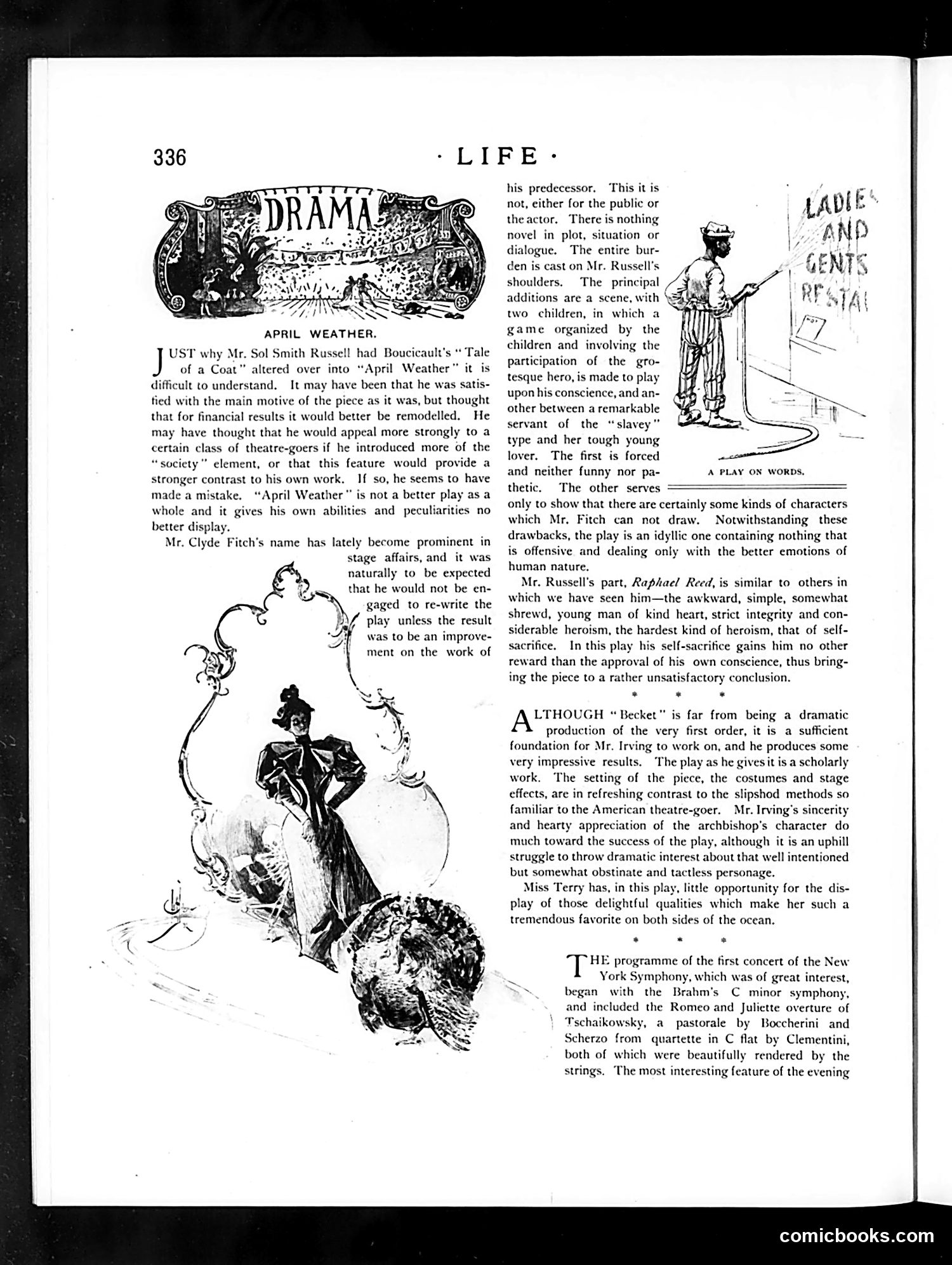
This page reviews theatrical productions of the era. The main text criticizes "April Weather," a reworked adaptation of Boucicault's play starring Sol Smith Russell—a popular comedian of the period. The critic argues playwright Clyde Fitch's revisions added nothing valuable, merely inserting "society element" scenes that don't serve the play, though Russell's performance (as the humble character Raphael Reed) remains earnest. The page also briefly reviews Henry Irving's "Becket," praising Irving's scholarly approach and staging while noting actress Ellen Terry has limited opportunities to display her talents. Finally, it covers the New York Symphony's inaugural concert, featuring Brahms and Tchaikovsky. The small illustration shows a woman posting a sign reading "LADIES AND GENTS RESTAI[N]"—likely satirizing theater audience behavior or venue management of the period, though the full joke isn't entirely clear from the visible portion.
📄 Transcribed text from this page (OCR, searchable)
Machine-transcribed from the original scan — historical spelling and the odd misread are preserved.
-LIFE- APRIL WEATHER. UST why Mr. Sol Smith Russel! had Boucicault’s J of a Coat” altered over into “April Weathe difficult to understand. It may have been that he was satis- tied with the main motive of the piece as it was, but thought that for financial results it would better be remodelled. He may have thought that he would appeal more strongly to a certain class of theatre-goers if he introduced more of the “society element, or that this feature would provide a stronger contrast to his own work. If so, he seems to have made a mistake. “April Weather" is not a better play as a whole and it gives his own abilities and peculiarities no better display. Mr. Clyde Fitch's name has lately become prominent in stage affairs, and it was naturally to be expected that he would not be en- gaged to re-write the play unless the result was to be an improve- ment on the work of his predecessor. This it is not, either for the public or theactor, There is nothing novel in plot, situation or dialogue. The entire bur- den is cast on Mr. Russell's shoulders. The principal “4 additions are a scene, with \S%4 two children, in which a game organized by the children and involving the participation of the gro- tesque hero, is made to play upon his conscience, and an- other between a remarkable servant of the type and her tough young lover. The first is forced and neither funny nor pa- thetic. The other seves ————— SS only to show that there are certainly some kinds of characters which Mr, Fitch can not draw. Notwithstanding these drawbacks, the play is an idyllic one containing nothing that is offensive and dealing only with the better emotions of human nature. Mr. Russell's part, Raphael Reed, is similar to others in which we have seen him—the awkward, simple, somewhat shrewd, young man of kind heart, strict integrity and con- siderable heroism, the hardest kind of heroism, that of self- sacrifice. In this play his self-sacrifice gains him no other reward than the approval of his own conscience, thus bring- ing the piece to a rather unsatisfactory conclusion. * . * A PLAY ON WORDS, LTHOUGH “ Becket” is far from being a dramatic production of the very first order, it is a sufficient foundation for Mr. Irving to work on, and he produces some very impressive results. The play as he givesit is a scholarly work. The setting of the piece, the costumes and stage effects, are in refreshing contrast to the slipshod methods so familiar to the American theatre-goer. Mr. Irving's sincerity and hearty appreciation of the archbishop’s character do much toward the success of the play, although it is an uphill struggle to throw dramatic interest about that well intentioned but somewhat obstinate and tactless personage. Miss Terry has, in this play, little opportunity for the dis- play of those delightful qualities which make her such a tremendous favorite on both sides of the ocean. . . . HE programme of the first concert of the New York Symphony, which was of great interest, began with the Brahm’s C minor symphony, and included the Romeo and Juliette overture of Tschaikowsky, a pastorale by Boccherini and Scherzo from quartette in C flat by Clementini, both of which were beautifully rendered by the strings. The most interesting feature of the evening comicbooks.com