
Life, 1893-11-23 · page 12 of 26
Life — November 23, 1893 — page 12: what you’re looking at
What you’re looking at
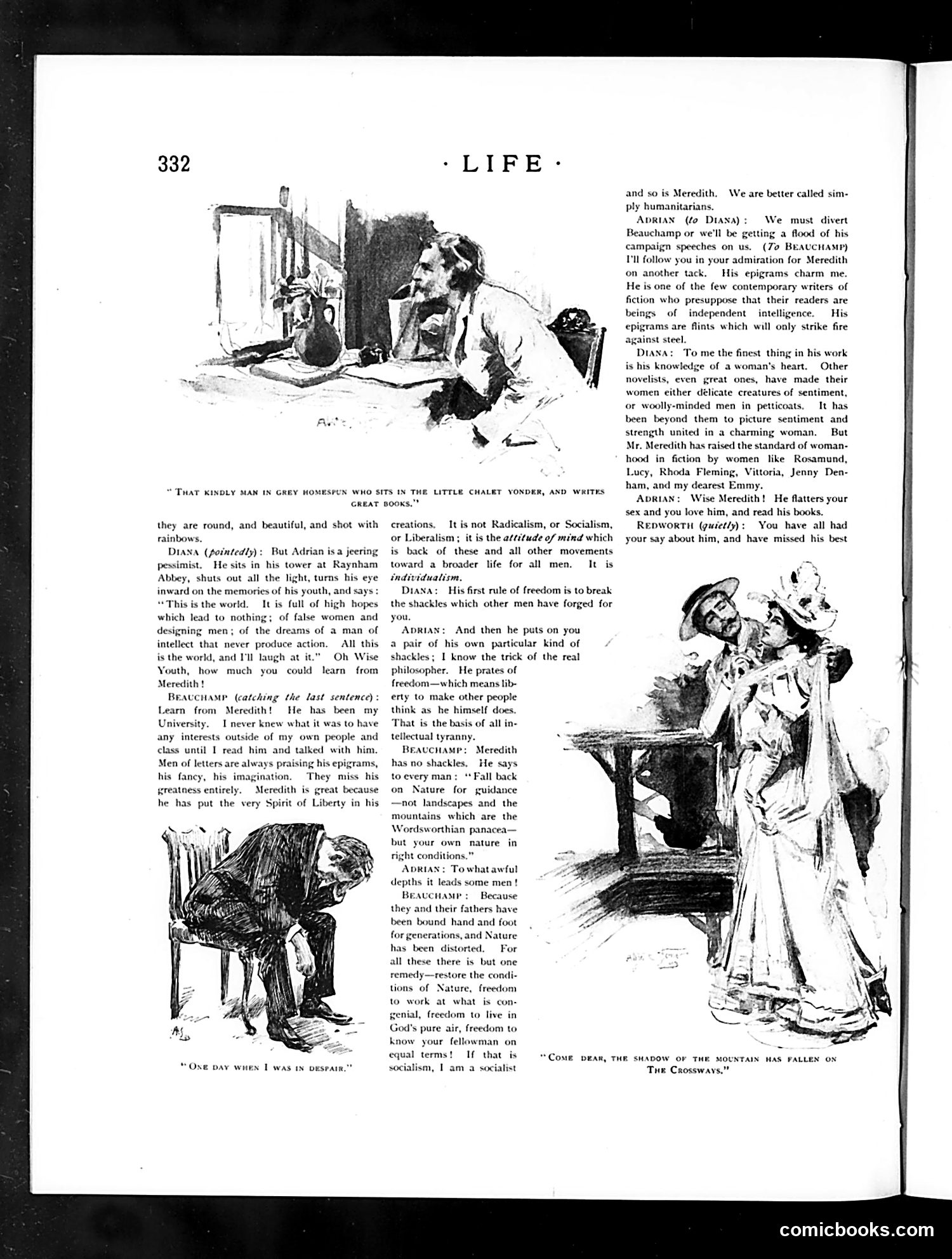
This page presents a literary dialogue debating the novelist **George Meredith** and his philosophical influence. The speakers—Adrian, Diana, and Beauchamp—represent different intellectual positions on individualism, freedom, and social reform. **The Satire's Point:** Beauchamp enthusiastically champions Meredith's "Spirit of Liberty" and individualism as the cure for social ills, advocating freedom to work, live in nature, and know fellowmen equally. Adrian cynically counters that Meredith merely trades one set of shackles for another—philosophers preach freedom while demanding others think as *they* do, constituting "intellectual tyranny." Diana adds that readers miss Meredith's true strength: his psychological portrayal of women combining sentiment and strength. **Context:** This reflects late-19th-century debates over Meredith's ideas and their real-world application. The cartoon mocks how reformers and philosophers can unconsciously impose new constraints while claiming liberation. The illustrations show contemplative male figures, emphasizing the cerebral, somewhat pretentious nature of the discussion.
📄 Transcribed text from this page (OCR, searchable)
Machine-transcribed from the original scan — historical spelling and the odd misread are preserved.
“THAT KINDLY MAN IN GREY HOMESPUN WHO SITS IN THE LITTLE CHALET YONDER, AND WRITES GREAT 800K: they are round, and beautiful, and shot with rainbows. DIANA (fointedly): But Adrian isa jeering pessimist. He sits in his tower at Raynham Abbey, shuts out all the light, turns his eye inward on the memories of his youth, and says : “This is the world. It is full of high hope which lead to nothing; of false women and designing men; of the dreams of a man of intellect that never produce action, All this is the world, and Fl laugh at it.” Oh Wise Youth, from Meredith ! BEAUCHAMP (catching the last sentence) : Learn from Meredith! He has my University, I never knew what it was to have any interests outside of my own people and class until I read him and talked with him, Men of letters are always praising his epigrams, his fancy, his imagina greatness entirely. Meredith is great because he has put the very Spirit of Liberty in his how much you could learn been They miss his “ Oxe Day witex Twas iN pesrain.”” creations, It is not Radicalism, or Socialism, or Liberalism ; it is the attitude of mind which is back of these and all other movements toward a broader life for all men. It is individualism, Diaxa: His first rule of freedom is to break the shackles which other men have forged for And then he puts on you a pair of his own particular kind of shackles; I know the trick of the real philosopher. He prates of freedom—which means lib- erty to make other people think as he himself does. ‘That is the basis of all in- tellectual tyranny. BraUcnamP: has no shackles. toevery man: ** on Nature for guidance —not landscapes and the mountains which are the Wordsworthian panacea— Meredith but your own nature in right conditions.” ADRIAN: Towhatawful depths it leads some men ! Beauctamr : Because they and their fathers have been bound hand and foot for generations, and Nature has been distorted, all these there is but one remedy—restore the condi- tions ¢ For Nature, freedom to work at what is con- genial, freedom to live in God's pure air, freedom to know your fellowman on equal terms! If that is socialism, I am a socialist and so is Meredith. ply humanitarians, AbRIAN (fo Diaxa): We must divert Beauchamp or we'll be getting a flood of his campaign speeches on us. (7o BEAUCHAMP) Tl follow you in your admiration for Meredith on another tack. His epigrams charm me. He is one of the few contemporary writers of fiction who presuppose that their readers are beings of independent intelligence. His epigrams are flints which will only strike fire against steel. Diaxa: To me the finest thing in his work is his knowledge of a woman's heart. Other novelists, even great ones, have made their women either délicate creatures of sentiment, or woolly-minded men in petticoats, It has been beyond them to picture sentiment and strength united in a charming woman. But Mr. Meredith has raised the standard of woman- hood in fiction by women like Rosamund, Lucy, Rhoda Fleming, Vittoria, Jenny Den- ham, and my dearest Emmy. AbRIAN: Wise Meredith! He flatters your sex and you love him, and read his books. Repwortit (guéet/y): You have all had your say about him, and have missed his best We are better called sim- “COME DEAR, THR SHADOW OF THE MOUNTAIN HAS FALLEN ON Tn Crossways,” comicbooks.com