
Life, 1893-11-23 · page 6 of 26
Life — November 23, 1893 — page 6: what you’re looking at
What you’re looking at
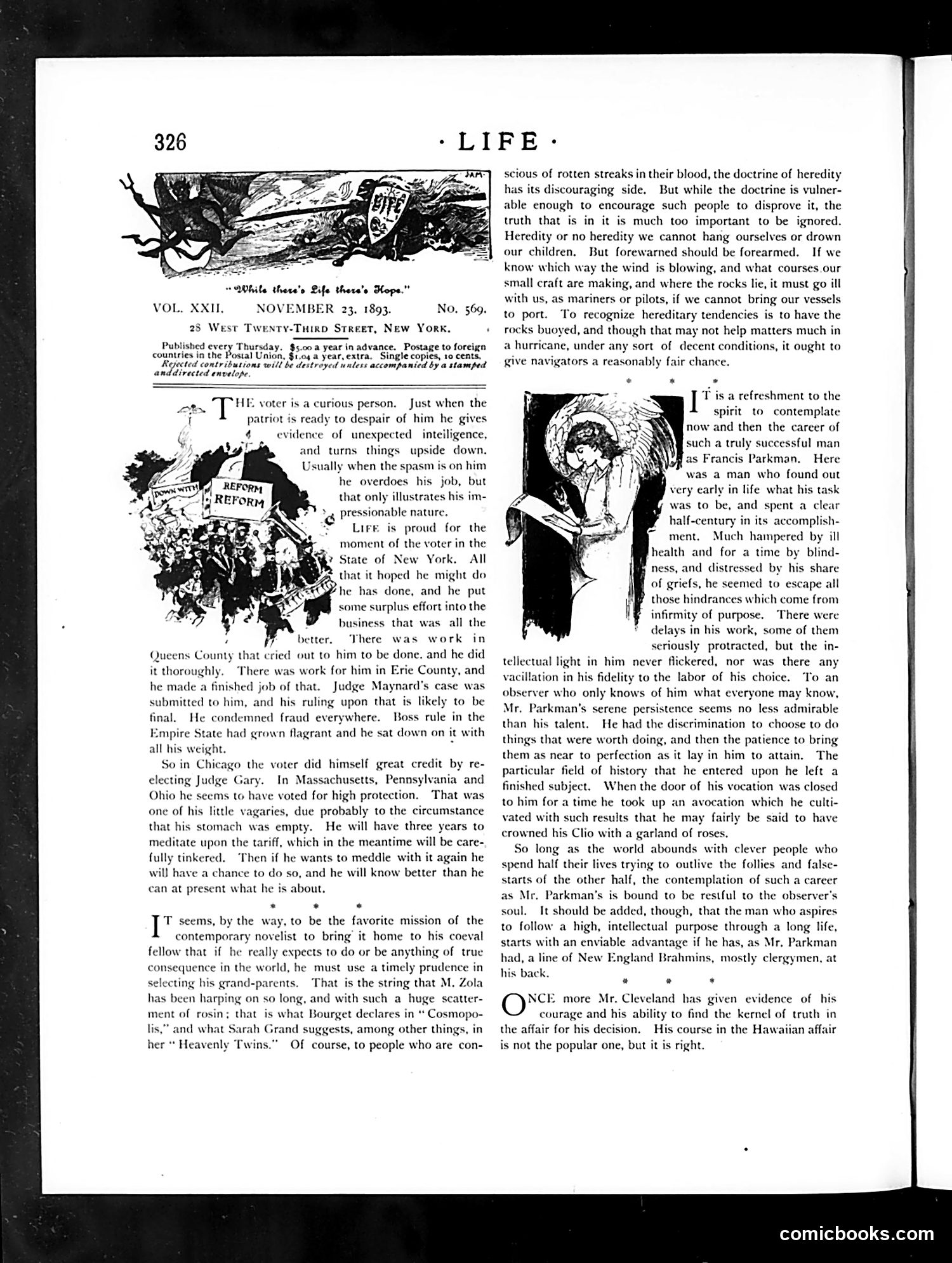
This page from *Life* magazine (November 23, 1893) contains two main elements: **Left cartoon:** A satirical illustration titled "While there's Life there's Hope" depicts a figure labeled "REFORM" being battered and trampled. This appears to critique the state of electoral reform efforts, showing reform as struggling or under attack—likely referencing contemporary political corruption or failed reform initiatives in New York and other states mentioned in the text. **Right section:** A biographical essay praising Francis Parkman, a historian noted for perseverance despite illness and blindness. The accompanying portrait illustrates this profile piece celebrating intellectual achievement and dedication to scholarly work. The page overall reflects *Life*'s dual mission: political satire on the left, cultural commentary on the right—typical of 1890s American satirical journalism.
📄 Transcribed text from this page (OCR, searchable)
Machine-transcribed from the original scan — historical spelling and the odd misread are preserved.
- LIFE: “While there's Life there's Hope. VOL. XXII, NOVEMBER 23, 1893. No. 569. 23 West Twenty-Tuiro Street, New York, cof ublished every Thursday. $5.00 a year in advance. Postage to foreign ‘ountries in the Postal Union, $1.04 a year,extra. Single copies, 10 cents, Rejected contributions will be deitroyed unless accompanied by a stamped anddirected envelope HE voter is a curious person. Just when the patriot is ready to despair of him he gives evidence of unexpected inteiligence, and turns things upside down. Usually when the spasm is on him he overdoes his job, but that only illustrates his im- ‘é pressionable nature. £ Lire is proud for the moment of the voter in the ? State of New York. All that it hoped he might do he has done, and he put some surplus effort into the business that was all the better, There work in Queens County that cried out to him to be done, and he did it thoroughly, There was work for him in Erie County, and he made a finished job of that. Judge Maynard's case was submitted to him, and his ruling upon that is likely to be final. He condemned fraud everywhere. Boss rule in the Empire State had grown flagrant and he sat down on it with was all his weight. So in Chicago the voter did himself great credit by re- In Massachusetts, Pennsylvania and ve voted for high protection. That was one of his little vagaries, due probably to the circumstance that his stomach was empty. He will have three years to meditate upon the tariff, which in the meantime will be care- fully tinkered. Then if he wants to meddle with it again he will have a chance to do so, and he will know better than he can at present what he is about, electing Judge Gary. Ohio he seems to . * . T seems, by the way, to be the favorite mission of the contemporary novelist to bring it home to his coeval fellow that if he really expects to do or be anything of true consequence in the world, he must use a timely prudence in selecting his grand-parents. That is the string that M. Zola has been harping on so long, and with such a huge scatter- ment of rosin; that is what Bourget declares in * Cosmopo- rah Grand suggests, among other things, in Of course, to people who are con- lis,” and what $ her “ Heavenly Twi scious of rotten streaks in their blood, the doctrine of heredity has its discouraging side. But while the doctrine is vulner- able enough to encourage such people to disprove it, the truth that is in it much too important to be ignored. Heredity or no heredity we cannot hang ourselves or drown our children, But forewarned should be forearmed. If we know which way the wind is blowing, and what courses.our small craft are making, and where the rocks lie, it must go ill with us, as mariners or pilots, if we cannot bring our vessels to port. To recognize hereditary tendencies is to have the rocks buoyed, and though that may not help matters much in a hurricane, under any sort of decent conditions, it ought to give navigators a reasonably fair chance. refreshment to the spirit to contemplate now and then the carcer of such a truly successful man as Francis Parkman. Here was a man who found out very early in life what his task was to be, and spent a clear half-century in its accomplish- ment. Much hampered by ill health and for a time by blind- ness, and distressed by his share of griefs, he seemed to escape all those hindrances which come from infirmity of purpose. ‘There were delays in his work, some of them seriously protracted, but the in- tellectual light in him never flickered, nor was there any vacillation in his fidelity to the labor of his choice. To an observer who only knows of him what everyone may know, Mr. Parkman's serene persistence seems no less admirable than his talent. He had the discrimination to choose to do things that were worth doing, and then the patience to bring them as near to perfection as it lay in him to attain. The particular field of history that he entered upon he left a finished subject. When the door of his vocation was closed to him for a time he took up an avocation which he culti- vated with such results that he may fairly be said to have crowned his Clio with a garland of ros So long as the world abounds with clever people who spend half their lives trying to outlive the follies and fals starts of the other half, the contemplation of such a career Parkman's is bound to be restful to the observer's soul. It should be added, though, that the man who aspires to follow a high, intellectual purpose through a long life, starts with an enviable advantage if he has, as Mr. Parkman had, a line of New England Brahmins, mostly clergymen, at his back. as Mr, * * . NCE more Mr. Cleveland has given evidence of his courage and his ability to find the kernel of truth in the affair for his decision. His course in the Hawaiian affair is not the popular one, but it is right. comicbooks.com