
A complete issue · 16 pages · 1892
Life — February 4, 1892
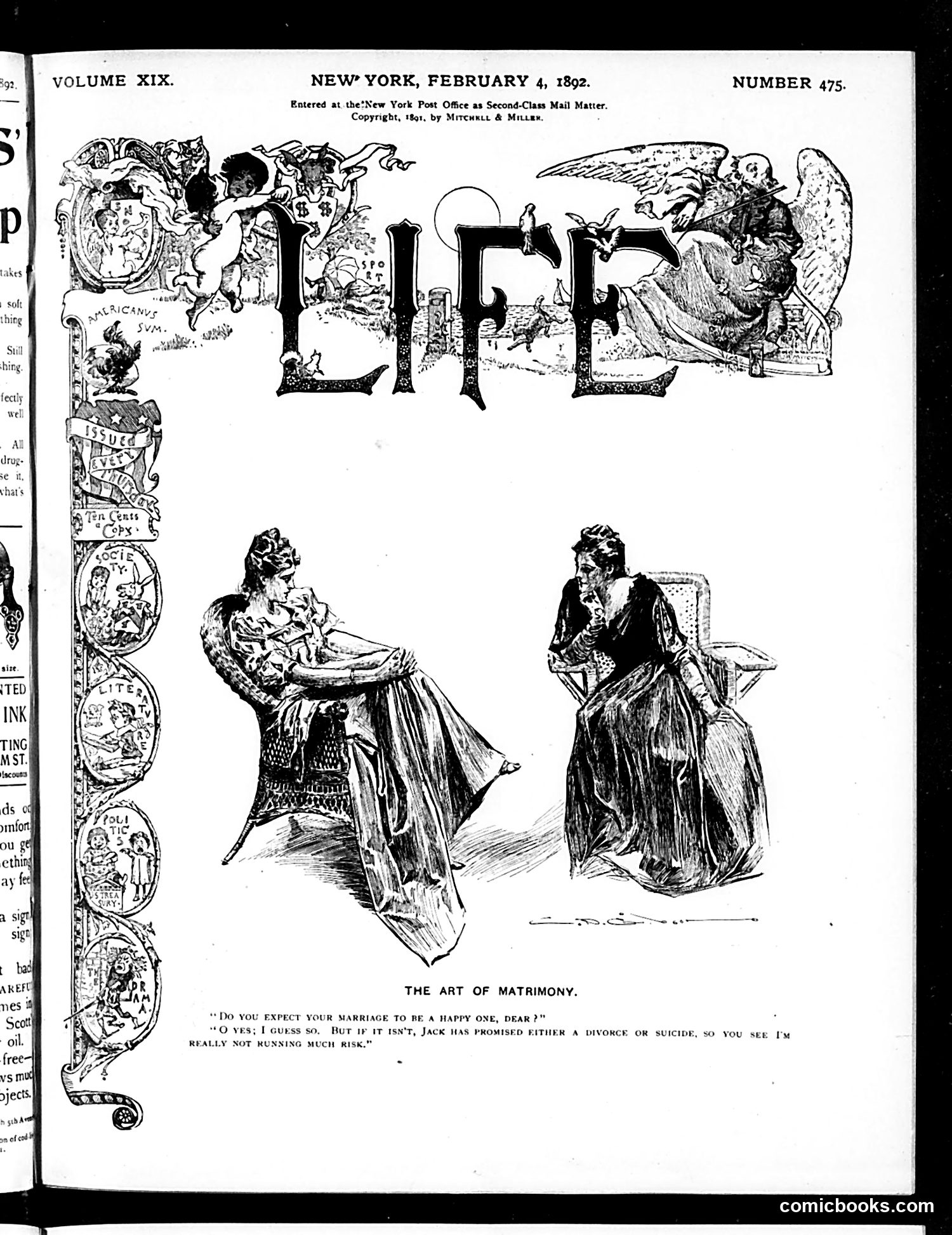
This satirical cartoon depicts two women in conversation about marriage prospects. The dialogue reveals the cynical humor: one woman asks if the other expects a happy marriage, and the response sarcastically suggests that her fiancé Jack has only promised "either a divorce or suicide"—so she's "really not running much risk." The joke satirizes late-19th-century marriage anxieties and gender relations. It mocks the precarious nature of matrimony for women, whose legal rights and economic security depended entirely on their husbands. The dark humor—treating divorce or a husband's suicide as acceptable outcomes—reflects contemporary concerns about unhappy marriages and the lack of viable exits for women trapped in bad unions.
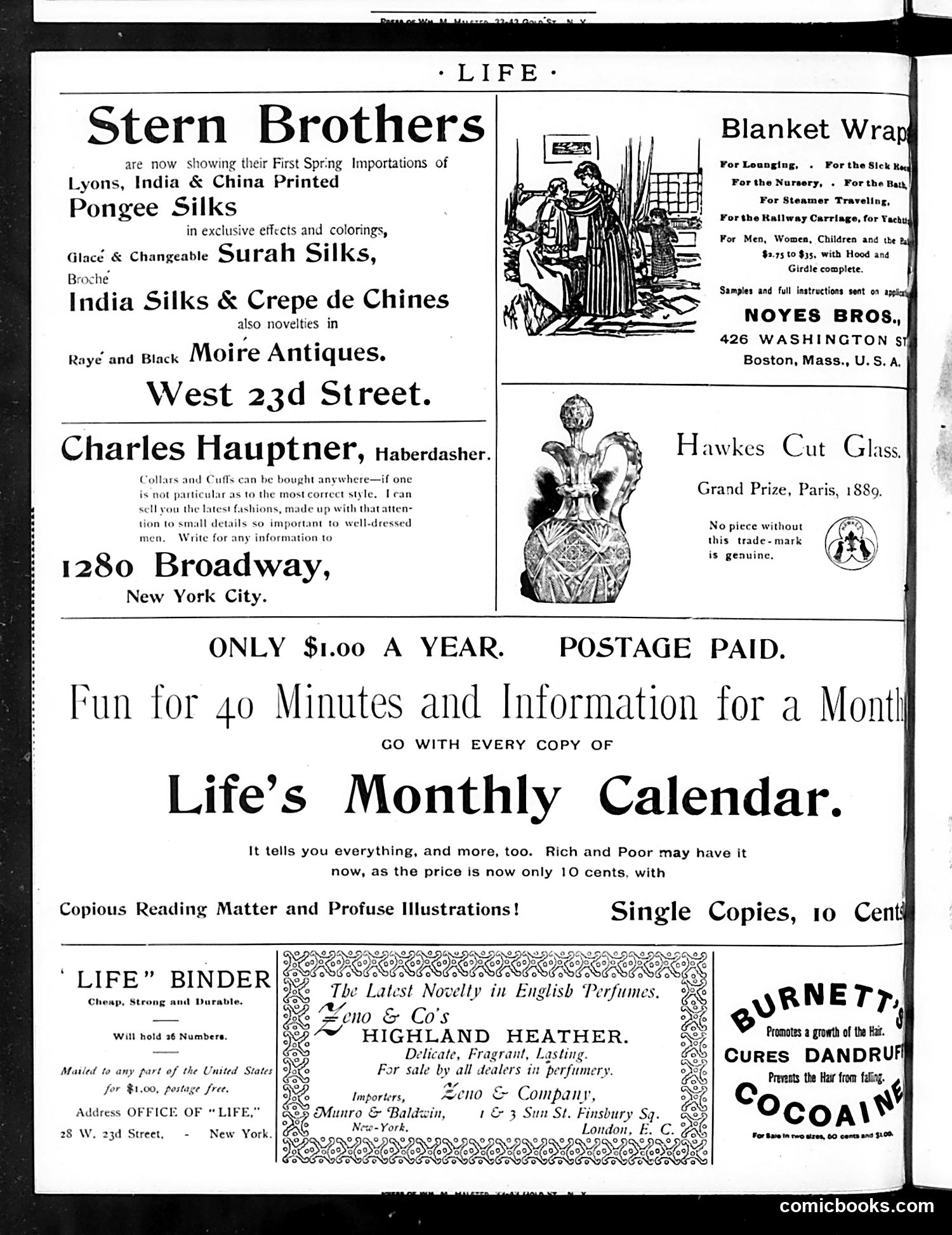
This page is **primarily advertising**, not political satire or editorial content. The ads include: - **Stern Brothers** (silk importer on West 23rd Street) - **Charles Hauptner** (haberdasher on Broadway) - **Noyes Bros.** (blanket wrap supplier in Boston) - **Hawkes Cut Glass** (with Grand Prize, Paris 1889) - **Life's Monthly Calendar** subscription offer - **Life Binder** for collecting issues - **Zeno & Co.'s Highland Heather** perfume - **Burnett's Cocaine** cough drops The small illustration (upper right) appears to be a generic domestic scene promoting blanket wraps—unremarkable by modern standards. There is **no identifiable political cartoon or satire** on this page. It's a typical late-19th-century magazine advertising spread showing period products and services.
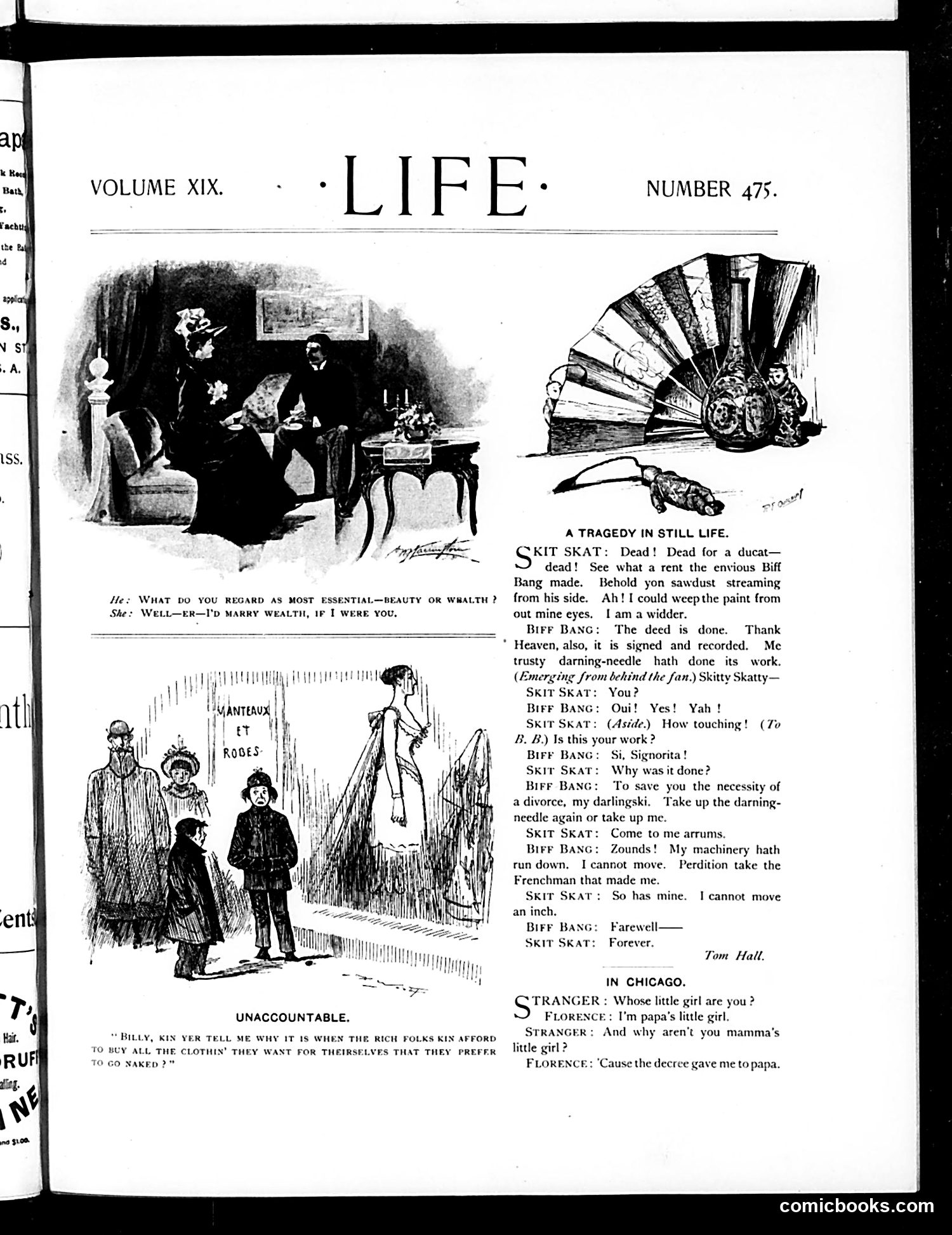
This page contains three satirical pieces: 1. **Top left cartoon**: A dialogue about marriage priorities—a man asks a woman whether she values beauty or wealth most, and she replies she'd marry for wealth. The satire critiques women's mercenary attitudes toward marriage. 2. **"A Tragedy in Still Life"**: A darkly comic sketch about a dead duck, featuring characters named "Biff Bang" and "Skit Skat" quarreling over responsibility for its death. The humor derives from treating the duck's death with mock-serious, dramatic language. 3. **"Unaccountable"**: Street scene satirizing wealthy people's hypocrisy—they demand poor children wear proper clothes while preferring to go naked themselves. 4. **"In Chicago"**: Brief dialogue about a child's parentage, playing on social assumptions.
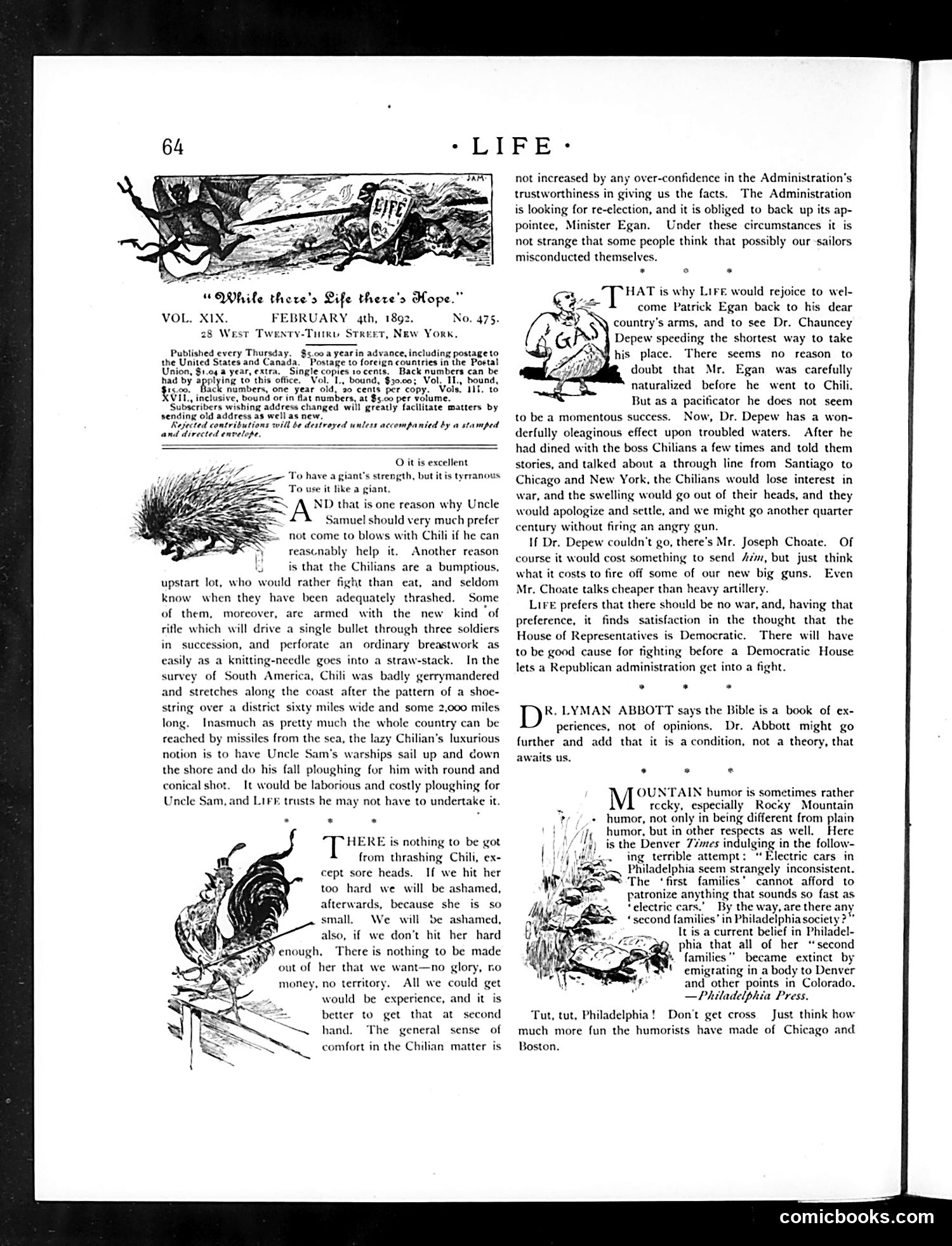
This *Life* page addresses the U.S. government's diplomatic tensions with Chile, likely following the 1891 Baltimore incident. The opening cartoon satirizes American naval power against Chilean forces, with the caption "White there's Life there's Hope." The text debates whether the U.S. should militarily intervene in Chile. It criticizes the Chilians as "bumptious" and armed with modern rifles, arguing they're unprepared for conflict with American naval superiority. The piece questions whether Patrick Egan (U.S. Minister to Chile) and Dr. Chauncy Depew should pursue war or diplomacy. The satire mocks both Chilean military capabilities and American political indecision about military action, presenting the conflict as potentially absurd given the disparity in naval power.
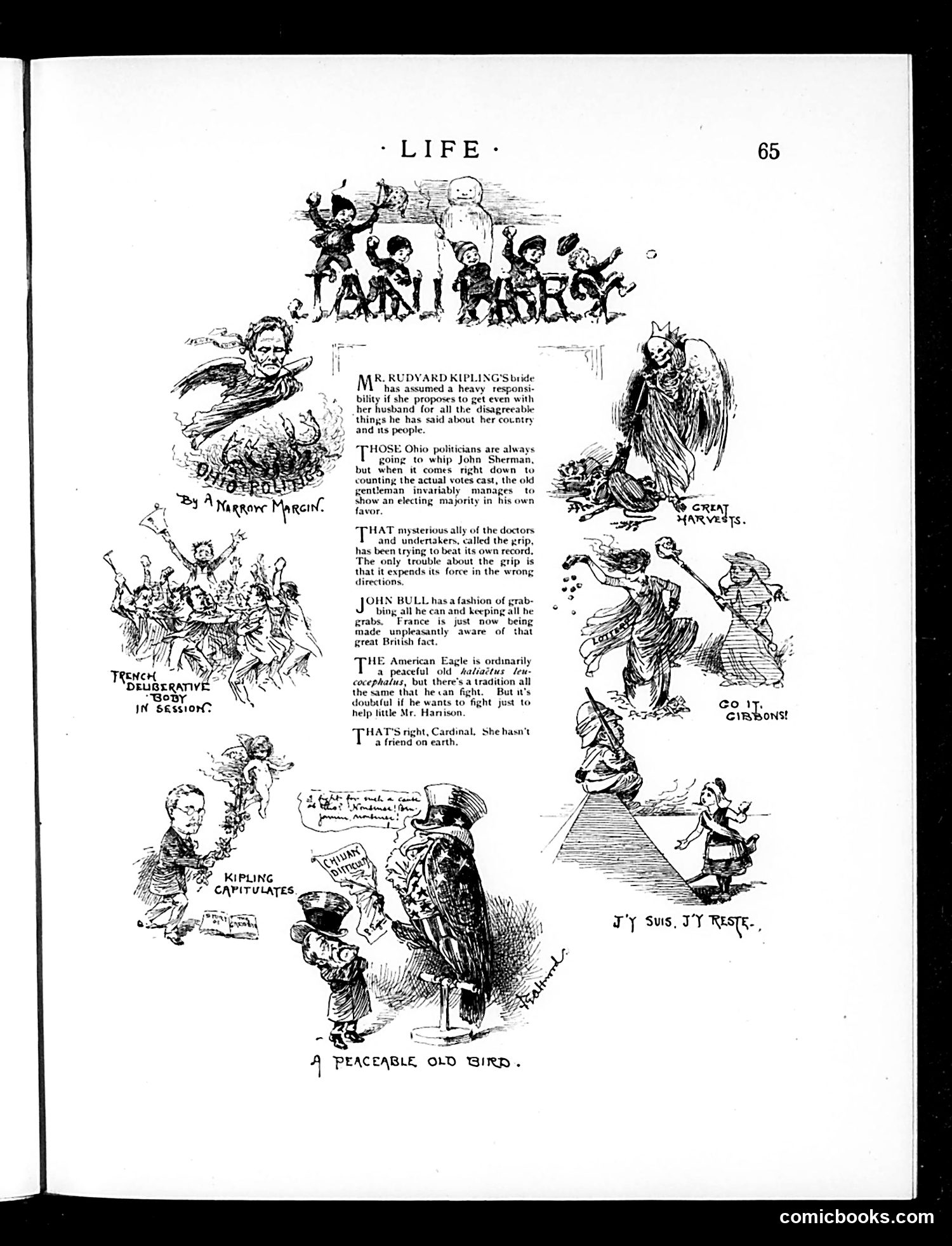
This page contains several political cartoons mocking figures and events of the early 20th century. The central text references **Rudyard Kipling's bride** assuming responsibility for her husband's controversial statements about America and Americans. Other satirical targets include: - **Ohio politicians** manipulating votes in Sherman's favor - **"The Grip"** (appears to be a political organization or faction) wasting resources - **John Bull** (Britain) grabbing territory - **The American Eagle** potentially fighting under Theodore Harrison's leadership - **Cardinal** having no earthly allies The cartoons employ allegorical figures and exaggerated character designs typical of early Life magazine satire, criticizing political corruption, imperial ambitions, and questionable foreign policy decisions of the era.
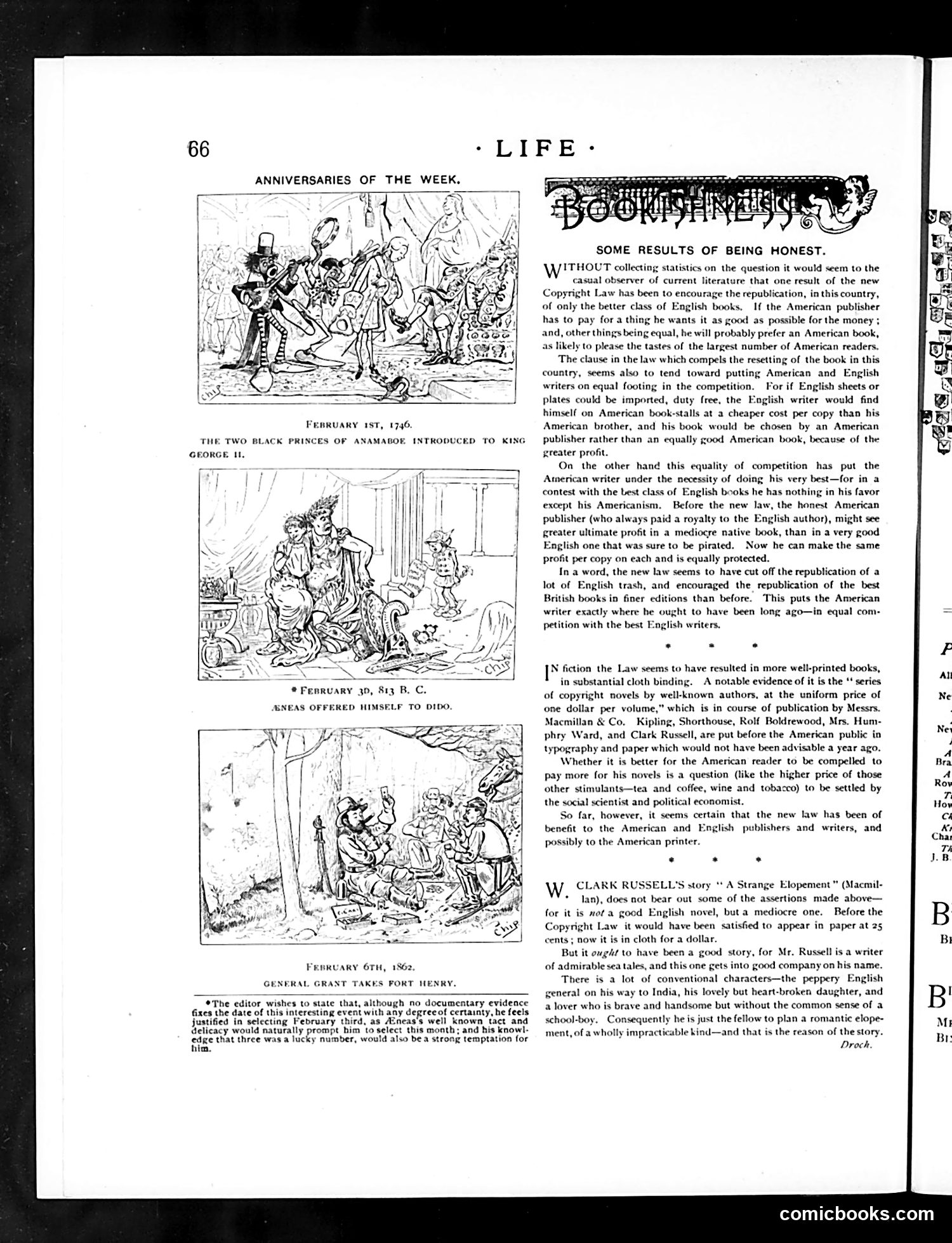
This page contains three historical illustrations under "Anniversaries of the Week," showing events from 1746, 813 B.C., and 1862. The main text article, "Some Results of Being Honest," discusses the American Copyright Law and its effects on publishing. The article argues the new copyright law encourages republication of American books and puts American and English writers on equal footing. It notes American publishers now face competition with English editions and must improve book quality and pricing to compete. The three illustrations commemorate historical events, though their specific subjects are difficult to identify clearly from the image alone. The page primarily serves as editorial commentary on copyright law's impact on the American publishing industry, rather than presenting satirical political cartoons.
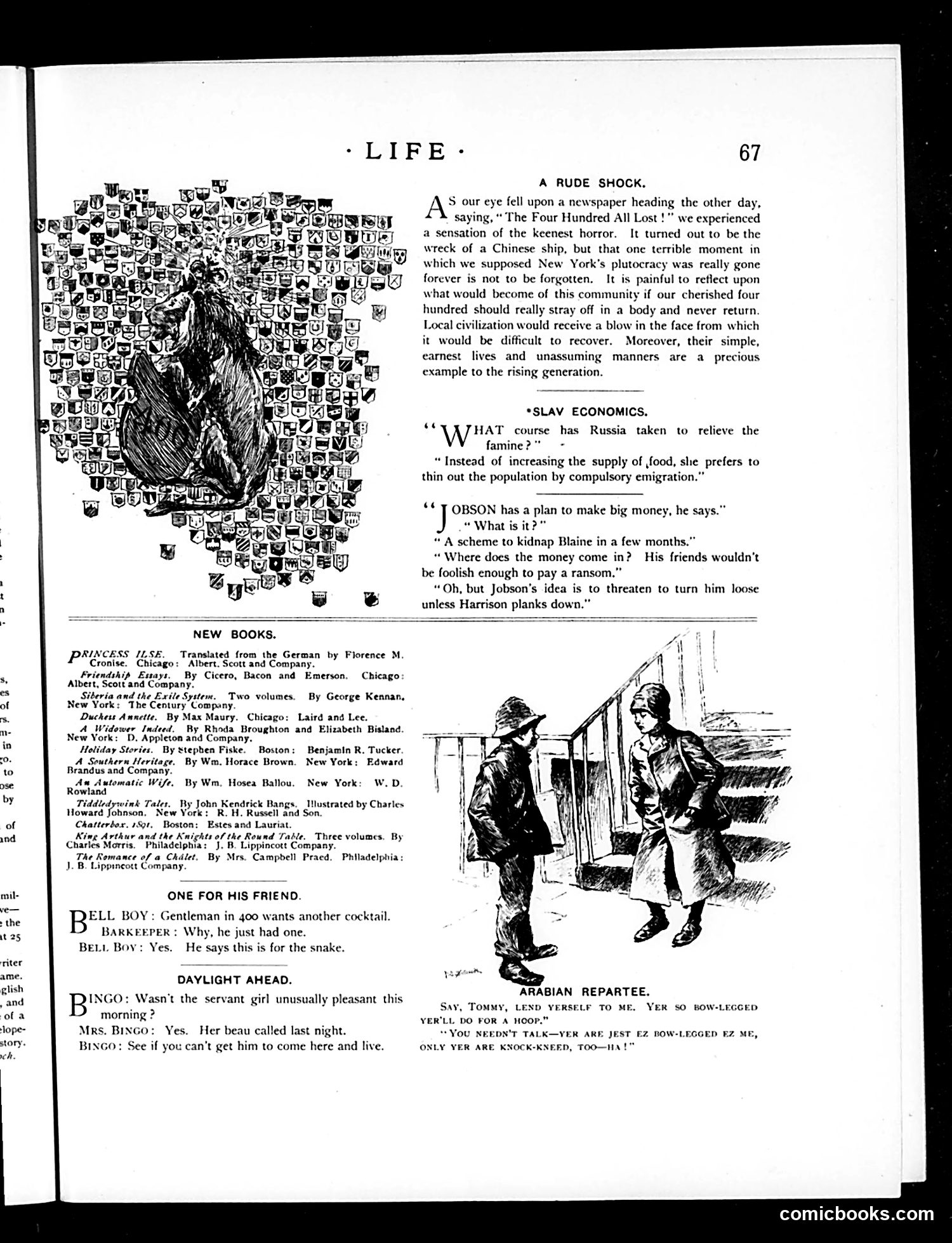
The large illustration on the left depicts a figure engulfed in flames surrounded by geometric shapes—likely representing a satirical commentary on urban chaos or industrial disaster, though the specific reference is unclear without additional context. The right illustration, titled "Arabian Repartee," shows two figures in what appears to be a domestic scene with dialect humor. The caption uses exaggerated phonetic spelling ("how-legged," "knob-kneed") to mock Middle Eastern or immigrant speech patterns—a common satirical device in early 20th-century American humor. The text sections include commentary on Chinese ship disasters, Russian famine relief policy, and a plot joke about kidnapping a character named Blaine. The "New Books" section lists contemporary publications, confirming this is a general-interest satirical magazine page mixing political commentary with light humor.
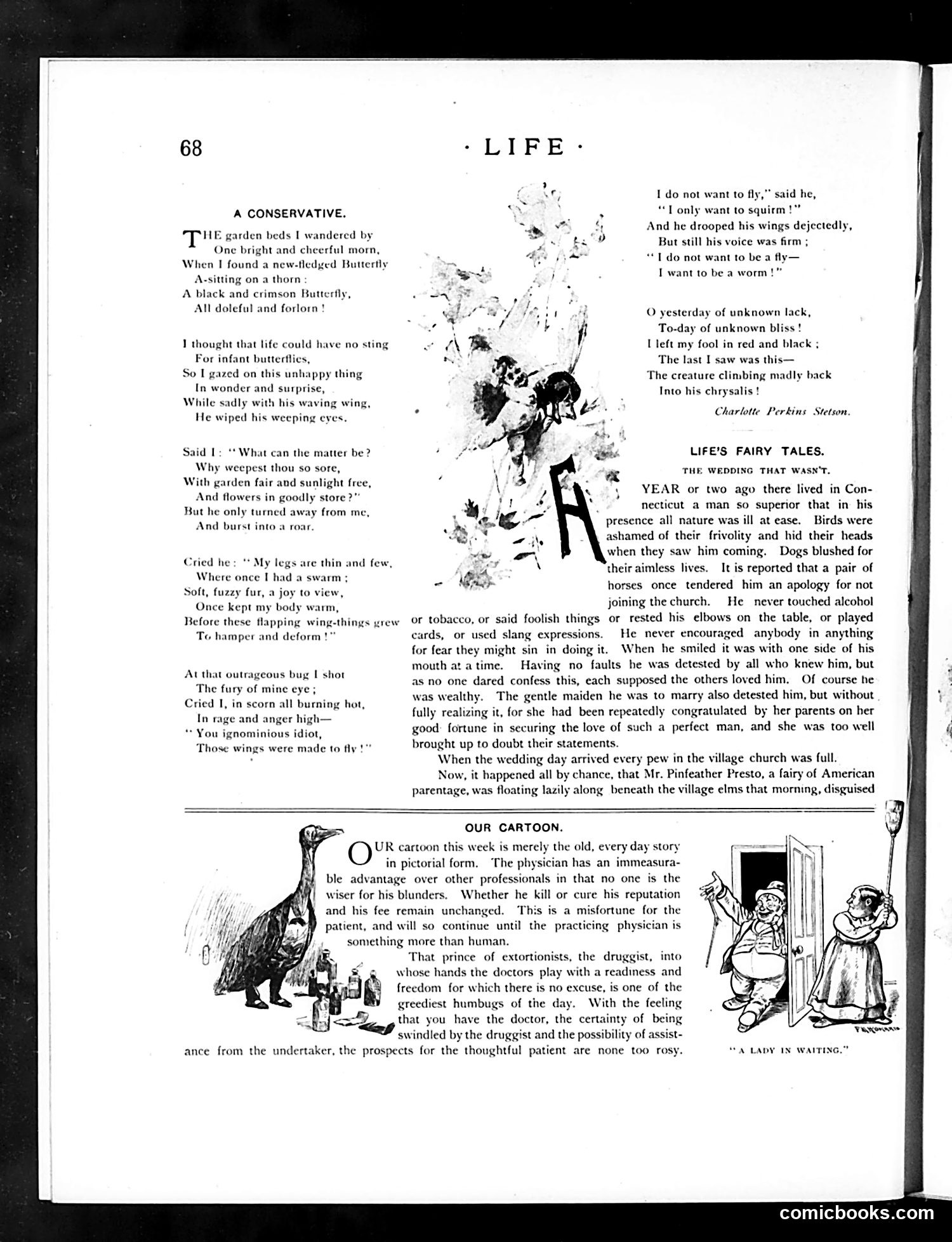
**"A Conservative"** poem (left) satirizes an overly cautious person who encounters a suffering butterfly. Rather than helping, the speaker obsesses about potential consequences, ultimately becoming angry at the insect. The satire targets conservative attitudes as paralyzingly fearful and ultimately cruel—choosing inaction over compassion. **"Life's Fairy Tales"** (right) presents a sarcastic romance: a man so morally superior he never errs, leading his fiancée to assume he's perfect. The irony suggests such "perfection" is either impossible or undesirable in real relationships. **"Our Cartoon"** (bottom) mocks physicians' freedom from accountability—they can bungle treatments with impunity while maintaining reputation and fees, unlike other professions. This critiques medical malpractice immunity as absurd and exploitative to patients.
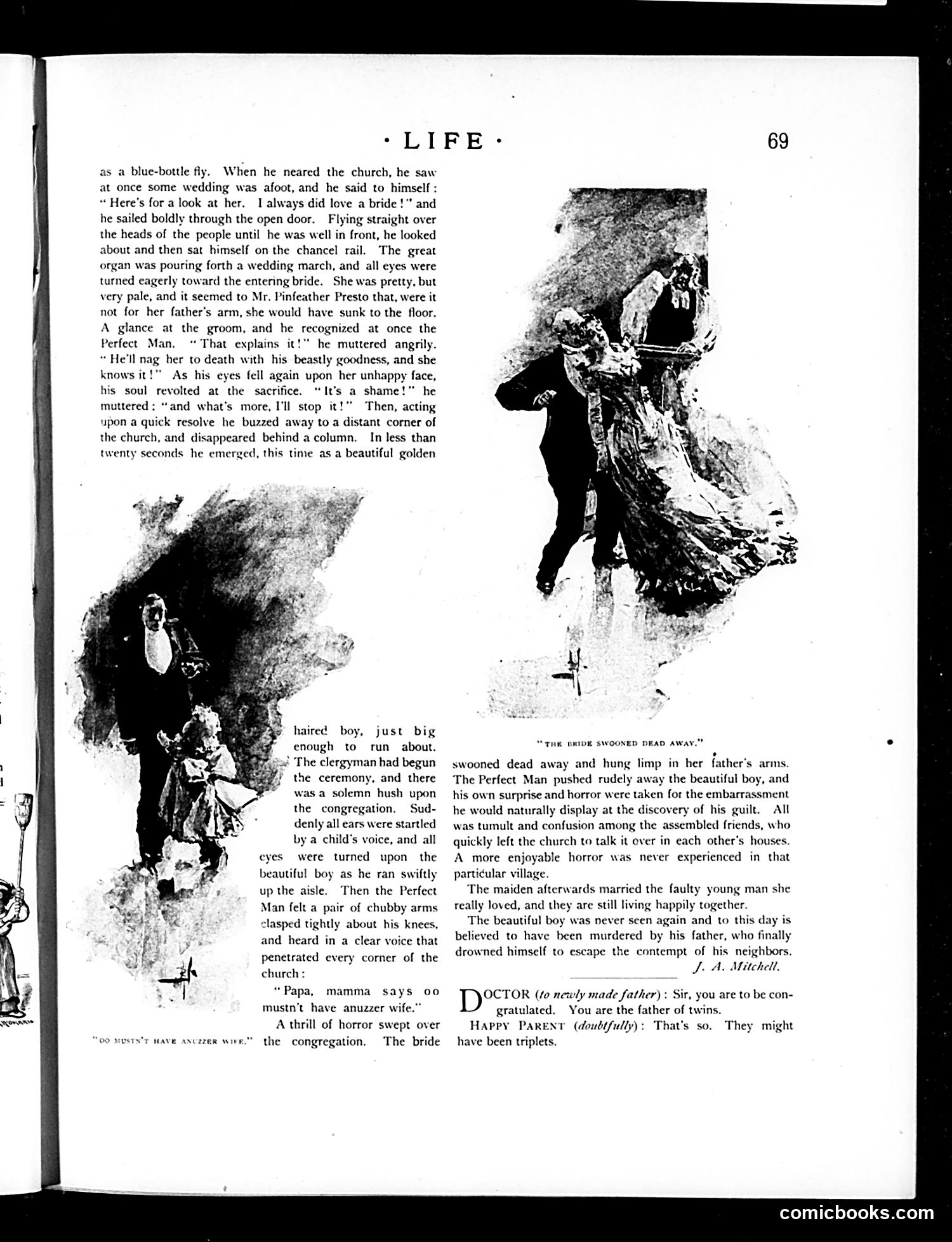
This page from *Life* magazine contains a narrative story with accompanying illustrations rather than political cartoons. The text describes a man (identified as "the Perfect Man") attending a wedding, becoming disgusted by the bride's pale appearance and her father's need to support her, then transforming into a golden-haired boy to disrupt the ceremony. The story appears to be satirizing idealized masculine virtue and social pretense—the "Perfect Man" character is hypocritically judgmental despite claiming moral superiority. The magical transformation suggests absurdist humor mocking rigid social conventions around weddings and gender roles. The bottom section includes a comedic dialogue between a doctor and "Happy Parent" about twin births, continuing the satirical tone about domestic life and parenthood.
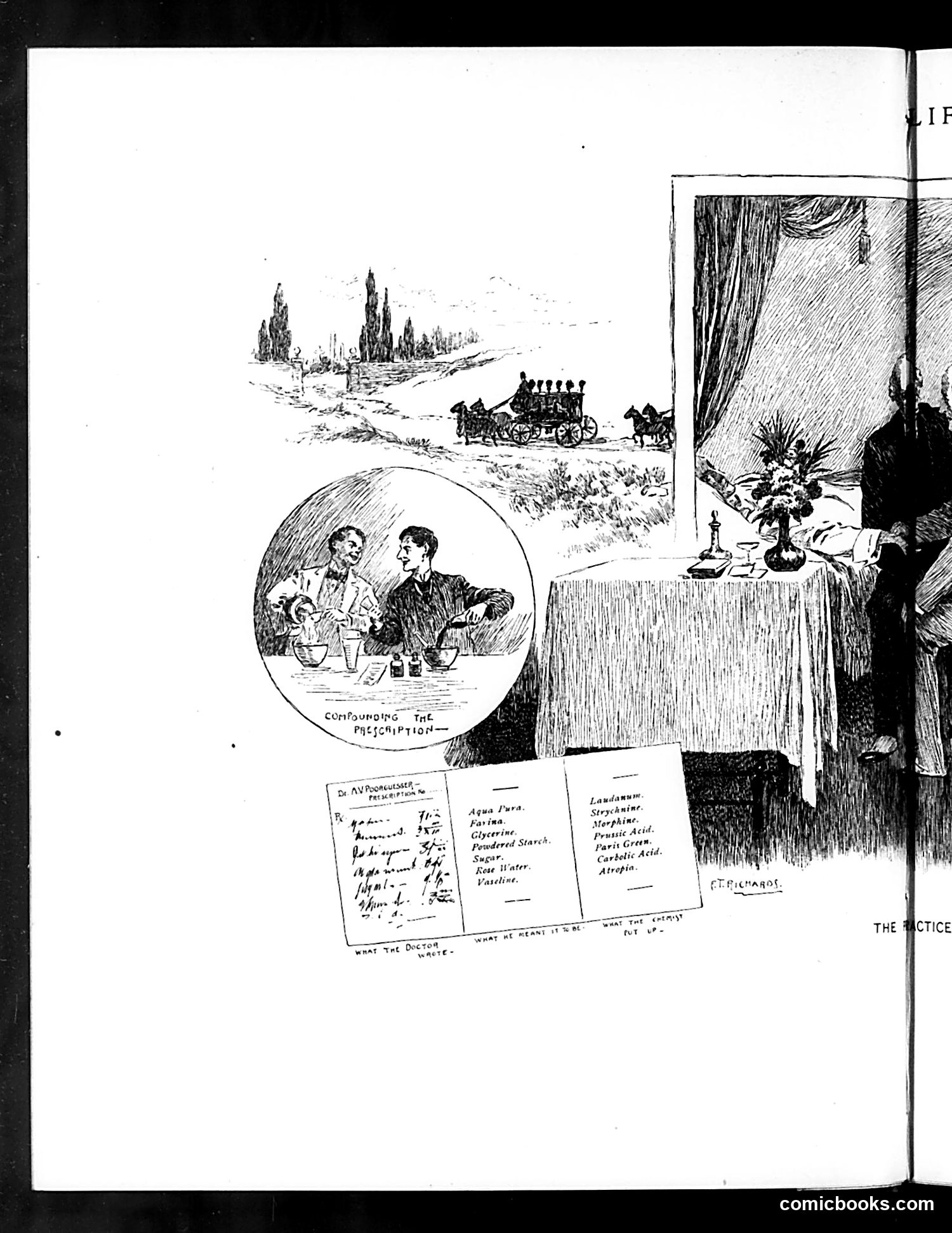
This cartoon satirizes prescription medicine practices. The central circular vignette shows two men examining bottles, labeled "Confounding the Prescription." Below are three prescription notes listing various ingredients—including items like "Powdered Starch," "Sugar," "Rose Water," and "Carbolic Acid." The caption "What the Doctor Wrote" contrasts with "What We Mean It to Be" and "What the Patient Put Up," suggesting confusion or deliberate alteration between what physicians prescribed and what pharmacists actually dispensed. The background landscape with a carriage and figures appears to show a broader scene, possibly a country estate. The satire critiques either pharmaceutical incompetence or intentional substitution of ingredients in prescriptions—a concern when drug regulation was minimal and accountability unclear.
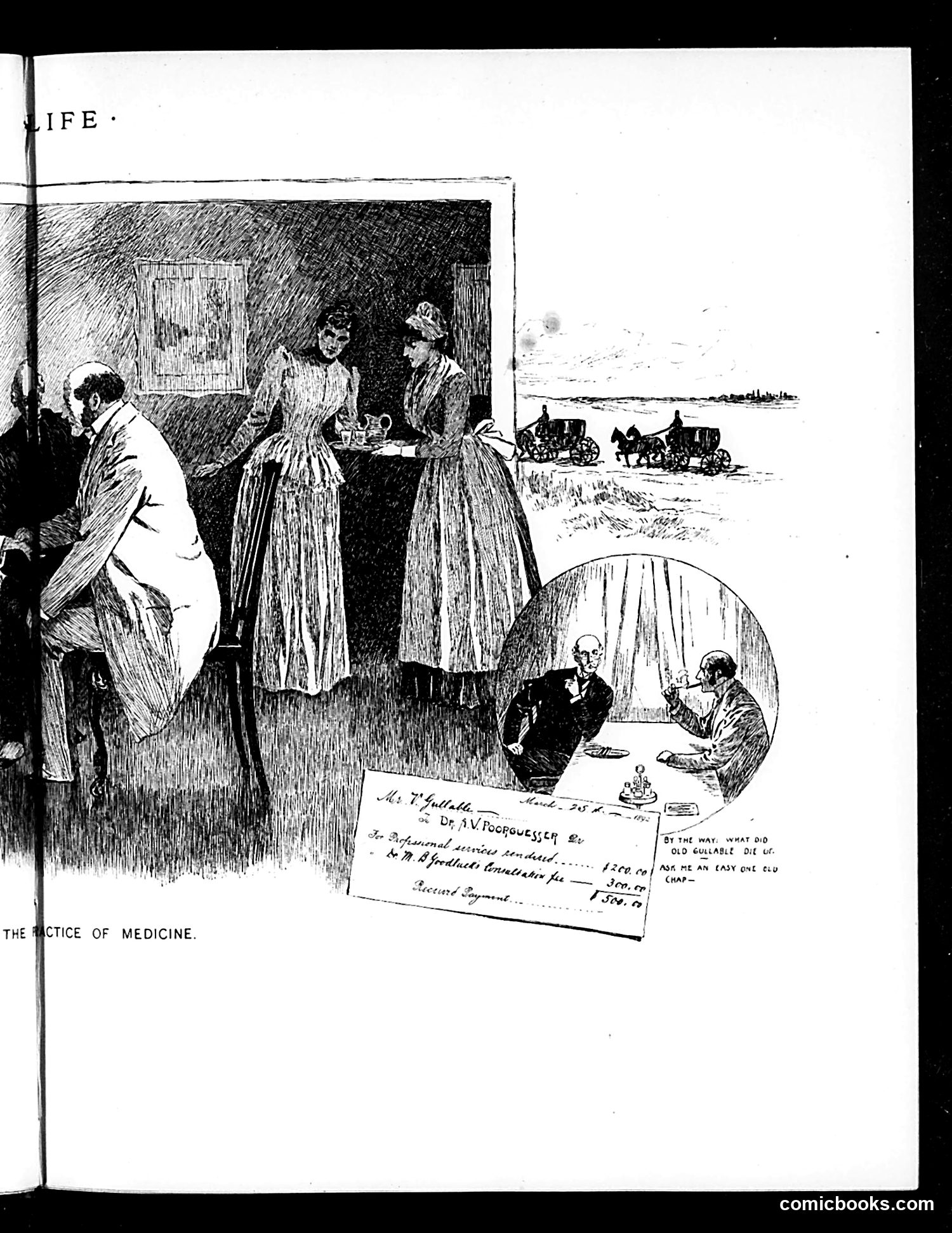
This satirical illustration critiques medical bill collection practices. The cartoon shows a doctor's office scene where well-dressed women converse while a man sits at a desk reviewing medical invoices. A separate vignette depicts two skeletal figures (representing Death) in what appears to be a tent or confined space, with a caption questioning whether a patient died "an easy death" or faced difficulty. The handwritten bill visible references Dr. A.V. Pooguevich and itemizes medical services with associated costs. The satire suggests that doctors prioritize billing and debt collection over patient welfare—the grim reaper vignette implies patients may die while physicians focus on financial accounts rather than their actual health outcomes.
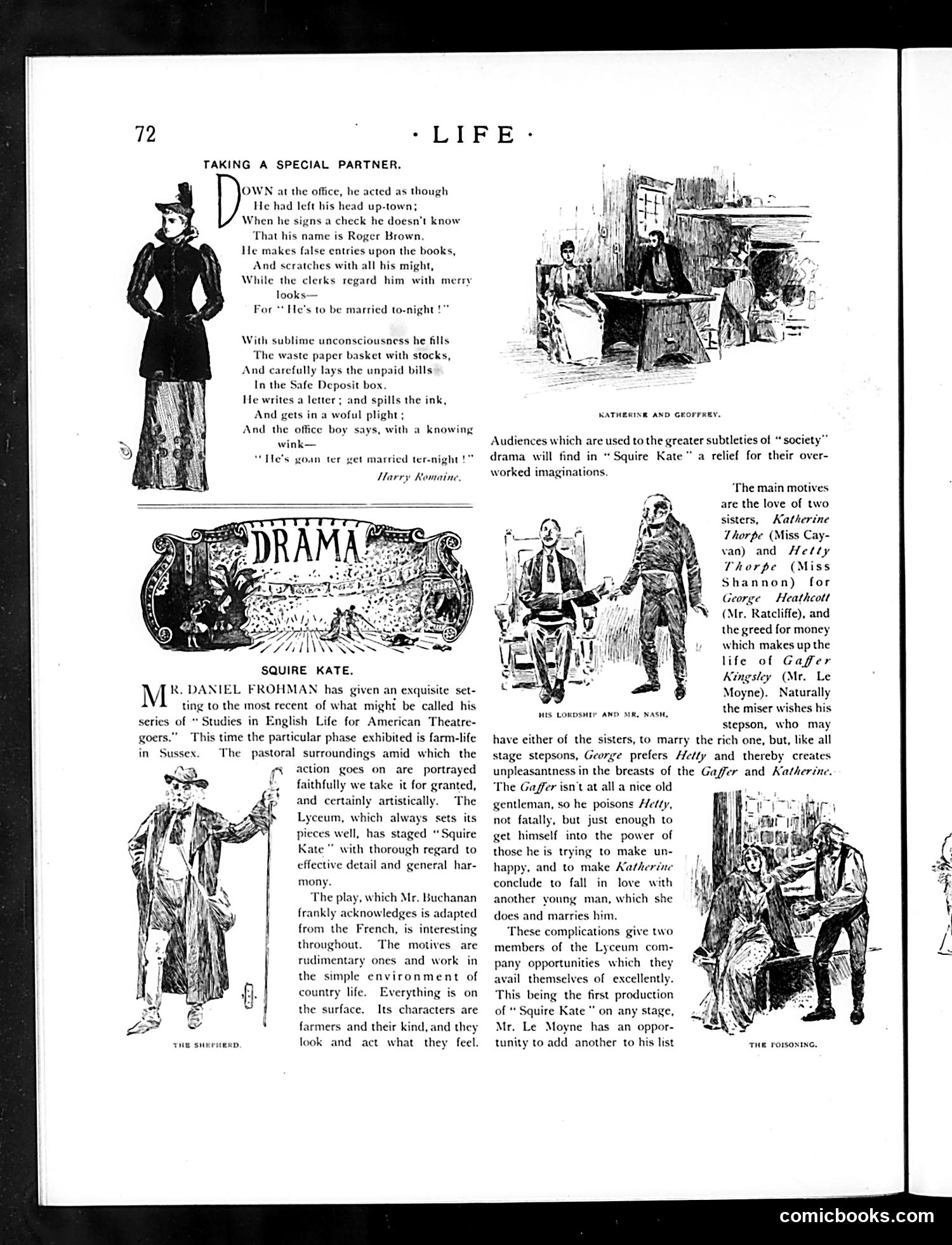
This page contains two distinct pieces: **The Poem "Taking a Special Partner"** satirizes office workers distracted by their impending wedding. "Roger Brown" makes clerical errors, misfiles documents, and generally neglects his job because he's getting married that night. The humor relies on the era's assumption that marriage—particularly for men—was so momentous it rendered them temporarily incompetent. The office boy's knowing wink suggests this is a predictable, relatable condition. **The Play Review for "Squire Kate"** covers a Lyceum Theatre production adapted from French drama. The plot involves two sisters (Katherine and Hetty Thorpe) competing for the affection of George Heathcott, while a miserly stepfather (Gaffer Kingsley) wants George to marry the wealthier sister. The review notes the villain even poisons Hetty (non-fatally) to manipulate others. The satire appears gentle—the critic suggests audiences tired of sophisticated "society" drama will find this farm-life melodrama refreshingly straightforward.
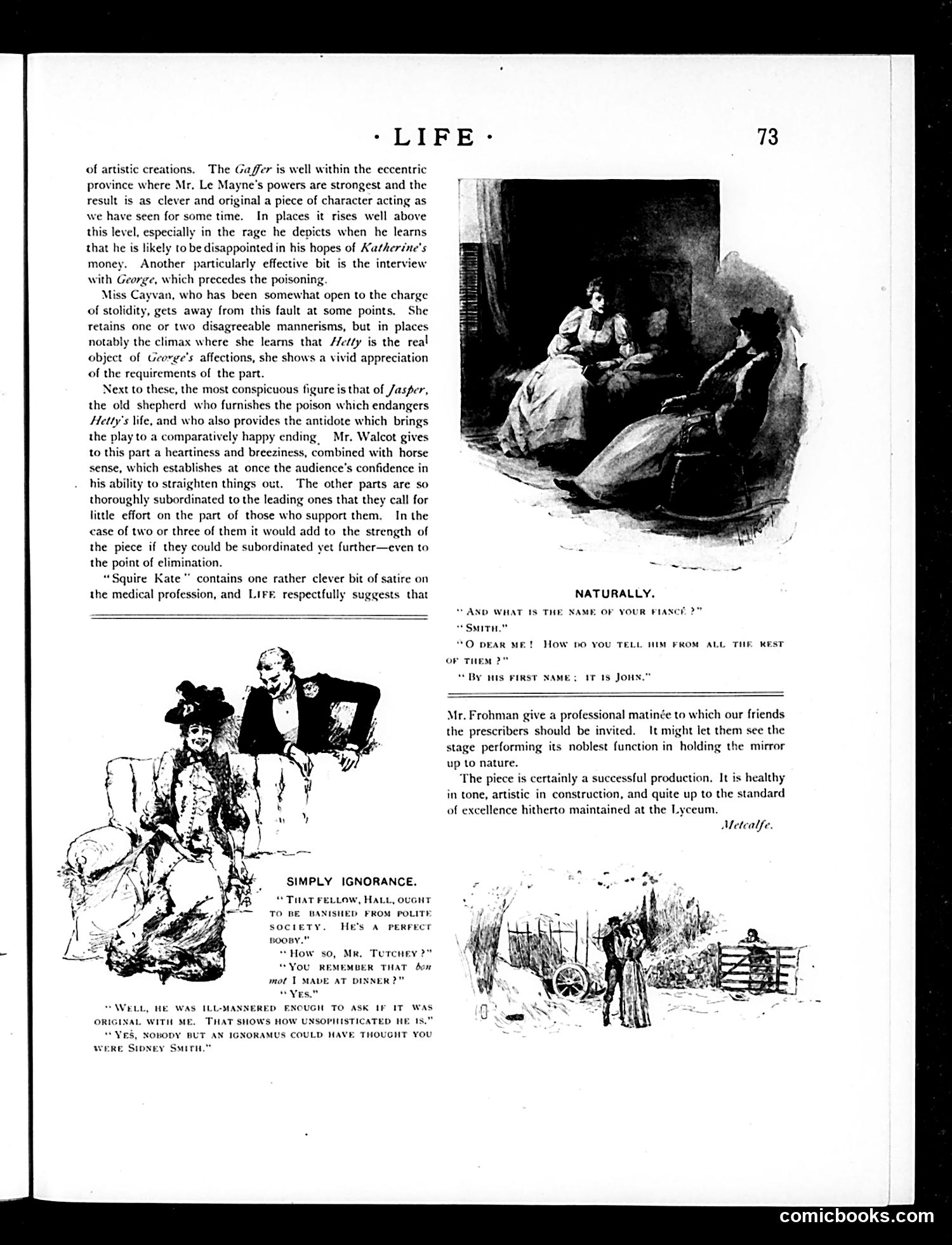
This page reviews theatrical productions, likely from the early 1900s. The main content discusses "The Gaffer," a stage play featuring character-driven performances. The text praises actor Le Mayne's portrayal of a money-obsessed character and critiques supporting performers like Miss Dean (playing Hetty) and Mr. Walcot (as Jasper, an old shepherd). The two cartoons illustrate social satire: 1. **"Naturally"** (top right): A woman distinguishes her fiancé from other men solely by his first name—John—mocking how interchangeable suitors appear to her, likely satirizing superficial courtship conventions. 2. **"Simply Ignorance"** (bottom left): A man is socially ostracized for asking if another's witty remark was original, rather than attributing it to Sidney Smith (a known wit). The satire targets affected intellectualism and social pretension—the questioner's honesty reveals him as "unsophisticated" among people concerned with appearing clever. Both cartoons mock Victorian-era social conventions and class affectation.
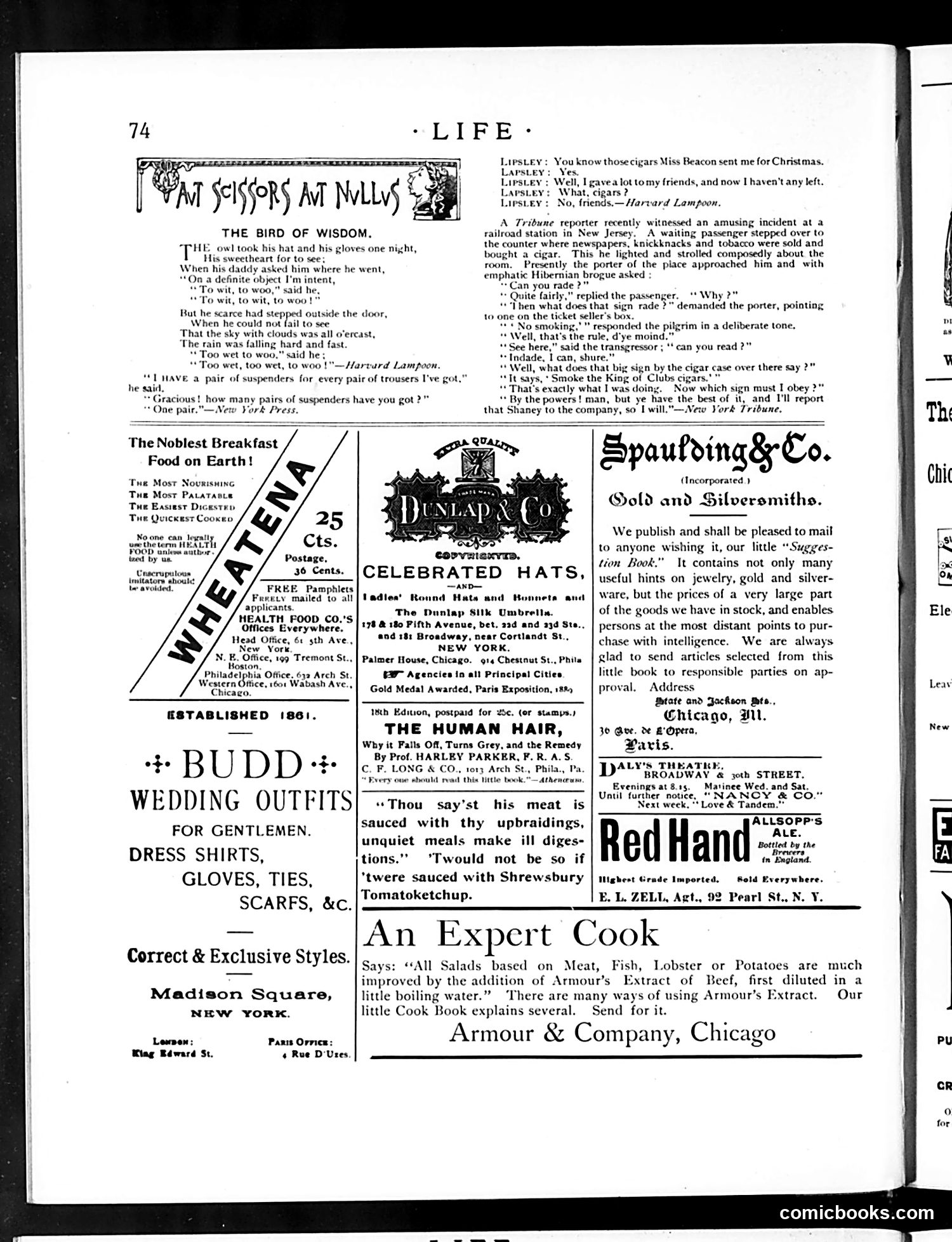
This page is primarily **advertisements and light humor pieces**, typical of Life magazine's satirical format. The main comic content includes three brief jokes: 1. **"The Bird of Wisdom"** — A Harvard Lampoon reprint about an owl attempting courtship thwarted by rain, with a punchline about "too wet to woo." 2. **A suspenders joke** — A man claims to own multiple suspenders but admits he only has one pair. 3. **The cigar/reading sign anecdote** — A porter confronts a passenger smoking in a "No Smoking" area at a train station. When asked if he can read, the passenger claims he was reading the *opposite* sign ("Smoke the King of Clubs cigars"), creating absurdist humor from contradictory signage. The remainder comprises period advertisements for gentlemen's clothing (Budd), hats (Dunlap), food products, and jewelry (Spaulding & Co.). **The satire is light and domestic** rather than political—focused on everyday social situations and wordplay rather than commentary on contemporary events.
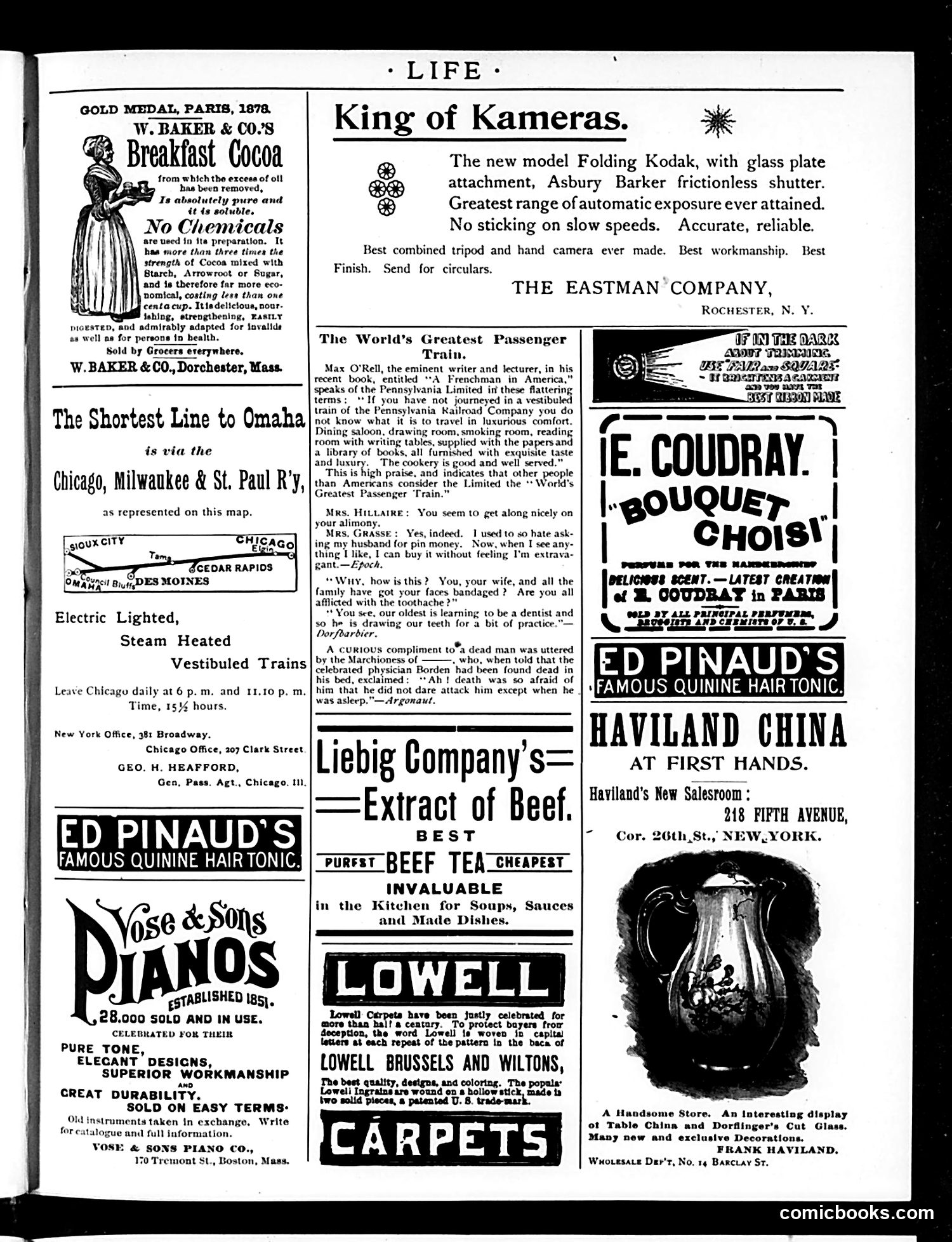
This is primarily a **commercial advertising page** from Life magazine, not a political cartoon. The page consists almost entirely of product advertisements typical of the 1870s-80s era: breakfast cocoa, pianos, hair tonic, cameras, railroad services, and carpets. The only satirical content appears to be **three brief humorous anecdotes** in the center column, including jokes about alimony, family dental practice, and a physician's death. These are mild domestic humor—not political commentary. The "King of Kameras" headline is simply advertising copy for the new Eastman Kodak folding camera, presented as a premium consumer product. The page reflects the magazine's mixed format of advertisements subsidizing satirical content. **For modern readers:** This shows how 19th-century magazines monetized through extensive ads while maintaining editorial content, and what products were marketed to affluent Americans of that era.
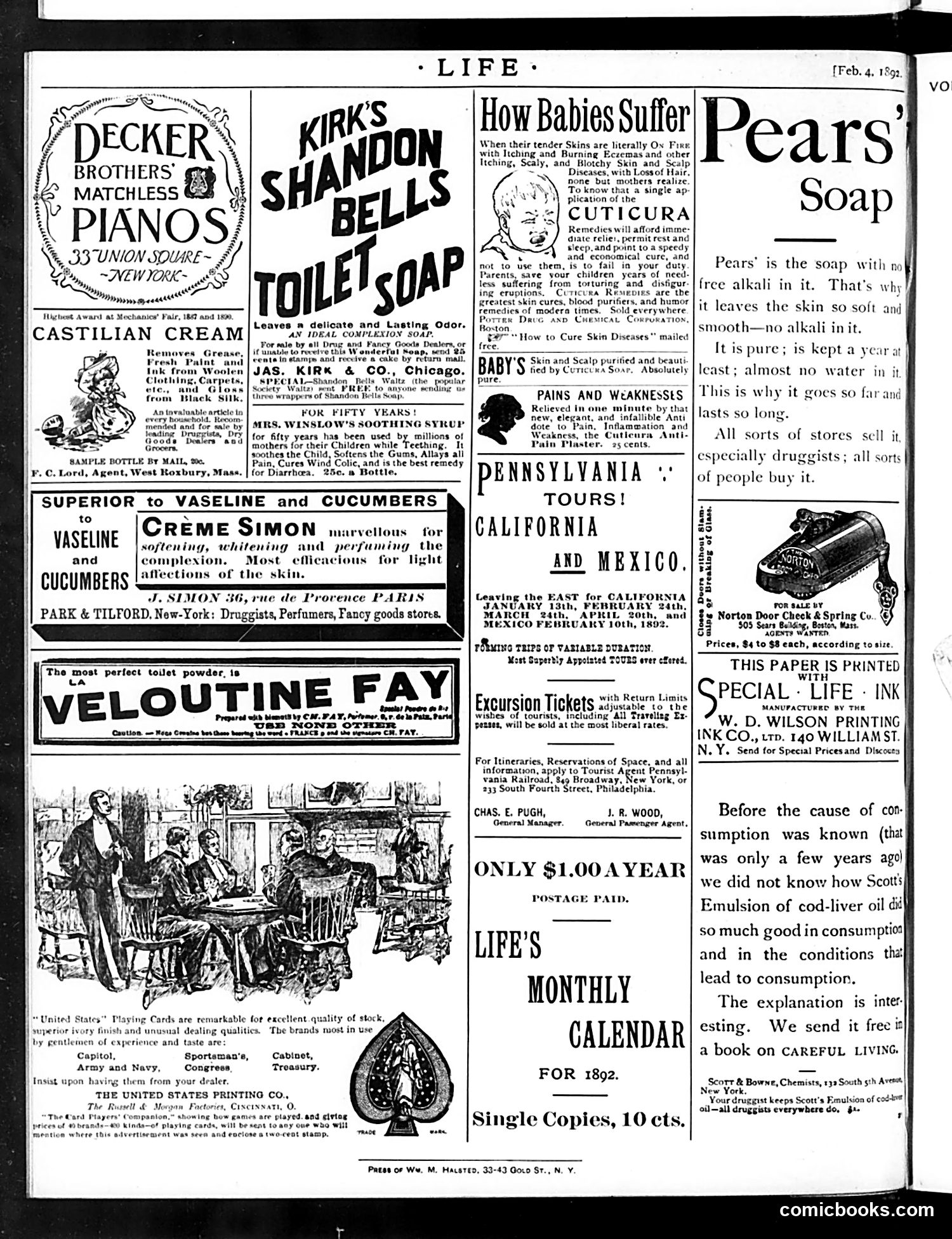
This page is **primarily advertising**, not editorial or satirical content. It features typical late-19th-century product advertisements for toiletries, patent medicines, and consumer goods common to the era. Notable ads include: - **Decker Brothers Pianos** and **Kirk's Shandon Bells Toilet Soap** - **Cuticura Remedies** for skin diseases and babies' eczema - **Mrs. Winslow's Soothing Syrup** (a real product containing opiates, marketed for teething) - **Vaseline** and various complexion creams - **Veloutime** face powder - Playing cards and California/Mexico tour packages The **sole illustration** shows a social scene with well-dressed figures, though its specific satirical meaning is unclear without additional context. The page reflects period attitudes: unregulated medical claims, skin-whitening products marketed to women, and opioid-based baby products presented as safe remedies—practices that modern readers would find shocking.