
Life, 1892-02-04 · page 12 of 16
Life — February 4, 1892 — page 12: what you’re looking at
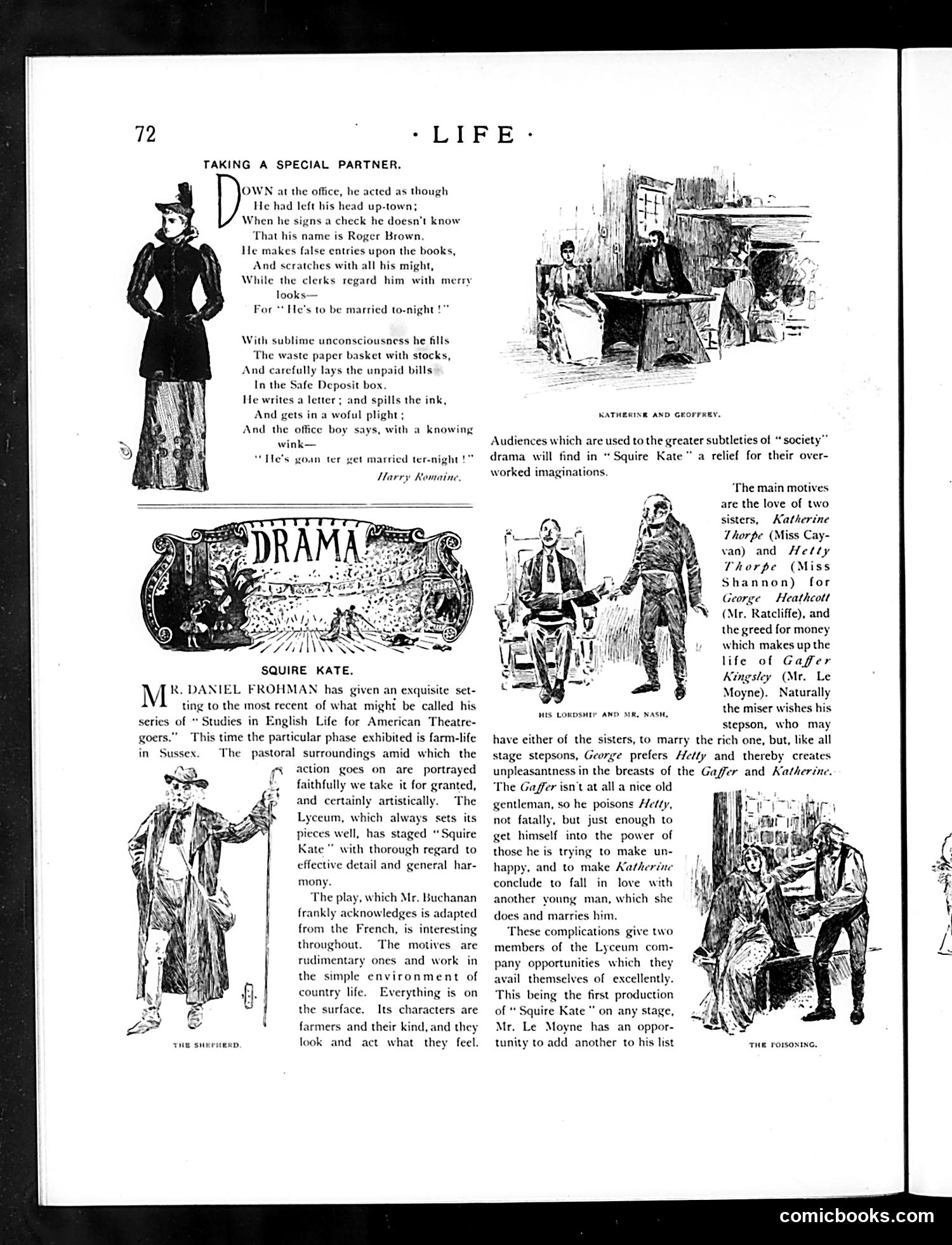
What you’re looking at
This page contains two distinct pieces: **The Poem "Taking a Special Partner"** satirizes office workers distracted by their impending wedding. "Roger Brown" makes clerical errors, misfiles documents, and generally neglects his job because he's getting married that night. The humor relies on the era's assumption that marriage—particularly for men—was so momentous it rendered them temporarily incompetent. The office boy's knowing wink suggests this is a predictable, relatable condition. **The Play Review for "Squire Kate"** covers a Lyceum Theatre production adapted from French drama. The plot involves two sisters (Katherine and Hetty Thorpe) competing for the affection of George Heathcott, while a miserly stepfather (Gaffer Kingsley) wants George to marry the wealthier sister. The review notes the villain even poisons Hetty (non-fatally) to manipulate others. The satire appears gentle—the critic suggests audiences tired of sophisticated "society" drama will find this farm-life melodrama refreshingly straightforward.
📄 Transcribed text from this page (OCR, searchable)
Machine-transcribed from the original scan — historical spelling and the odd misread are preserved.
-LIFE-: TAKING A SPECIAL PARTNER. OWN at the office, he acted as though He had left his head up-town; When he signs a check he doesn't know That his name is Roger Brown. He makes false entries upon the books, And scratches with all his might, While the clerks regard him with merry looks— For “He's to be married to-night!" With sublime unconsciousness he fills The waste paper basket with stocks, And carefully lays the unpaid bills In the Safe Deposit box. He writes a letter; and spills the ink, And gets in a woful plight; And the office boy says, with a knowing wink— KATHERINE AND GEOFFREY. Audiences which are used to the greater subtleties of “ society” drama will find in “Squire Kate” a relief for their over- worked imaginations. “He's goan ter get married terenight 17 Harry Romaine, ‘The main motives are the love of two sisters, Katherine Thorpe (Miss Cay- van) and Hetty Thorpe (Miss Shannon) for George Heathcott (Mr. Ratcliffe), and the greed for money which makes up the life of Gaffer Kingsley (Mr. Le Moyne). Naturally the miser wishes his stepson, who m; have either of the sisters, to marry the rich one, but, lik stage stepsons, George prefers Helly and thereby creates unpleasantness in the breasts of the Gaffer and Katherine. SQUIRE KATE. WV R. DANIEL FROHMAN has given an exquisite set- ting to the most recent of what might be called his sel of “ Studies in English Life for American Theatre- goers This time the particular phase exhibited is farm-life in Sussex. The pastoral surroundings amid which the action goes on are portrayed MIS LORDSHIP AND MR, NASH, THE SHEPHERD, faithfully we take it for granted, and certainly artistically. The Lyceum, which always sets its picces well, has staged “ Squire Kate” with thorough regard to effective detail and general har- mony. The play, which Mr. Buchanan frankly acknowledges is adapted from the French, is interesting throughout. The motives are rudimentary ones and work in the simple environment of country life. the surface. Everything is on Its characters are farmers and their kind, and they look and act what they feel. The Gaffer isn’ at all a nice old gentleman, so he poisons Hefty, not fatally, but just enough to get himself into the power of those he is trying to make un- happy, and to make Katherine conclude to fall in love with another young man, which she does and marries him. These complications give two members of the Lyceum com- pany opportunities which they avail themselves of excellently. This being the first production of “ Squire Kate ” on any stage, Mr. Le Moyne has an oppor- tunity to add another to his list THE POISONING. comicbooks.com