
Life, 1892-02-04 · page 13 of 16
Life — February 4, 1892 — page 13: what you’re looking at
What you’re looking at
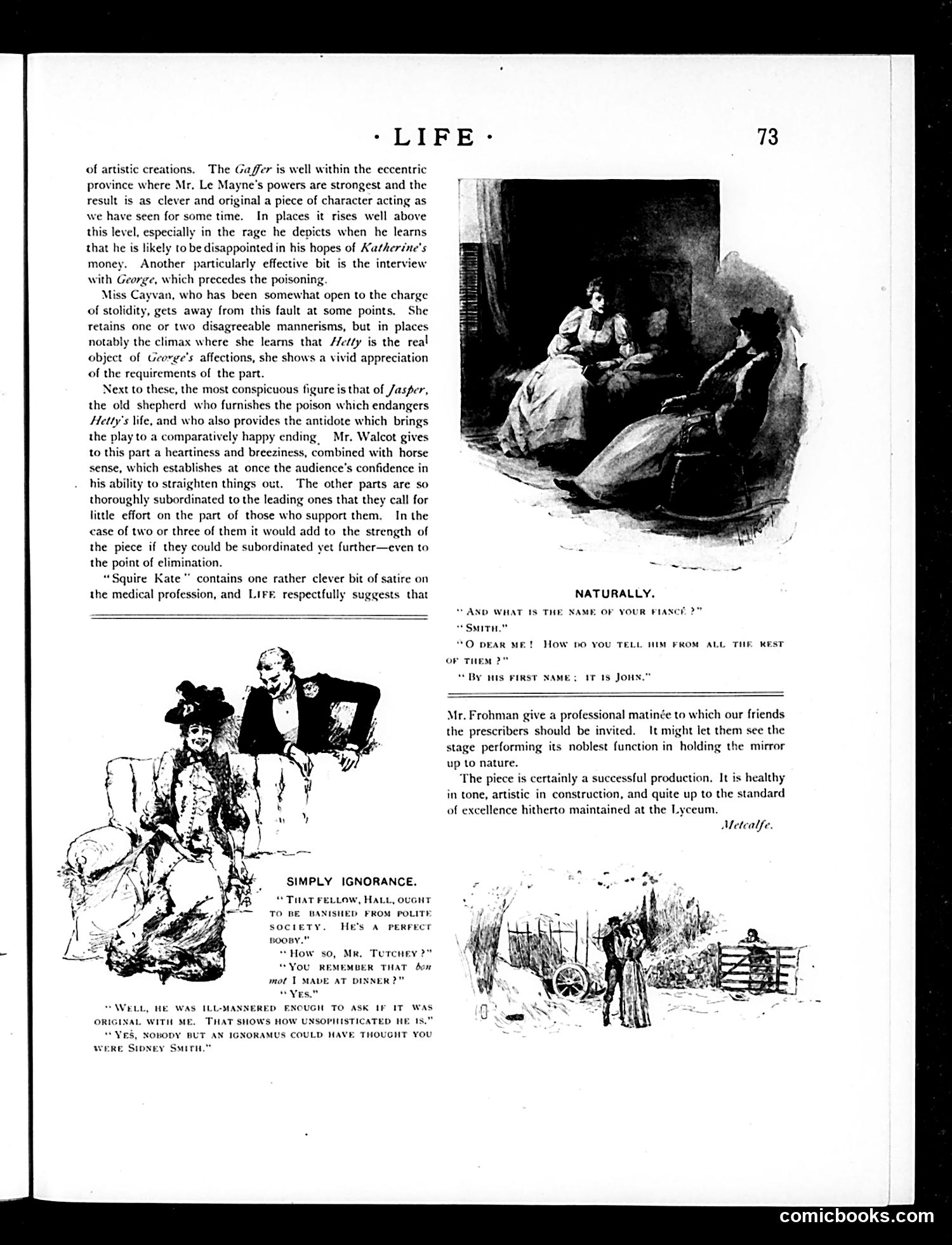
This page reviews theatrical productions, likely from the early 1900s. The main content discusses "The Gaffer," a stage play featuring character-driven performances. The text praises actor Le Mayne's portrayal of a money-obsessed character and critiques supporting performers like Miss Dean (playing Hetty) and Mr. Walcot (as Jasper, an old shepherd). The two cartoons illustrate social satire: 1. **"Naturally"** (top right): A woman distinguishes her fiancé from other men solely by his first name—John—mocking how interchangeable suitors appear to her, likely satirizing superficial courtship conventions. 2. **"Simply Ignorance"** (bottom left): A man is socially ostracized for asking if another's witty remark was original, rather than attributing it to Sidney Smith (a known wit). The satire targets affected intellectualism and social pretension—the questioner's honesty reveals him as "unsophisticated" among people concerned with appearing clever. Both cartoons mock Victorian-era social conventions and class affectation.
📄 Transcribed text from this page (OCR, searchable)
Machine-transcribed from the original scan — historical spelling and the odd misread are preserved.
- LIFE: of artistic creations, The Gaffer is well within the eccentric province where Mr, Le Mayne’s powers are strongest and the result is as clever and original a piece of character acting as een for some time. In plat it rises well above this level, especially in the rage he depicts when he learns that he is likely to be disappointed in his hopes of Katherine's money. Another particularly effective bit is the interview which precedes the poisoning. an, who has been somewhat open to the charge of stolidity, gets away from this fault at some points. She retains one or two disagreeable mannerisms, but in places notably the climax where she learns that /Yefly is the real object of George's affections, she shows a vivid appreciation of the requirements of the part. Next to these, the most conspicuous figure is that of Jasper, the old shepherd who furnishes the poison which endangers Hetty’s \ife, and who also provides the antidote which brings the play to a comparatively happy ending, Mr. Walcot gives to this part a heartiness and breeziness, combined with horse sense, which establishes at once the audience's confidence in his ability to straighten things out. The other parts are so thoroughly subordinated to the leading ones that they call for little effort on the part of those who support them, In the case of two or three of them it would add to the strength of the piece if they could be subordinated yet further—even to the point of elimination. “Squire Kate contains one rather clever bit of satire on the medical profession, and LiFe respectfully suggests that NATURALLY. ‘AND WHAT 18 THE NAME OF YOUR FIANCE >” Seat.” “O DEAR ME! How po you TELL HIM FROM ALL THE KEST oF THEM 2" FIRST NAME; IT 18 JOHN,” Mr. Frohman give a professional matinée to which our friends the prescribers should be invited. It might let them see the stage performing its noblest function in holding the mirror up to nature. The piece is certainly a successful production, It is healthy in tone, artistic in construction, and quite up to the standard of excellence hitherto maintained at the Lyceum. Metcalfe. SIMPLY IGNORANCE, “ TuaT FELLOW, HALL, OUGHT TO BE DANISHED FROM POLITE society. He's A PERFECT noosy. “How so, Mk, Tutcuey 2?” “YOU REMEMBER THAT don mot 1 MAD ER?" “AVELL, HE WAS ILL-MAN 3 NOUGH TO ASK IF IT WAS ORIGINAL WITH ME. THAT SHOWS HOW UNSOPHISTICATED HE “YES, NOKODY BUT AN IGNORAMUS COULD HAVE THOUGHT YOU were Sipney Swirn.” comicbooks.com