
A complete issue · 18 pages · 1889
Life — May 16, 1889
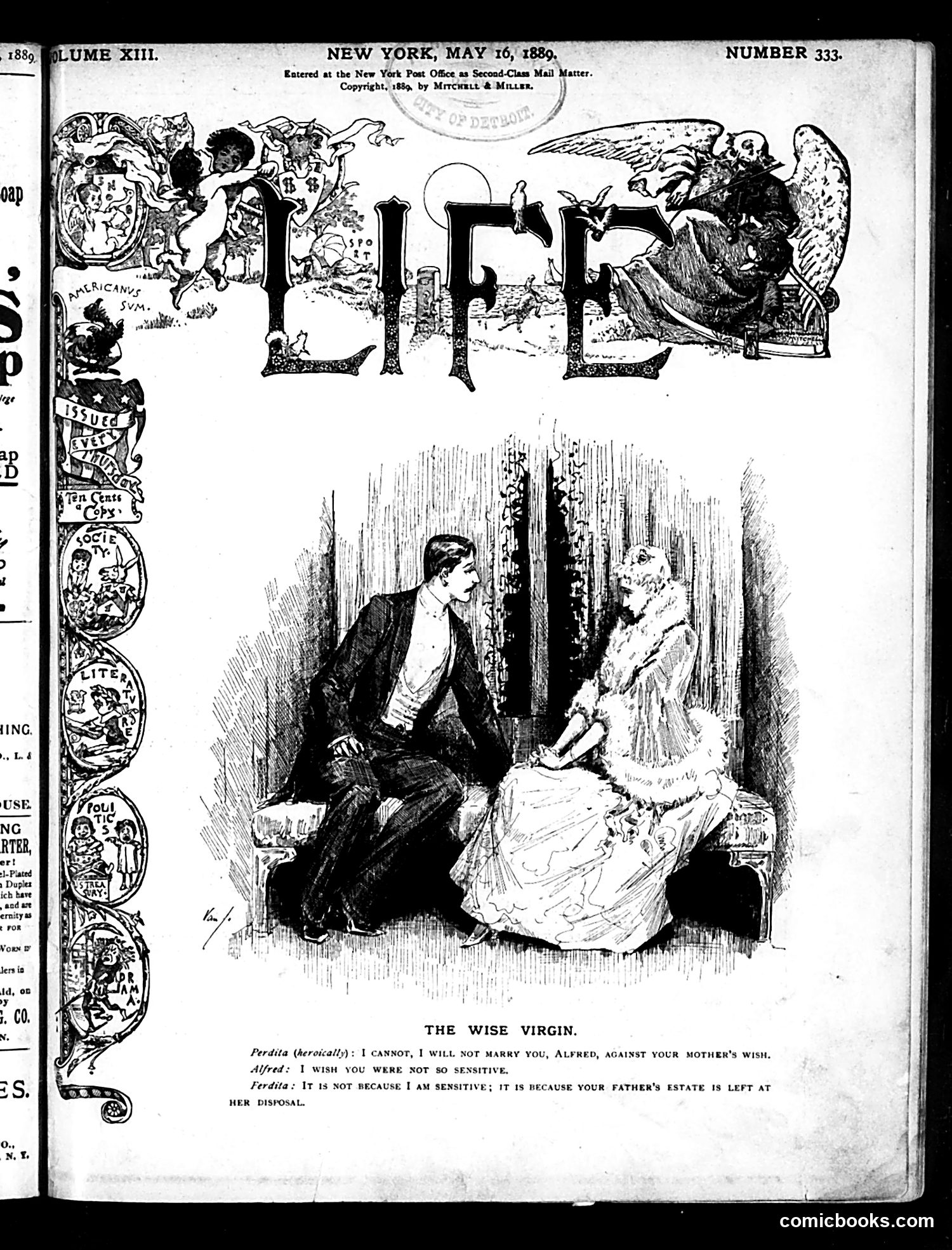
This satirical illustration depicts a domestic dispute over marriage and inheritance. A young woman (Perdita) refuses a suitor (Alfred) despite his desire to marry her. Her stated reason: she won't marry against her mother's wishes, and more crucially, because her father's estate remains undistributed at her mother's discretion. The satire targets a woman exercising financial and familial control—she withholds her inheritance settlement as leverage over her daughter's marital choices. The cartoon's title ironically calls her "wise," mocking both her mercenary motives and the era's expectations around women's dependency on male relatives for financial security. The dialogue reveals tension between romantic desire and economic reality in late-19th-century courtship.
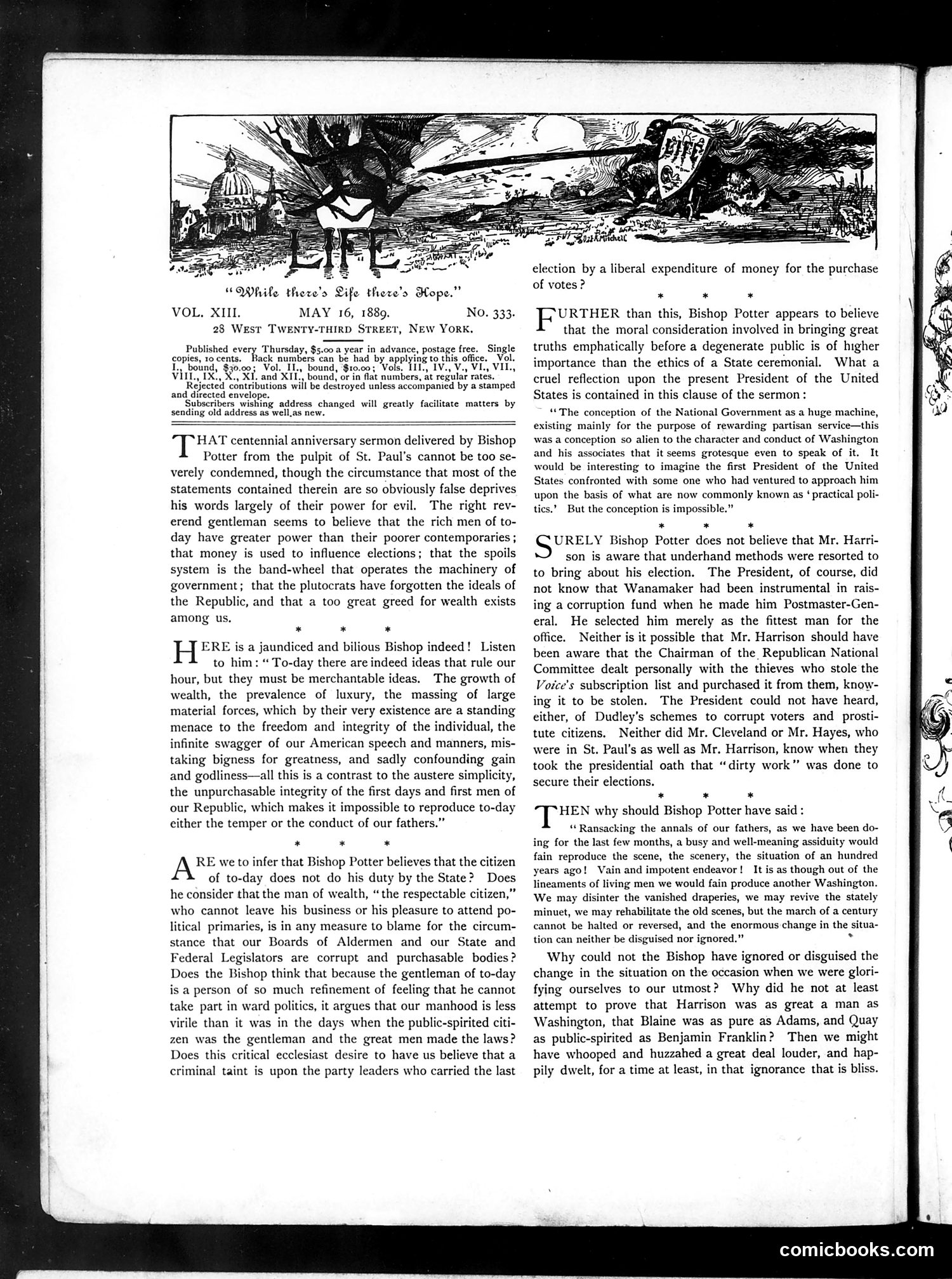
The masthead cartoon depicts a figure labeled "Life" sitting beneath a dead tree, observing a distant cityscape (likely Washington D.C., given the dome visible). This illustrates the magazine's central critique: Bishop Potter's recent sermon condemned American politics as corrupt and morally bankrupt. The article mocks Potter for his naïve moral outrage while simultaneously defending political corruption. The satire targets the 1888 presidential election, referencing "Wanamaker" (appears to be a fundraiser involved in vote-buying allegations) and suggesting President Harrison benefited from undisclosed corruption without his knowledge. The cartoon's barren landscape symbolizes how partisan corruption has killed American ideals—the magazine's sardonic point being that clergy like Potter misunderstand politics' inherently transactional nature.
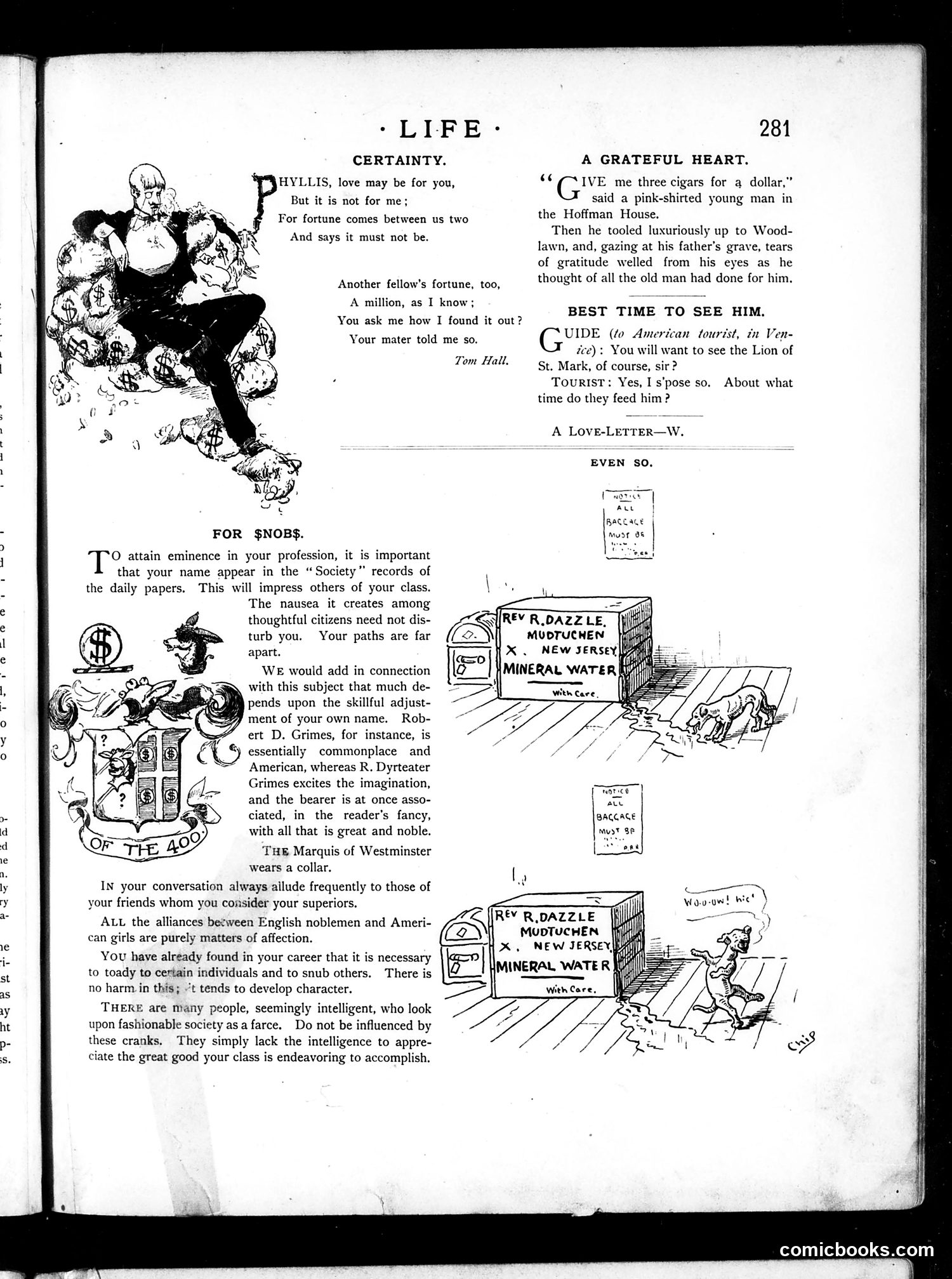
This page contains several satirical pieces mocking American social pretension: **"For Snobs"** (left): A lengthy article ridicules those seeking prominence through newspaper "Society" mentions. It critiques the practice of strategically appearing in daily papers to impress one's class, offering examples like "Robert D. Grimes" (common name) versus "R. Dyrewater Grimes" (affected spelling). The accompanying heraldic emblem labeled "Of the 400" references New York's exclusive social circle. **Right side**: Three brief humorous items mock tourism advice and a love letter, plus cartoon advertisements for "Rev. R. Dazzle's Mudtuchem Mineral Water from New Jersey"—clearly fake patent medicine ads mocking dubious health products common to the era. The overall tone satirizes American class-consciousness and commercial quackery.
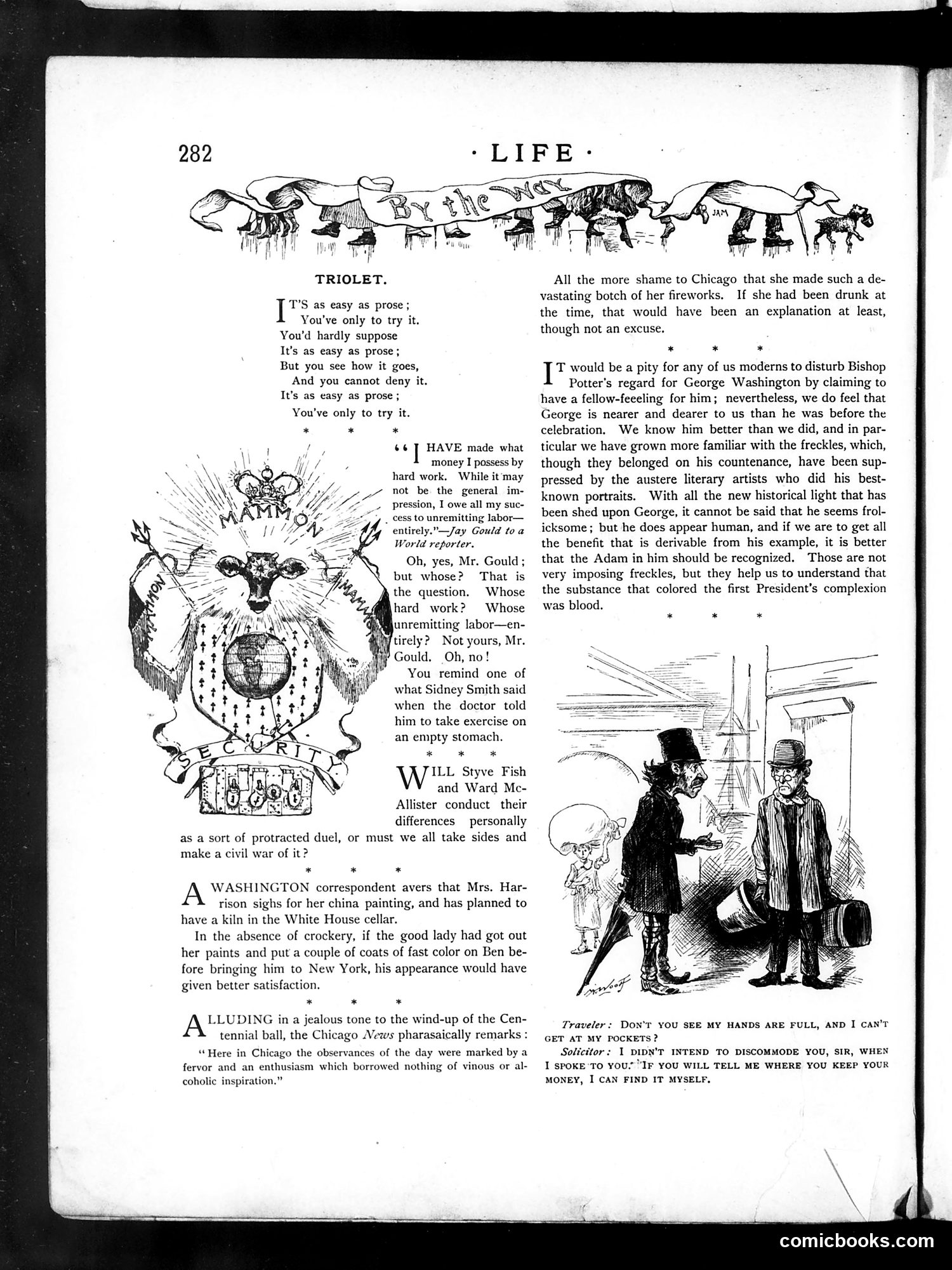
This page contains satirical commentary on late 19th-century American politics and society. The main text discusses **Bishop Potter's regard for George Washington**, suggesting Washington was more relatable and human than his literary portrayals suggest—noting his freckles and complexion were inherited traits worth recognizing. The page includes commentary on **Stye Fish and Ward McAllister** conducting "differences personally"—likely referring to a public dispute between these social figures. A Washington correspondent's anecdote mocks **Mrs. Harrison** (wife of President Benjamin Harrison), joking that she planned to kiln-fire china in the White House cellar, and sarcastically suggesting she should have painted Ben's face on pottery instead. The bottom illustration depicts a solicitor approaching a traveler about money—a common satirical scenario about financial troubles or con artists.
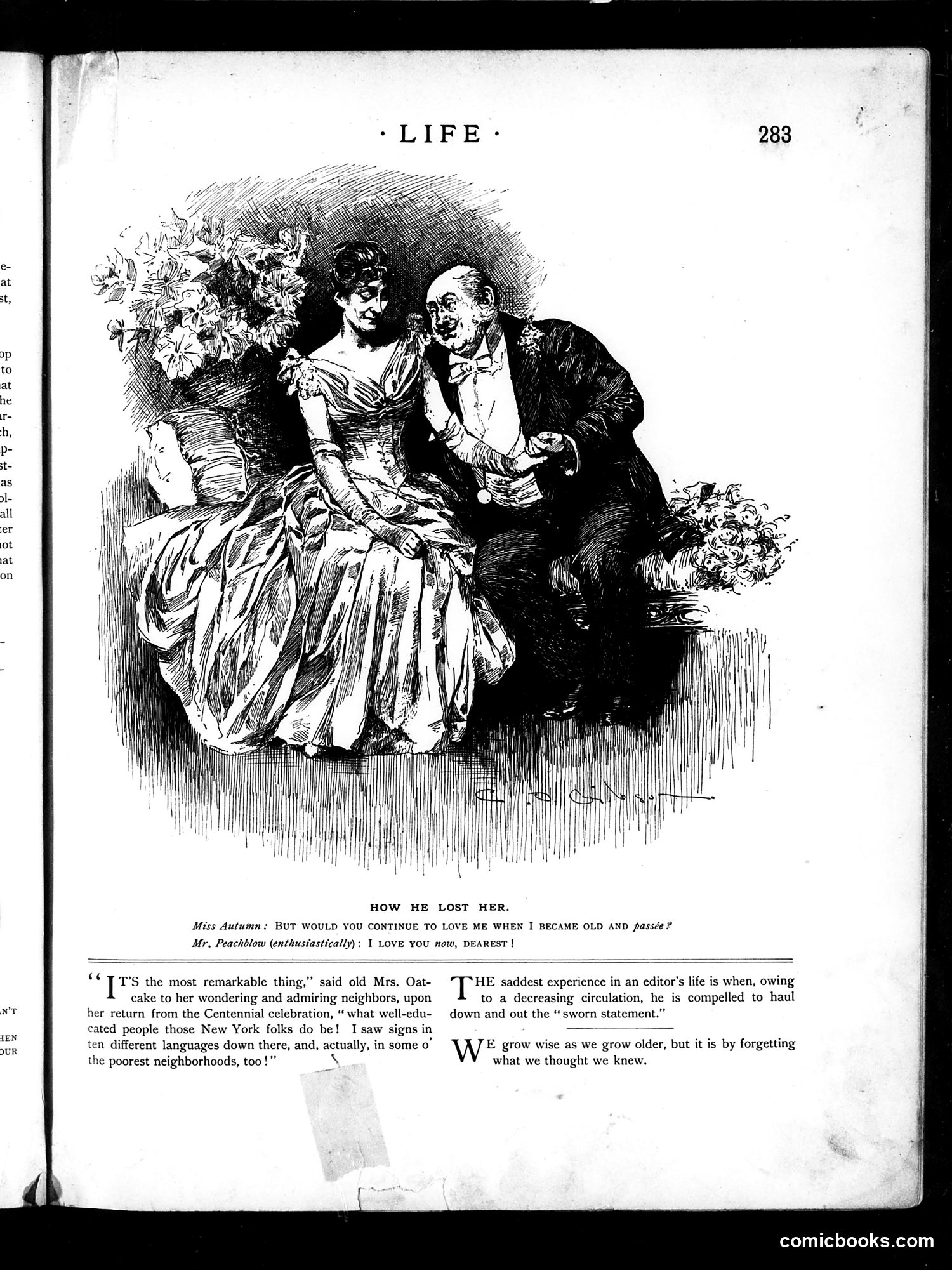
This satirical illustration depicts a romantic scene where a woman sits between two men—one appearing elderly and another middle-aged. The caption records a dialogue about enduring love despite aging. The humor targets male anxieties about aging and romantic obsolescence. The woman's initial declaration of eternal love is challenged by the man's question: "But would you continue to love me when I became old and *passé*?" His concern—that he will become undesirable with age—drives the narrative. The accompanying text commentary reinforces this theme: "We grow wise as we grow older, but it is by forgetting what we thought we knew." The satire mocks masculine vanity and the fear that romantic affection is conditional upon youth and vitality, suggesting men worry their value diminishes with age.
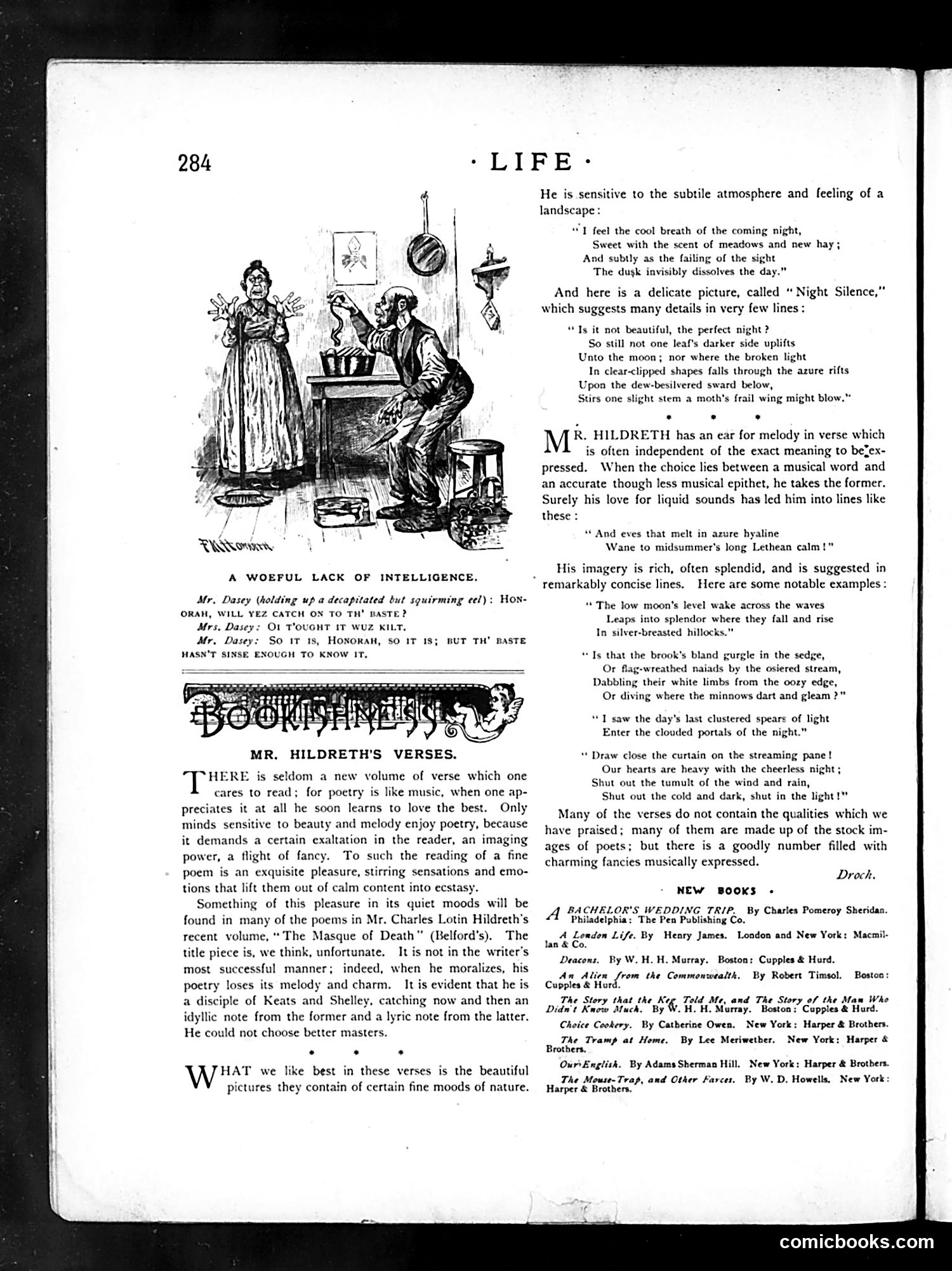
The page contains a satirical cartoon titled "A Woeful Lack of Intelligence" depicting a domestic scene. A man (labeled "Mr. Dazzy") appears disheveled while holding what seems to be a dripping object. A woman scolds him, with dialogue suggesting he's done something foolish—he "ought it wuz kilt" (thought it was killed) when instructed to do something, but "th' haste hasn't since enough to know it" (lacked the sense to know it). The satire mocks male incompetence in domestic matters or following simple instructions. This reflects period humor about bumbling husbands unable to manage basic household tasks—a common comedic trope in early 20th-century American humor that reinforced gender stereotypes about male practical abilities. The remainder of the page reviews Mr. Hildreth's poetry, discussing his ear for melody and imagery.
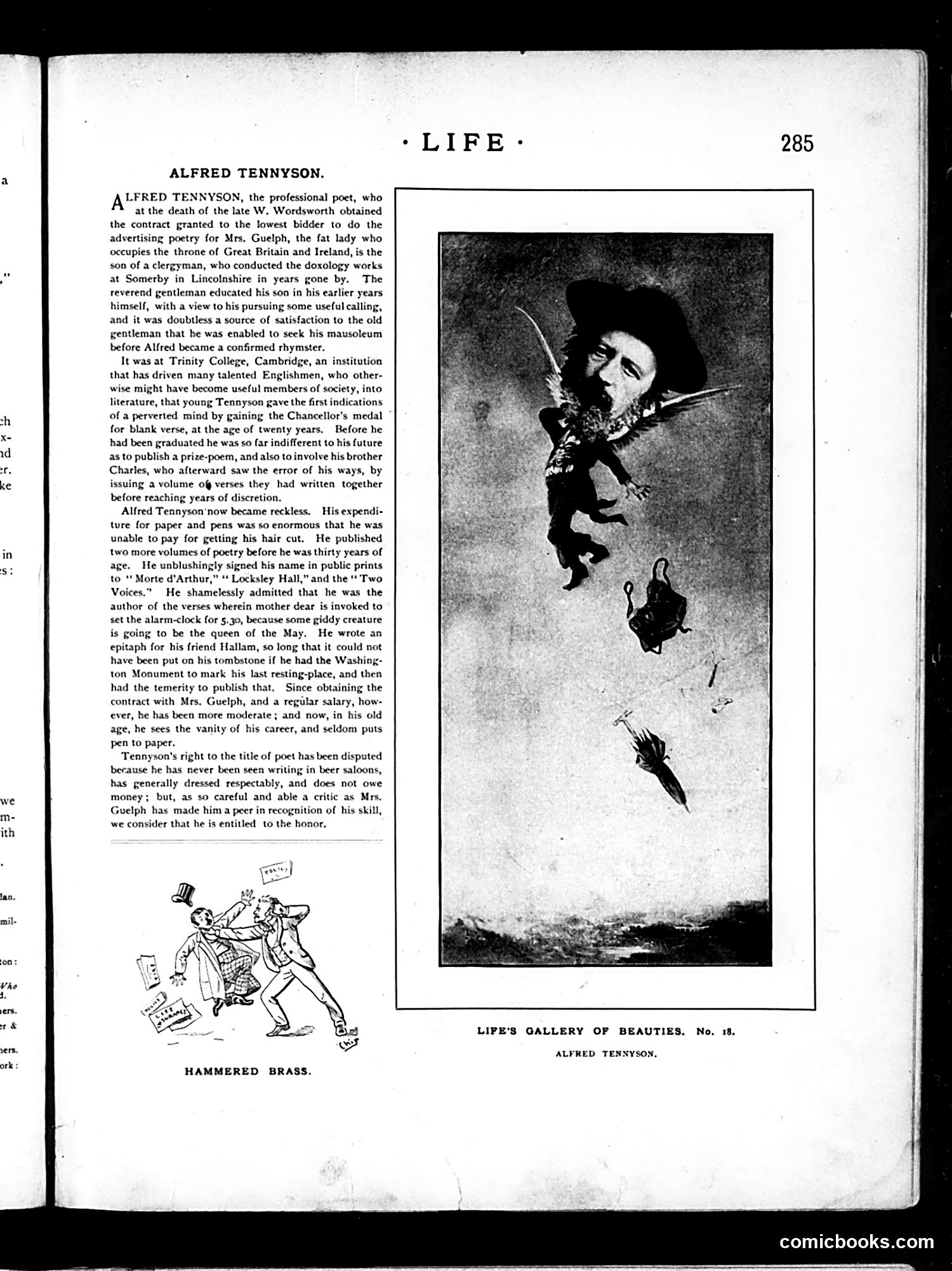
This page, numbered 285 from *Life* magazine, features an article about poet Alfred Tennyson alongside a satirical cartoon titled "Hammered Brass." The cartoon depicts two figures—apparently journalists or critics—aggressively hammering away at what appears to be a brass object or plaque. The satire likely critiques the contemporary literary establishment's harsh treatment of poets through relentless criticism and public scrutiny. The accompanying article discusses Tennyson's career challenges, including his financial struggles, prolific but sometimes frivolous publishing, and his status as a professional writer dependent on commercial success. The cartoon visually reinforces the article's theme: that working poets faced constant, punishing pressure from critics and the publishing industry—they were being metaphorically "hammered" by the brass (the establishment).
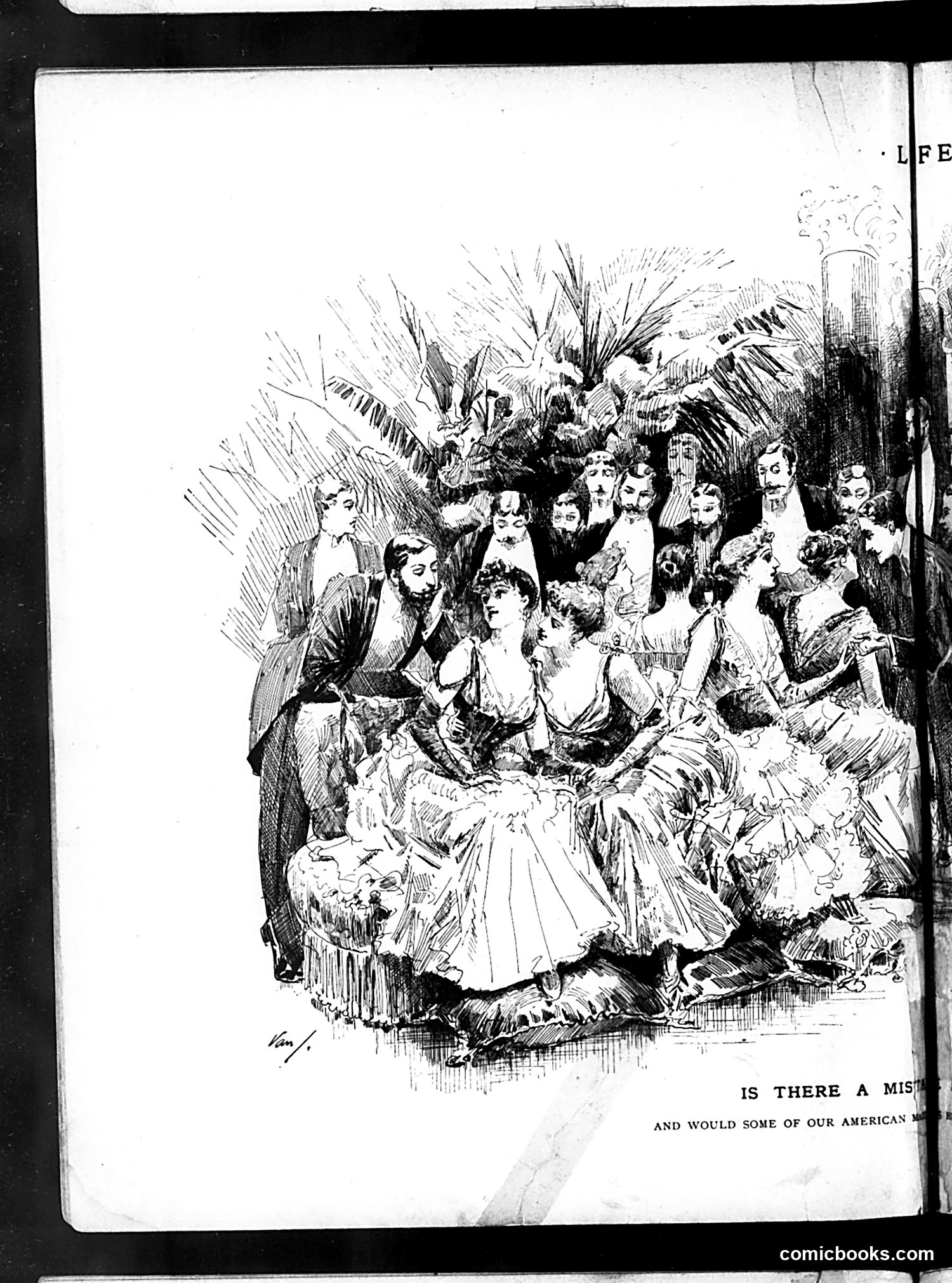
This appears to be a satirical illustration from Life magazine depicting an elegant social gathering of women in late 19th or early 20th-century dress, with ornate feathered hats and formal gowns. A man on the left appears to be observing or addressing the group. The visible text fragment reads "IS THERE A MIST" and "AND WOULD SOME OF OUR AMERICAN" (text is cut off). Without the complete caption, the full satirical point is unclear, but the image likely satirizes American high society women's fashion, social pretensions, or behavior at formal gatherings. The man's observational stance suggests he may be commenting critically on the scene. The elaborate hats and dress suggest mockery of excessive fashion or vanity among wealthy American women.
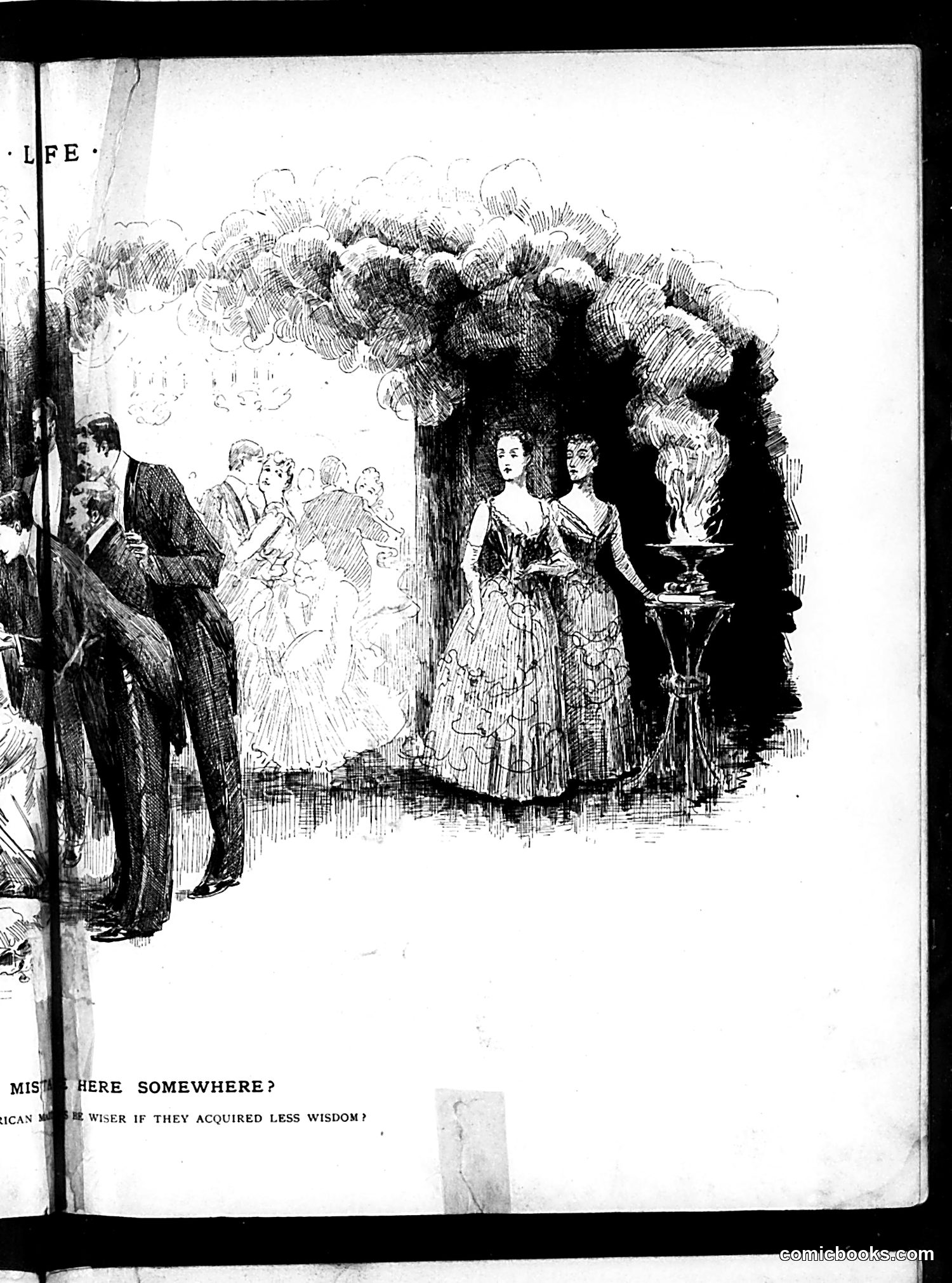
This illustration depicts an elegant social gathering, likely a formal party or salon. Two well-dressed women stand prominently in the center near a fireplace, while men in formal attire converse on the left. The cartoon's caption reads "MIST... HERE SOMEWHERE?" followed by text suggesting "...WISER IF THEY ACQUIRED LESS WISDOM?" The satire appears to mock upper-class social pretension and intellectual affectation among wealthy women. The caption's fragmented nature suggests someone searching for "Miss" (a young unmarried woman), while the text implies criticism of women acquiring "wisdom"—likely satirizing the era's debates about women's education and intellectual ambitions versus traditional social roles. The detailed rendering emphasizes the characters' fashionable dress and composed demeanor, typical of Life's commentary on high society.
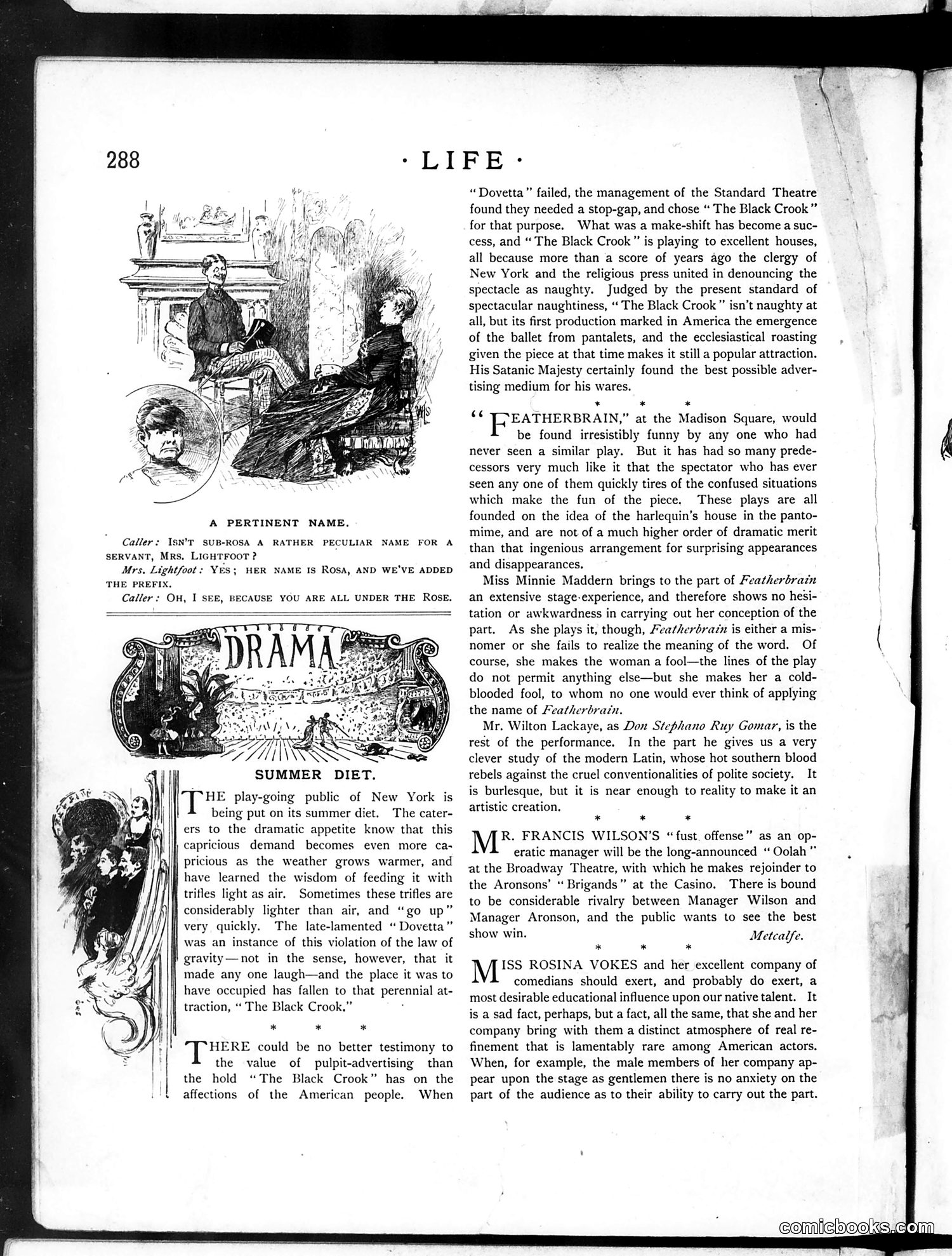
This page discusses theatrical productions of the summer theater season. The sketches illustrate dramatic scenes rather than political satire. The text reviews several plays: "The Black Crook" (praised as surprisingly successful), "Featherbrain" at Madison Square (criticized as derivative harlequin farce), and mentions of "Oolah" at the Broadway Theatre and a rivalry between managers Wilson and Aronso. The key illustration shows a dialogue labeled "A PERTINENT NAME" where a Caller questions whether "sub-rosa" is a peculiar name for a beverage, and Mrs. Lightfoot responds that it's actually "Rosa" with added prefixes—a mild wordplay joke about nomenclature. The content is primarily **theatrical criticism** rather than political commentary, typical of Life's cultural coverage during this period.
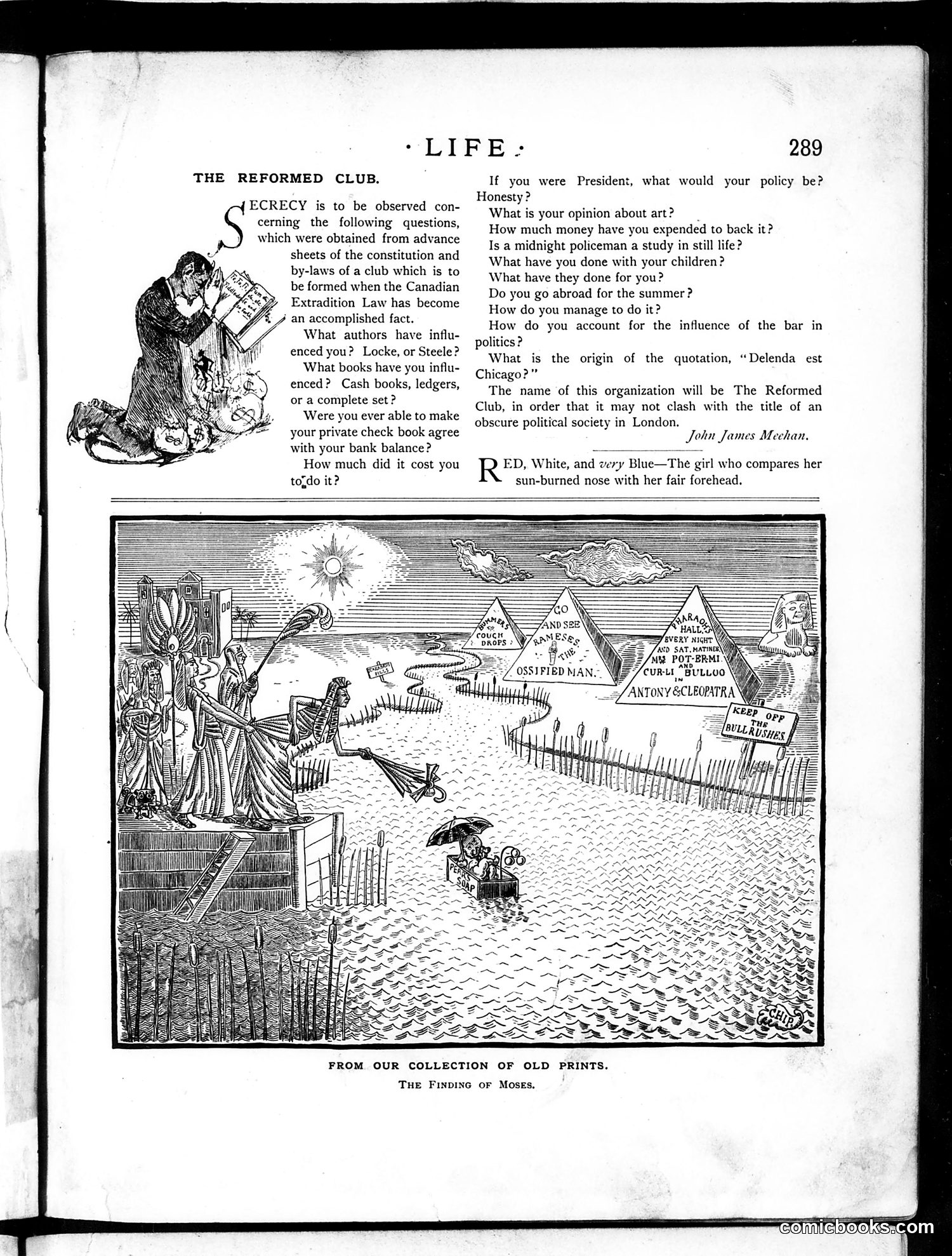
This page contains two distinct elements: **Upper Section:** A satirical questionnaire titled "The Reformed Club," proposing a new organization called The Reformed Club (to avoid clashing with an existing London society). It presents ironic questions for prospective members about their financial honesty, literary influences, and personal conduct—questions designed to reveal hypocrisy among the wealthy and educated classes. **Lower Section:** An allegorical engraving titled "The Finding of Moses," from the magazine's collection of old prints. It depicts the biblical scene where Pharaoh's daughter discovers the infant Moses, rendered in classical artistic style with elaborate period costume and landscape. The juxtaposition suggests the magazine used historical artwork to provide visual interest alongside satirical social commentary about contemporary society and morality.
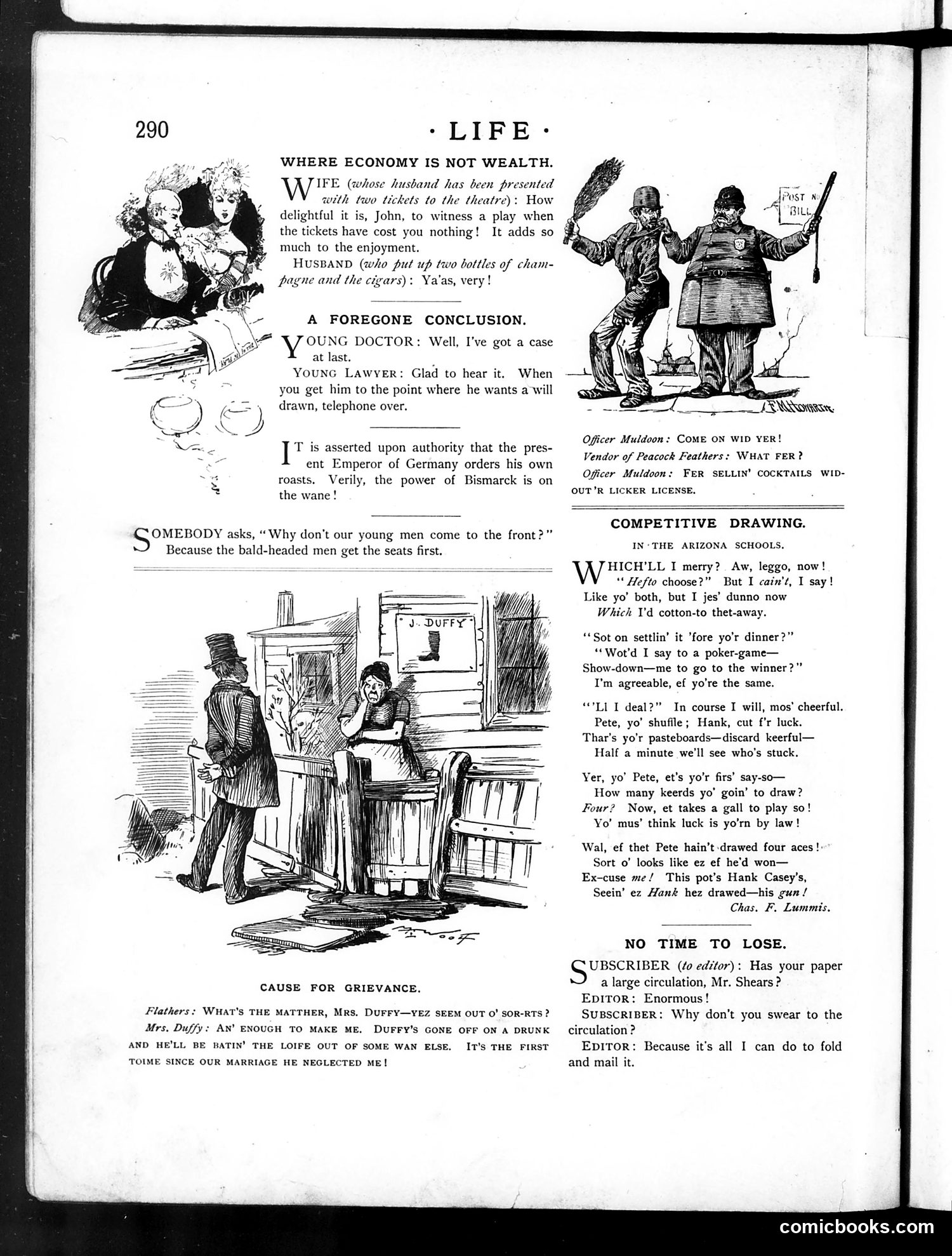
This page contains five unrelated comic sketches mocking various social situations: **"Where Economy Is Not Wealth"**: A couple celebrates free theater tickets, though the husband had to pay dearly (champagne and cigars) to obtain them—satirizing false economy. **"A Foregone Conclusion"**: Young professionals (doctor and lawyer) cynically discuss exploiting clients—the doctor will send patients to the lawyer for will-drawing, implying mutual financial benefit. **"Officer Muldoon" sketch**: A street vendor is arrested for selling cocktails without a liquor license, reflecting Prohibition-era enforcement. **"Competitive Drawing in Arizona Schools"**: A dialect-heavy romantic/gambling scene showing rural or frontier courtship customs, ending when a card game winner is threatened at gunpoint. **"No Time to Lose"**: An editor admits his paper's enormous circulation exists only because he personally folds and mails each copy—absurdist humor about inefficiency. The sketches use various accents and caricatures (Irish officer, rural Southwestern dialect) typical of early 20th-century American humor.
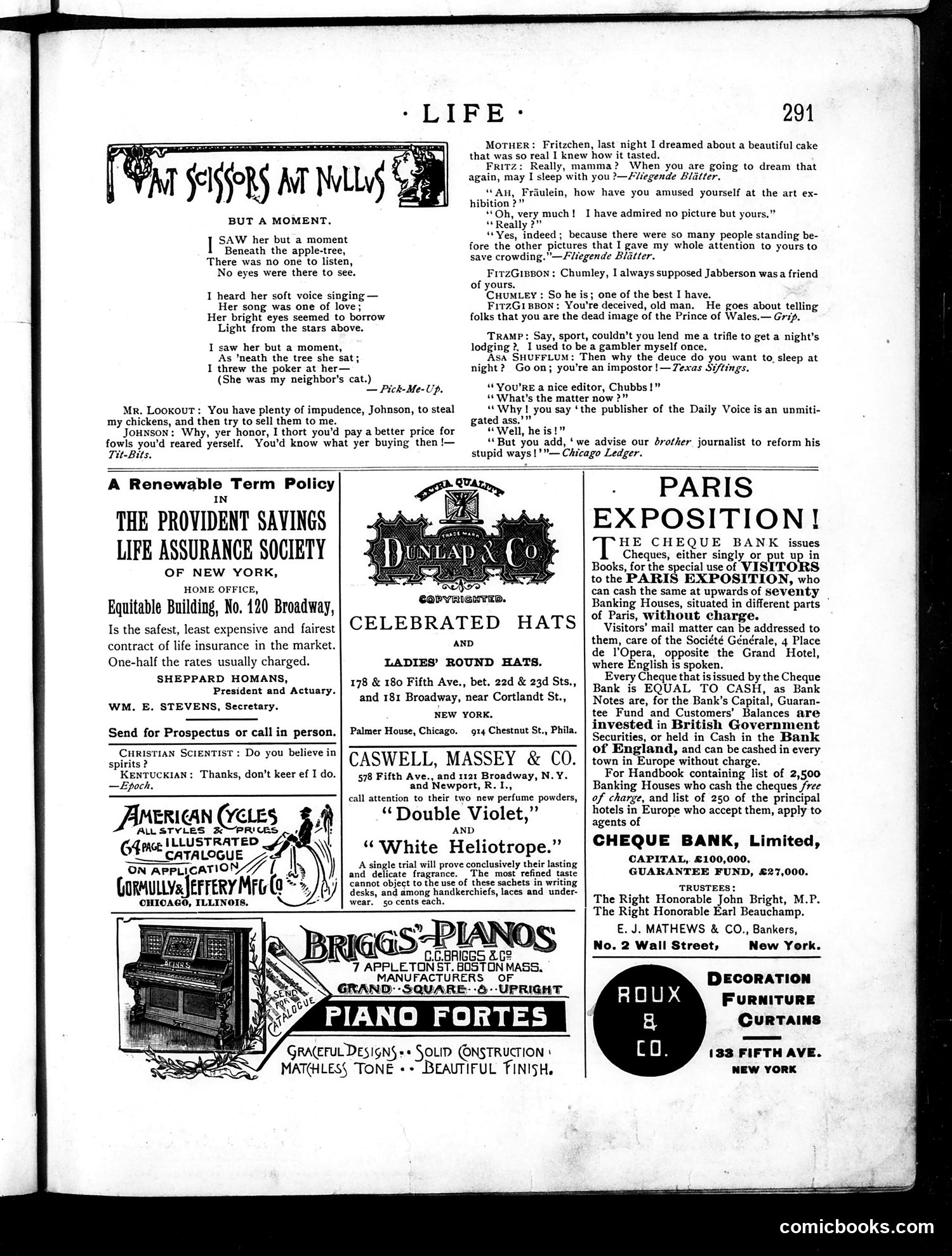
This page contains multiple short comic sketches typical of Life's satirical format. The main cartoon, "I Saw Her But a Moment," is a classic *trick ending* joke: a sentimental poem about a romantic encounter beneath an apple tree abruptly reveals the "her" is actually the neighbor's cat—and the narrator threw a poker at it. The humor relies on readers' expectations of romance being subverted by domestic absurdity. The page also includes several other brief jokes mocking human behavior: a thief's illogical sales pitch, a mother's dream-sharing mishap, and social pretense. These satirize everyday foolishness and hypocrisy rather than specific political figures. The remaining space is filled with period advertisements for life insurance, perfumes, pianos, and banking services—standard magazine filler for the era.
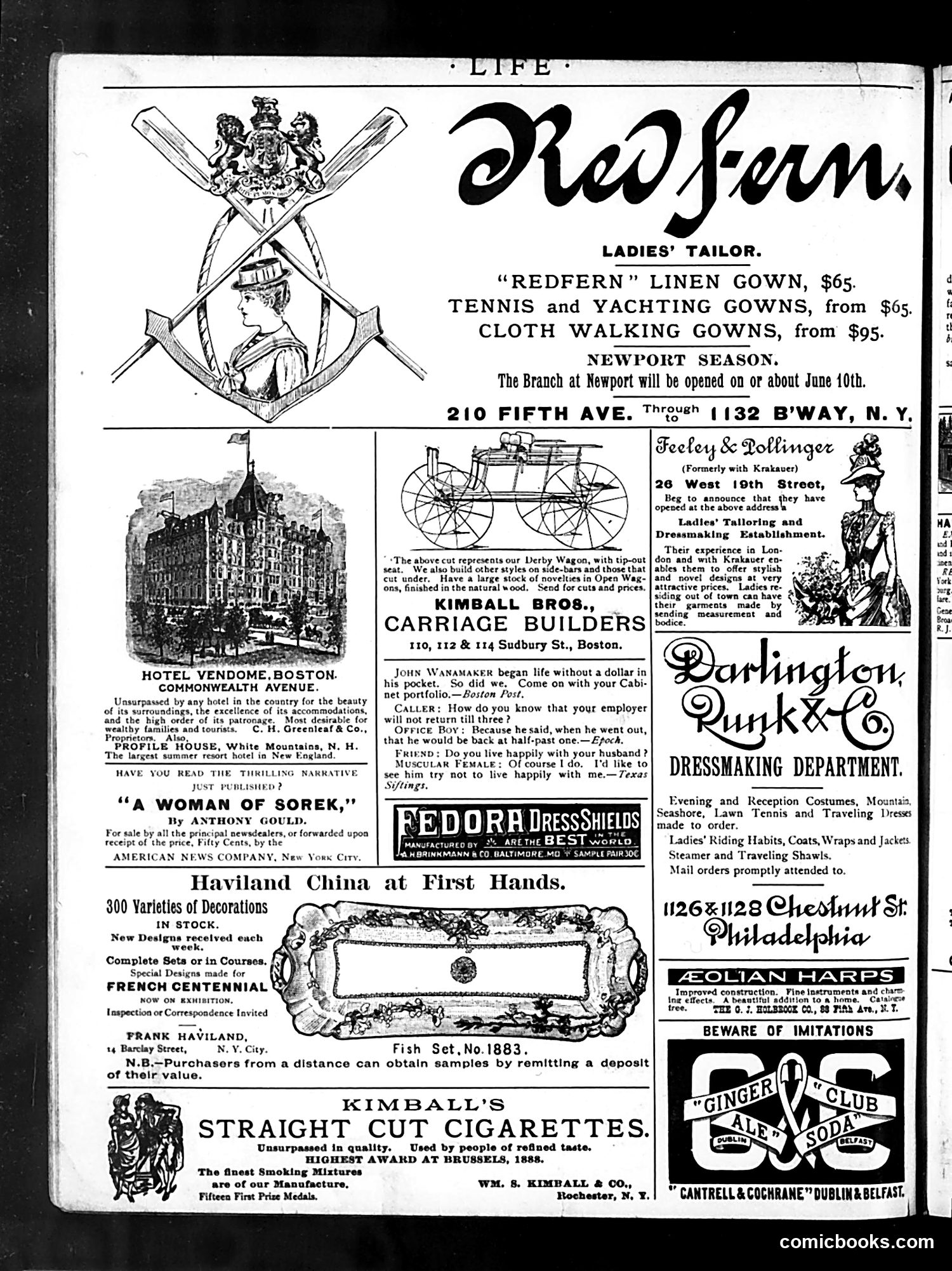
This is primarily an **advertising page** from Life magazine, with minimal editorial cartoon content. The page showcases late 19th-century commercial advertisements for luxury goods and services targeting wealthy Americans. The small cartoon vignettes embedded among ads are brief workplace humor: - An **office boy joke** about knowing his employer won't return until afternoon - A **dialogue between friends** about marital happiness, with a "muscular female" making a self-deprecating joke about her husband tolerating her These are lightweight gags typical of the era's magazines. The bulk of the page advertises **high-end establishments and goods**: Redfern ladies' tailoring ($65 gowns), Kimball carriage builders, Haviland china, and hotels like Boston's Hotel Vendome. Notably, John Wanamaker department store includes a success narrative ("began life without a dollar"). **Modern context**: This reflects Gilded Age America's consumer culture and the aspirational advertising directed at the wealthy leisure class. The "Newport Season" mention references the famous Rhode Island resort.
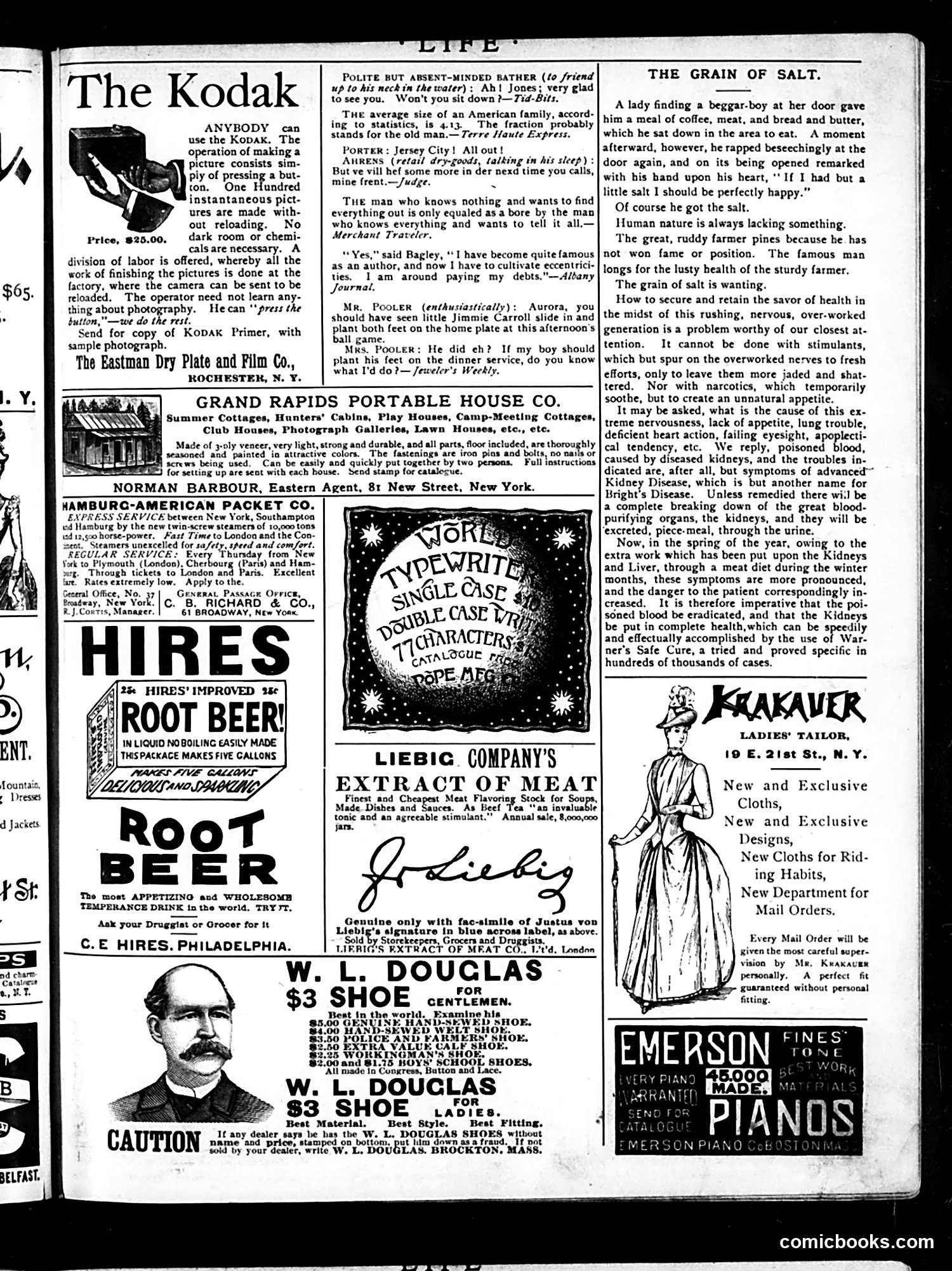
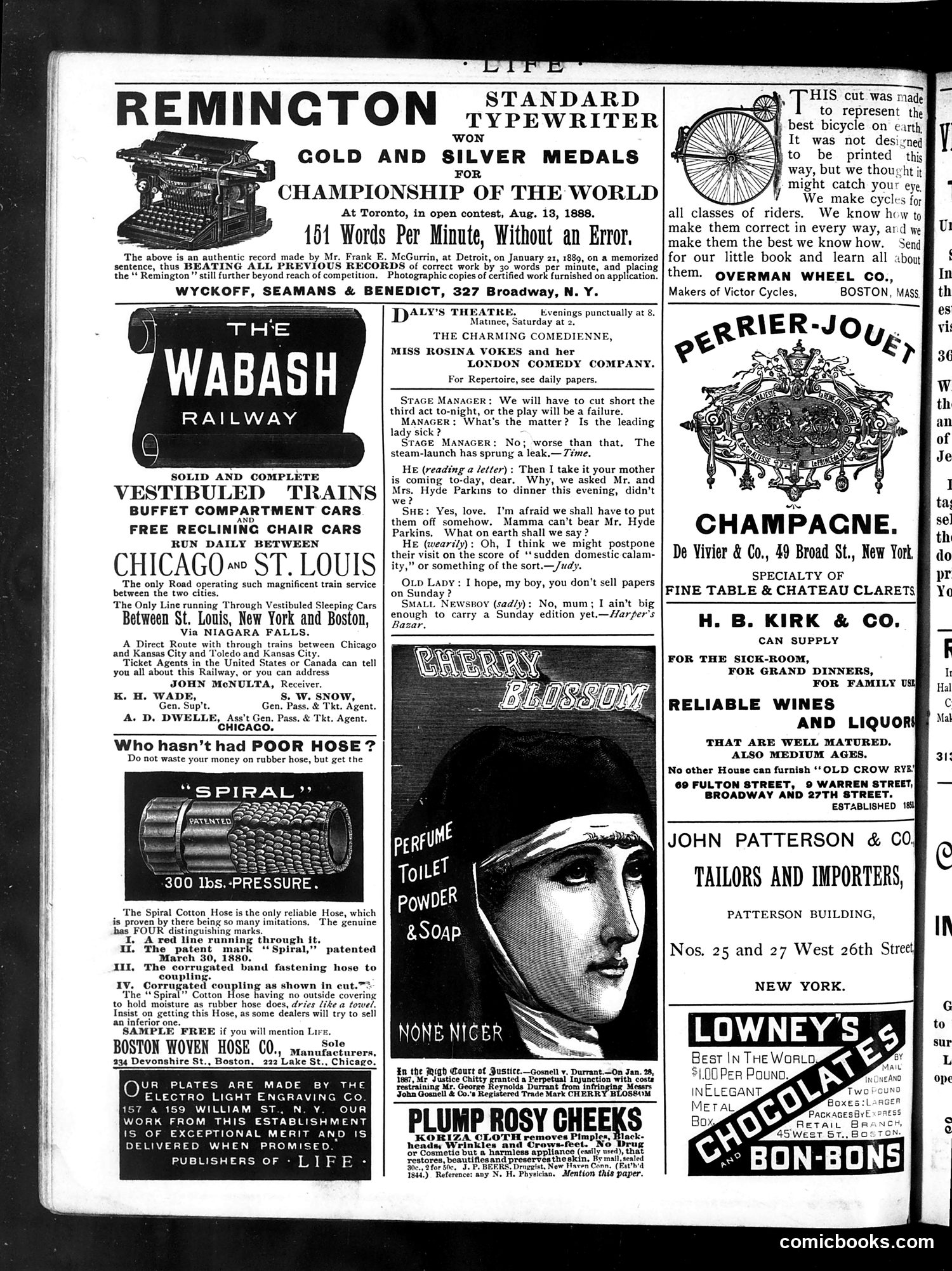
This page is primarily **advertisements and light humor** with no significant political cartoons. The content includes: **Major Ads:** - Remington typewriter (promoting a speed record of 151 words/minute) - Wabash Railway (train service) - Spiral Cotton Hose (emphasizing superior quality over imitators) **Humor Sections:** Several short comedic dialogues and jokes typical of 1880s magazines: - A stage manager explaining why a play must be shortened (a steam-launch has sprung a leak—absurdist humor) - A couple needing to postpone dinner guests due to an unexpected maternal visit - A street urchin too small to sell Sunday newspapers **Other Ads:** Cherry Blossom perfume/powder, Plump Rosy Cheeks cosmetic cloth, and various business services. There is **no political satire or caricature** of identifiable public figures. The page reflects typical Victorian-era consumer culture and gentle domestic humor for middle-class readers.
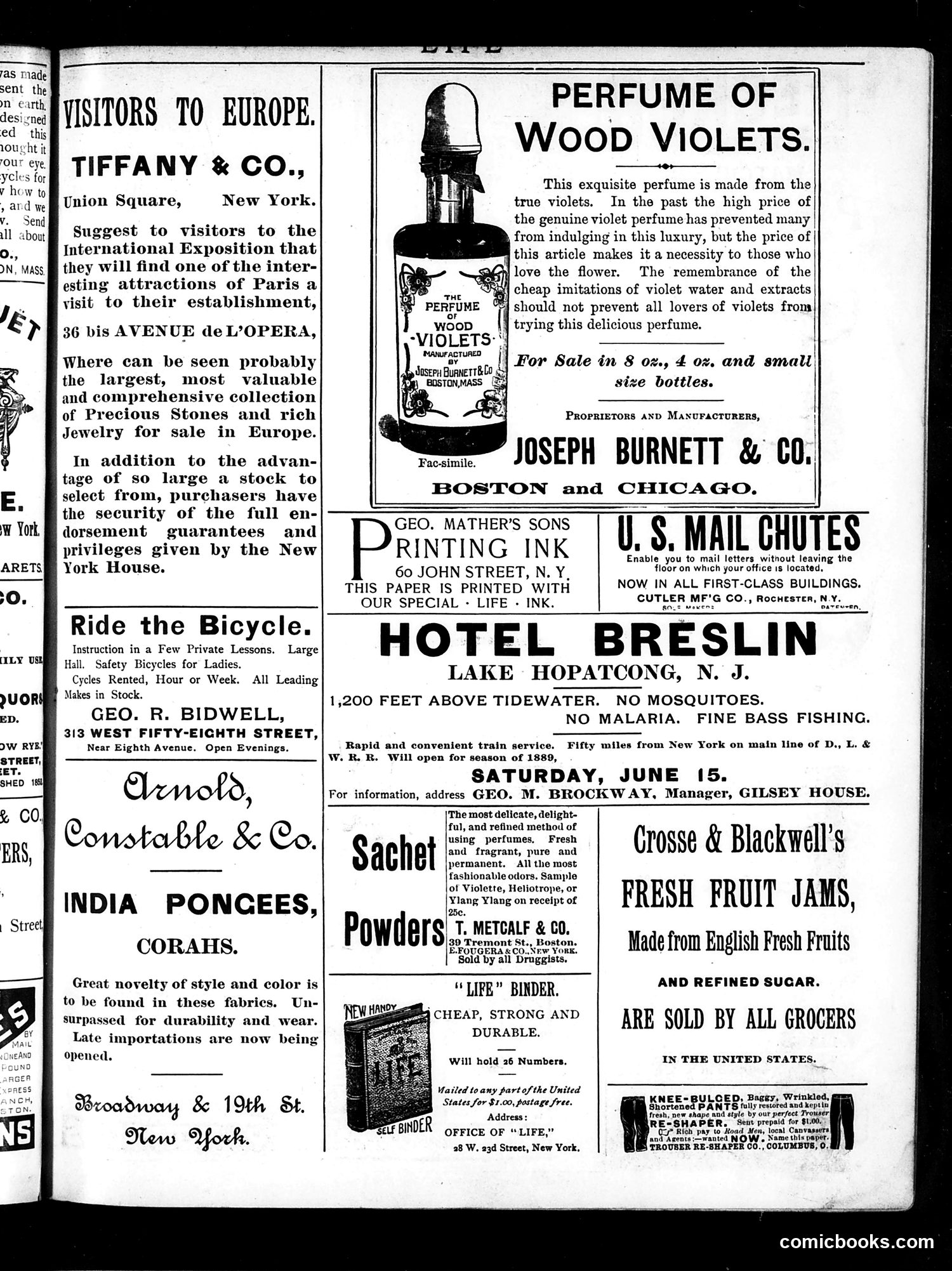
This is primarily an **advertising page** from Life magazine (circa 1889, based on the Hotel Breslin opening date). There are no political cartoons or satirical content to interpret. The page features luxury goods and services aimed at wealthy Americans: Tiffany & Co. jewelry for European travelers, bicycle instruction for ladies, imported Indian fabrics, violet perfume, printing ink, a resort hotel in New Jersey, sachets and powders, fruit preserves, and a novelty "trouser re-shaper" device. The ads reflect **Gilded Age consumer culture**—expensive perfumes justified by claims of affordability compared to alternatives, leisure activities (bicycling for women was relatively new), and resort tourism. The trouser re-shaper advertisement at bottom suggests even mundane garment maintenance was marketed as a luxury service to the affluent. This page demonstrates how Life funded itself through high-end advertising rather than serving satirical content on this particular spread.
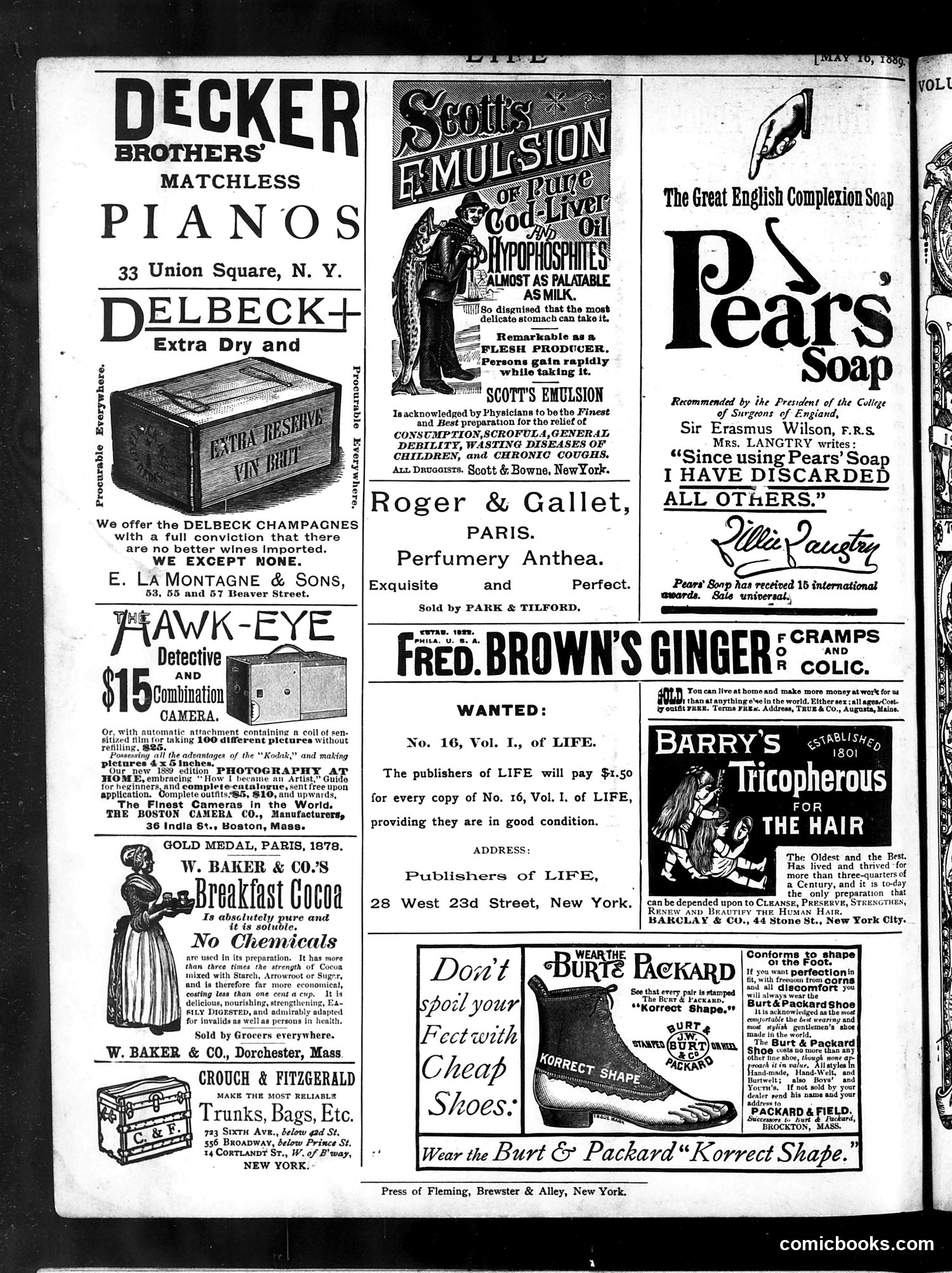
This is primarily an **advertising page** with no political cartoons or satirical content visible. The page contains Victorian-era commercial advertisements for consumer products including: - **Pianos** (Decker Brothers) - **Champagne** (Delbeck) - **Photography equipment** (Hawk-Eye camera) - **Cocoa** (W. Baker & Co.) - **Soap** (Pears' Soap, endorsed by actress Lillie Langtry and Sir Erasmus Wilson) - **Patent medicines** (Scott's Emulsion for consumption, Fred. Brown's Ginger for cramps) - **Hair products** (Barry's Tricopherous) - **Shoes** (Burt & Packard "Korrect Shape") - **Luggage** (Crouch & Fitzgerald) The page also contains a **want ad** from Life's publishers offering $1.50 for back copies of the magazine. The advertisements reflect late-Victorian consumer culture and make health/beauty claims typical of the era—many would be considered misleading today. No satire is evident.