
Life, 1889-05-16 · page 2 of 18
Life — May 16, 1889 — page 2: what you’re looking at
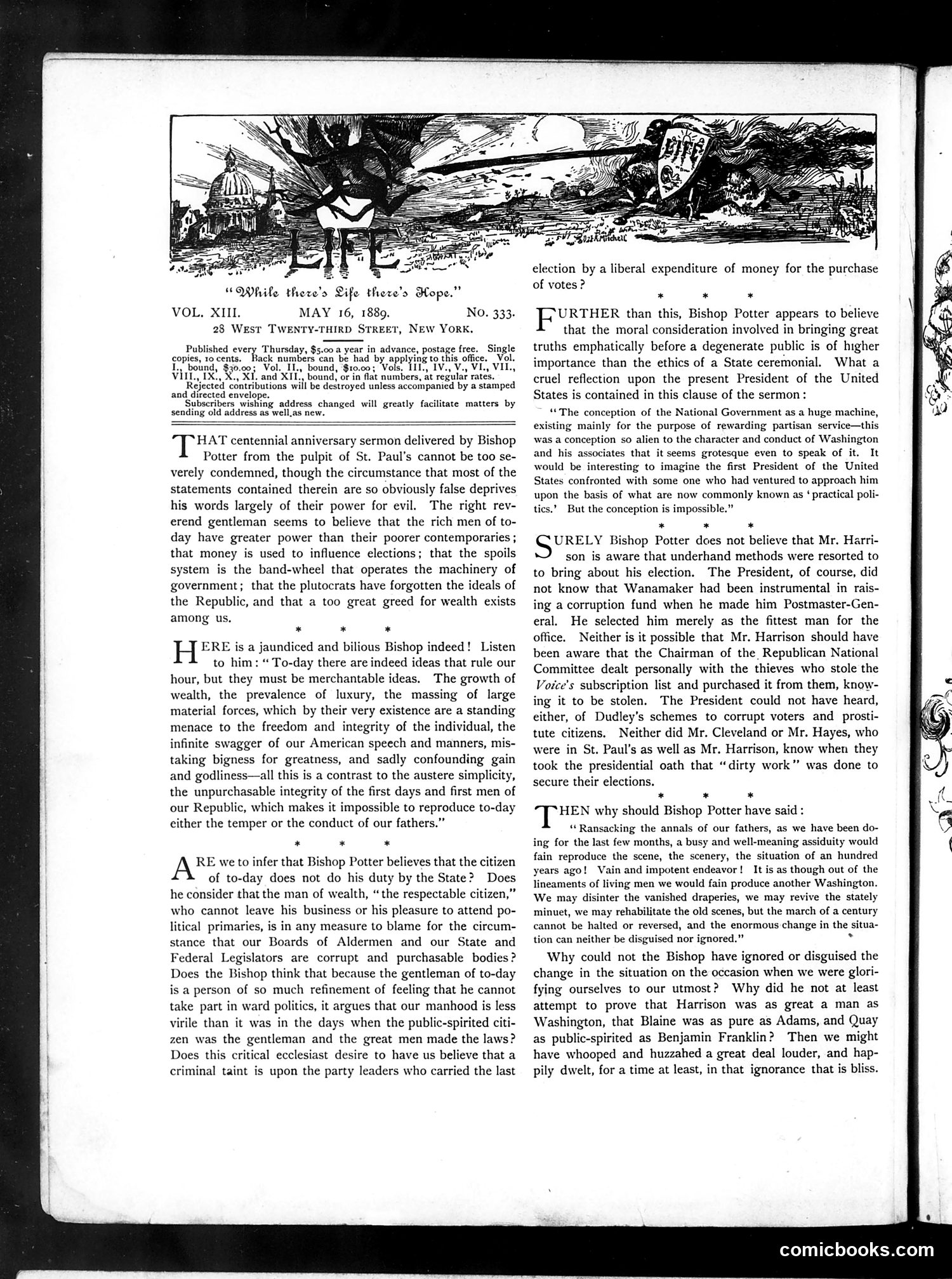
What you’re looking at
The masthead cartoon depicts a figure labeled "Life" sitting beneath a dead tree, observing a distant cityscape (likely Washington D.C., given the dome visible). This illustrates the magazine's central critique: Bishop Potter's recent sermon condemned American politics as corrupt and morally bankrupt. The article mocks Potter for his naïve moral outrage while simultaneously defending political corruption. The satire targets the 1888 presidential election, referencing "Wanamaker" (appears to be a fundraiser involved in vote-buying allegations) and suggesting President Harrison benefited from undisclosed corruption without his knowledge. The cartoon's barren landscape symbolizes how partisan corruption has killed American ideals—the magazine's sardonic point being that clergy like Potter misunderstand politics' inherently transactional nature.
📄 Transcribed text from this page (OCR, searchable)
Machine-transcribed from the original scan — historical spelling and the odd misread are preserved.
“While there's Life theze’s Hope.” VOL, XIII. MAY 16, 1889. 28 West TWENTY-THIRD STRI NO. 333+ , New York, Published every Thursday, $5.00 a year in advance, postage free. Single copies, 10 cents. Back numbers can be had by applying to this office. Vol. 1 bound, $70.00; Vol. Il, bound, $10.00; Vols, {IIs IV., V. Vi. VIL., Virr., 1X1, X., XI, and X11, bound, or in flat numbers, at regular rates, Rejected contributions will be destroyed unless accompanied by a stamped and directed envelope. Subscribers wishing address changed will greatly facilitate matters by sending old address as well.as new. HAT centennial anniversary sermon delivered by Bishop Potter from the pulpit of St. Paul’s cannot be too se- verely condemned, though the circumstance that most of the statements contained therein are so obviously false deprives his words largely of their power for evil. The right rev- erend gentleman seems to believe that the rich men of to- day have greater power than their poorer contemporaries ; that money is used to influence elections; that the spoils system is the band-wheel that operates the machinery of government; that the plutocrats have forgotten the ideals of the Republic, and that a too great greed for wealth exists among us, * * * H ERE is a jaundiced and bilious Bishop indeed! Listen to him: “ To-day there are indeed ideas that rule our hour, but they must be merchantable ideas. The growth of wealth, the prevalence of luxury, the massing of large material forces, which by their very existence are a standing menace to the freedom and integrity of the individual, the infinite swagger of our American speech and manners, mis- taking bigness for greatness, and sadly confounding gain and godliness—all this is a contrast to the austere simplicity, the unpurchasable integrity of the first days and first men of our Republic, which makes it impossible to reproduce to-day either the temper or the conduct of our fathers.” * * * RE we to infer that Bishop Potter believes that the citizen of to-day does not do his duty by the State? Does he consider that the man of wealth, “the respectable citizen,” who cannot leave his business or his pleasure to attend po- litical primaries, is in any measure to blame for the circum- stance that our Boards of Aldermen and our State and Federal Legislators are corrupt and purchasable bodies? Does the Bishop think that because the gentleman of to-day is a person of so much refinement of feeling that he cannot take part in ward politics, it argues that our manhood is less virile than it was in the days when the public-spirited citi- zen was the gentleman and the great men made the laws? Does this critical ecclesiast desire to have us believe that a criminal taint is upon the party leaders who carried the last = ey! a) Pra ee election by a liberal expenditure of money for the purchase of votes ? * * * URTHER than this, Bishop Potter appears to believe that the moral consideration involved in bringing great truths emphatically before a degenerate public is of higher importance than the ethics of a State ceremonial. What a cruel reflection upon the present President of the United States is contained in this clause of the sermon: “The conception of the National Government as a huge machine, existing mainly for the purpose of rewarding partisan service—this was a conception so alien to the character and conduct of Washington and his associates that it seems grotesque even to speak of it. It would be interesting to imagine the first President of the United States confronted with some one who had ventured to approach him upon the basis of what are now commonly known as ‘ practical poli- tics,’ But the conception is impossible.” * * * URELY Bishop Potter does not believe that Mr. Harri- son is aware that underhand methods were resorted to to bring about his election. The President, of course, did not know that Wanamaker had been instrumental in rais- ing a corruption fund when he made him Postmaster-Gen- eral. He selected him merely as the fittest man for the office. Neither is it possible that Mr. Harrison should have been aware that the Chairman of the Republican National Committee dealt personally with the thieves who stole the Voice's subscription list and purchased it from them, know- ing it to be stolen. The President could not have heard, either, of Dudley's schemes to corrupt voters and prosti- tute citizens. Neither did Mr. Cleveland or Mr. Hayes, who were in St. Paul's as well as Mr. Harrison, know when they took the presidential oath that “dirty work” was done to secure their elections. * * * Tes why should Bishop Potter have said : “ Ransacking the annals of our fathers, as we have been do- ing for the last few months, a busy and well-meaning assiduity would fain reproduce the scene, the scenery, the situation of an hundred years ago! Vain and impotent endeavor! It is as though out of the lineaments of living men we would fain produce another Washington. ‘We may disinter the vanished draperies, we may revive the stately minuet, we may rehabilitate the old scenes, but the march of a century cannot be halted or reversed, and the enormous change in the situa- tion can neither be disguised nor ignored.” > Why could not the Bishop have ignored or disguised the change in the situation on the occasion when we were glori- fying ourselves to our utmost? Why did he not at least attempt to prove that Harrison was as great a man as Washington, that Blaine was as pure as Adams, and Quay as public-spirited as Benjamin Franklin? Then we might have whooped and huzzahed a great deal louder, and hap- pily dwelt, for a time at least, in that ignorance that is bliss. comicbooks.com