
Life, 1889-05-16 · page 6 of 18
Life — May 16, 1889 — page 6: what you’re looking at
What you’re looking at
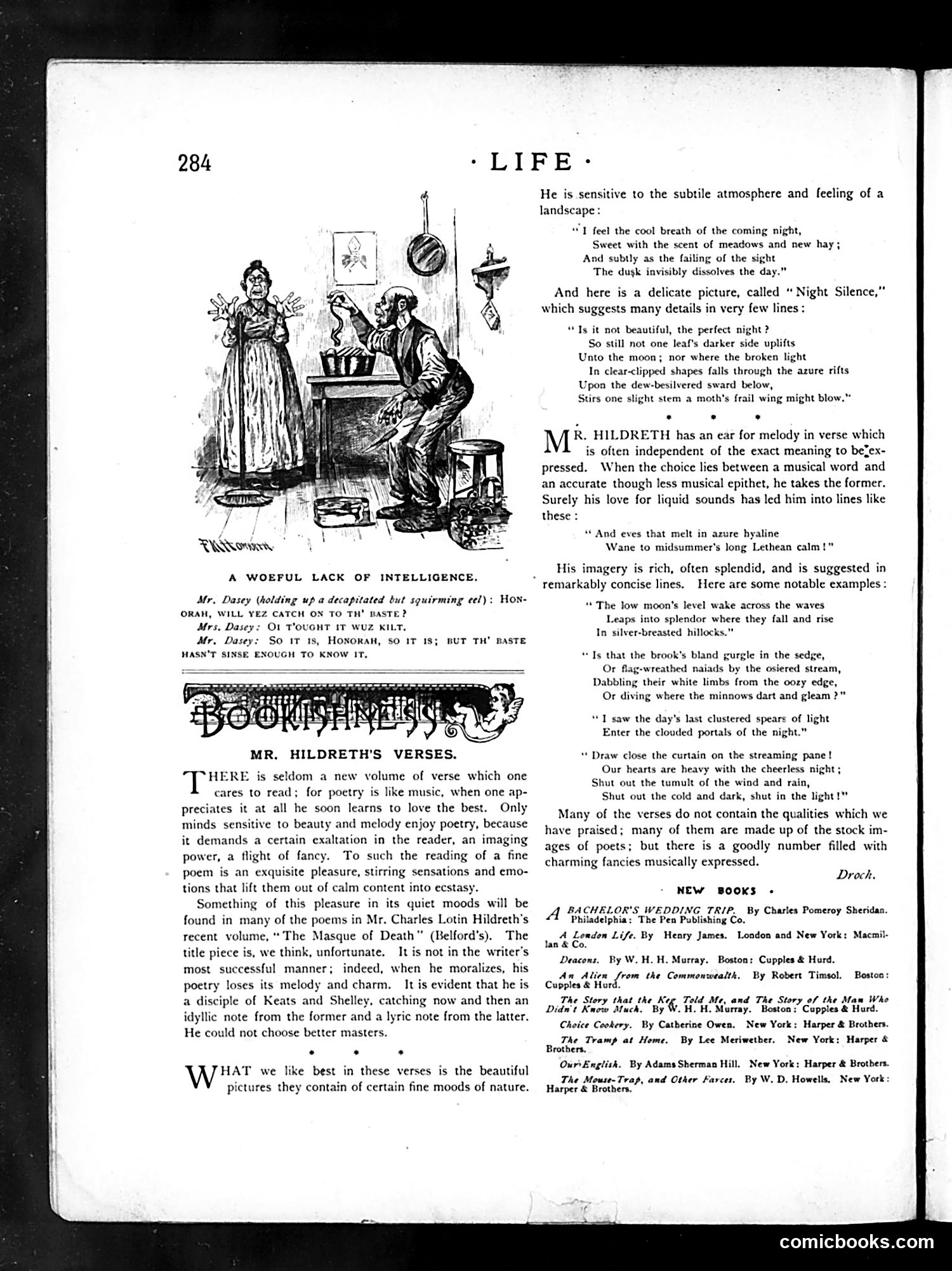
The page contains a satirical cartoon titled "A Woeful Lack of Intelligence" depicting a domestic scene. A man (labeled "Mr. Dazzy") appears disheveled while holding what seems to be a dripping object. A woman scolds him, with dialogue suggesting he's done something foolish—he "ought it wuz kilt" (thought it was killed) when instructed to do something, but "th' haste hasn't since enough to know it" (lacked the sense to know it). The satire mocks male incompetence in domestic matters or following simple instructions. This reflects period humor about bumbling husbands unable to manage basic household tasks—a common comedic trope in early 20th-century American humor that reinforced gender stereotypes about male practical abilities. The remainder of the page reviews Mr. Hildreth's poetry, discussing his ear for melody and imagery.
📄 Transcribed text from this page (OCR, searchable)
Machine-transcribed from the original scan — historical spelling and the odd misread are preserved.
- LIFE: VWrouw A WOEFUL LACK OF INTELLIGENCE, Mr, Dasey (holding up a decapitated but squirming eel): HON- ORAH, WILL YEZ CATCH ON TO TH’ BASTE? O1 MovonT IT wuz KILT, So 17 18, Honoran, 5 OUGH TO KNOW IT, IT 18; BUT TH’ BASTE MR. HILDRETH'S VERSES. SRE is seldom a new volume of verse which one cares to read; for poetry is like music, when one ap- preciates it at all he soon learns to love the best. Only minds sensitive to beauty and melody enjoy poetry, because it demands a certain exaltation in the reader, an imaging power, a flight of fancy. To such the reading of a fine poem is an exquisite pleasure, stirring sensations and emo- tions that lift them out of calm content into ecstasy. Something of this pleasure in its quiet moods will be found in many of the poems in Mr. Charles Lotin Hildreth’s recent volume, “The Masque of Death” (Belford’s). The title piece is, we think, unfortunate, It is not in the writer's most successful manner; indeed, when he moralizes, his poetry loses its melody and charm. It is evident that he is a disciple of Keats and Shelley, catching now and then an idyllic note from the former and a lyric note from the latter. He could not choose better masters. . . . HAT we like best in these verses is the beautiful pictures they contain of certain fine moods of nature. * remarkably concise lines. He is sensitive to the subtile atmosphere and feeling of a landscape: “I feel the cool breath of the coming night, Sweet with the scent of meadows and new hay; And subtly as the failing of the sight The dusk invisibly dissolves the day.” And here is a delicate picture, called “ Night Silence,” which suggests many details in very few lines: “Is it not beautiful, the perfect night ? So still not one leaf's darker side uplifts Unto the moon; nor where the broken light In clear-clipped shapes falls through the azure rifts Upon the dew-besilvered sward below, Stirs one slight stem a moth’s frail wing might blow,” . . . R. HILDRETH has an ear for melody in verse which is often independent of the exact meaning to bezex- pressed. When the choice lies between a musical word and an accurate though less musical epithet, he takes the former. Surely his love for liquid sounds has led him into lines like these : “And eves that melt in azure hyaline Wane to midsummer’s long Lethean calm!” His imagery is rich, often splendid, and is suggested in Here are some notable examples : “The low moon's level wake across the waves Leaps into splendor where they fall and rise In silver-breasted hillocks.”” ‘Is that the brook’s bland gurgle in the sedge, Or flag-wreathed naiads by the osiered stream, Dabbling their white limbs from the oozy edge, Or diving where the minnows dart and gleam ?” “1 saw the day's last clustered spears of light Enter the clouded portals of the night.” “ Draw close the curtain on the streaming pane! Our hearts are heavy with the cheerless night; Shut out the tumult of the wind and rain, Shut out the cold and dark, shut in the light!” Many of the verses do not contain the qualities which we have praised; many of them are made up of the stock im- ages of poets; but there is a goodly number filled with charming fancies musically expressed. Droch. NEW BOOKS - A. BACHELOR'S WEDDING TRIP. By Charles Pomeroy Sheridan. Philadelphia: The Pen Publishing Co, A London Life. By Henry James. London and New York: Macmil- lan & Co. Deacons. By W.H. H. Murray. An Alien from the Commonwealth. Cupples & Hurd. The Story that the Kye Told Me, and The Story of the Man Whe Didn't Know Much. By W.H.H. Murray. Boston: Cupples & Hurd. Choice Cookery. By Catherine Owen. The Tramp at Home. Brothers. OurrEnglith. By Adams Sherman Hill. New York: Harper & Brothers. The Mouse-Trap, and Other Farces. By W. D. Howells, New York: Harper & Brothers. Boston: Cupples & Hurd. By Robert Timsol. Bostoo: New York: Harper & Brothers. By Lee Meriwether. New York: Harper & comicbooks.com