
Life, 1889-05-16 · page 4 of 18
Life — May 16, 1889 — page 4: what you’re looking at
What you’re looking at
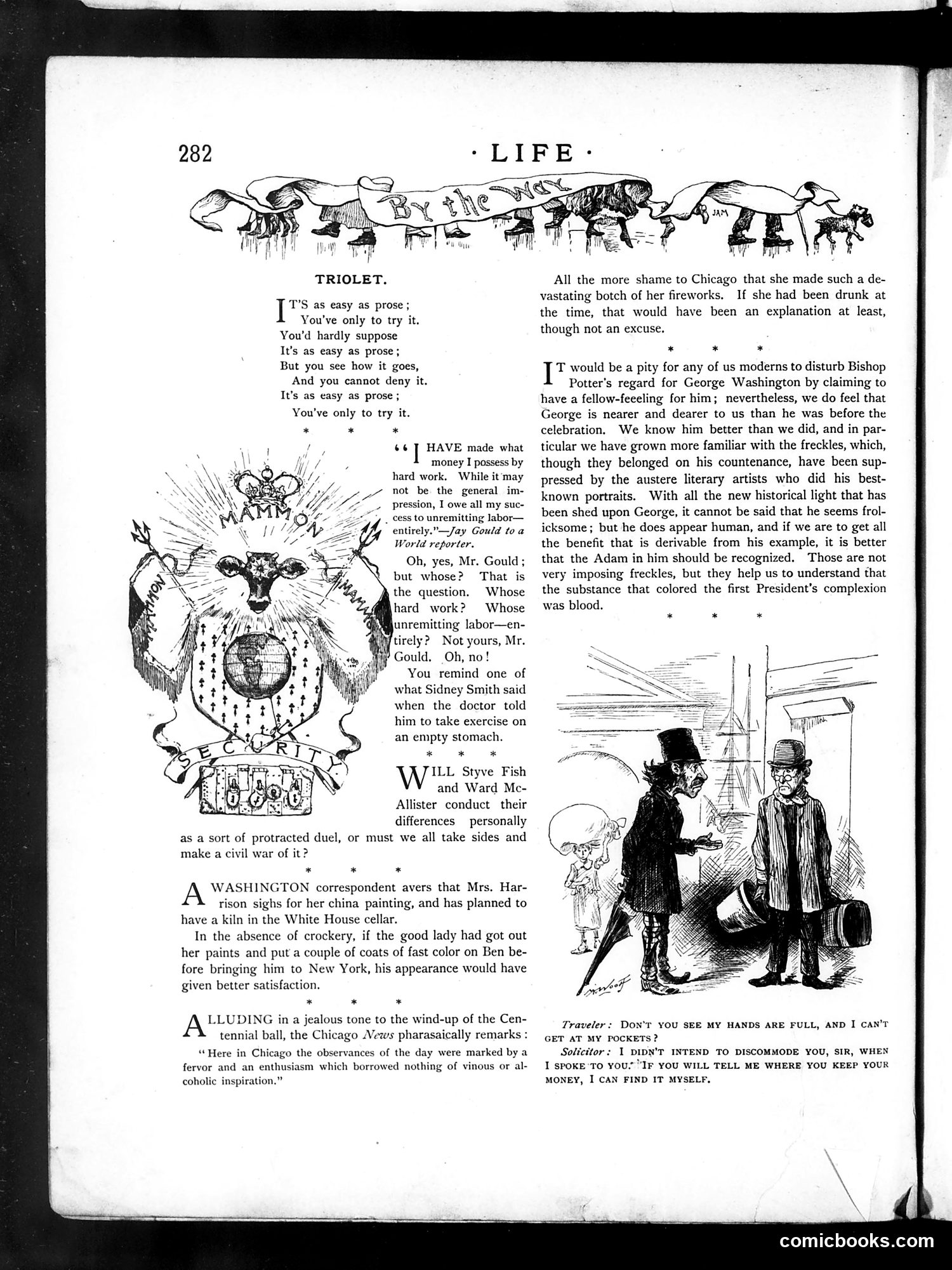
This page contains satirical commentary on late 19th-century American politics and society. The main text discusses **Bishop Potter's regard for George Washington**, suggesting Washington was more relatable and human than his literary portrayals suggest—noting his freckles and complexion were inherited traits worth recognizing. The page includes commentary on **Stye Fish and Ward McAllister** conducting "differences personally"—likely referring to a public dispute between these social figures. A Washington correspondent's anecdote mocks **Mrs. Harrison** (wife of President Benjamin Harrison), joking that she planned to kiln-fire china in the White House cellar, and sarcastically suggesting she should have painted Ben's face on pottery instead. The bottom illustration depicts a solicitor approaching a traveler about money—a common satirical scenario about financial troubles or con artists.
📄 Transcribed text from this page (OCR, searchable)
Machine-transcribed from the original scan — historical spelling and the odd misread are preserved.
TRIOLET. 'S as easy as prose ; You've only to try it. You'd hardly suppose It’s as easy as prose; But you see how it goes, And you cannot deny it. It's as easy as prose ; You've only to try it. * 66 [ HAVE made what money I possess by hard work, While it‘may not be the general im- pression, I owe all my suc- _ cess to unremitting labor— entirely."—/ay Gould toa World reporter. Oh, yes, Mr. Gould; but whose? That is the question. Whose hard work? Whose unremitting labor—en- tirely? Not yours, Mr. Gould. Oh, no! You remind one of what Sidney Smith said when the doctor told him to take exercise on an empty stomach. eK x ILL Styve Fish and Ward Mc- Allister conduct their differences _ personally as a sort of protracted duel, or must we all take sides and make a civil war of it ? * * * WASHINGTON correspondent avers that Mrs. Har- rison sighs for her china painting, and has planned to have a kiln in the White House cellar. In the absence of crockery, if the good lady had got out her paints and put a couple of coats of fast color on Ben be- fore bringing him to New York, his appearance would have given better satisfaction. * * * LLUDING in a jealous tone to the wind-up of the Cen- tennial ball, the Chicago ews pharasaically remarks : “Here in Chicago the observances of the day were marked by a fervor and an enthusiasm which borrowed nothing of vinous or al- coholic inspiration.” All the more shame to Chicago that she made such a de- vastating botch of her fireworks. If she had been drunk at the time, that would have been an explanation at least, though not an excuse. * * * J* would be a pity for any of us moderns to disturb Bishop Potter's regard for George Washington by claiming to have a fellow-feeeling for him; nevertheless, we do feel that George is nearer and dearer to us than he was before the celebration. We know him better than we did, and in par- ticular we have grown more familiar with the freckles, which, though they belonged on his countenance, have been sup- pressed by the austere literary artists who did his best- known portraits. With all the new historical light that has been shed upon George, it cannot be said that he seems frol- icksome; but he does appear human, and if we are to get all the benefit that is derivable from his example, it is better that the Adam in him should be recognized. Those are not very imposing freckles, but they help us to understand that the substance that colored the first President’s complexion was blood. Traveler: DON’T YOU SEE MY HANDS ARE FULL, AND I CAN'T GET AT MY POCKETS? Solicitor: 1 DIDN'T INTEND TO DISCOMMODE YOU, SIR, WHEN I sPOKE‘TO YOU. "IF YOU WILL TELL ME WHERE YOU KEEP YOUR MONEY, I CAN FIND IT MYSELF, comicbooks.com