
Life, 1889-05-16 · page 10 of 18
Life — May 16, 1889 — page 10: what you’re looking at
What you’re looking at
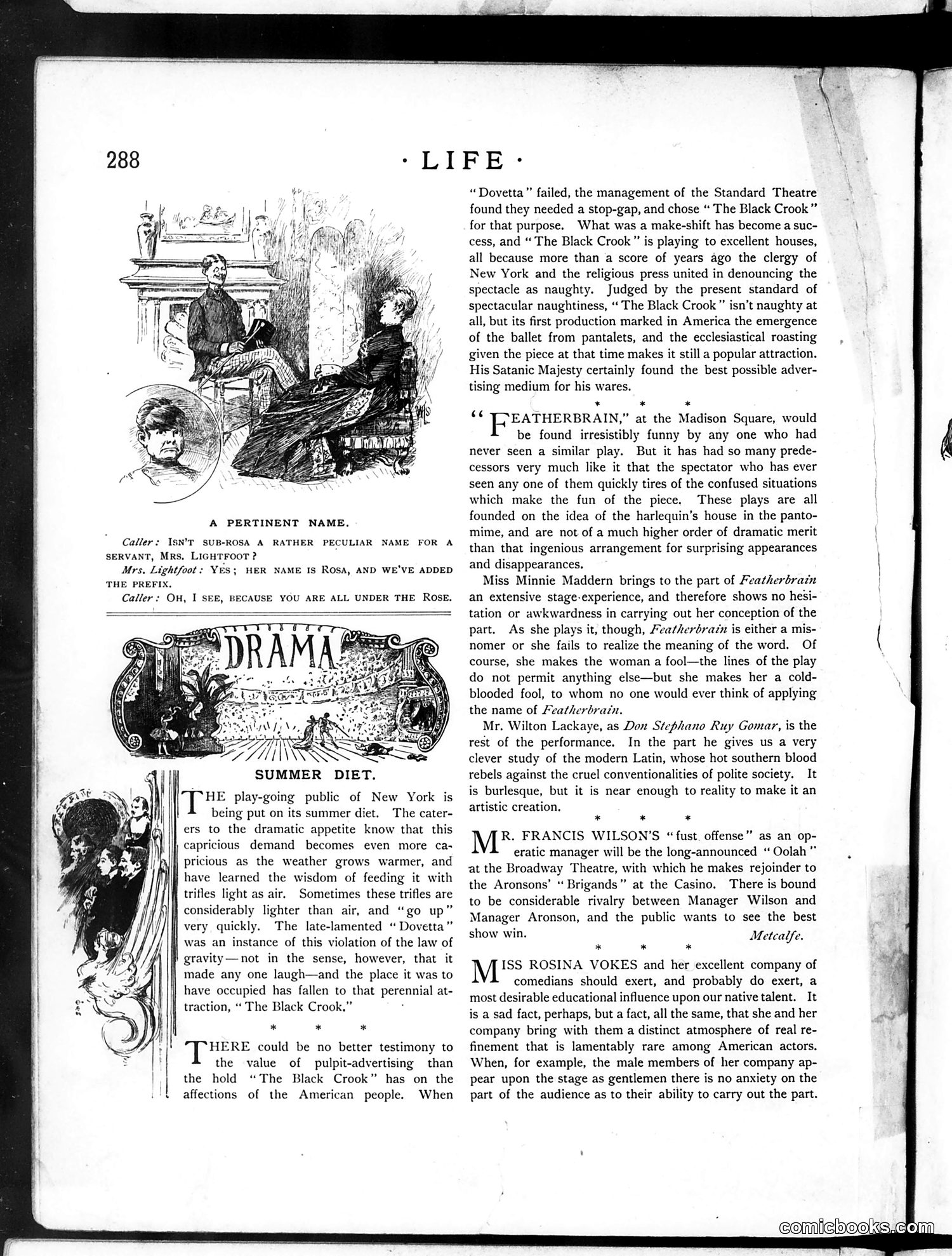
This page discusses theatrical productions of the summer theater season. The sketches illustrate dramatic scenes rather than political satire. The text reviews several plays: "The Black Crook" (praised as surprisingly successful), "Featherbrain" at Madison Square (criticized as derivative harlequin farce), and mentions of "Oolah" at the Broadway Theatre and a rivalry between managers Wilson and Aronso. The key illustration shows a dialogue labeled "A PERTINENT NAME" where a Caller questions whether "sub-rosa" is a peculiar name for a beverage, and Mrs. Lightfoot responds that it's actually "Rosa" with added prefixes—a mild wordplay joke about nomenclature. The content is primarily **theatrical criticism** rather than political commentary, typical of Life's cultural coverage during this period.
📄 Transcribed text from this page (OCR, searchable)
Machine-transcribed from the original scan — historical spelling and the odd misread are preserved.
A PERTINENT NAME. Caller: ISN'T SUB-ROSA A RATHER PECULIAR NAME FOR A SERVANT, MRS. LIGHTFOOT ? Mrs, Lightfoot: YES; WER NAME 1S ROSA, AND WE'VE ADDED THE PREFIX. Caller: OW, 1 SEE, BECAUSE YOU ARE ALL UNDER THE ROSE. SUMMER DIET. HE play-going public of New York is being put on its summer diet. The cater- ers to the dramatic appetite know that this capricious demand becomes even more ca-~ pricious as the weather grows warmer, and have learned the wisdom of feeding it with trifles light as air. Sometimes these trifles are considerably lighter than air, and “go up” very quickly. The late-lamented “ Dovetta” was an instance of this violation of the law of gravity—not in the sense, however, that it made any one laugh—and the place it was to have occupied has fallen to that perennial at- traction, “ The Black Crook.” * * * HERE could be no better testimony to the value of pulpit-advertising than the hold “The Black Crook” has on the affections of the American people. When “Dovetta” failed, the management of the Standard Theatre found they needed a stop-gap, and chose “ The Black Crook” for that purpose. What was a make-shift has become a suc- cess, and “ The Black Crook” is playing to excellent houses, all because more than a score of years ago the clergy of New York and the religious press united in denouncing the spectacle as naughty. Judged by the present standard of spectacular naughtiness, ‘‘ The Black Crook” isn’t naughty at all, but its first production marked in America the emergence of the ballet from pantalets, and the ecclesiastical roasting given the piece at that time makes it still a popular attraction. His Satanic Majesty certainly found the best possible adver- tising medium for his wares. * * « 66 T>EATHERBRAIN,” at the Madison Square, would be found irresistibly funny by any one who had never seen a similar play. But it has had so many prede- cessors very much like it that the spectator who has ever seen any one of them quickly tires of the confused situations which make the fun of the piece. These plays are all founded on the idea of the harlequin’s house in the panto- mime, and are not of a much higher order of dramatic merit than that ingenious arrangement for surprising appearances and disappearances. Miss Minnie Maddern brings to the part of Featherbracn an extensive stage-experience, and therefore shows no hesi- tation or awkwardness in carrying out her conception of the part. As she plays it, though, Fea/herérazn is either a mis- nomer or she fails to realize the meaning of the word. Of course, she makes the woman a fool—the lines of the play do not permit anything else—but she makes her a cold- blooded fool, to whom no one would ever think of applying the name of Featherbrain. Mr. Wilton Lackaye, as Dox Stephano Ruy Gomar, is the rest of the performance. In the part he gives us a very clever study of the modern Latin, whose hot southern blood rebels against the cruel conventionalities of polite society. It is burlesque, but it is near enough to reality to make it an artistic creation. * * * R. FRANCIS WILSON'’S “fust. offense” as an op- eratic manager will be the long-announced “ Oolah” at the Broadway Theatre, with which he makes rejoinder to the Aronsons’ “ Brigands” at the Casino. There is bound to be considerable rivalry between Manager Wilson and Manager Aronson, and the public wants to see the best show win. Metcalfe. * * * ISS ROSINA VOKES and her excellent company of comedians should exert, and probably do exert, a most desirable educational influence upon our native talent. It is a sad fact, perhaps, but a fact, all the same, that she and her company bring with them a distinct atmosphere of real re- finement that is lamentably rare among American actors. When, for example, the male members of her company ap- pear upon the stage as gentlemen there is no anxiety on the part of the audience as to their ability to carry out the part.