
Life, 1889-05-16 · page 7 of 18
Life — May 16, 1889 — page 7: what you’re looking at
What you’re looking at
This page, numbered 285 from *Life* magazine, features an article about poet Alfred Tennyson alongside a satirical cartoon titled "Hammered Brass." The cartoon depicts two figures—apparently journalists or critics—aggressively hammering away at what appears to be a brass object or plaque. The satire likely critiques the contemporary literary establishment's harsh treatment of poets through relentless criticism and public scrutiny. The accompanying article discusses Tennyson's career challenges, including his financial struggles, prolific but sometimes frivolous publishing, and his status as a professional writer dependent on commercial success. The cartoon visually reinforces the article's theme: that working poets faced constant, punishing pressure from critics and the publishing industry—they were being metaphorically "hammered" by the brass (the establishment).
📄 Transcribed text from this page (OCR, searchable)
Machine-transcribed from the original scan — historical spelling and the odd misread are preserved.
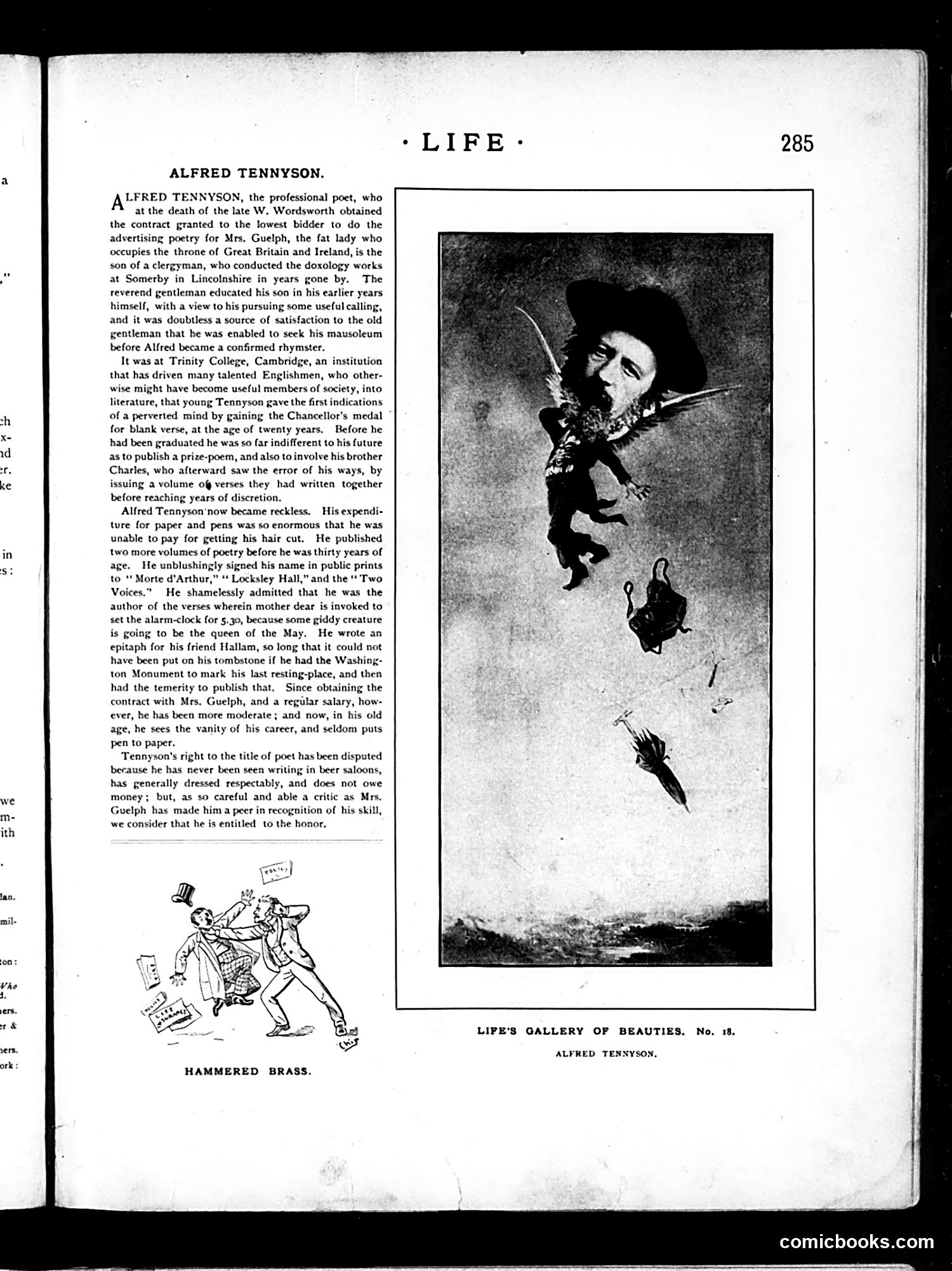
ALFRED TENNYSON. LFRED TENNYSON, the professional poet, who at the death of the late W. Wordsworth obtained the contract granted to the lowest bidder to do the advertising poetry for Mrs. Guelph, the fat lady who occupies the throne of Great Britain and Ireland, is the son of a clergyman, who conducted the doxology works at Somerby in Lincolnshire in years gone by. The reverend gentleman educated his son in his earlier years himself, with a view to his pursuing some useful calling, and it was doubtless a source of satisfaction to the old gentleman that he was enabled to seek his mausoleum before Alfred became a confirmed rhymster. It was at Trinity College, Cambridge, an institution that has driven many talented Englishmen, who other- wise might have become useful members of society, into literature, that young Tennyson gave the first indications of a perverted mind by gaining the Chancellor's medal for blank verse, at the age of twenty years, Before he had been graduated he was so far indifferent to his future as to publish a prize-poem, and also to involve his brother Charles, who afterward saw the error of his ways, by issuing a volume o@ verses they had written together before reaching years of discretion. Alfred Tennyson‘now became reckless. His expendi- ture for paper and pens was so enormous that he was unable to pay for getting his hair cut. He published two more volumes of poetry before he was thirty years of age. He unblushingly signed his name in public prints to “Morte d’Arthur,” * Locksley Hall,” and the Two Voices.” He shamelessly admitted that he was the author of the verses wherein mother dear is invoked to set the alarm-<clock for 5.30, because some giddy creature is going to be the queen of the May. He wrote an epitaph for his friend Hallam, so long that it could not have been put on his tombstone if he had the Washing- ton Monument to mark his last resting-place, and then had the temerity to publish that. Since obtaining the contract with Mrs, Guelph, and a regular salary, how- ever, he has been more moderate; and now, in his old age, he sees the vanity of his career, and seldom puts pen to paper. ‘Tennyson's right to the title of poet has been disputed because he has never been seen writing in beer saloons, has generally dressed respectably, and does not owe money; but, as so careful and able a critic as Mrs. Guelph has made him a peer in recognition of his skill, we consider that he is entitled to the honor. HAMMERED BRASS. LIFE'S GALLERY OF BEAUTIES. ALFRED TENNYSON, No, 18. comicbooks.com