
A complete issue · 20 pages · 1889
Life — April 11, 1889
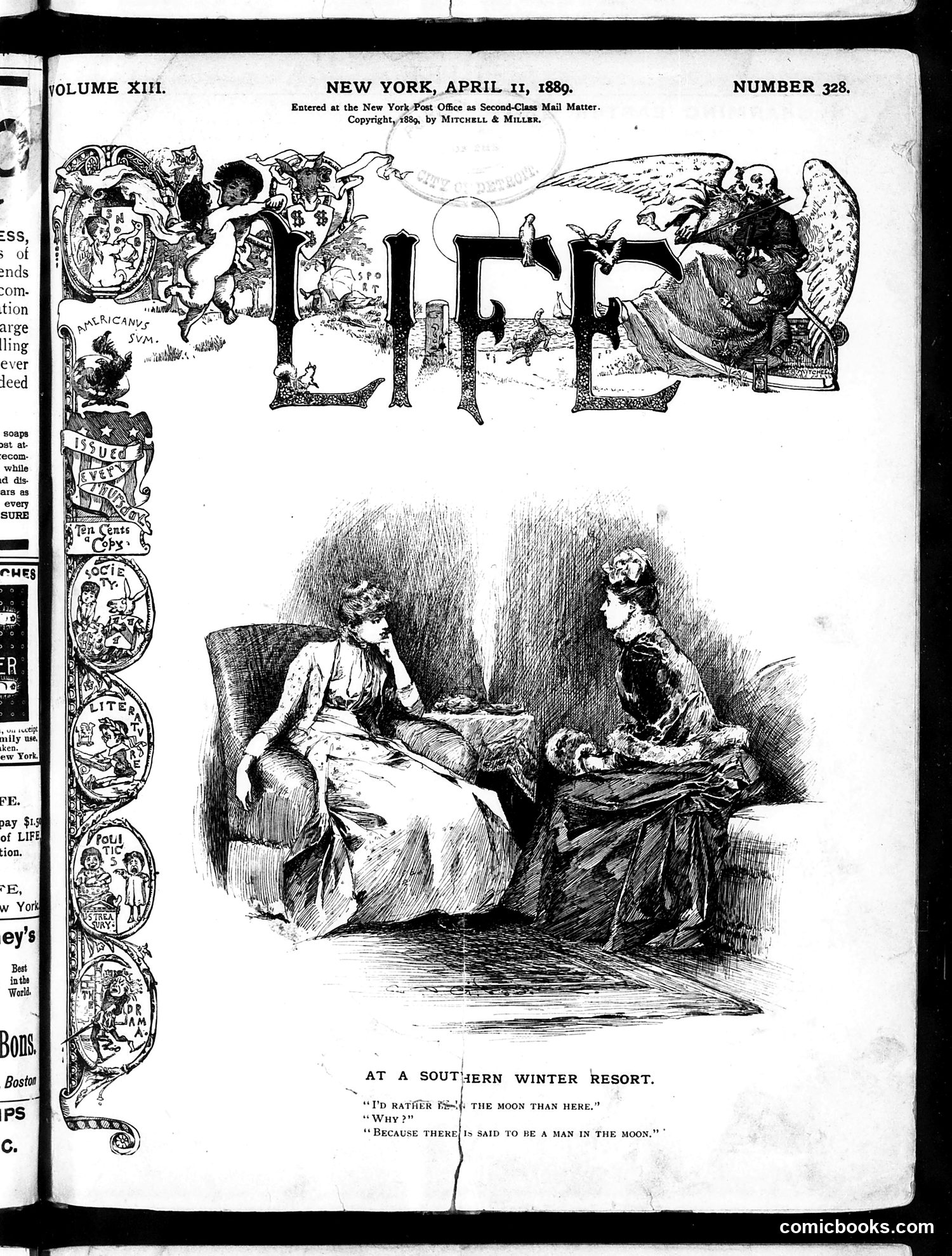
**Main Illustration: "At a Southern Winter Resort"** Two women in 1880s dress sit conversing. The dialogue below reads: - "I'd rather see the moon than here." - "Why?" - "Because there is said to be a man in the moon." **The Satire:** This is a social commentary on the scarcity of eligible men at Southern winter resorts. The joke depends on the era's assumption that unmarried women primarily sought male companionship. By preferring to see "a man in the moon" rather than attend a Southern resort, the woman indicates these fashionable vacation destinations were populated by women but notably lacked available men—making them disappointing for romantic prospects. It's gentle satire targeting wealthy leisure culture and gender expectations of the Gilded Age.
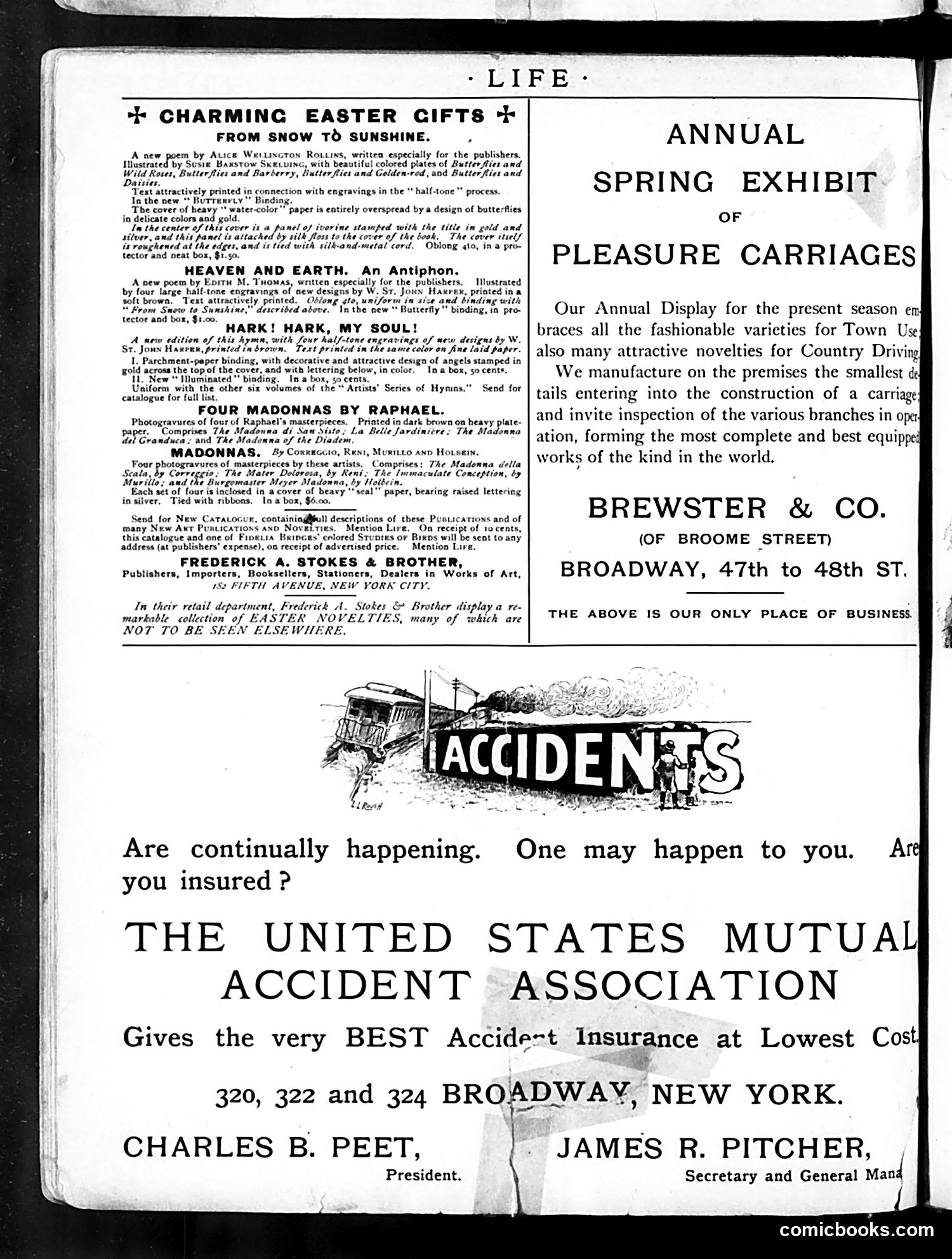
This page is primarily **advertising with minimal editorial content**. The top section contains book advertisements for Easter-themed poetry and art publications from Frederick A. Stokes & Brother publishers. The main illustrated content is a large **accident insurance advertisement** featuring a cartoon of a vehicle collision. The image shows a carriage or early automobile crashed into what appears to be a streetcar or train, with figures nearby—a visual meant to dramatize the dangers of modern transportation. The advertisement for **The United States Mutual Accident Association** uses this dramatic collision imagery to persuade readers to purchase accident insurance, with the tagline: "Accidents are continually happening. One may happen to you. Are you insured?" This reflects early-20th-century concerns about transportation safety and the emerging insurance industry.
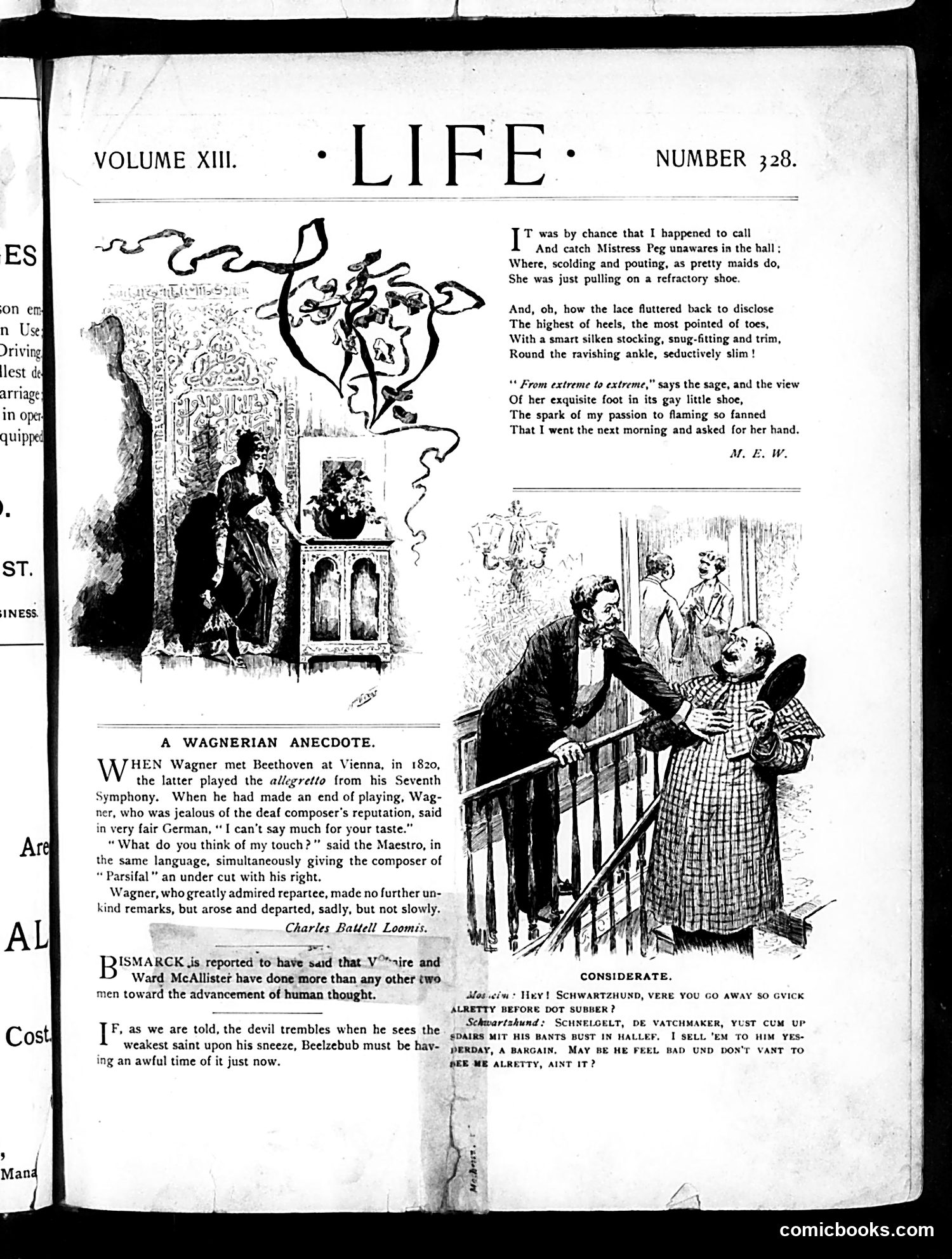
This page contains three distinct items: 1. **"A Wagnerian Anecdote"**: A humorous story about composer Wagner meeting Beethoven in 1820. Wagner played Beethoven's Seventh Symphony allegro, and when Beethoven criticized his interpretation, Wagner responded by insulting Beethoven's famous composition "Parsifal"—a joke on the rivalry between these composers. 2. **Poetry about a Woman's Foot**: Romantic verse celebrating a woman's shoe and ankle, reflecting Victorian-era genteel fascination with women's fashion and modest physicality. 3. **Right Illustration & Caption**: Shows what appears to be a domestic dispute or servant-employer conflict, with dialect dialogue about a dachshund ("Schwartzuhund"). The humor involves class dynamics and mangled German-English speech patterns typical of period satire. The page reflects turn-of-century American satirical interests: European cultural figures, sentimental romanticism, and ethnic/class humor.
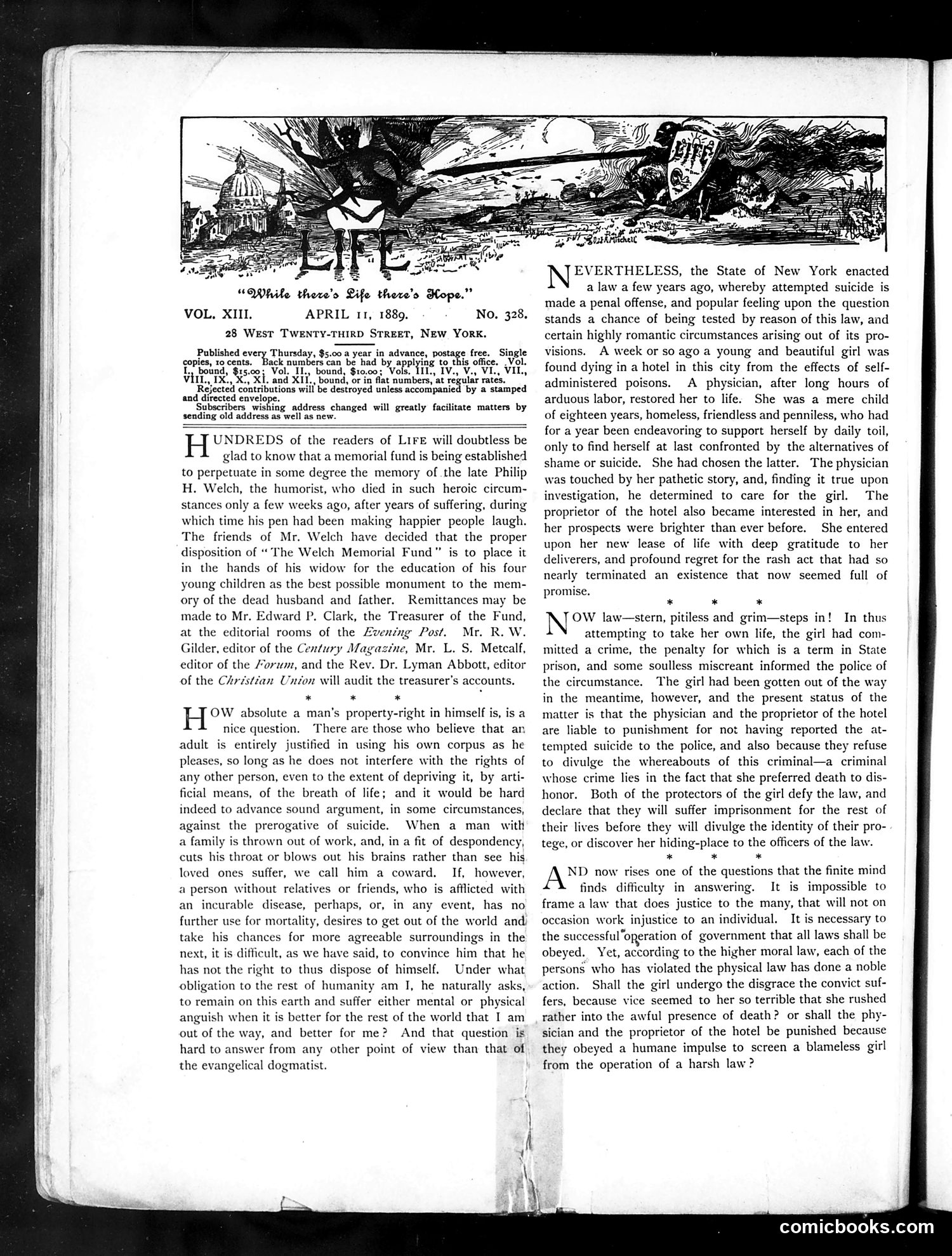
The page contains two editorial sections debating New York State's attempted-suicide law rather than a political cartoon. The masthead illustration depicts a large tree with figures beneath it and classical architectural elements (a domed building, possibly representing government), alongside the motto "While there's Life there's Hope." The articles discuss a case of a young woman found dying from self-administered poison in a hotel. The debate centers on whether the physician and hotel proprietor should face legal punishment for failing to report the suicide attempt to police. The satire critiques the law's harshness: should rescuers be criminalized for saving lives? The pieces wrestle with competing values—legal obligation versus humanitarian compassion—exposing the tension between rigid law and moral justice.
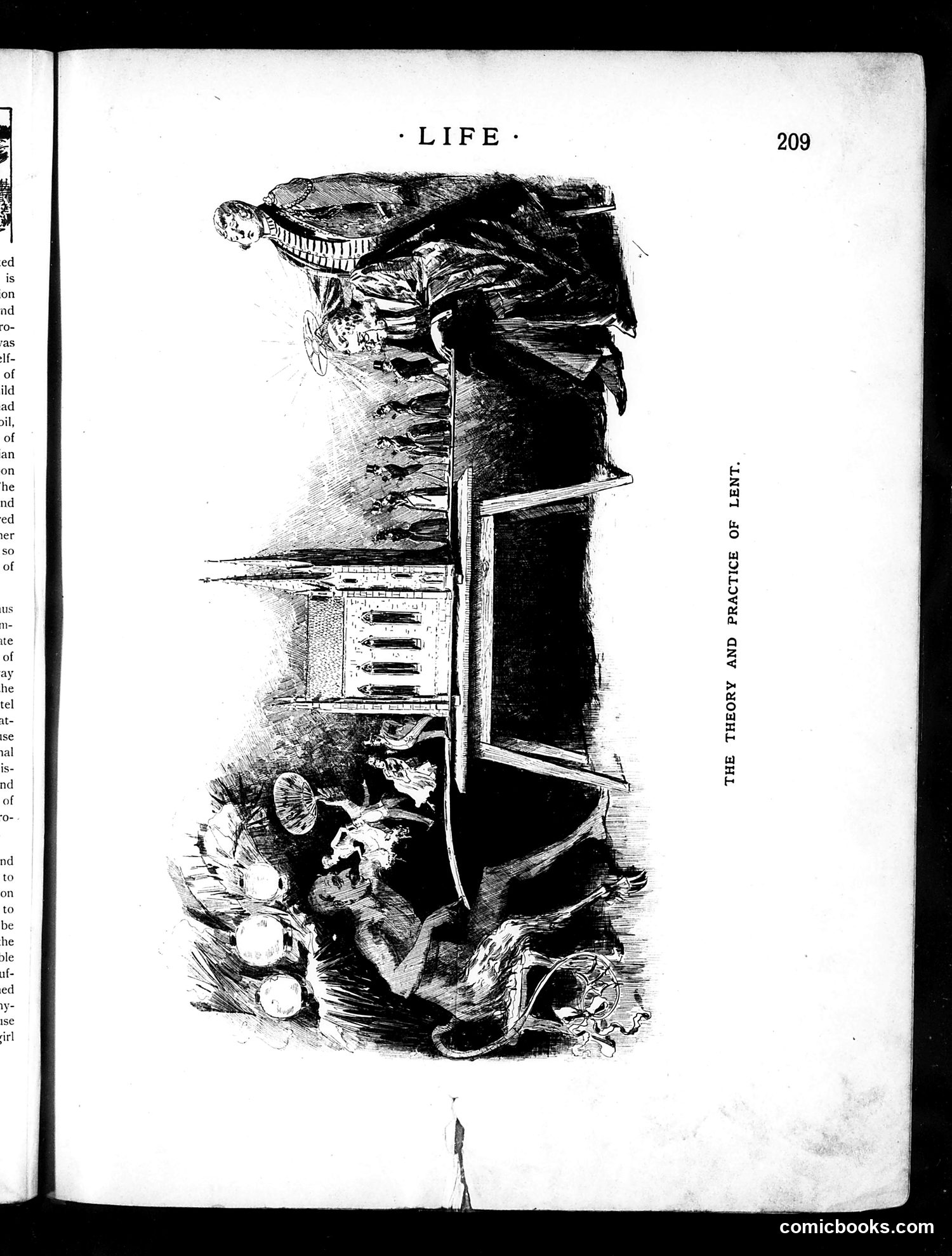
This satirical cartoon contrasts religious ideals with actual behavior during Lent, the Christian period of fasting and sacrifice. The top half depicts a skeletal, ascetic figure representing the *theory* of Lent—austere self-denial. The bottom half shows the *practice*—a rotund, well-fed person surrounded by abundant food and drink, clearly indulging rather than fasting. The visual joke is the stark hypocrisy: while Lent supposedly demands abstinence and spiritual discipline, many people continued eating heartily and enjoying worldly pleasures. By showing these opposing images vertically, the cartoon mocks the gap between religious principle and actual human behavior during this observance. This reflects a common satirical target in Life magazine: the gap between professed morality and lived practice.
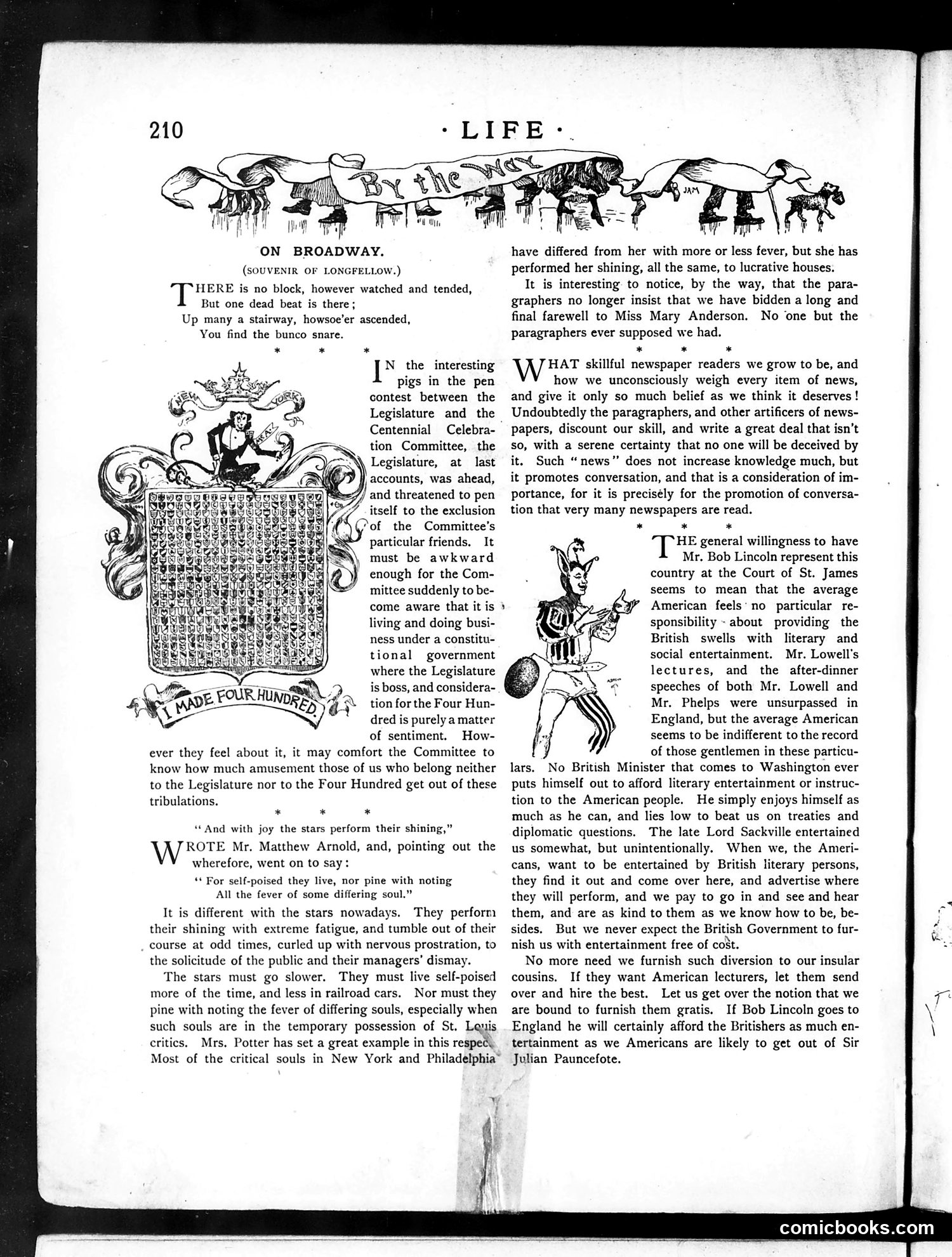
This page contains two distinct pieces: **"On Broadway"** (left) is a poem criticizing theatrical stars who perform with insufficient energy and emotional investment. It argues performers must maintain high standards despite fatigue, referencing the "solitude of the public" and audience expectations. **The main article** (right) discusses American expectations regarding British cultural entertainment and diplomacy. It appears to reference tensions over whether the British government should provide free literary entertainment to Americans, using figures like "Mr. Bob Lincoln" and "Mr. Lowell" (likely allusions to specific contemporary British/American diplomatic figures, though unclear precisely which). The satire critiques American entitlement regarding British cultural contributions while also ribbing British reluctance to provide gratis entertainment—a transatlantic cultural squabble of the period.
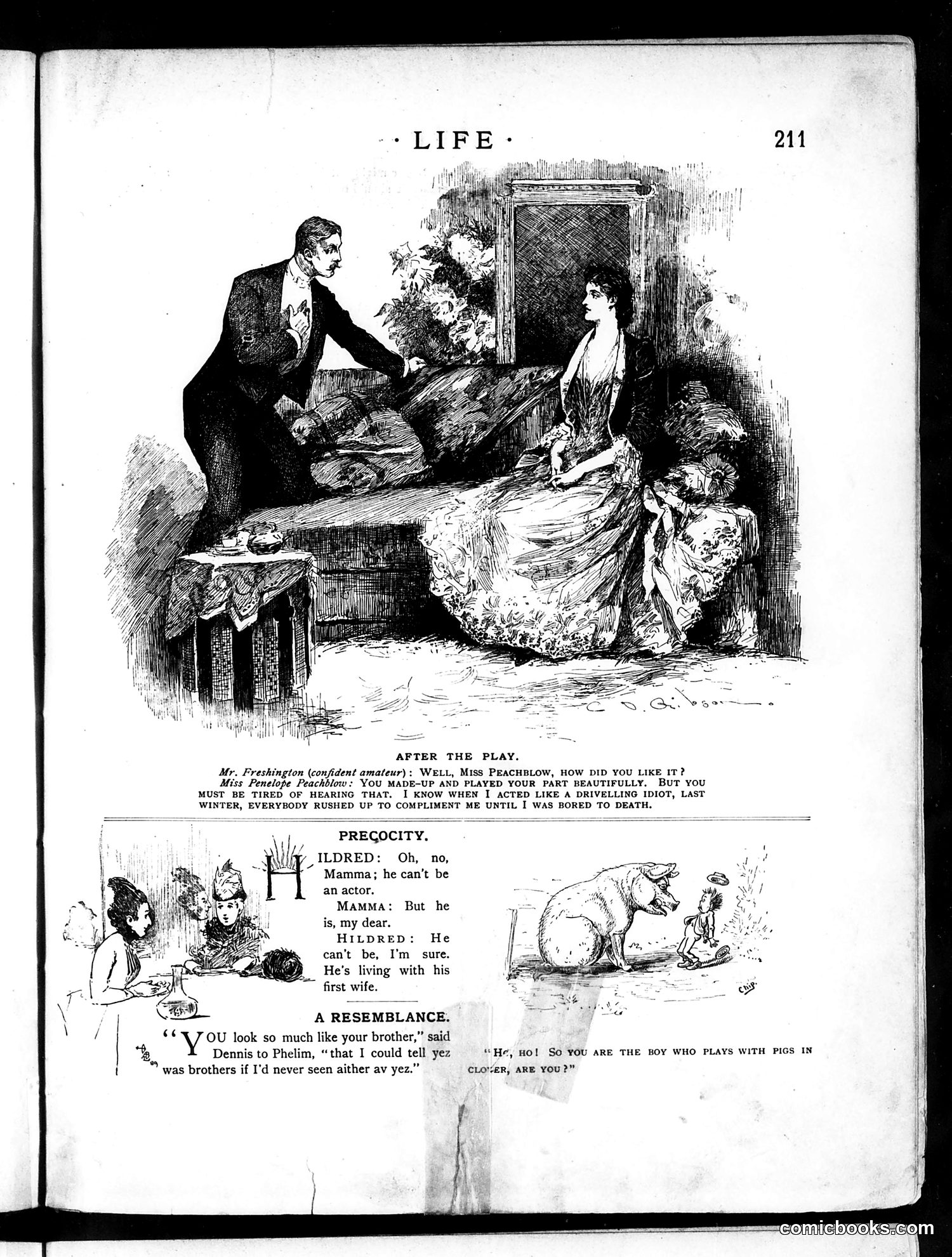
This page contains three satirical sketches: **"After the Play"**: A theater scene where Mr. Frushington compliments Miss Peachblow's acting, but she dismisses actors as "drivelling idiots," suggesting theatrical pretension and social hypocrisy. **"Precocity"**: A domestic scene where a mother defends her son as an actor, while his sister Hildred insists he's actually living with his first wife—implying the boy has abandoned theatrical ambitions for early marriage, treating adulthood prematurely. **"A Resemblance"**: A man named Dennis resembles his brother Phelim so closely they could pass for twins, though they'd "never seen" each other—likely satirizing improbable family resemblances or mistaken identity tropes. The humor targets theatrical vanity, precocious life choices, and coincidental similarities common to period comedic literature.
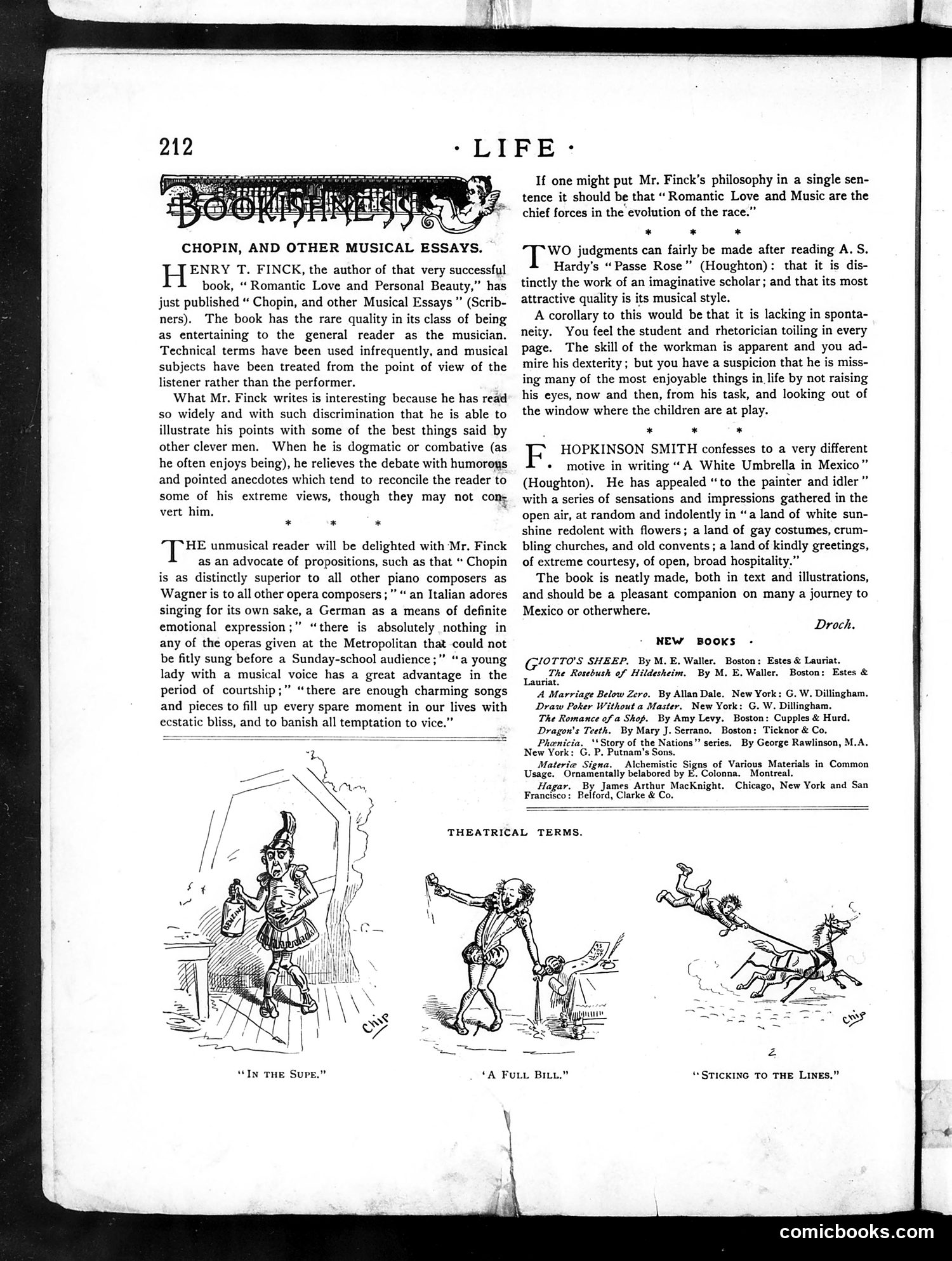
This page primarily contains **literary book reviews** rather than political cartoons. The main content discusses Henry T. Finck's essay collection on Chopin and romantic music, and F. Hopkinson Smith's travel writing about Mexico. The three small **theatrical cartoon sketches** at the bottom use stage terminology as visual puns: - **"In the Supes"** (supernumeraries/extras): Shows a soldier - **"A Full Bill"** (full theatrical program): Depicts acrobatic performers - **"Sticking to the Lines"** (theatrical script/blocking): Shows figures in exaggerated poses These are lighthearted wordplay jokes targeting theater audiences familiar with backstage terminology. The cartoons don't reference specific political figures or events—they're simply humorous visual gags playing on theatrical jargon.
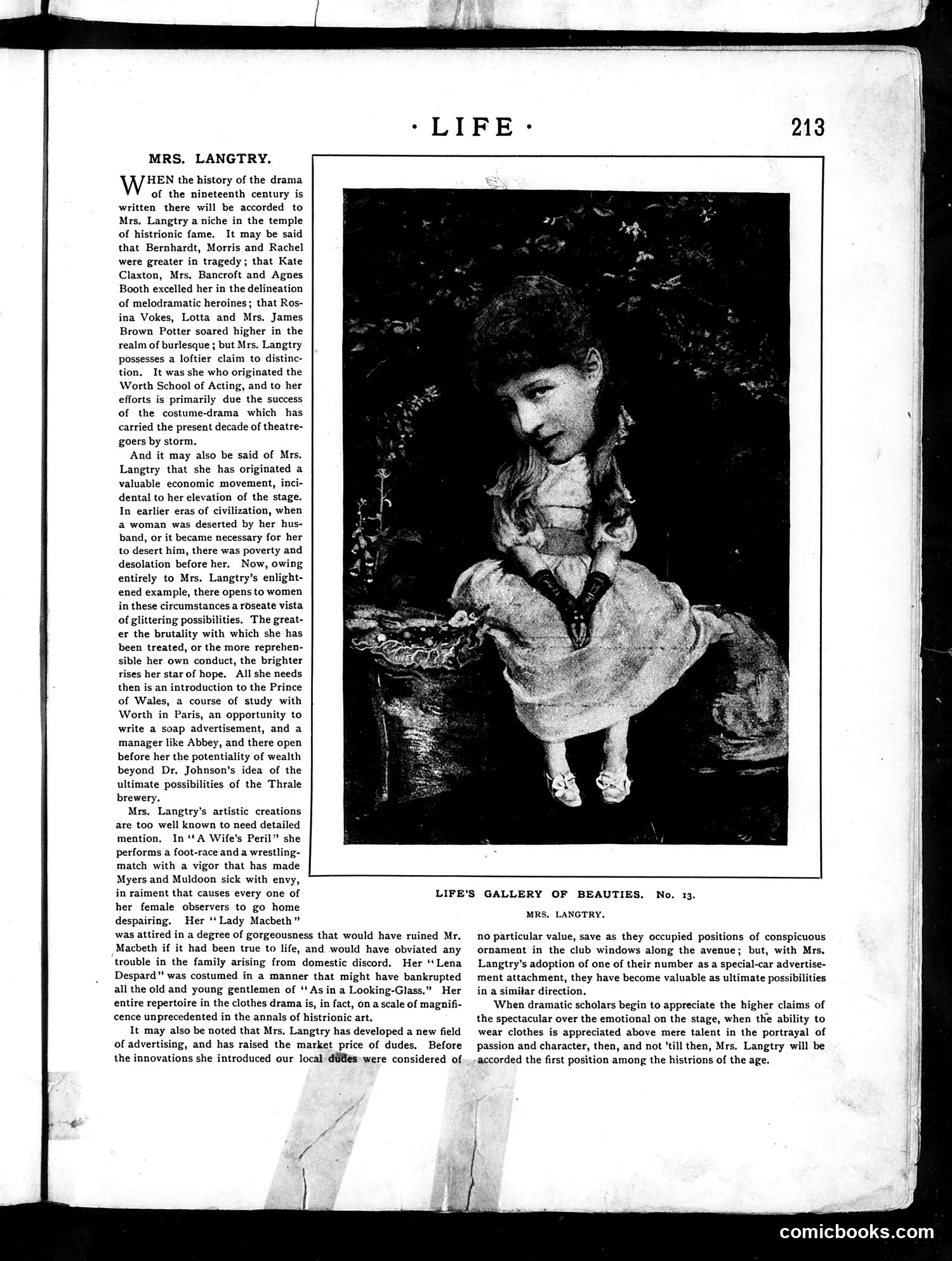
This page features a biographical article and portrait photograph of **Mrs. Langtry**, a prominent theatrical performer of the late 19th/early 20th century. The text praises her accomplishments in drama and her role in founding the Worth School of Acting, crediting her with elevating the status of costume-drama theater. The article emphasizes her significance as a pioneering female performer who achieved financial independence and opened professional opportunities for women in theater. It references specific dramatic roles and notes her innovations in advertising and theatrical management. The photograph shows her in elaborate costume with period dress and ornamental headpiece, illustrating her work in theatrical production. The content celebrates her as a trailblazer in women's professional advancement through entertainment.
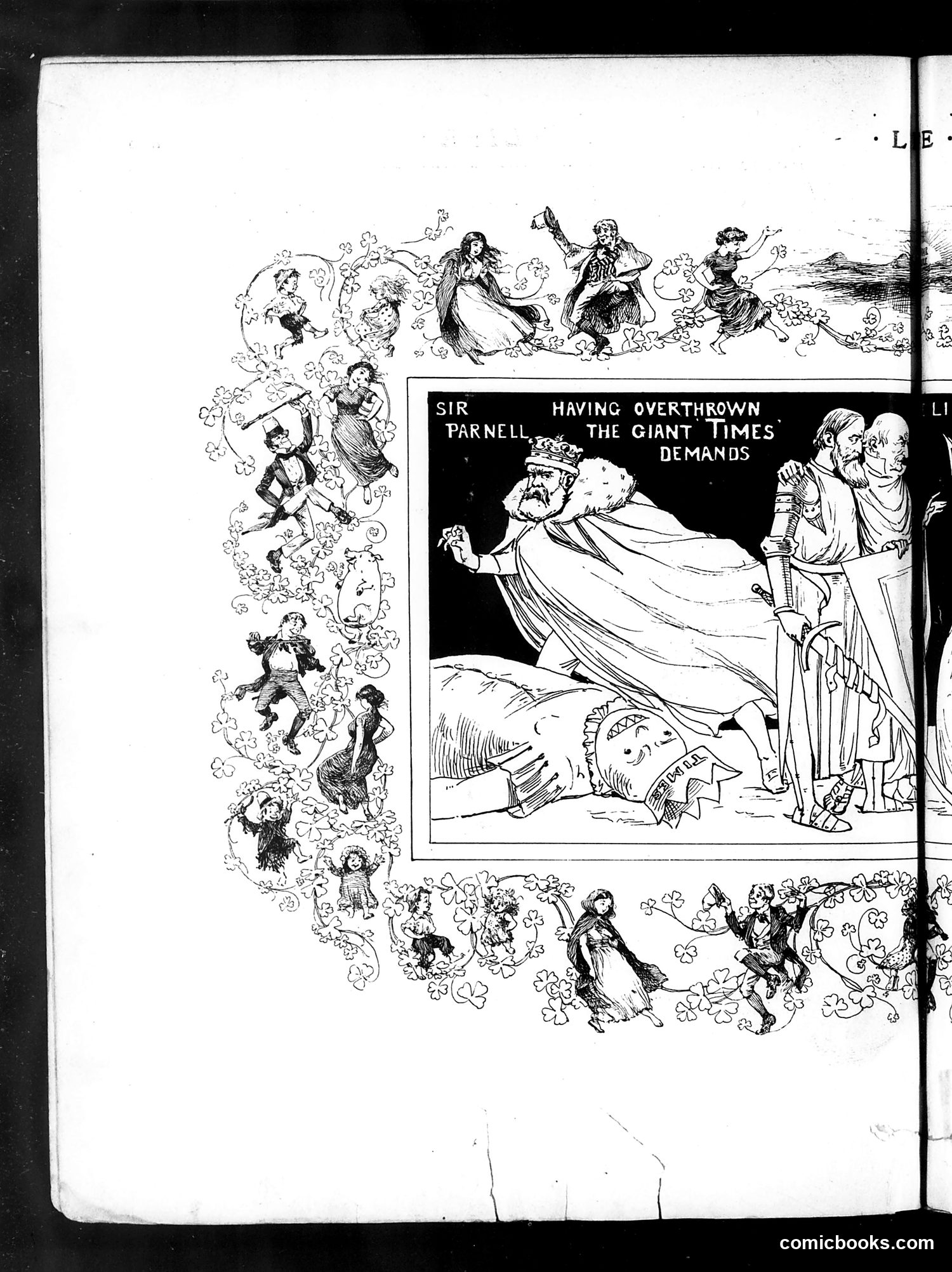
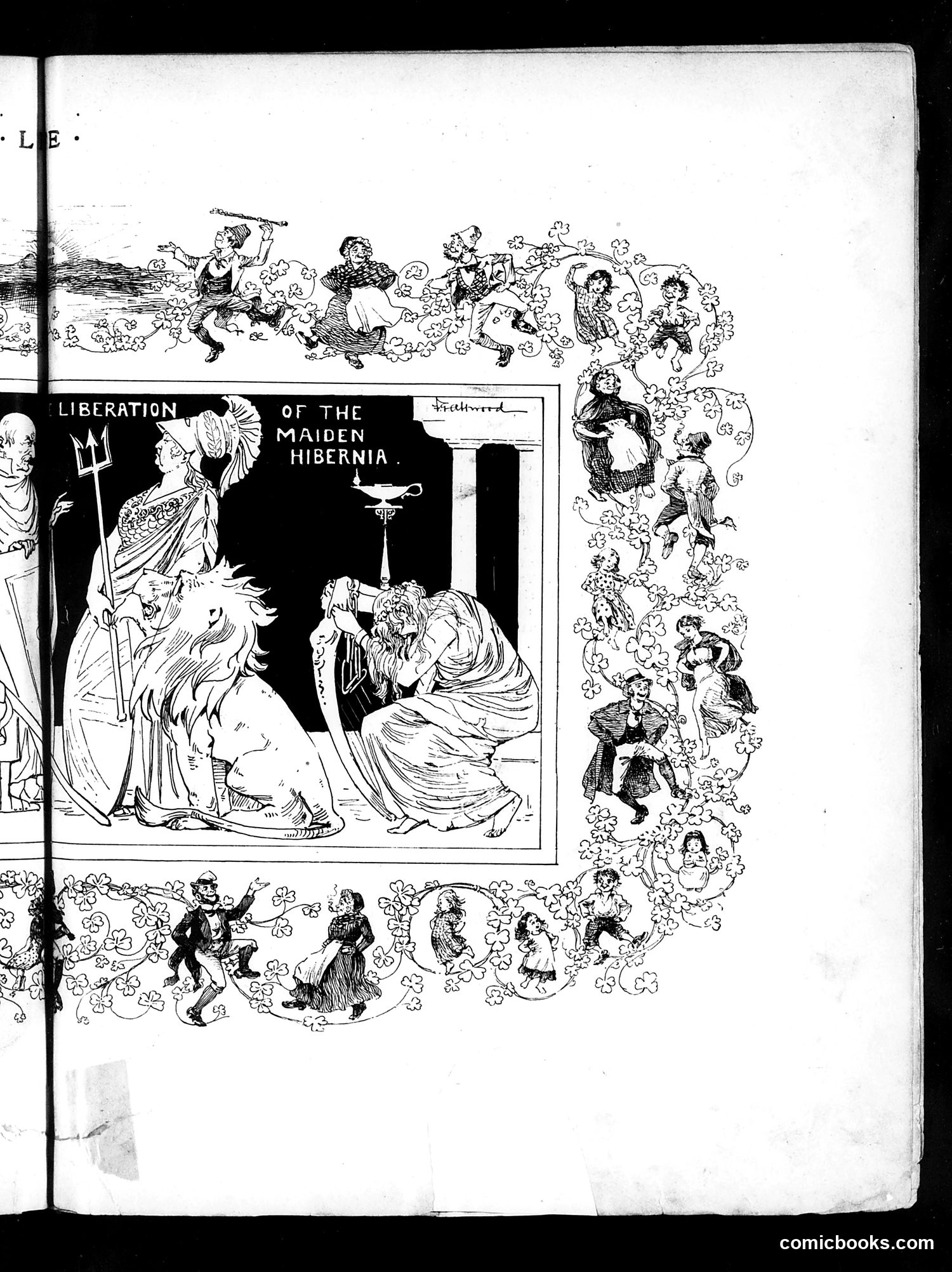
This is a satirical illustration from *Life* magazine featuring Sir Charles Parnell, the Irish nationalist leader. The central cartoon shows Parnell as a giant figure being overthrown, with the caption "SIR PARNELL HAVING OVERTHROWN THE GIANT TIMES DEMANDS." The satire references Parnell's conflict with *The Times* newspaper, which had published false letters implicating him in violence. The "giant" represents *The Times*' power and authority. The surrounding decorative border depicts numerous cherubs and figures celebrating or dancing, suggesting public or political jubilation over Parnell's vindication or political triumph. The cartoon satirizes how Parnell, despite powerful institutional opposition, achieved a significant victory against the influential newspaper—reversing the expected power dynamic where major publications typically dominate political figures.
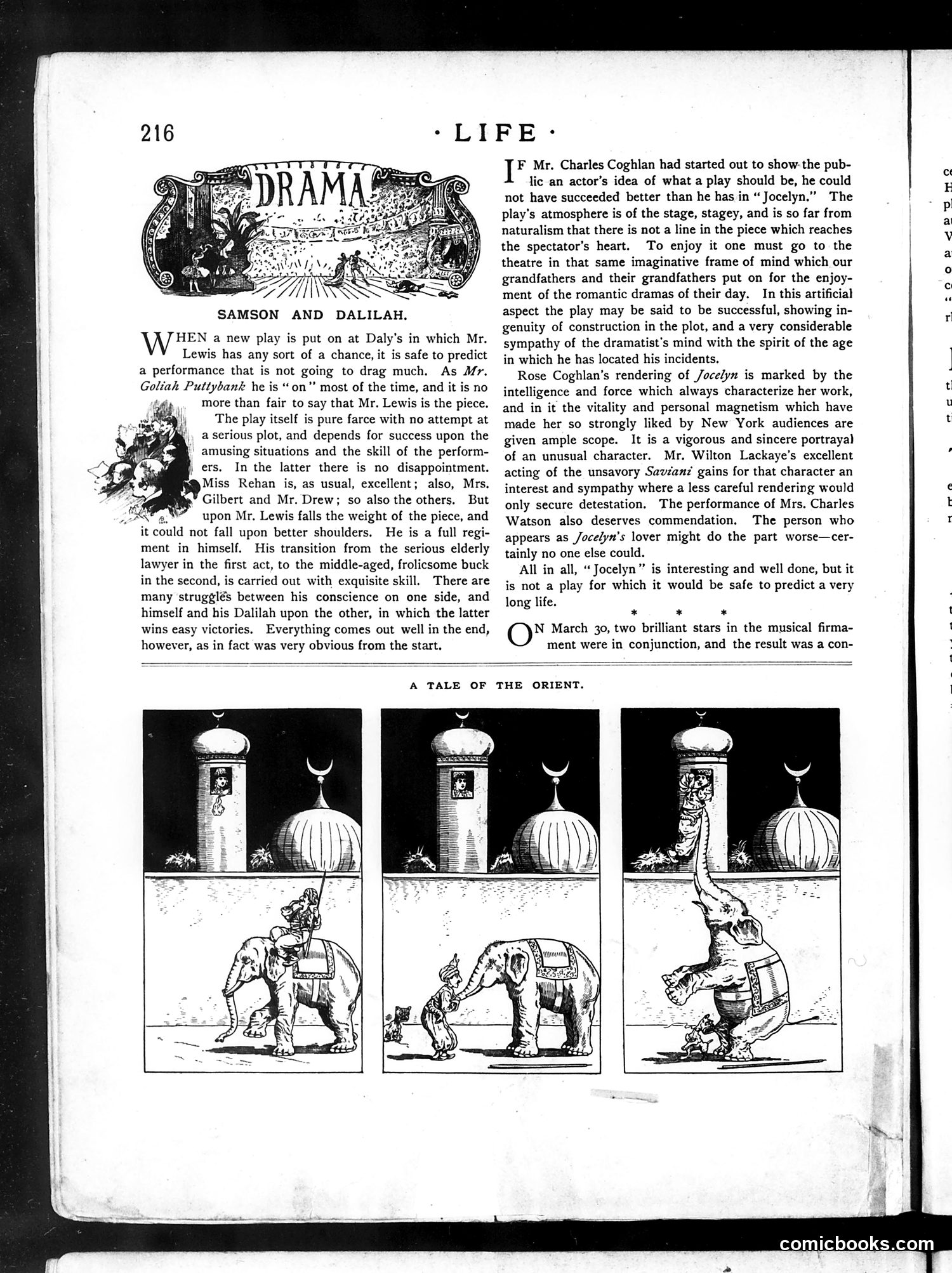
This page reviews theatrical performances from what appears to be the 1880s-90s. The top section praises actor Mr. Lewis in "Samson and Dalilah" at Daly's Theatre, noting his comedic skill carries the "pure farce" despite weak plot. The text commends supporting actresses Miss Rehan and Mrs. Gilbert. Below, critic reviews Charles Coghlan in "Jocelyn," noting its deliberately artificial, old-fashioned staginess—designed for audiences who enjoy romantic melodrama rather than naturalistic theater. Rose Coghlan (likely Charles's wife) receives praise for her vital performance, as does actor Wilton Lackaye for bringing sympathy to an otherwise unsavory character. The reviewer predicts "Jocelyn" won't have lasting success despite competent execution. The three illustrations labeled "A Tale of the Orient" depict elephants with ornate howdahs (ceremonial platforms) and minaret-style towers—likely visual commentary, though its satirical target is unclear from this page alone.
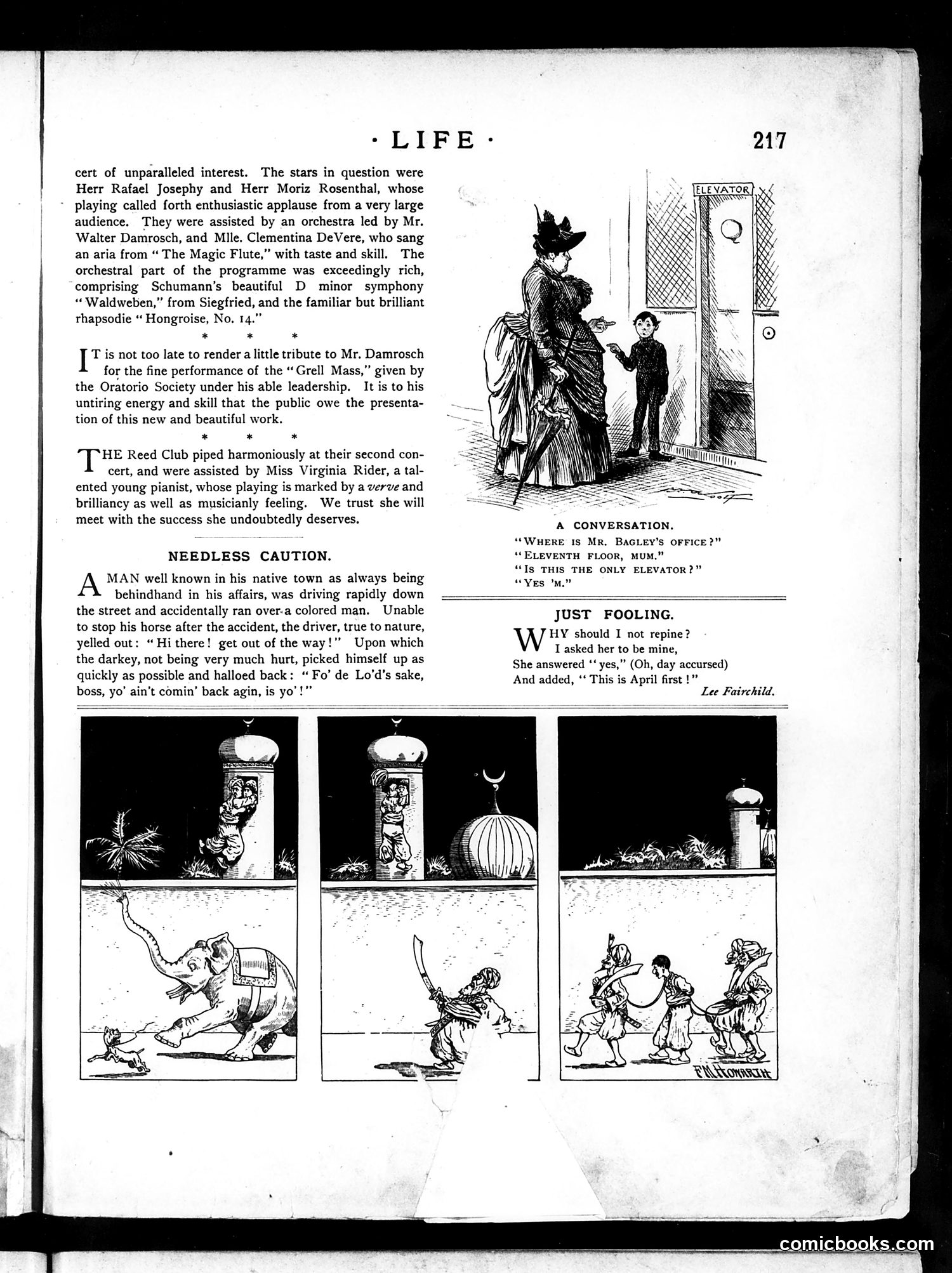
**Main Text Content:** Music reviews praising performances by pianists Josephy and Rosenthal, conductor Walter Damrosch, and pianist Virginia Rider at various concerts in New York. **"A Conversation" Cartoon:** Shows a woman asking a man about Mr. Bagley's office location. The humor relies on the woman's apparent anxiety about elevator safety—she asks if it's "the only elevator," suggesting she's nervous about using it. The man's responses are straightforward, making her worry seem excessive or comedic. **"Needless Caution" Story:** A careless driver hits a Black man but cannot stop. The driver yells a warning; the injured man, using dialect ("Fo' de Lo'd's sake"), humorously responds that the driver shouldn't worry about coming back. The "joke" relies on the man's apparent unconcern despite injury—period humor that reflects racist stereotypes about Black Americans. **"Just Fooling" Poem:** A man proposes to a woman who accepts, but reveals on April Fool's Day she was joking. Light romantic humor playing on the holiday's deceptions.
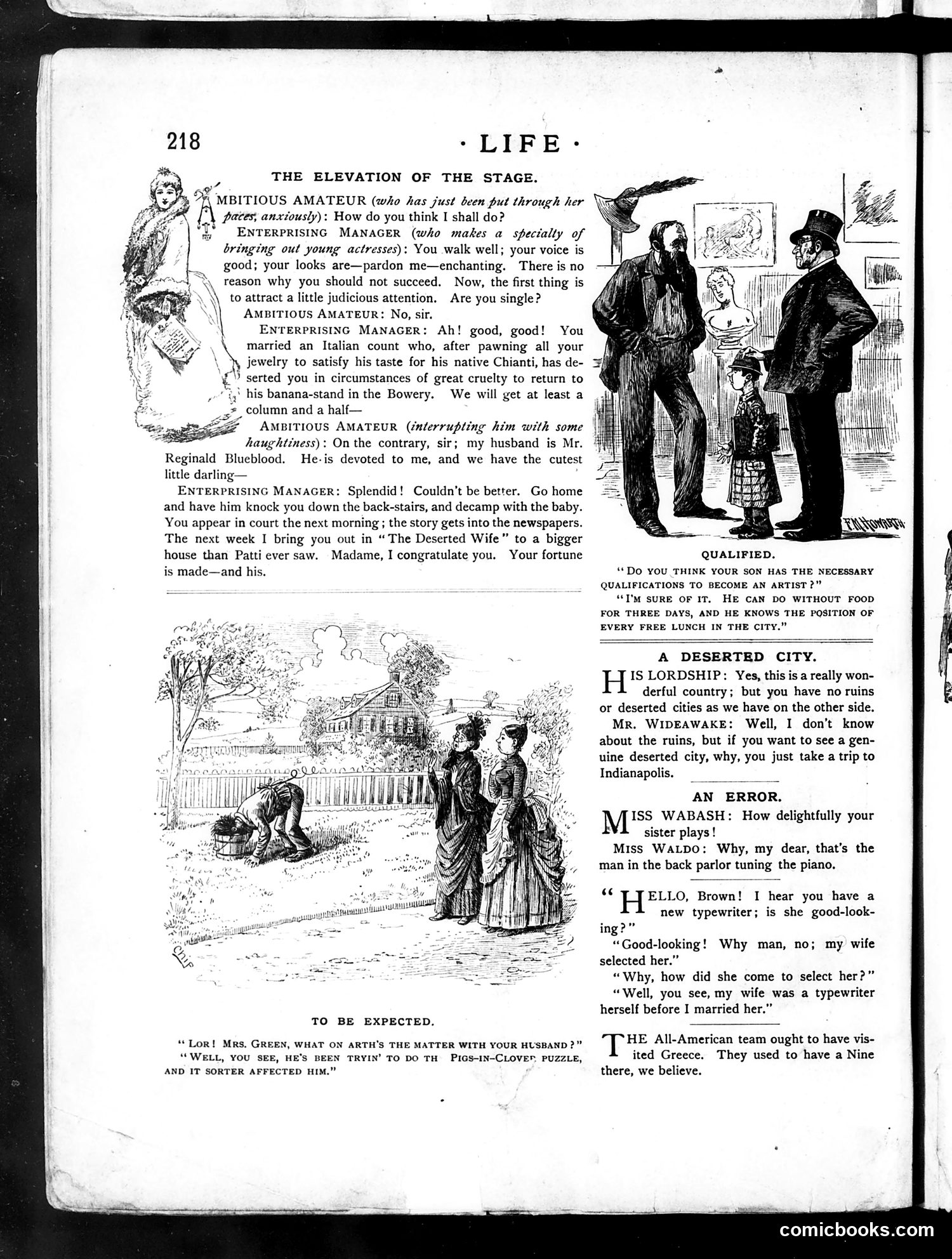
This page satirizes theatrical promotion and American society through several interconnected jokes: **The main cartoon** mocks how theater managers exploit actresses' personal scandals for publicity. An ambitious amateur actress seeks advice; the manager suggests fabricating a dramatic story—having her respectable husband (Mr. Reginald Blueblood) publicly abandon her so she can appear in court, generating newspaper coverage to promote her debut in "The Deserted Wife." The satire targets both the sensationalism of theatrical marketing and newspapers' appetite for scandal. **Supporting jokes** continue the theme: an artist son survives by knowing every free lunch location in the city; a British lordship is told Indianapolis is a "deserted city" (implying it's empty/dead); a man's new typewriter is actually his wife, who was herself a typewriter operator before marriage—a period-accurate joke about women's employment. The overall message: American show business cynically manufactures drama from real human suffering for profit, while society treats such scandals as entertainment.
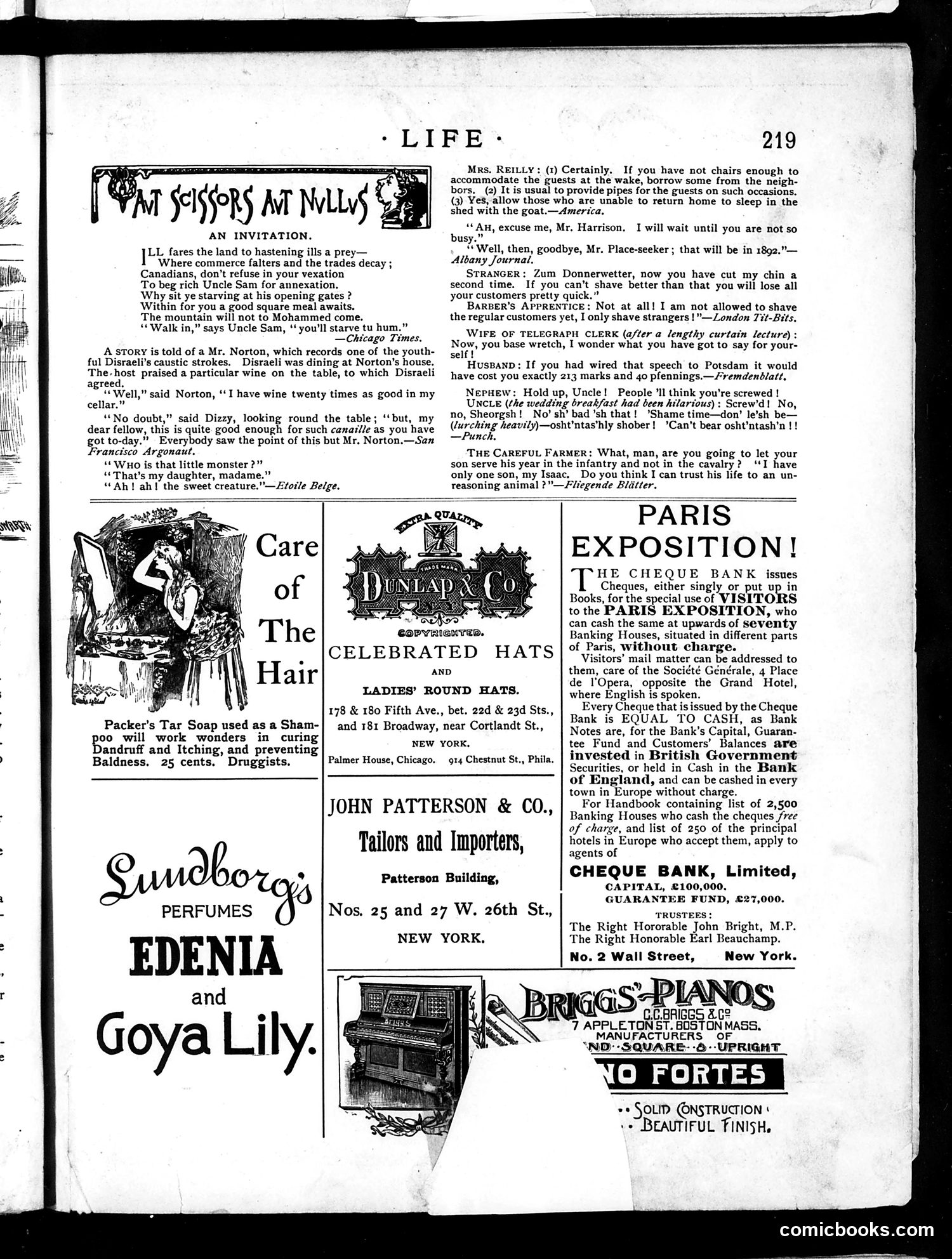
This page contains multiple short satirical anecdotes and jokes rather than a single cartoon. **Key content:** The opening poem mocks Canadian economic hardship, suggesting annexation to the U.S. as a solution—likely referencing 1890s trade disputes between Canada and America. Several brief anecdotes follow: one attributes a cutting remark to Disraeli about dinner guests' social class; others are brief jokes about Irish wake customs, a barber's apprentice injuring customers, a drunk uncle at a wedding, and a farmer's distrust of cavalry service for his son. **Context for modern readers:** These represent typical *Life* magazine humor—often featuring ethnic stereotypes (Irish, German), class commentary, and domestic situations treated as comedy. The jokes rely on wordplay and social observation common to 1890s satire. The page is primarily filled with period advertisements for hats, tailors, perfumes, and pianos, with a prominent notice about the Paris Exposition cheque bank service.
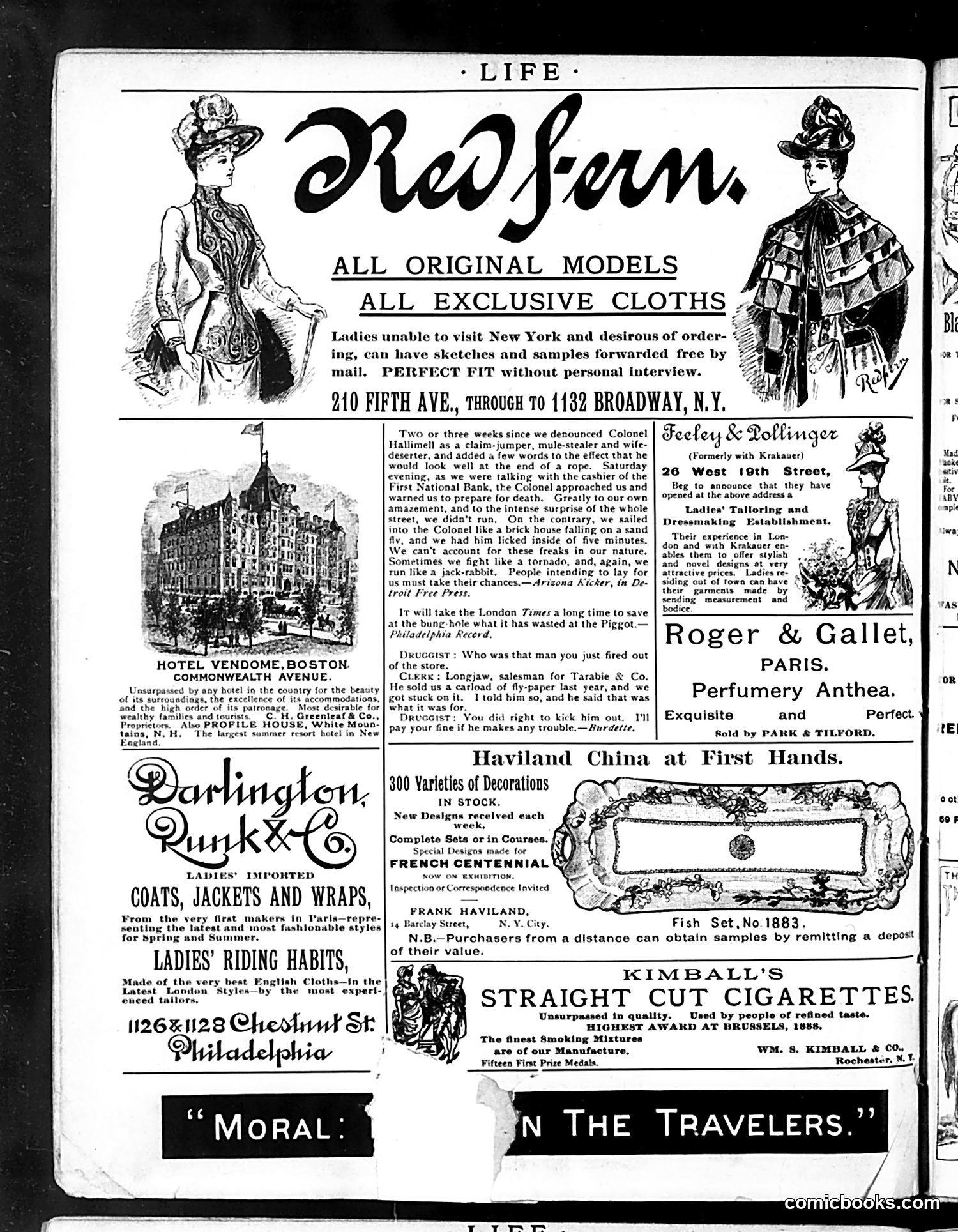
This is primarily an **advertising page** from Life magazine, not a political cartoon page. It contains multiple commercial advertisements for late 19th-century goods and services: women's fashion (Red Fern clothing, Darlington Runk & Co. coats), hotels, perfume, china, cigarettes, and tailoring services. The page includes three brief **humorous anecdotes** rather than political satire: 1. A story about an Arizona newspaper editor who unexpectedly won a fight with Colonel Halliwell after being threatened 2. A joke about the London Times wasting resources 3. A drugstore dialogue about a fly-paper salesman who got "stuck"—a pun on adhesive These are light, everyday humor pieces typical of Life's satirical tone, poking fun at personal folly and commercial absurdity rather than politics. The "Moral: In the Travelers" caption at bottom appears incomplete and unclear in meaning.
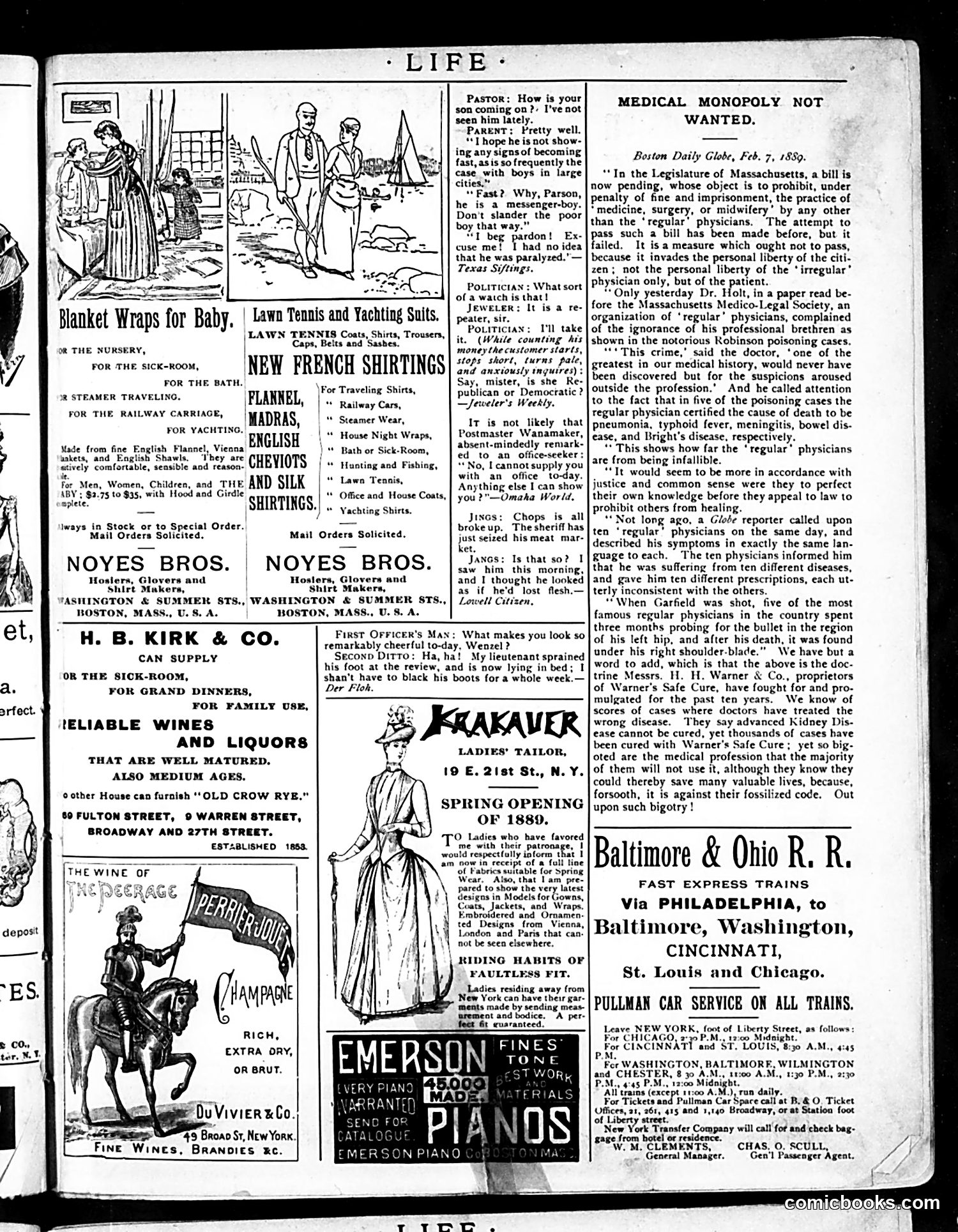
This page mixes advertisements with brief satirical jokes typical of *Life* magazine's format. The visible cartoons are small comic dialogues: 1. **"Fast Boy"**: A minister misunderstands a father's comment. When the pastor warns against the boy becoming "fast" (morally loose), the father protests—the boy is merely a messenger-boy, hardly immoral. The pastor's deadpan response ("I had no idea he was paralyzed") jokes that "fast" could mean rapid movement, creating a pun on the word's multiple meanings. 2. **Politician's Watch**: A politician asks if a customer's watch is "Republican or Democratic"—absurdist humor mocking politicians' obsession with party allegiance even in irrelevant contexts. 3. **Postmaster Wanamaker**: A joke about the postmaster being unable to provide office positions to job-seekers. The right column contains a serious editorial opposing medical licensing monopolies, arguing such restrictions invade personal liberty—a libertarian critique of professional regulation. The page is primarily **advertising** (wines, clothing, pianos, rail service).
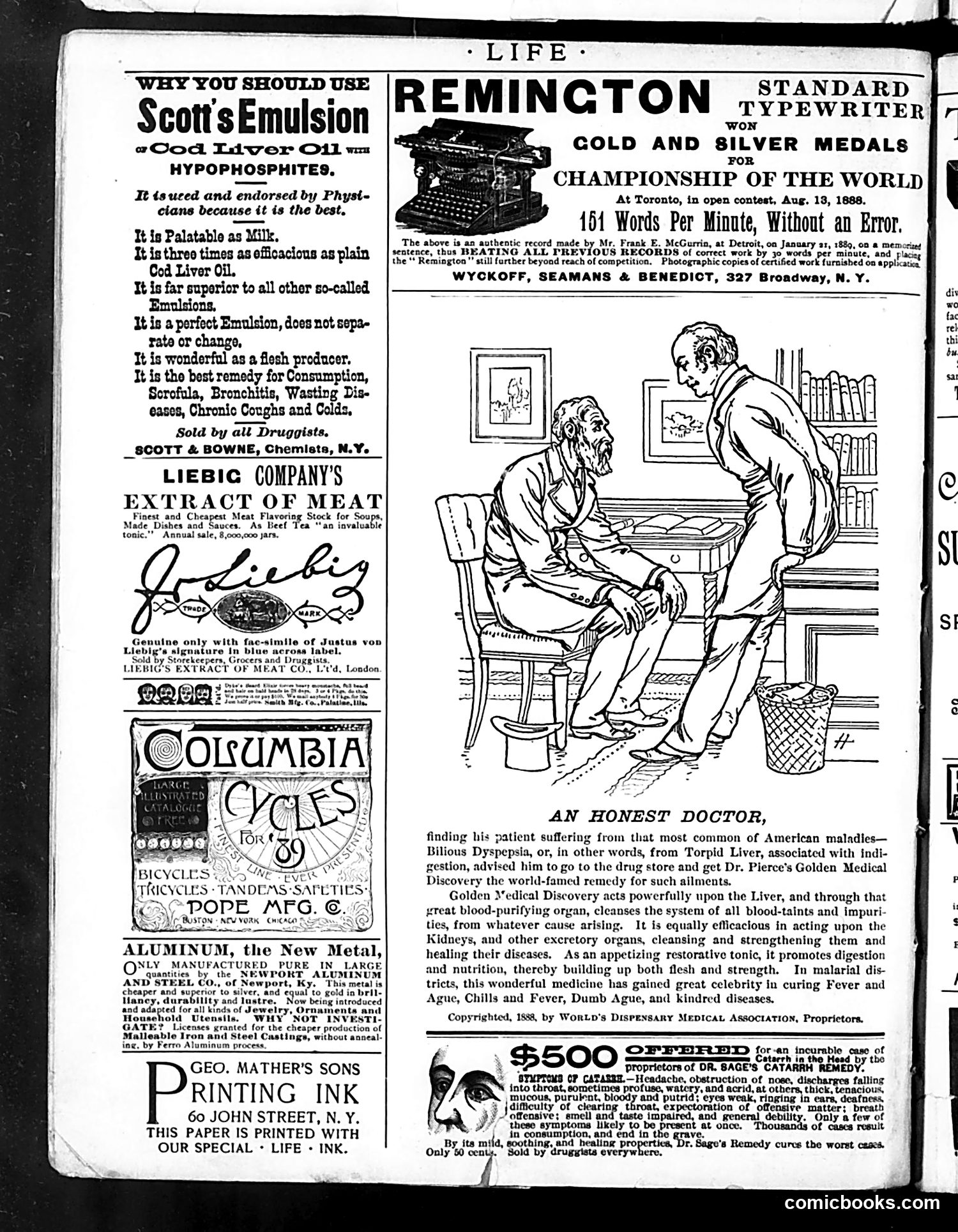
This page is primarily **advertisements** for patent medicines, but the central cartoon illustrates a satirical commentary on medical practice in 1888. The cartoon depicts a doctor advising a patient to purchase Dr. Pierce's Golden Medical Discovery from a drugstore rather than providing direct medical treatment himself. The satire mocks the era's endemic problem: doctors openly recommending commercially-available patent medicines, often with financial incentive or genuine belief in their efficacy. The accompanying text ironically titles the scene "An Honest Doctor," suggesting that steering patients toward patent remedies (rather than prescribing his own treatments or genuine medical care) represents unusual honesty in the profession. The irony is sharp: the patient with "Bilious Dyspepsia" and "Torpid Liver"—common complaints of the era—receives no actual examination or personalized care, only a commercial recommendation. This reflects Life's skepticism toward both the medical establishment and the unregulated patent medicine industry that flourished in the late 19th century.
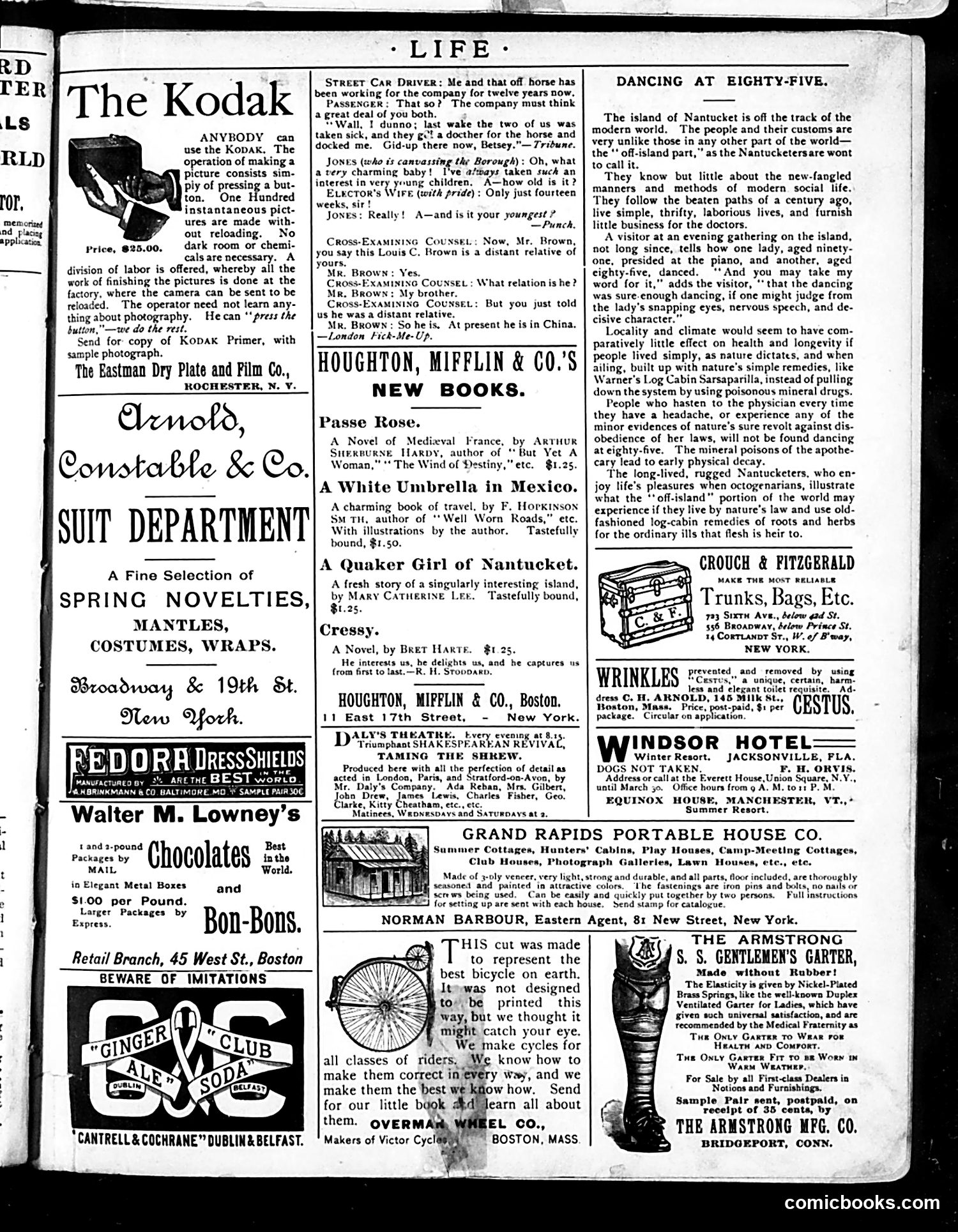
This is primarily an **advertising page** from Life magazine with minimal satirical content. The few jokes/cartoons present include: 1. **Street Car Driver anecdote**: A humorous complaint about class disparity—when both a driver and horse fell ill, the company hired a doctor for the horse but *docked the driver's pay*. The satire targets corporate callousness and the ironic valuation of animals over workers. 2. **Cross-examination dialogue**: A comedic legal exchange where a witness claims someone is a "distant relative," then admits he's his brother currently in China—absurdist humor about evasive testimony. 3. **"A Quaker Girl of Nantucket"**: The feature article celebrates the isolated, old-fashioned lifestyle of Nantucket residents, noting a 90-year-old woman and 85-year-old dancing together—gentle humor celebrating longevity and resistance to modern social conventions. The page is dominated by **book advertisements, department store promotions, chocolates, bicycles, and hotels**—typical period advertising rather than editorial satire.
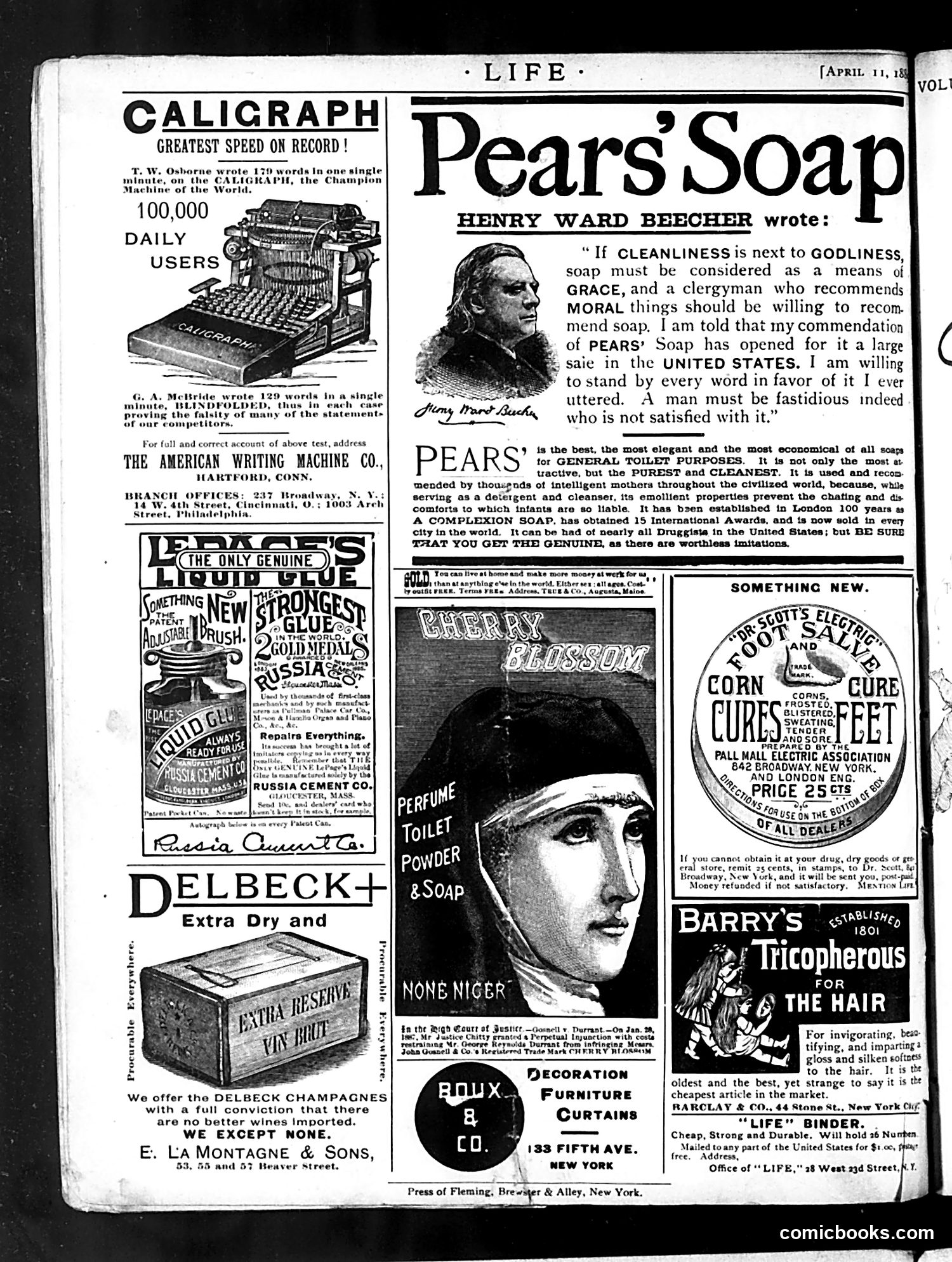
This page is primarily **advertising**, not political satire. It features product endorsements and commercial notices typical of 1880s publications. The notable content includes a **testimonial from Henry Ward Beecher** (a prominent Protestant clergyman) endorsing Pears' Soap. Beecher equates cleanliness with godliness, lending moral authority to the product—a common advertising strategy of the era. The text emphasizes the soap's purity, 100-year London history, and 15 international awards. Other advertisements include the Caligraph typewriter (claiming 100,000 daily users and speed records), Russia Cement, Delbeck Champagnes, Dr. Scott's foot salve, Barry's Tricopherous hair treatment, and furniture/curtain services. The page reflects **late Victorian consumer culture**, where religious figures and scientific claims legitimized commercial products. There is no political cartoon; the layout is standard period advertising.