
Life, 1889-04-11 · page 8 of 20
Life — April 11, 1889 — page 8: what you’re looking at
What you’re looking at
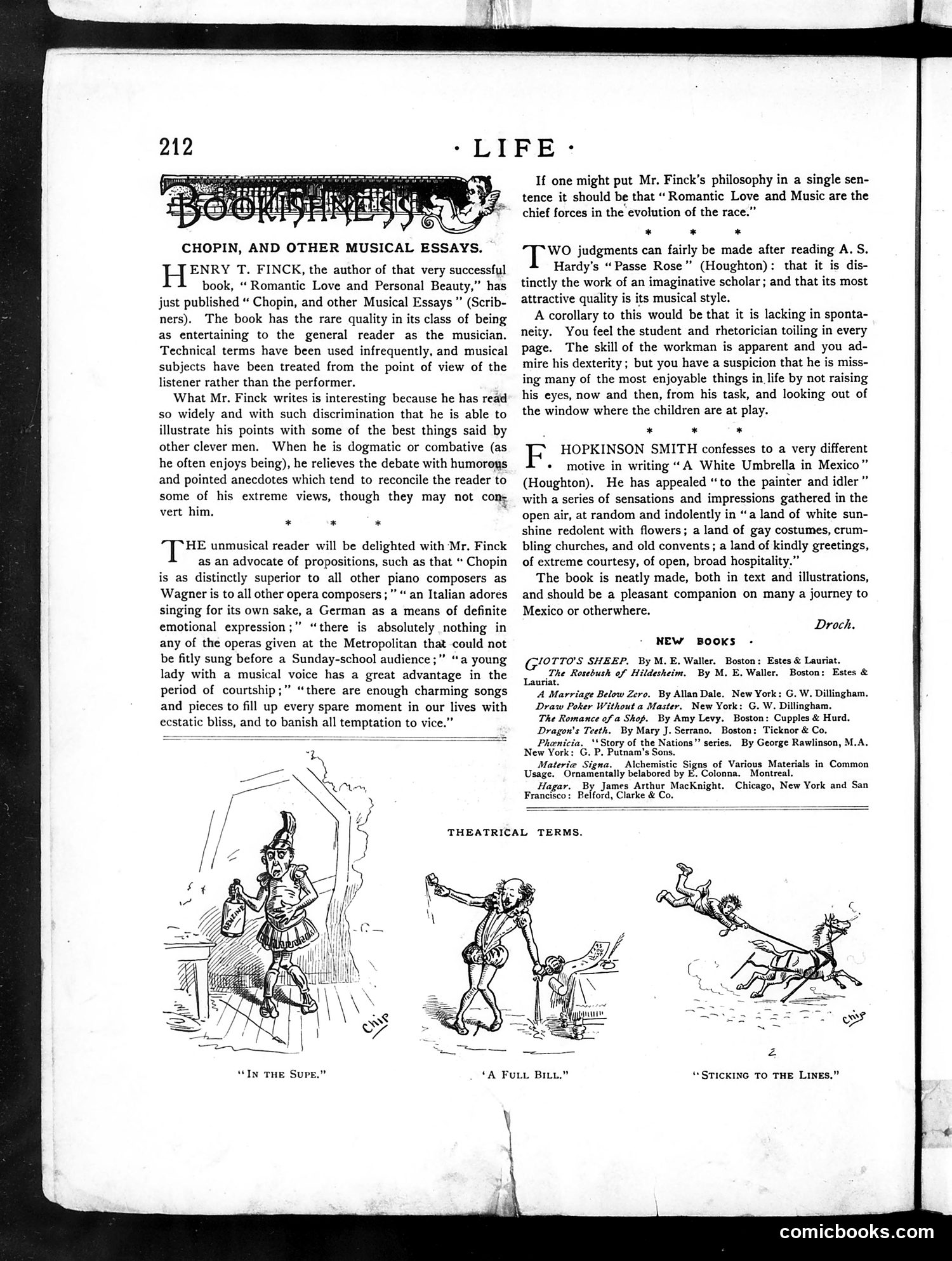
This page primarily contains **literary book reviews** rather than political cartoons. The main content discusses Henry T. Finck's essay collection on Chopin and romantic music, and F. Hopkinson Smith's travel writing about Mexico. The three small **theatrical cartoon sketches** at the bottom use stage terminology as visual puns: - **"In the Supes"** (supernumeraries/extras): Shows a soldier - **"A Full Bill"** (full theatrical program): Depicts acrobatic performers - **"Sticking to the Lines"** (theatrical script/blocking): Shows figures in exaggerated poses These are lighthearted wordplay jokes targeting theater audiences familiar with backstage terminology. The cartoons don't reference specific political figures or events—they're simply humorous visual gags playing on theatrical jargon.
📄 Transcribed text from this page (OCR, searchable)
Machine-transcribed from the original scan — historical spelling and the odd misread are preserved.
CHOPIN, AND OTHER MUSICAL ESSAYS. ENRY T. FINCK, the author of that very successful book, “ Romantic Love and Personal Beauty,” has just published “ Chopin, and other Musical Essays ” (Scrib- ners). The book has the rare quality in its class of being as entertaining to the general reader as the musician. Technical terms have been used infrequently, and musical subjects have been treated from the point of view of the listener rather than the performer. What Mr. Finck writes is interesting because he has read so widely and with such discrimination that he is able to illustrate his points with some of the best things said by other clever men. When he is dogmatic or combative (as he often enjoys being), he relieves the debate with humoroys and pointed anecdotes which tend to reconcile the reader to some of his extreme views, though they may not cons vert him. * * * i Rass unmusical reader will be delighted with Mr. Finck as an advocate of propositions, such as that “ Chopin is as distinctly superior to all other piano composers as Wagner is to all other opera composers ;" “ an Italian adores singing for its own sake, a German as a means of definite emotional expression ;” “there is absolutely nothing in any of the operas given at the Metropolitan that could not be fitly sung before a Sunday-school audience ;" “a young lady with a musical voice has a great advantage in the period of courtship;” “there are enough charming songs and pieces to fill up every spare moment in our lives with ecstatic bliss, and to banish all temptation to vice.” If one might put Mr. Finck’s philosophy in a single sen- tence it should be that “Romantic Love and Music are the chief forces in the evolution of the race.” * * * Exe judgments can fairly be made after reading A. S. Hardy's “Passe Rose” (Houghton): that it is dis- tinctly the work of an imaginative scholar ; and that its most attractive quality is its musical style. A corollary to this would be that it is lacking in sponta- neity. You feel the student and rhetorician toiling in every page. The skill of the workman is apparent and you ad- mire his dexterity ; but you have a suspicion that he is miss- ing many of the most enjoyable things in life by not raising his eyes, now and then, from his task, and looking out of the window where the children are at play. * * * HOPKINSON SMITH confesses to a very different * motive in writing “A White Umbrella in Mexico” (Houghton). He has appealed “to the painter and idler ” with a series of sensations and impressions gathered in the open air, at random and indolently in “a land of white sun- shine redolent with flowers; a land of gay costumes, crum- bling churches, and old convents ; a land of kindly greetings, of extreme courtesy, of open, broad hospitality.” The book is neatly made, both in text and illustrations, and should be a pleasant companion on many a journey to Mexico or otherwhere. Droch. NEW BOOKS - G/0TTO'S SHEEP. By M.E, Waller. Boston: Estes & Lauriat. The Rosebush of Hildesheim. By M. E. Waller. Boston: Estes & Lauriat. A Marriage Below Zero. By Allan Dale. New York: G. W. Dillingham. Draw Poker Without a Master. New York: G. W. Dillingham. The Romance of a Shop. By Amy Levy. Boston: Cupples & Hurd. Dragon's Teeth. By Mary J. Serrano, Boston: Ticknor & Co, icia, ‘Story of the Nations” series. By George Rawlinson, M.A. P. Putnam’s Sons. Materia Signa. Alchemistic Signs of Various Materials in Common Usage. Ornamentally belabored by E. Colonna, Montreal. Hogar. By James Arthur MacKnight, Chicago, New York and San Francisco: Belford, Clarke & Co. THEATRICAL TERMS. “IN THE Supe.” ‘A Fut BILL.” “STICKING TO THE LINES.” comicbooks.com