
Life, 1889-04-11 · page 6 of 20
Life — April 11, 1889 — page 6: what you’re looking at
What you’re looking at
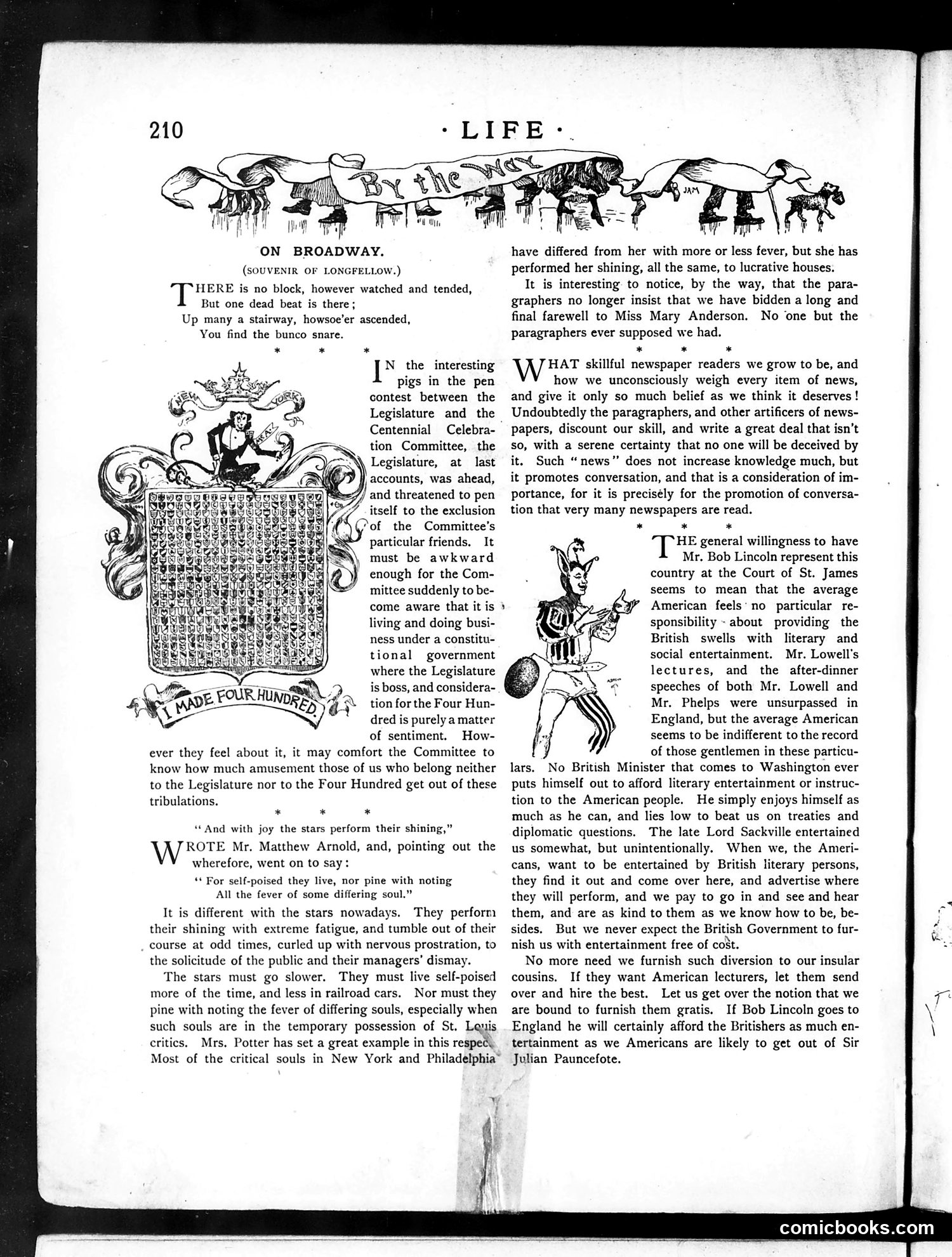
This page contains two distinct pieces: **"On Broadway"** (left) is a poem criticizing theatrical stars who perform with insufficient energy and emotional investment. It argues performers must maintain high standards despite fatigue, referencing the "solitude of the public" and audience expectations. **The main article** (right) discusses American expectations regarding British cultural entertainment and diplomacy. It appears to reference tensions over whether the British government should provide free literary entertainment to Americans, using figures like "Mr. Bob Lincoln" and "Mr. Lowell" (likely allusions to specific contemporary British/American diplomatic figures, though unclear precisely which). The satire critiques American entitlement regarding British cultural contributions while also ribbing British reluctance to provide gratis entertainment—a transatlantic cultural squabble of the period.
📄 Transcribed text from this page (OCR, searchable)
Machine-transcribed from the original scan — historical spelling and the odd misread are preserved.
ON BROADWAY. (SOUVENIR OF LONGFELLOW.) HERE is no block, however watched and tended, But one dead beat is there; Up many a stairway, howsoe’er ascended, You find the bunco snare. * * N the interesting pigs in the pen contest between the Legislature and the Centennial Celebra- tion Committee, the Legislature, at last accounts, was ahead, and threatened to pen itself to the exclusion of the Committee’s particular friends, It must be awkward enough for the Com- mittee suddenly to be- come aware that it is living and doing busi- ness under a constitu- tional government where the Legislature is boss, and considera- tion for the Four Hun- dred is purely a matter of sentiment. How- ever they feel about it, it may comfort the Committee to know how much amusement those of us who belong neither to the Legislature nor to the Four Hundred get out of these tribulations. NCCES, SHEE NEHER ED es * * * ‘And with joy the stars perform their shining,” ROTE Mr. Matthew Arnold, and, pointing out the wherefore, went on to say: “* For self-poised they live, nor pine with noting All the fever of some differing soul.” It is different with the stars nowadays. They perform their shining with extreme fatigue, and tumble out of their course at odd times, curled up with nervous prostration, to the solicitude of the public and their managers’ dismay. The stars must go slower. They must live self-poised more of the time, and less in railroad cars. Nor must they pine with noting the fever of differing souls, especially when such souls are in the temporary possession of St. Louis critics. Mrs. Potter has set a great example in this respec. Most of the critical souls in New York and Philadelphia” have differed from her with more or less fever, but she has performed her shining, all the same, to lucrative houses. It is interesting to notice, by the way, that the para- graphers no longer insist that we have bidden a long and final farewell to Miss Mary Anderson. No one but the paragraphers ever supposed we had. * * * HAT skillful newspaper readers we grow to be, and how we unconsciously weigh every item of news, and give it only so much belief as we think it deserves! Undoubtedly the paragraphers, and other artificers of news- papers, discount our skill, and write a great deal that isn’t so, with a serene certainty that no one will be deceived by it. Such “news” does not increase knowledge much, but it promotes conversation, and that is a consideration of im- portance, for it is precisély for the promotion of conversa- tion that very many newspapers are read. * * * HE general willingness to have Mr. Bob Lincoln represent this country at the Court of St. James seems to mean that the average American feels‘ no particular re- sponsibility - about providing the British swells with literary and social entertainment. Mr. Lowell's lectures, and the after-dinner speeches of both Mr. Lowell and Mr. Phelps were unsurpassed in England, but the average American seems to be indifferent to the record of those gentlemen in these particu- lars. No British Minister that comes to Washington ever puts himself out to afford literary entertainment or instruc- tion to the American people. He simply enjoys himself as much as he can, and lies low to beat us on treaties and diplomatic questions. The late Lord Sackville entertained us somewhat, but unintentionally. When we, the Ameri- cans, want to be entertained by British literary persons, they find it out and come over here, and advertise where they will perform, and we pay to go in and see and hear them, and are as kind to them as we know how to be, be- sides. But we never expect the British Government to fur- nish us with entertainment free of cost. No more need we furnish such diversion to our insular cousins. If they want American lecturers, let them send over and hire the best. Let us get over the notion that we are bound to furnish them gratis. If Bob Lincoln goes to England he will certainly afford the Britishers as much en- tertainment as we Americans are likely to get out of Sir Julian Pauncefote. comicbooks.com