
Life, 1889-04-11 · page 4 of 20
Life — April 11, 1889 — page 4: what you’re looking at
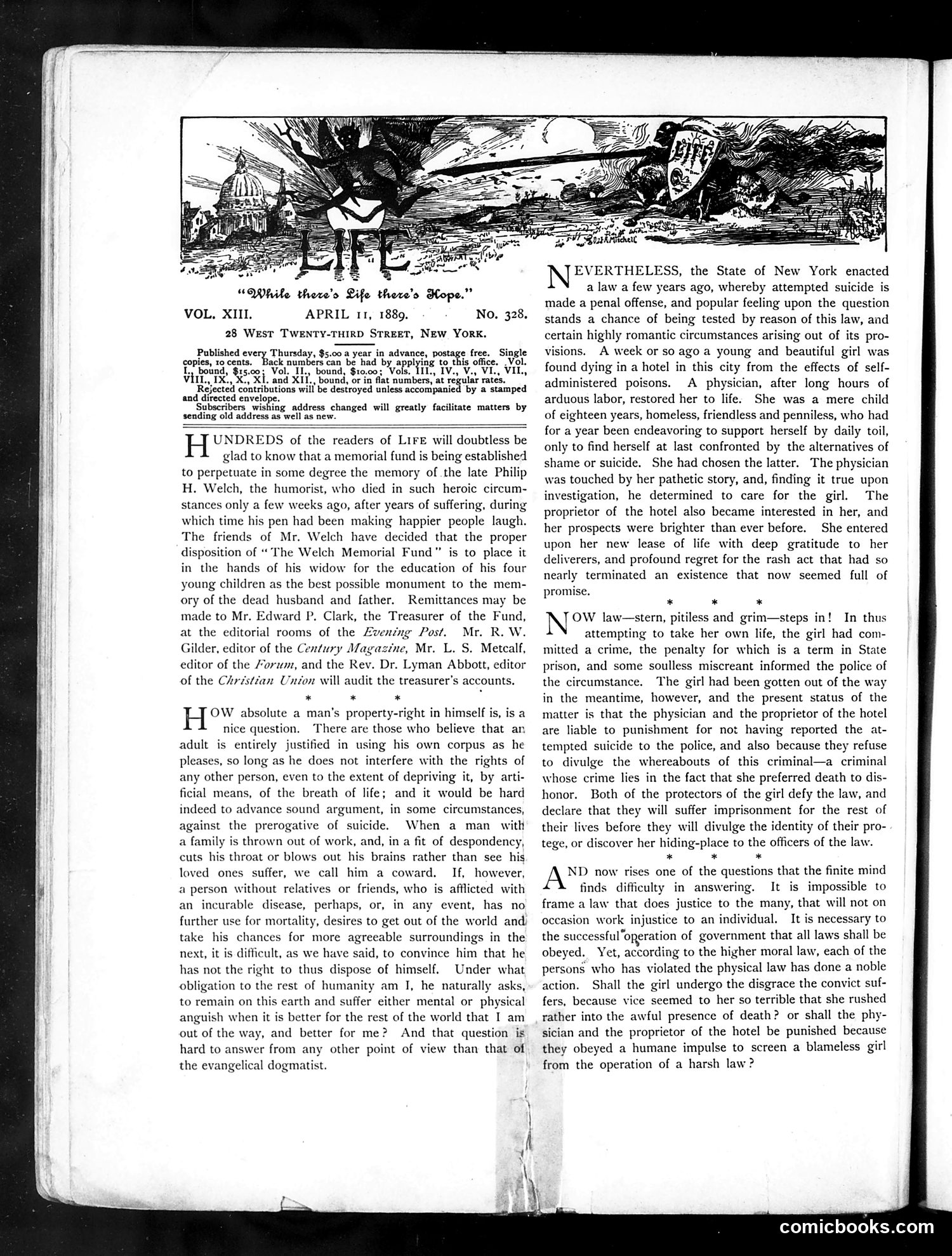
What you’re looking at
The page contains two editorial sections debating New York State's attempted-suicide law rather than a political cartoon. The masthead illustration depicts a large tree with figures beneath it and classical architectural elements (a domed building, possibly representing government), alongside the motto "While there's Life there's Hope." The articles discuss a case of a young woman found dying from self-administered poison in a hotel. The debate centers on whether the physician and hotel proprietor should face legal punishment for failing to report the suicide attempt to police. The satire critiques the law's harshness: should rescuers be criminalized for saving lives? The pieces wrestle with competing values—legal obligation versus humanitarian compassion—exposing the tension between rigid law and moral justice.
📄 Transcribed text from this page (OCR, searchable)
Machine-transcribed from the original scan — historical spelling and the odd misread are preserved.
“Mhile there's Life there’s Hop VOL. XIII. APRIL 11, 1889. No. 328. 28 West TWENTY-THIRD STREET, NEW YorK. Thursday, $5.00 a year in advance, postage free. Single gopies, ro cents. "Back numbers can be had by applying to this ofice. Vol L, bound, $15.00; Vol. II., bound, $10.00; Vols. III., IV., V., VI., VIL, viIL, IX., X., XL and XIT7., bound, or in flat numbers, at regular rates. Rejected contributions will be destroyed unless accompanied by a stamped and directed envelope. subscribers wishing address changed will greatly facilitate matters by sending old address as well as new. Published eve UNDREDS of the readers of Lire will doubtless be glad to know that a memorial fund is being established to perpetuate in some degree the memory of the late Philip H. Welch, the humorist, who died in such heroic circum- stances only a few weeks ago, after years of suffering, during which time his pen had been making happier people laugh. The friends of Mr. Welch have decided that the proper disposition of The Welch Memorial Fund” is to place it in the hands of his widow for the education of his four young children as the best possible monument to the mem- ory of the dead husband and father. Remittances may be made to Mr. Edward P. Clark, the Treasurer of the Fund, at the editorial rooms of the ening Post. Mr. R.W. Gilder, editor of the Century Magazine, Mr. L. S. Metcalf, editor of the /orwm, and the Rev. Dr. Lyman Abbott, editor of the Chréstéan Un/on will audit the treasurer's accounts. * * * . H absolute a man's property-right in himself is, is a nice question. There are those who believe that an adult is entirely justified in using his own corpus as he pleases, so long as he does not interfere with the rights of any other person, even to the extent of depriving it, by arti- ficial means, of the breath of life; and it would be hard indeed to advance sound argument, in some circumstances, against the prerogative of suicide. When a with a family is thrown out of work, and, in a fit of despondency, cuts his throat or blows out his brains rather than see his loved ones suffer, we call him a coward. If, a person without relatives or friends, who is afflicted with an incurable disease, perhaps, or, in any event, has no further use for mortality, desires to get out of the world and take his chances for more agreeable surroundings in the next, it is difficult, as we have said, to convince him that he has not the right to thus dispose of himself. Under what obligation to the rest of humanity am I, he naturally asks, man however, to remain on this earth and suffer either mental or physical anguish when it is better for the rest of the world that I am out of the way, and better for me? And that question is hard to answer from any other point of view than that of the evangelical dogmatist. EVERTHELESS, the State of New York enacted a law a few years ago, whereby attempted suicide is made a penal offense, and popular feeling upon the question stands a chance of being tested by reason of this law, and certain highly romantic circumstances arising out of its pro- visions. A week or so ago a young and beautiful girl was found dying in a hotel in this city from the effects of self- administered poisons. A physician, after long hours of arduous labor, restored her to life. She was a mere child of eighteen years, homeless, friendless and penniless, who had for a year been endeavoring to support herself by daily toil, only to find herself at last confronted by the alternatives of shame or suicide. She had chosen the latter. The physician was touched by her pathetic story, and, finding it true upon investigation, he determined to care for the girl. The proprietor of the hotel also became interested in her, and her prospects were brighter than ever before. She entered upon her new lease of life with deep gratitude to her deliverers, and profound regret for the rash act that had so nearly terminated an existence that now seemed full of promise. * * * J OW law—stern, pitiless and grim—steps in! In thus ‘attempting to take her own life, the girl had com- mitted a crime, the penalty for which is a term in State prison, and some soulless miscreant informed the police of the circumstance. The girl had been gotten out of the way in the meantime, however, and the present status of the matter is that the physician and the proprietor of the hotel are liable to punishment for not having reported the at- tempted suicide to the police, and also because they refuse to divulge the whereabouts of this criminal—a criminal whose crime lies in the fact that she preferred death to dis- honor. Both of the protectors of the girl defy the law, and declare that they will suffer imprisonment for the rest of their lives before they will divulge the identity of their pro- tege, or discover her hiding-place to the officers of the law. * * * A™ now rises one of the questions that the finite mind finds difficulty in answering. It is impossible to frame a law that does justice to the many, that will not on occasion work injustice to an individual. It is necessary to the successful “operation of government that all laws shall be obeyed. Yet, according to the higher moral law, each of the persons who has violated the physical law has done a noble action. Shall the girl undergo the disgrace the convict suf- fers, because vice seemed to her so terrible that she rushed rather into the awful presence of death? or shall the phy- sician and the proprietor of the hotel be punished because they obeyed a humane impulse to screen a blameless girl from the operation of a harsh law ? comicbooks.com