
Life, 1889-04-11 · page 12 of 20
Life — April 11, 1889 — page 12: what you’re looking at
What you’re looking at
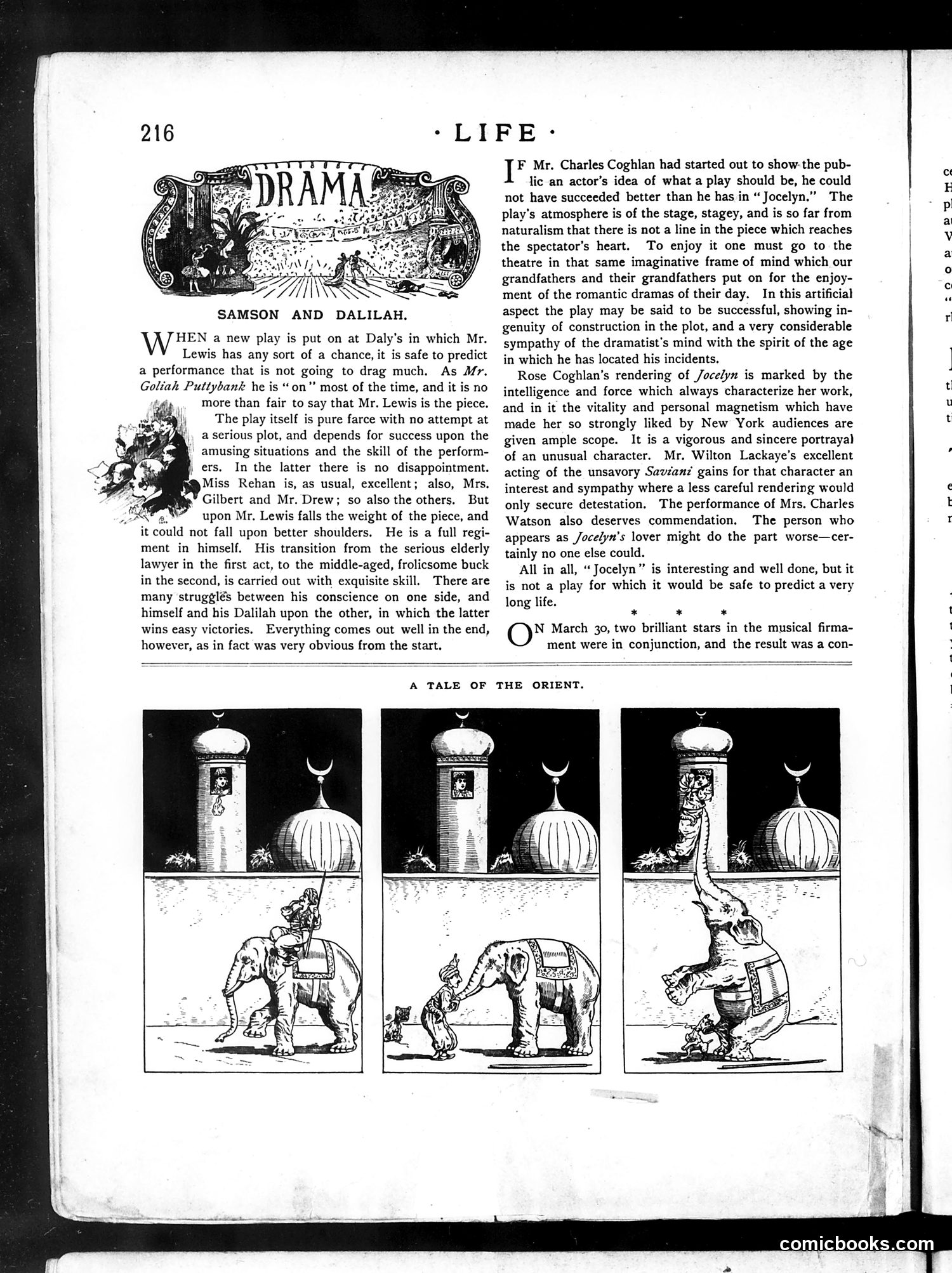
This page reviews theatrical performances from what appears to be the 1880s-90s. The top section praises actor Mr. Lewis in "Samson and Dalilah" at Daly's Theatre, noting his comedic skill carries the "pure farce" despite weak plot. The text commends supporting actresses Miss Rehan and Mrs. Gilbert. Below, critic reviews Charles Coghlan in "Jocelyn," noting its deliberately artificial, old-fashioned staginess—designed for audiences who enjoy romantic melodrama rather than naturalistic theater. Rose Coghlan (likely Charles's wife) receives praise for her vital performance, as does actor Wilton Lackaye for bringing sympathy to an otherwise unsavory character. The reviewer predicts "Jocelyn" won't have lasting success despite competent execution. The three illustrations labeled "A Tale of the Orient" depict elephants with ornate howdahs (ceremonial platforms) and minaret-style towers—likely visual commentary, though its satirical target is unclear from this page alone.
📄 Transcribed text from this page (OCR, searchable)
Machine-transcribed from the original scan — historical spelling and the odd misread are preserved.
> LIFE: SAMSON AND DALILAH. HEN a new play is put on at Daly's in which Mr. Lewis has any sort of a chance, it is safe to predict a performance that is not going to drag much. As Mr. Goliah Puttybank he is “on” most of the time, and it is no more than fair to say that Mr. Lewis is the piece. The play itself is pure farce with no attempt at a serious plot, and depends for success upon the amusing situations and the skill of the perform- ) ers. In the latter there is no disappointment. Miss Rehan is, as usual, excellent; also, Mrs. Sip Gilbert and Mr. Drew; so also the others. But AAT ag: upon Mr. Lewis falls the weight of the piece, and it could not fall upon better shoulders. He is a full regi- ment in himself. His transition from the serious elderly lawyer in the first act, to the middle-aged, frolicsome buck in the second, is carried out with exquisite skill. There are many strugglés between his conscience on one side, and himself and his Dalilah upon the other, in which the latter wins easy victories. Everything comes out well in the end, however, as in fact was very obvious from the start. F Mr. Charles Coghlan had started out to show-the pub- lic an actor’s idea of what a play should be, he could not have succeeded better than he has in “Jocelyn.” The play's atmosphere is of the stage, stagey, and is so far from naturalism that there is not a line in the piece which reaches the spectator’s heart. To enjoy it one must go to the theatre in that same imaginative frame of mind which our grandfathers and their grandfathers put on for the enjoy- ment of the romantic dramas of their day. In this artificial aspect the play may be said to be successful, showing in- genuity of construction in the plot, and a very considerable sympathy of the dramatist’s mind with the spirit of the age in which he has located his incidents. Rose Coghlan’s rendering of Jocelyn is marked by the intelligence and force which always characterize her work, and in it the vitality and personal magnetism which have made her so strongly liked by New York audiences are given ample scope. It is a vigorous and sincere portrayal of an unusual character. Mr. Wilton Lackaye’s excellent acting of the unsavory Savéanz gains for that character an interest and sympathy where a less careful rendering would only secure detestation. The performance of Mrs. Charles Watson also deserves commendation. The person who appears as Jocelyn’s lover might do the part worse—cer- tainly no one else could. All in all, “Jocelyn” is interesting and well done, but it is not a play for which it would be safe to predict a very life. long life. * * . N March 30, two brilliant stars in the musical firma- ment were in conjunction, and the result was a con- A TALE OF THE ORIENT. re ae