
A complete issue · 14 pages · 1888
Life — September 27, 1888
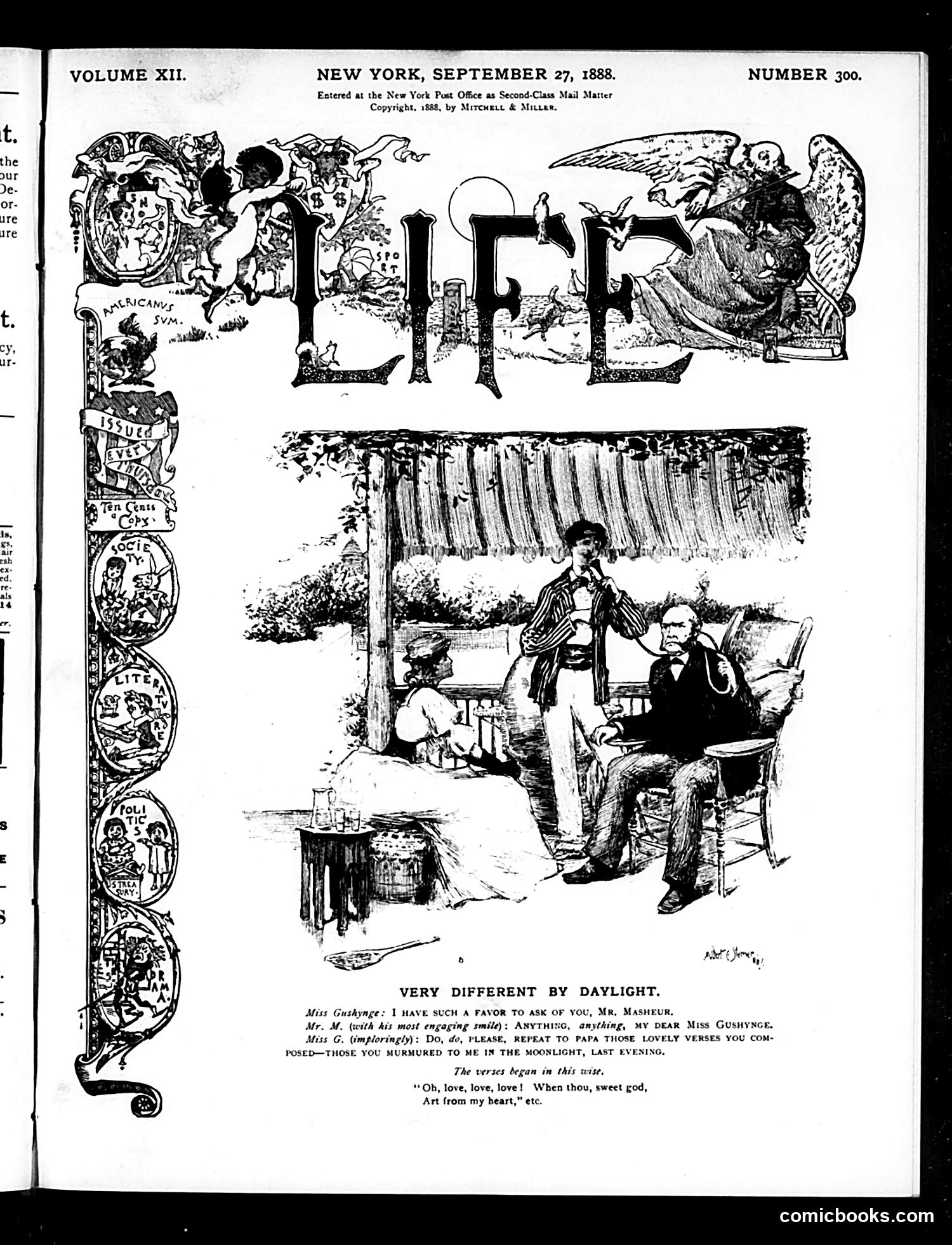
This satirical cartoon depicts a social comedy about courtship and deception. The scene shows three figures beneath a pergola: a young woman (Miss Gushynge) stands between two men—one seated and one standing—in what appears to be a daytime garden setting. The title and dialogue suggest a contrast between nighttime romance and daytime reality. Miss Gushynge asks Mr. Masher to repeat "lovely verses" he allegedly composed for her "in the moonlight, last evening," while an impatient older man (likely her father) sits nearby. The joke satirizes the gap between romantic pretense and daylight truth—suggesting the verses were either fabricated or seem far less charming in daylight. It mocks both the suitor's poetic affectations and the young woman's gullibility regarding moonlit romance.
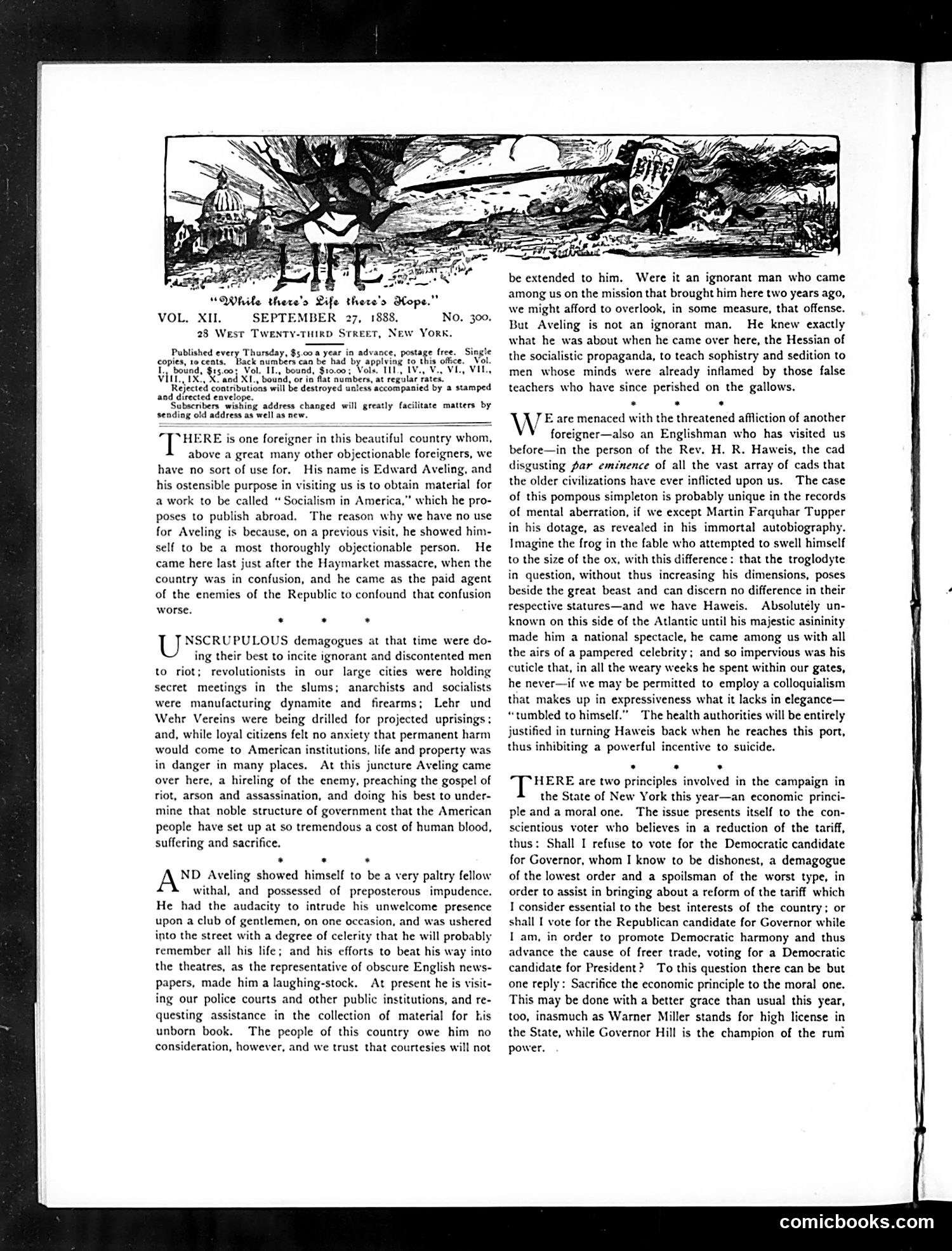
The small cartoon at the top depicts a figure labeled "Where there's a will there's a way," likely satirizing a political figure of the moment, though the specific identity is unclear from the image alone. The main text discusses a foreigner named Aveling visiting America to promote socialism. The article criticizes him as an "ignorant man" and "objectionable person" who came after the Haymarket massacre (1886) to spread socialist propaganda. The piece then pivots to New York state politics, debating whether voters should support a Democratic or Republican gubernatorial candidate based on moral principles versus economic policy—specifically mentioning positions on free trade and alcohol ("rum power"). The satire targets both foreign radical agitators and domestic political compromise.
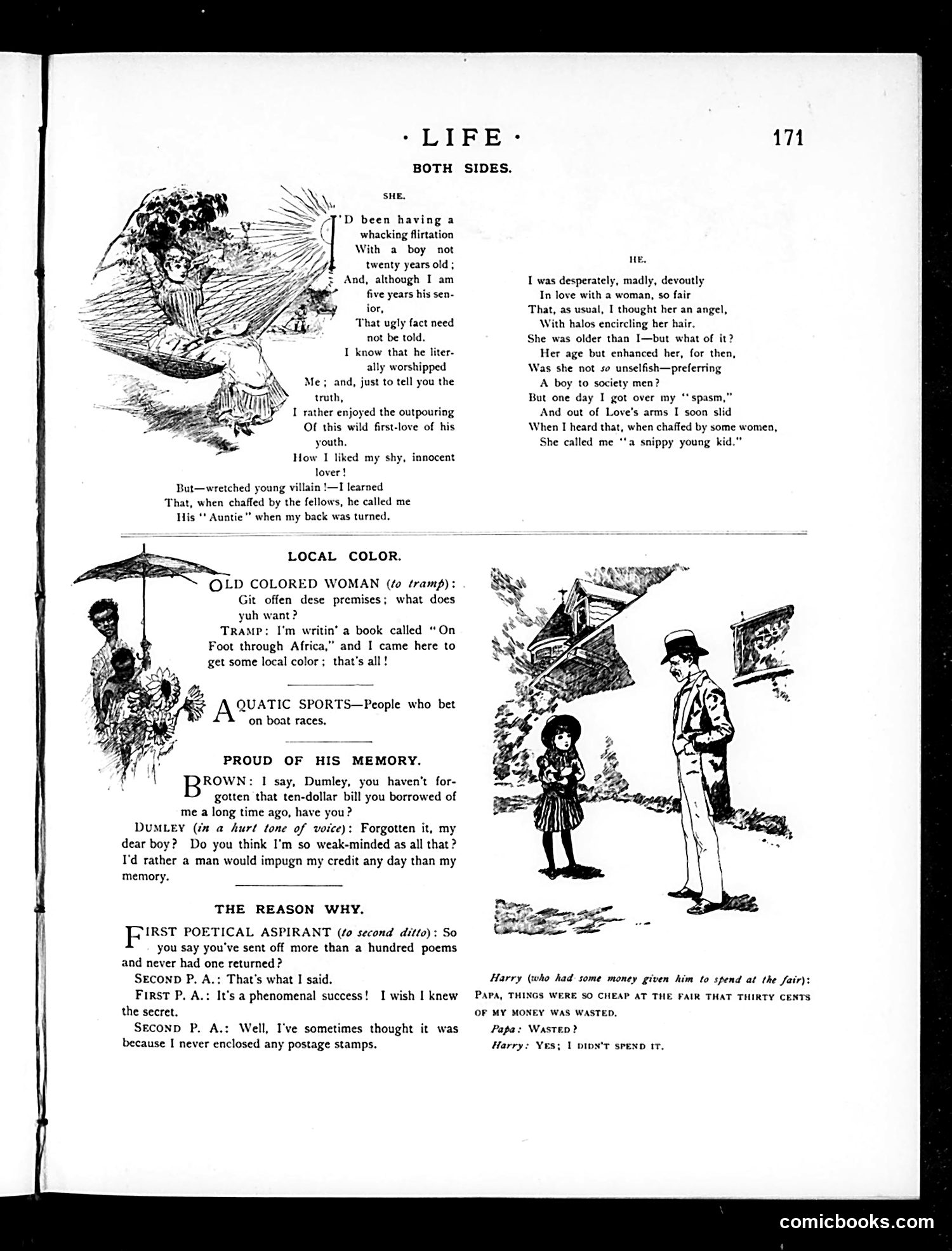
This page contains satirical humor pieces rather than political cartoons. The content includes: **"Both Sides"**: A romantic dialogue where a woman admits to a youthful flirtation with a boy, while the man reveals he was infatuated with an older woman. The humor plays on gender double standards and romantic hypocrisy. **"Local Color"**: A brief joke about an old colored woman seeking "local color" for a book called "On Foot through Africa." **"Proud of His Memory"**: A joke about Dumley denying he forgot a ten-dollar debt, claiming he'd "rather a man would impugn my credit any day than my memory." **"The Reason Why"**: A dialogue mocking a poet who sent over a hundred poems but never had one returned—the punchline being he never included postage stamps. The illustrations are simple line drawings accompanying these jokes.
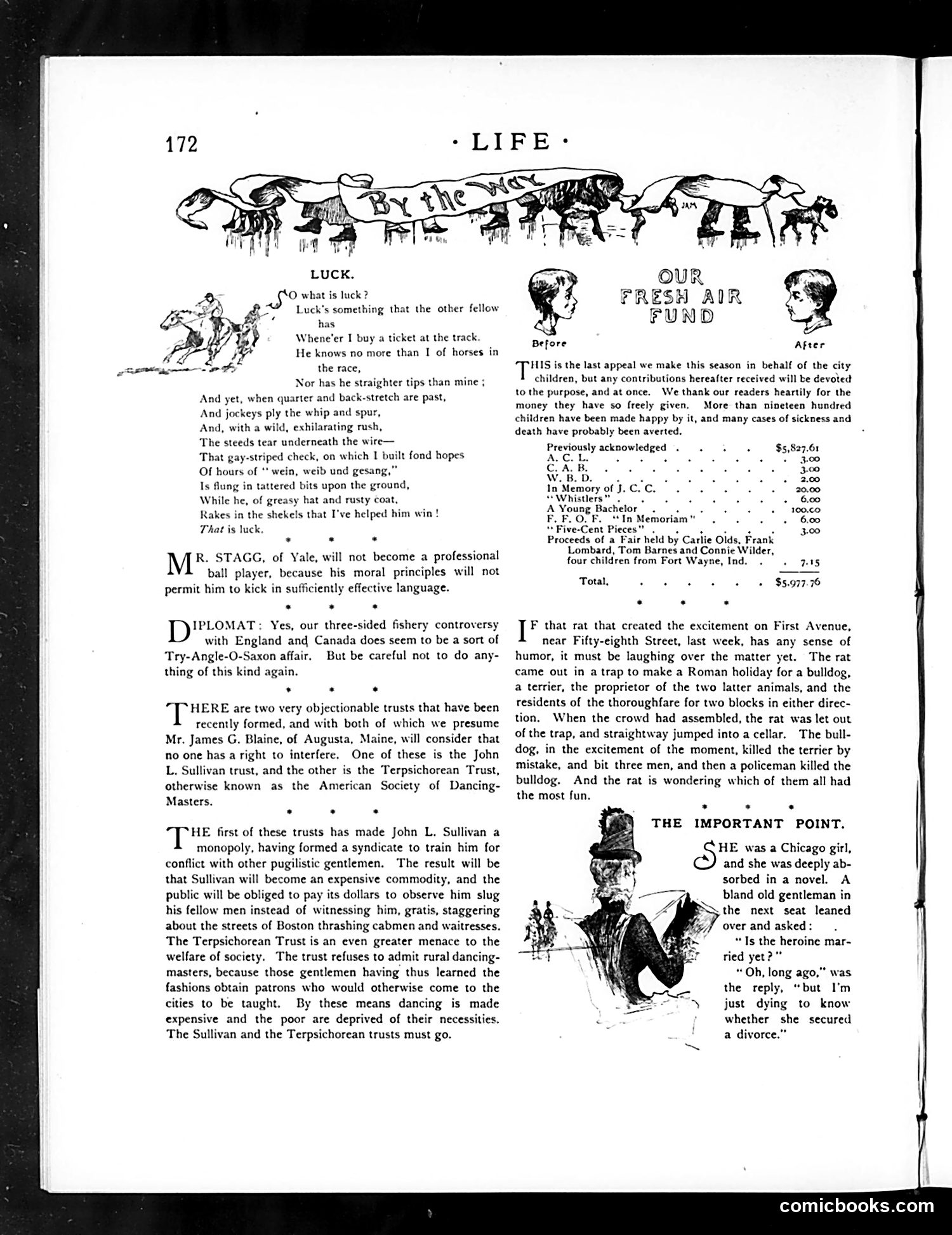
This page contains several satirical pieces typical of early 20th-century Life magazine: **"Luck"** - A poem mocking horse-racing gambling, suggesting luck favors those with insider knowledge rather than honest effort. **Mr. Stagg of Yale** - Brief criticism of a Yale official who refuses to adopt stronger moral language principles for ball players. **The Diplomat** - Commentary on Anglo-Canadian fishery disputes, warning against escalating conflicts. **Trust Criticism** - Two lengthy paragraphs attacking the John L. Sullivan boxing trust and the Terpsichorean (dancing) trust, arguing these monopolies harm public welfare by making entertainment expensive and inaccessible to poor people. **"The Important Point"** - A short anecdote about a Chicago woman absorbed in a novel, whose primary concern about the heroine is whether she obtained a divorce—reflecting contemporary social anxieties about marriage and women's independence. The page exemplifies progressive-era social criticism common to Life.
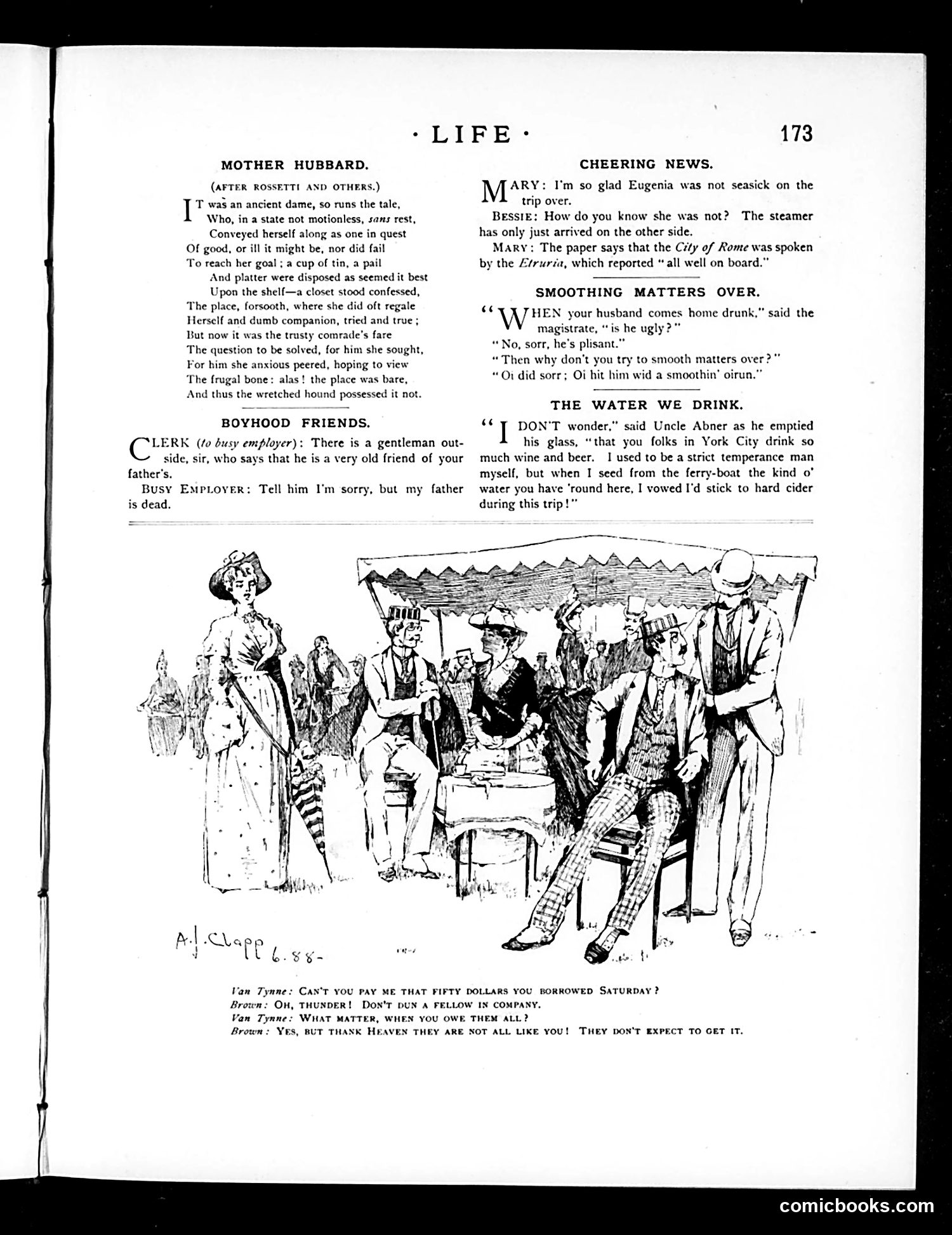
This page contains several short humorous pieces typical of Life's satirical content. The main cartoon depicts a seaside or beach scene with well-dressed figures in conversation under an awning. The jokes address everyday social situations: a wife questioning her drunk husband's appearance ("is he ugly?"), advice about smoothing over marital conflicts, and Uncle Abner's observations about drinking water quality in York City versus his preference for cider. The cartoon's caption focuses on a character named Tynne borrowing fifty dollars on Saturday, with Brown responding that people shouldn't expect repayment—a commentary on casual lending practices and financial irresponsibility among acquaintances. The humor targets middle-class domestic life, marriage dynamics, and social pretensions of the era.
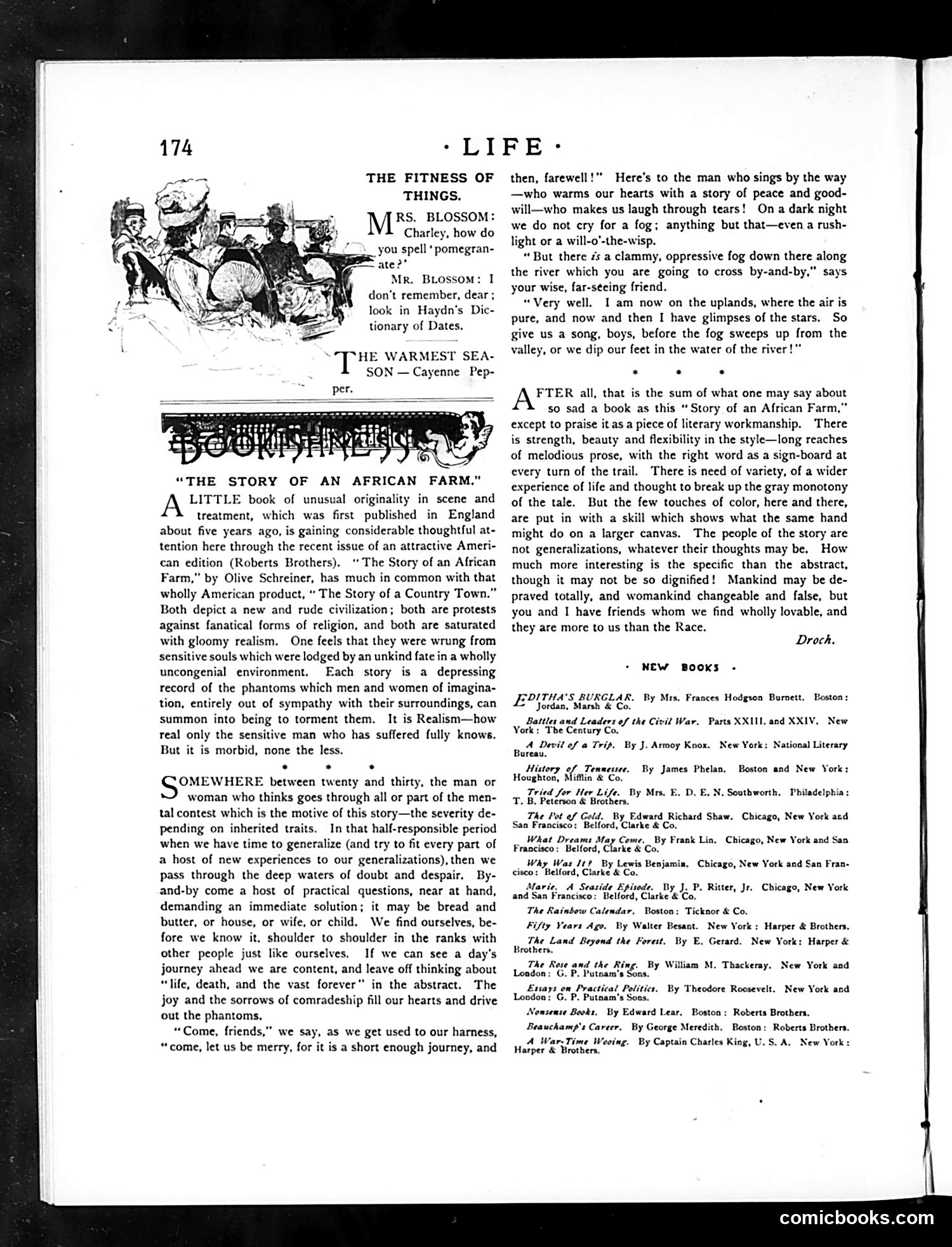
The page features two sections: **Top cartoon:** Titled "The Fitness of Things," this depicts a dialogue between Mrs. Blossom and Mr. Blossom about pomegranates and Haydn's Dictionary of Dates. The humor appears domestic and wordplay-based rather than overtly political—likely a gentle satire on marriage dynamics or pretentious household knowledge. **Main content:** A literary review of "The Story of an African Farm" by Olive Schreiner, praising its artistic merit while acknowledging its gloomy realism and social commentary. The reviewer notes the book critiques religious dogmatism and social hypocrisy, commending its psychological depth despite some stylistic limitations. The page is primarily **book review and literary criticism**, with advertising below. The cartoon's satire appears domestic rather than political.
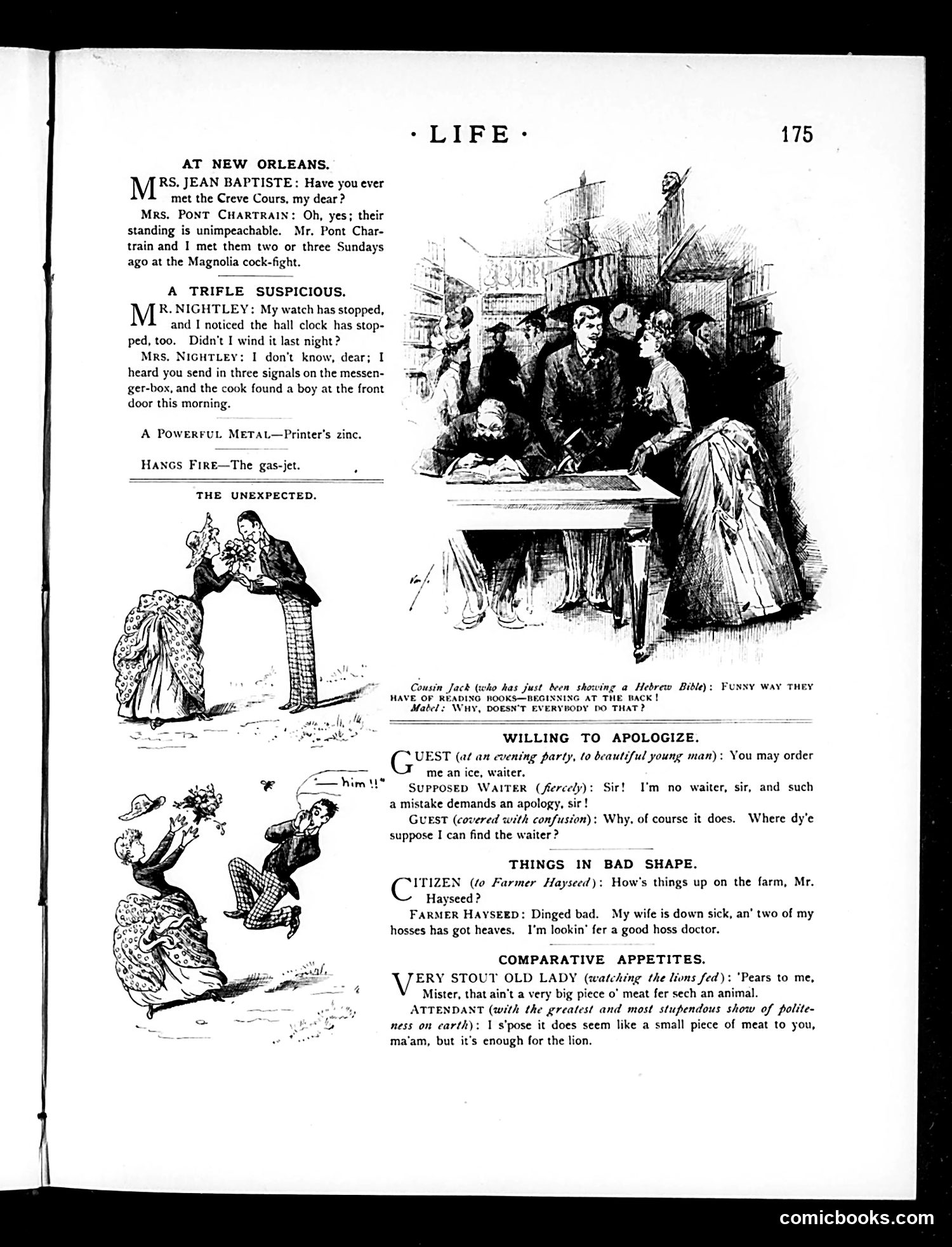
This page contains several short humorous anecdotes and accompanying sketches, typical of Life's satirical format. **"At New Orleans"** references the Creve Cours, apparently a notable social group whose standing was unimpeachable—a joke about social pretension. **"A Trifle Suspicious"** plays on domestic miscommunication: a wife misinterprets her husband's watch-stopping and messenger-boy signals as suspicious behavior. **"Willing to Apologize"** satirizes a waiter's refusal to take responsibility, deflecting blame onto his position. **"Things in Bad Shape"** and **"Comparative Appetites"** are brief, straightforward jokes about farming troubles and a lion's small meal portion. The sketches are crude, expressive line-drawings typical of period humor magazines. Overall, this page showcases everyday social absurdities and class-based humor rather than specific political content.
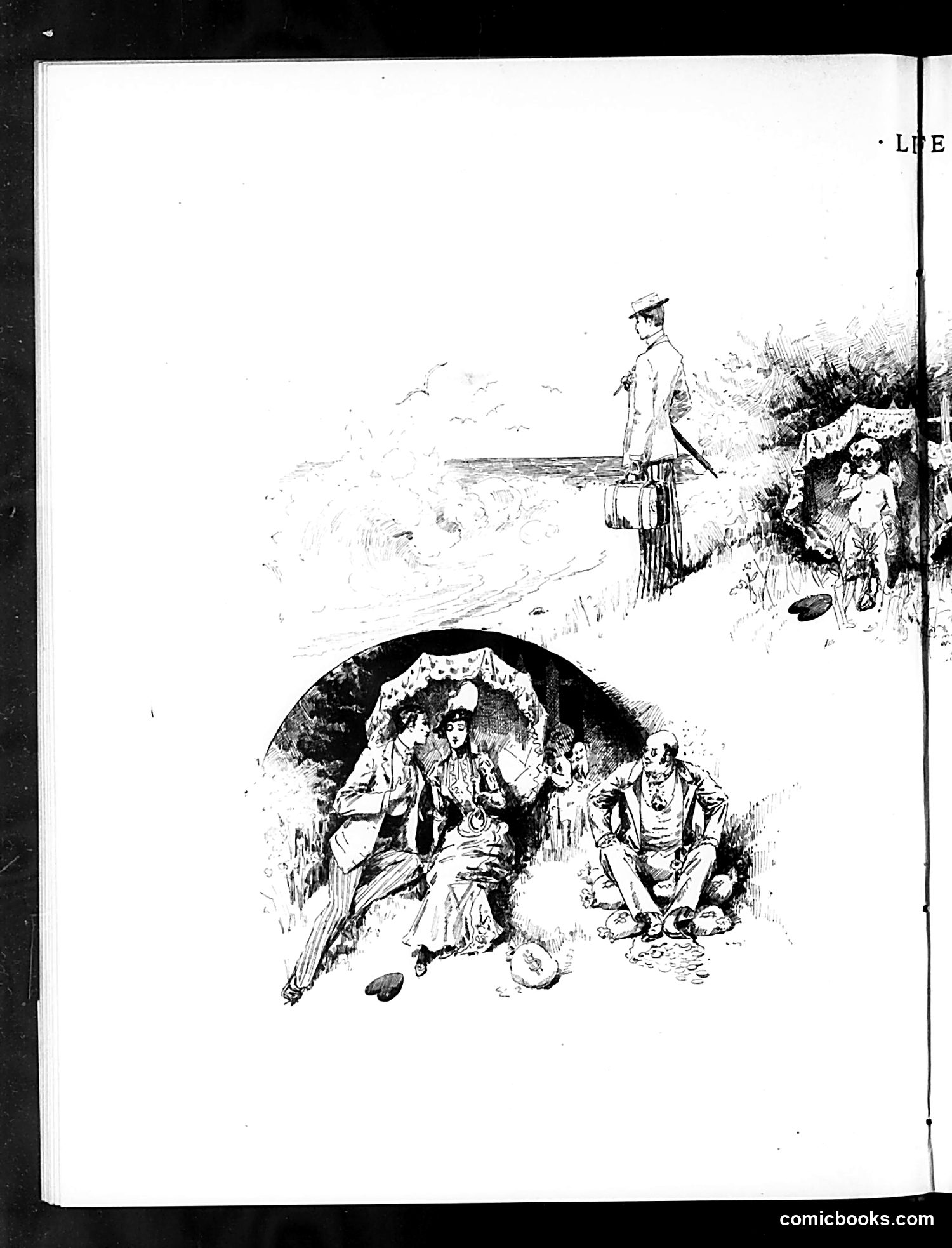
This appears to be a single illustration from *Life* magazine showing a beach or seaside scene with social satire. The image depicts two distinct groups: **Lower section**: A family huddled under a large umbrella during what appears to be poor weather, suggesting they're determined beach-goers enduring unpleasant conditions. **Upper section**: Figures on a hill, including someone with a walking stick observing the scene below. The satire likely mocks the stubbornness or desperation of beachgoers who persist in their seaside leisure despite bad weather—a commentary on social conventions or class behavior. The contrast between the struggling family below and the observer above suggests irony about vacation expectations versus reality, or possibly class differences in leisure pursuits. Without visible captions or dates, the specific historical context remains unclear, though the artistic style suggests early-to-mid 20th century.
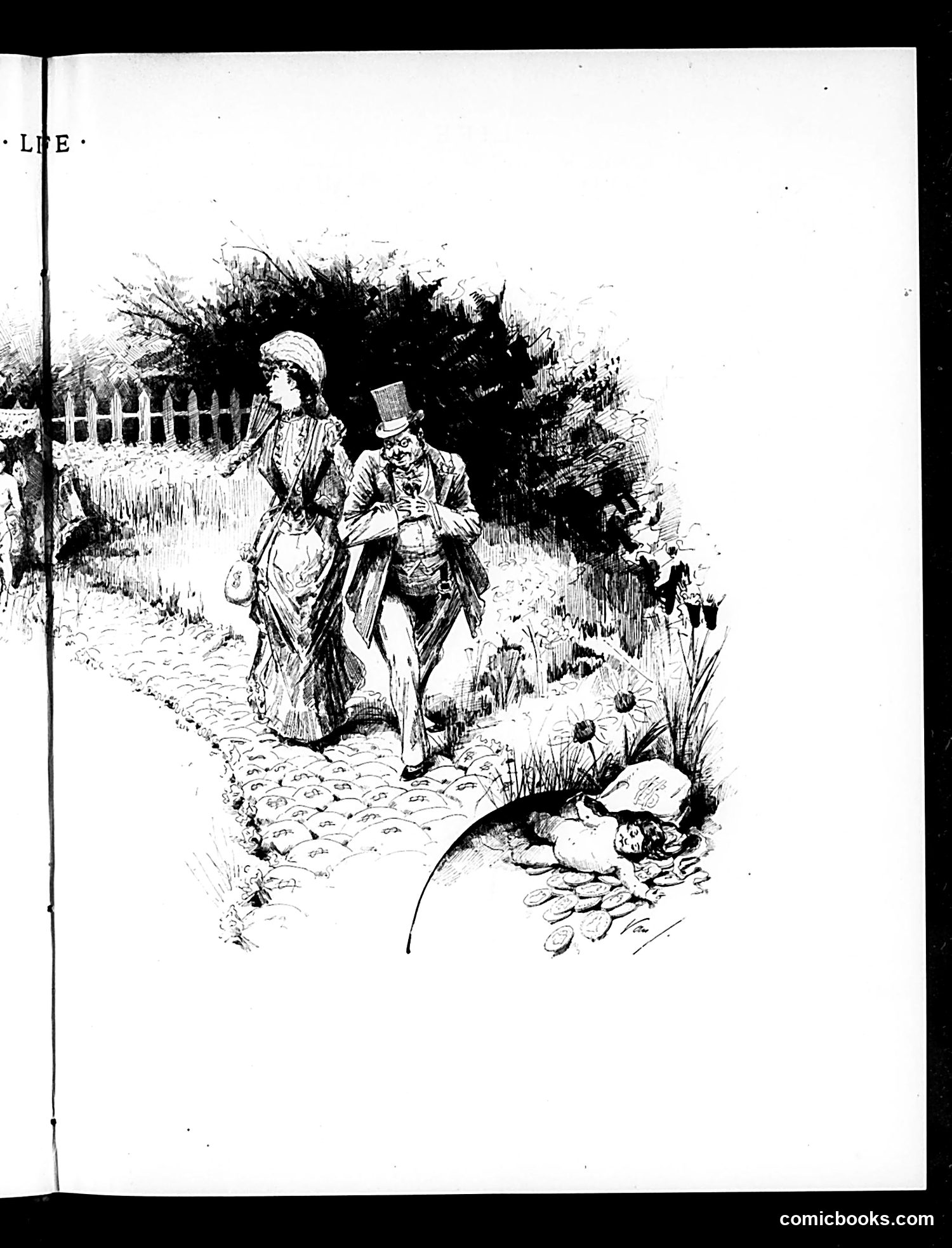
This page from *Life* magazine shows a satirical illustration featuring two well-dressed figures—a man in a top hat and a woman in period clothing—walking past what appears to be a dead or injured person lying by the roadside near a fence and flowers. The cartoon likely satirizes **indifference to poverty or social suffering** among the wealthy and well-to-do classes. The contrast between the elegantly dressed, apparently oblivious couple and the unfortunate person at roadside suggests social commentary on class inequality and the callousness of the privileged toward those in need. Without visible captions or clearer context, the specific political event or figure being critiqued remains unclear, but the moral message about selective blindness to human hardship is evident in the composition itself.
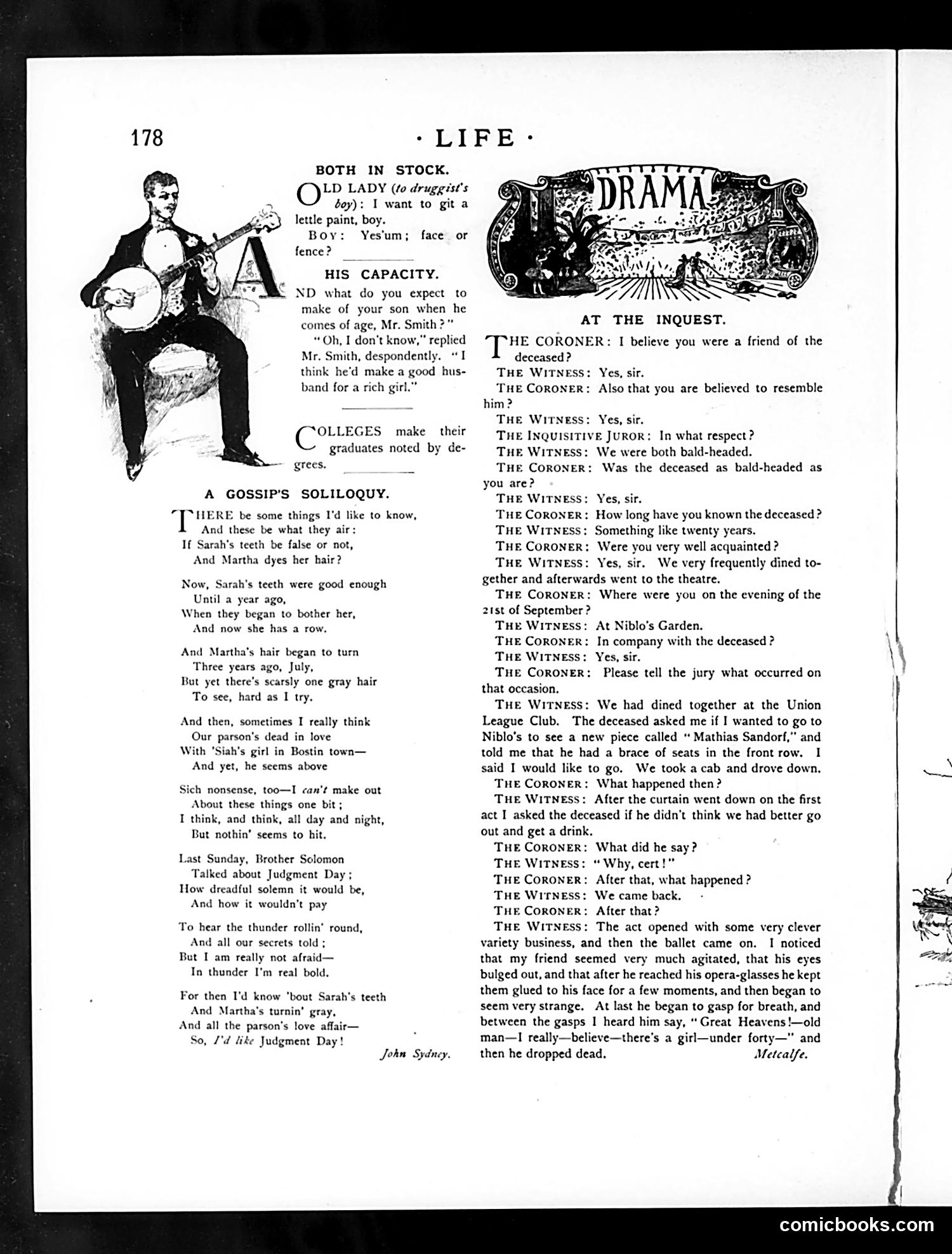
This page contains three distinct pieces of humor: 1. **"Both in Stock"** (top): A brief joke about a druggist's son becoming a "good husband for a rich girl"—satirizing middle-class aspiration and the commercialization of marriage. 2. **"A Gossip's Soliloquy"** (left): A poem by John Sydney about aging women (Sarah and Martha), mocking how gossip preoccupies itself with trivial concerns like hair color while ignoring weightier matters. The reference to "Brother Solomon" discussing Judgment Day suggests satirizing selective moral concern. 3. **"At the Inquest"** (right): A dramatic dialogue at a coroner's inquest where a witness testifies about a friend's death at a theater. The deceased died suddenly during "Mathias Sandorf," apparently from the play's intensity—satire on melodramatic theater's exaggerated emotional effects on audiences.
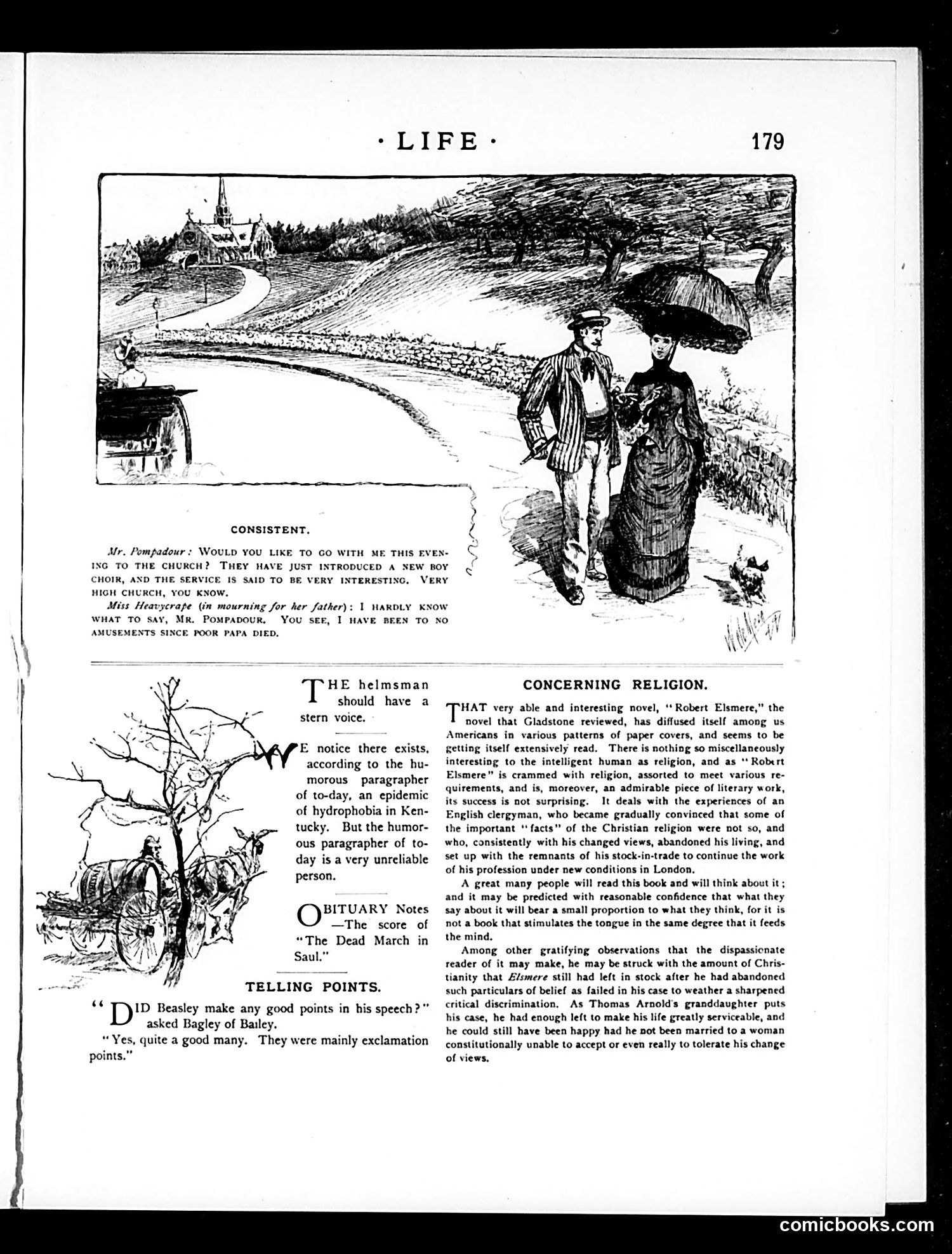
**The Cartoons:** The top illustration shows a social joke about Victorian courtship etiquette. A man (Mr. Pompadour) invites a woman in mourning (Miss Heavycrape) to church, claiming the new choir and "high church" service will be interesting. She declines, saying she's attended no amusements since her father died—a dig at the rigid mourning conventions of the era, where widows and bereaved relatives were expected to withdraw from social life entirely. **The Text Sections:** The page includes three brief humor items mocking contemporary writing trends and speech, followed by a substantial essay reviewing *Robert Elsmere*, an 1888 novel by Mrs. Humphry Ward about an English clergyman who loses religious faith. The review notes the book was famously reviewed by Prime Minister Gladstone and discusses how the protagonist abandons his church position but retains Christian values—exploring the tension between dogma and ethical living that troubled Victorian intellectuals. The satire targets rigid social conventions and the earnest religious debates of the 1880s-90s.
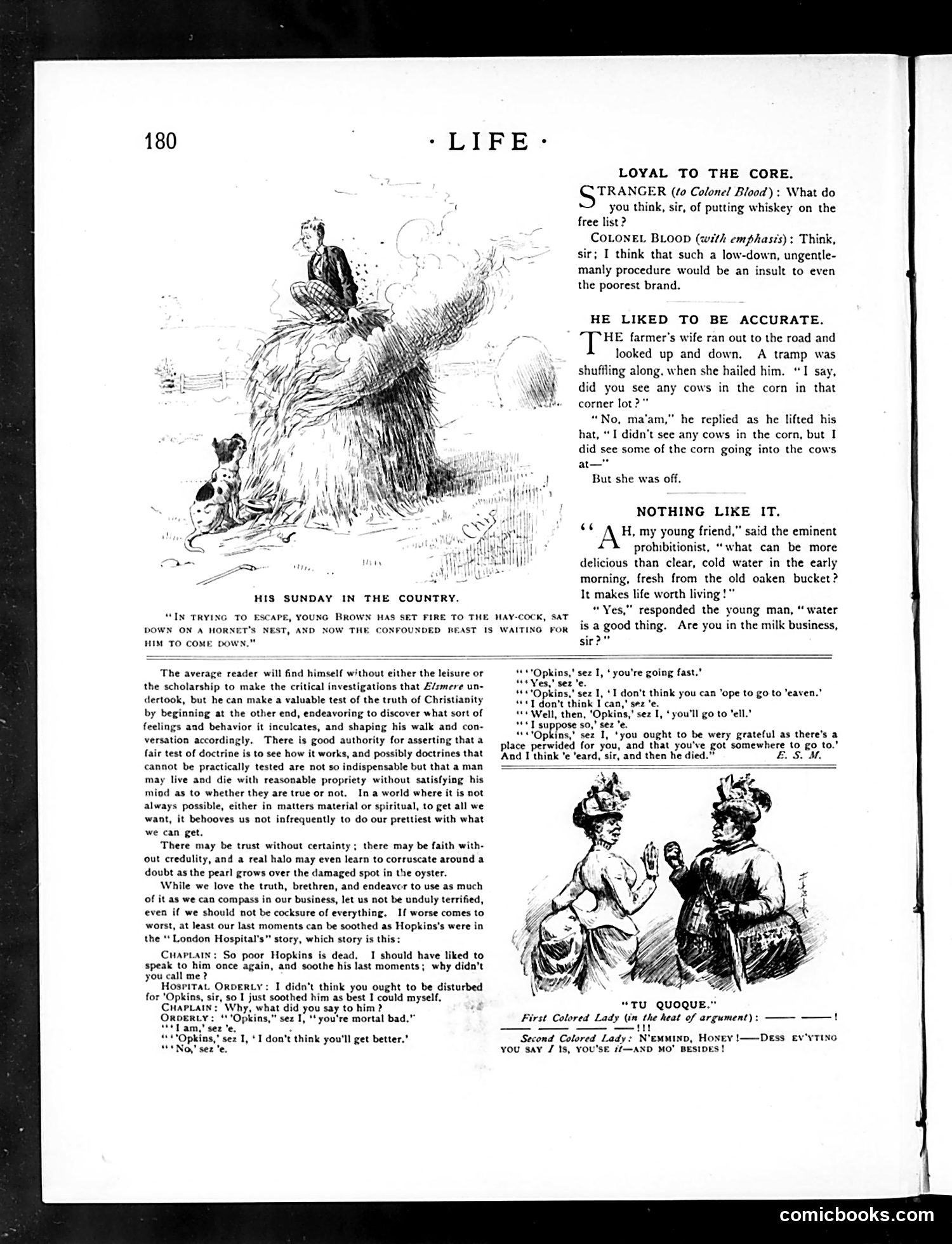
This page contains several brief satirical pieces typical of Life magazine's humor: **"Loyal to the Core"** mocks a character identified as "Colonel Blood" for his hypocrisy—he defends even "the poorest brand" of whiskey against placing it on a free list, revealing snobbish class pretensions masquerading as principle. **"He Liked to Be Accurate"** presents wordplay: a tramp pedantically distinguishes between seeing cows in corn versus corn entering cows' mouths, missing the farmer's wife's actual concern through literal-minded interpretation. **"Nothing Like It"** satirizes a prohibitionist's sanctimonious praise of water, which a young man deflates by asking if he works in the milk business—implying the prohibitionist profits from promoting water's "superiority." The bottom sketch, **"Tu Quoque,"** shows two Black women in argument, using dialect humor common (though offensive by modern standards) in period publications. The lengthy prose passage discusses Christian doctrine's practical effects rather than doctrinal certainty, followed by a hospital anecdote about comforting the dying through brutal honesty.
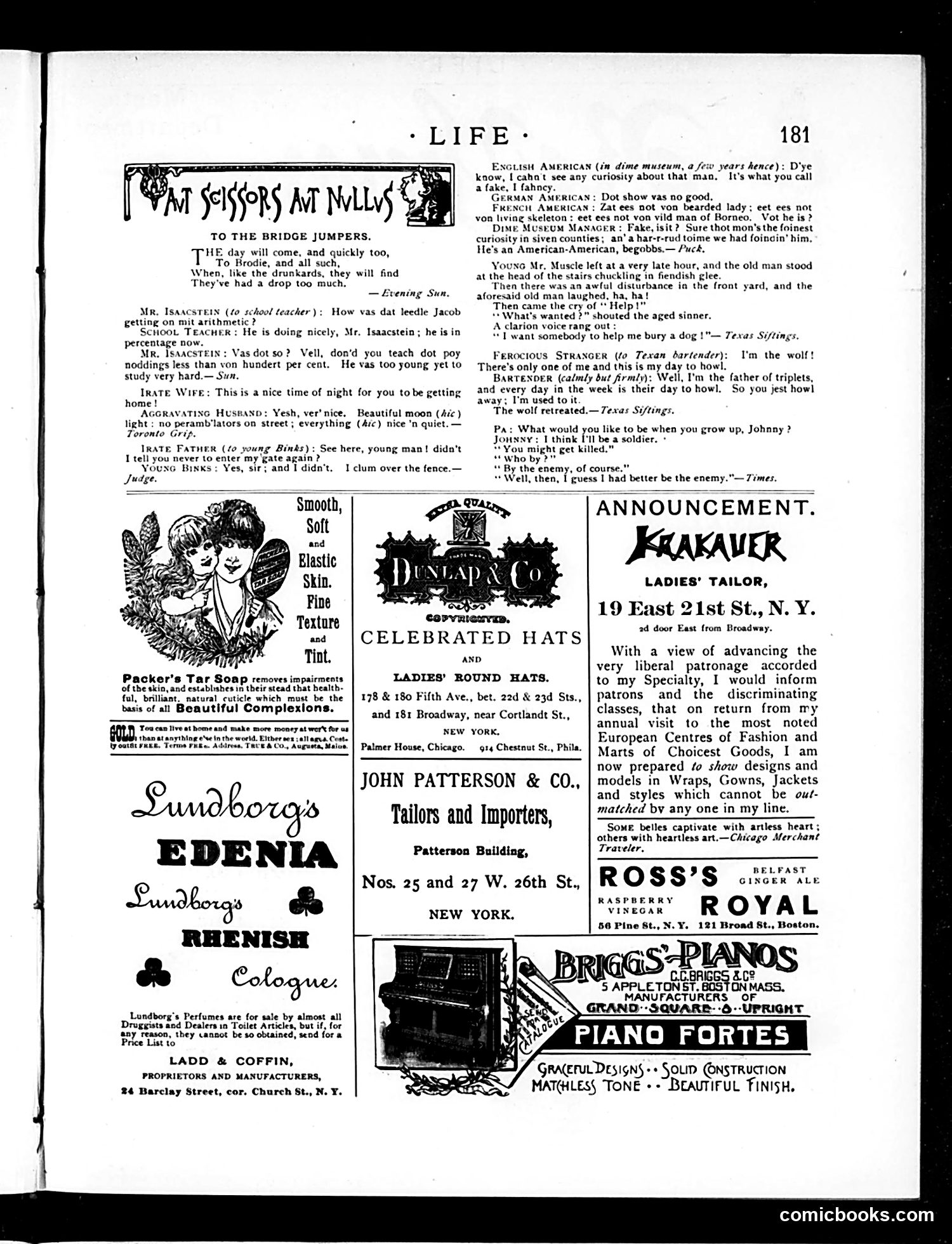
This page contains **multiple short humor pieces** rather than a single cartoon. The jokes satirize contemporary American society through ethnic and immigrant stereotypes common to the era: **Key pieces:** 1. **"Scissors at Nullys / To the Bridge Jumpers"** — References Steve Brodie, who famously claimed to have jumped Brooklyn Bridge in 1886, satirizing reckless stunt-seekers. 2. **Ethnic humor dialogues** — Several jokes mock German-American, French-American, and Irish immigrants through exaggerated accents and malapropisms (Isaacstein's Yiddish-inflected English, the German-American's dialect). 3. **The "American-American" joke** — A dime museum manager presents an ordinary American as the exhibit's "finest curiosity," satirizing both immigrant fascination with oddities and American ordinariness. 4. **The soldier/enemy joke** — A child's logical conclusion that becoming "the enemy" solves the problem of getting killed—absurdist humor about war's futility. The page is primarily **advertising** below the humor section, with product promotions for hats, tailoring, soap, and pianos.
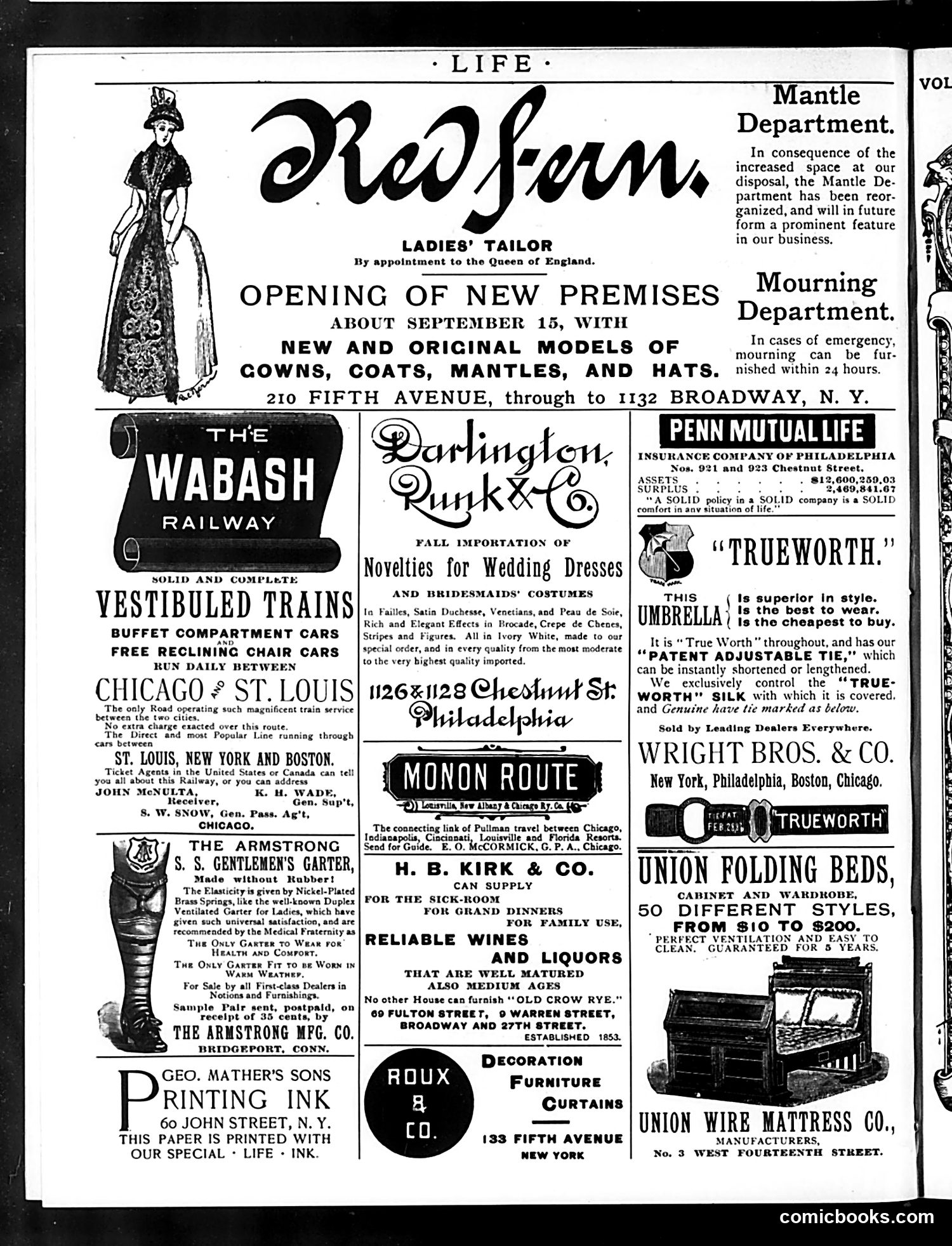
This is primarily an **advertising page** from Life magazine with no political cartoons or satire. The page showcases various commercial advertisements typical of the era (appears to be early 1900s based on styling and references). Notable content includes: - **Red Fern** ladies' tailor advertising new premises opening September 15, featuring fashionable women's clothing - **The Wabash Railway** promoting luxury train service between Chicago and St. Louis - **Armstrong Garter** company marketing men's garters without rubber - Various other period advertisements for wines, furniture, umbrellas, and household goods The page reflects Edwardian-era consumer culture and business practices. The fashion advertisement references "By appointment to the Queen of England," suggesting aspirational marketing linked to British royal patronage—common practice for upscale American retailers of that period. **No satirical content is evident.** This is a straightforward commercial publication page designed to generate revenue through paid advertising rather than editorial commentary.