
Life, 1888-09-27 · page 6 of 14
Life — September 27, 1888 — page 6: what you’re looking at
What you’re looking at
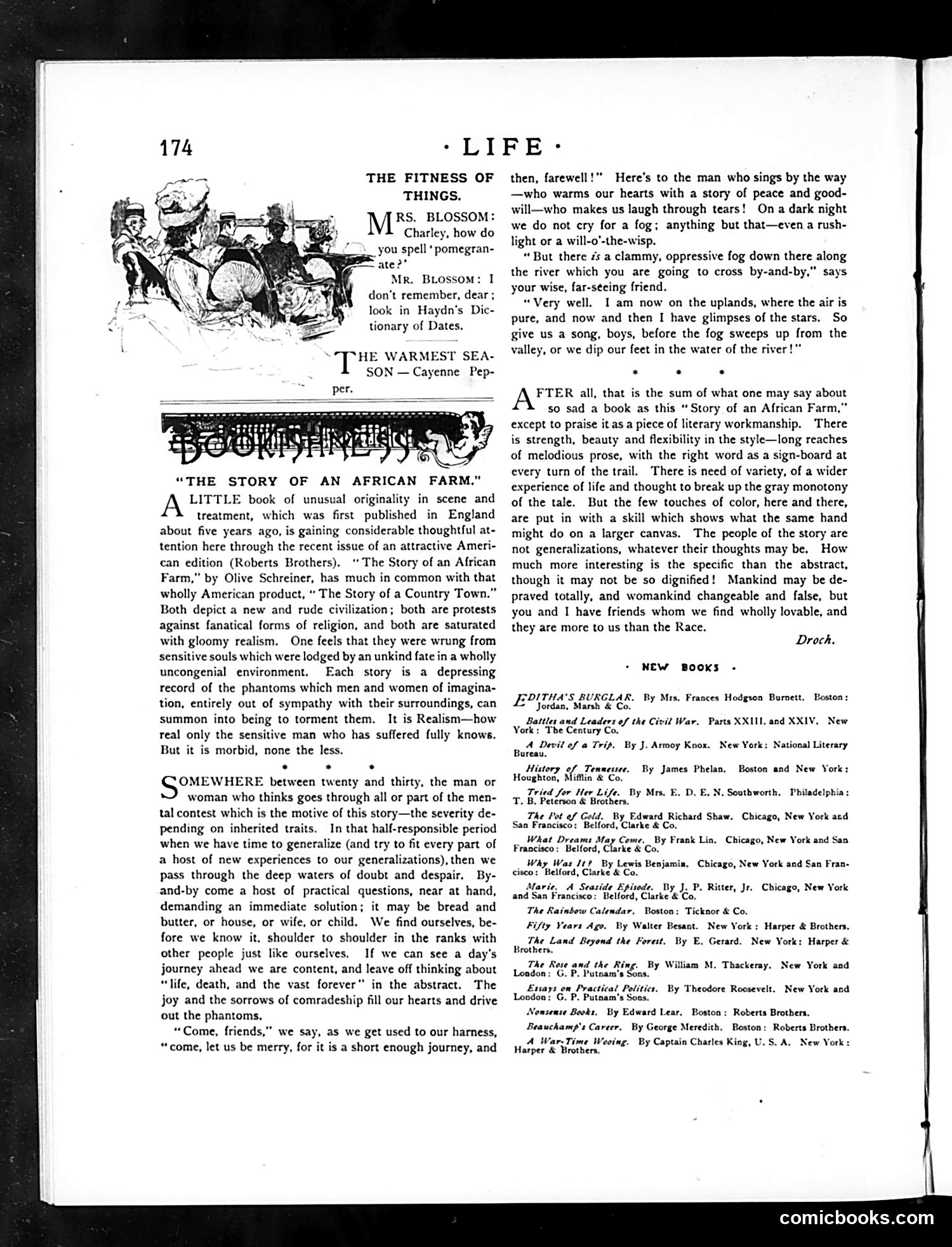
The page features two sections: **Top cartoon:** Titled "The Fitness of Things," this depicts a dialogue between Mrs. Blossom and Mr. Blossom about pomegranates and Haydn's Dictionary of Dates. The humor appears domestic and wordplay-based rather than overtly political—likely a gentle satire on marriage dynamics or pretentious household knowledge. **Main content:** A literary review of "The Story of an African Farm" by Olive Schreiner, praising its artistic merit while acknowledging its gloomy realism and social commentary. The reviewer notes the book critiques religious dogmatism and social hypocrisy, commending its psychological depth despite some stylistic limitations. The page is primarily **book review and literary criticism**, with advertising below. The cartoon's satire appears domestic rather than political.
📄 Transcribed text from this page (OCR, searchable)
Machine-transcribed from the original scan — historical spelling and the odd misread are preserved.
*- LIFE: THE FITNESS OF THINGS. RS. BLOSSOM: Charley, how do you spell ‘pomegran- ate?’ Mr. Bossom: I don’t remember, dear ; look in Haydn's Dic- tionary of Dates. . “TH WARMEST SEA- SON — Cayenne Pep- “THE STORY OF AN AFRICAN FARM.” LITTLE book of unusual originality in scene and treatment, which was first published in England about five years ago, is gaining considerable thoughtful at- tention here through the recent issue of an attractive Ameri- can edition (Roberts Brothers). ‘ The Story of an African Farm,” by Olive Schreiner, has much in common with that wholly American product, “ The Story of a Country Town.” Both depict a new and rude civilization; both are protests against fanatical forms of religion, and both are saturated with gloomy realism. One feels that they were wrung from sensitive souls which were lodged by an unkind fate in a wholly uncongenial environment. Each story is a depressing record of the phantoms which men and women of imagina- tion, entirely out of sympathy with their surroundings, can summon into being to torment them. It is Realism—how real only the sensitive man who has suffered fully knows. But it is morbid, none the less. . . . OMEWHERE between twenty and thirty, the man or woman who thinks goes through all or part of the men- tal contest which is the motive of this story—the severity de- pending on inherited traits. In that half-responsible period when we have time to generalize (and try to fit every part of a host of new experiences to our generalizations), then we pass through the deep waters of doubt and despair. By- and-by come a host of practical questions, near at hand, demanding an immediate solution; it may be bread and butter, or house, or wife, or child. We find ourselves, be- fore we know it, shoulder to shoulder in the ranks with other people just like ourselves. If we can see a day's journey ahead we are content, and leave off thinking about “life, death, and the vast forever” in the abstract. The joy and the sorrows of comradeship fill our hearts and drive out the phantoms, “Come, friends,” we say, as we get used to our harness, “come, let us be merry, for it is a short enough journey, and then, farewell!’ Here's to the man who sings by the way —who warms our hearts with a story of peace and good- will—who makes us laugh through tears! On a dark night we do not cry for a fog; anything but that—even a rush- light or a will-o’-the-wisp. “ But there ¢s a clammy, oppressive fog down there along the river which you are going to cross by-and-by,” says your wise, far-seeing friend. “Very well. I am now on the uplands, where the air is pure, and now and then I have glimpses of the stars. So give us a song, boys, before the fog sweeps up from the valley, or we dip our feet in the water of the river!” . . . FTER all, that is the sum of what one may say about so sad a book as this “Story of an African Farm,” except to praise it as a piece of literary workmanship. There is strength, beauty and flexibility in the style—long reaches of melodious prose, with the right word as a sign-board at every turn of the trail. There is need of variety, of a wider experience of life and thought to break up the gray monotony of the tale. But the few touches of color, here and there, are put in with a skill which shows what the same hand might do on a larger canvas. The people of the story are not generalizations, whatever their thoughts may be. How much more interesting is the specific than the abstract, though it may not be so dignified! Mankind may be de- praved totally, and womankind changeable and false, but you and I have friends whom we find wholly lovable, and they are more to us than the Race. Drock. + NEW BOOKS - PDITHA'S BURGLAR. By Mrs, Frances Hodgson Burnett, Boston: Jordan, Marsh & Co. Battles and Leaders of the Civil War. York: The Century Co. A Devit of a Trip. By J. Armoy Knox. ureau, Parts XXIII. and XXIV, New New York: National Literary History of Tennessee. Houghtos, Miflin & Co, Tried for Her Life. 1. Br Padeon & Brothers. The Pot ef Geld. By Edward Richard Shaw. Chicago, New York acd San Francisco: Belford, Clarke & Co, What Dreams May Come. By Frank Lin, Francisco: Belford, Clarke & Co. Why Was Jt? By Lewis Benjamia, Chicago, New York and San Fran- cisco: Belford, Clarke & Co. Marie, A Seaside Episode. By J. P. Ritter, Jr. and San Francisco: Belford, Clarke &'Co, The Rainbow Calendar, Boston: Ticknor & Co. Fifty Years Age. Vy Walter Besant. The Land Beyond the Forest, Brothers. The Rese and the Ring. By William M, Thackeray. New York and Leadon: G. P. Putnam's Sons. By James Phelan, Boston and New York: By Mrs. E. D. E, N, Southworth, Philadelphia: Chicago, New Vork and San Chicago, New York New York : Harper & Brothers. By E, Gerard. New York: Harper & Essays on Practical Politics. By Theodore Roosevelt. New York and London: G. P. Putnam's Sons. By Edward Lear, Bostoa : Roberts Brothers, Beauchamp's Career. By George Meredith. Boston: Roberts Brothers. A War-Time Weoing. By Captain Charles King, U.S.A. New York: Harper & Brothers. Nonsense Books, comicbooks.com