
Life, 1888-09-27 · page 11 of 14
Life — September 27, 1888 — page 11: what you’re looking at
What you’re looking at
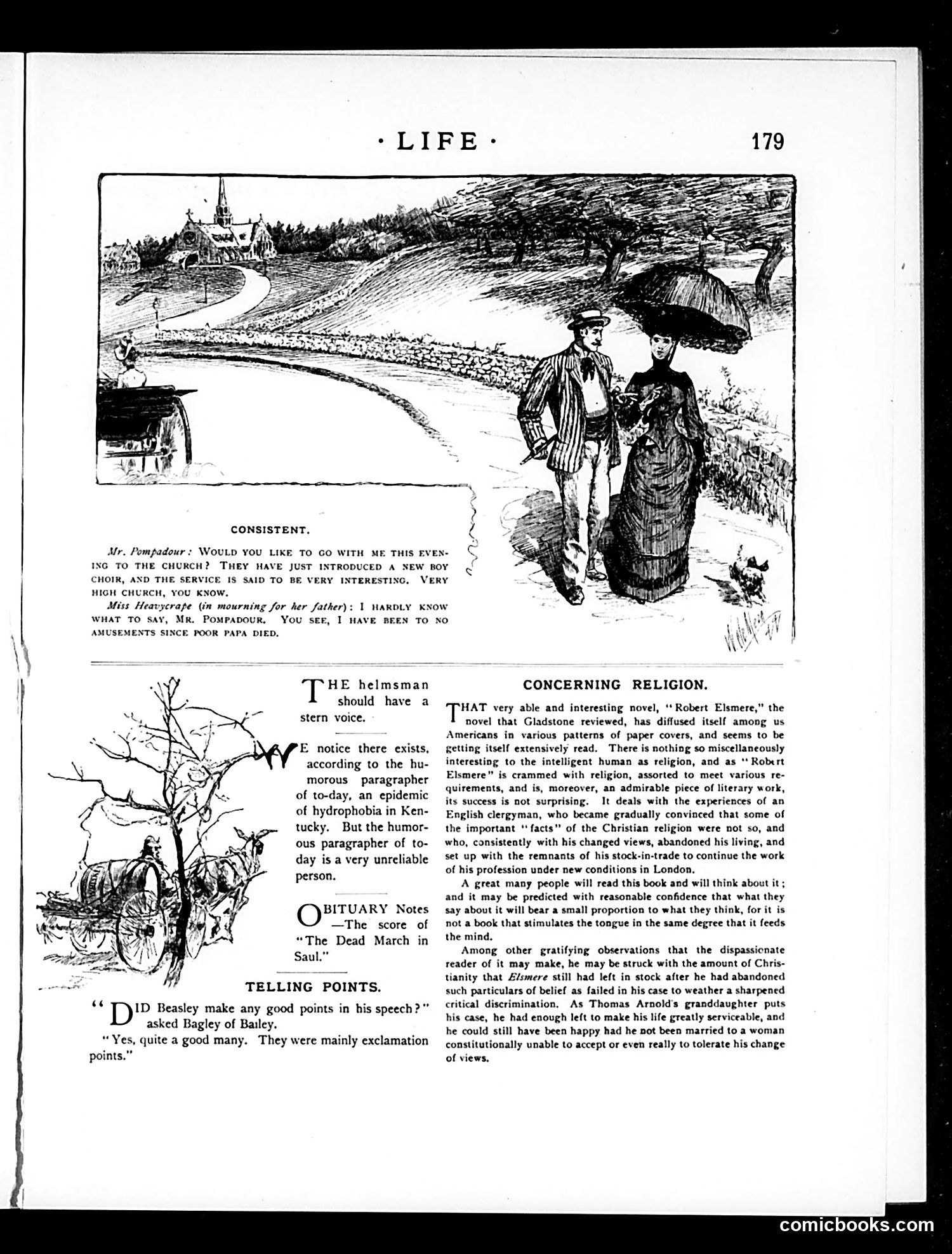
**The Cartoons:** The top illustration shows a social joke about Victorian courtship etiquette. A man (Mr. Pompadour) invites a woman in mourning (Miss Heavycrape) to church, claiming the new choir and "high church" service will be interesting. She declines, saying she's attended no amusements since her father died—a dig at the rigid mourning conventions of the era, where widows and bereaved relatives were expected to withdraw from social life entirely. **The Text Sections:** The page includes three brief humor items mocking contemporary writing trends and speech, followed by a substantial essay reviewing *Robert Elsmere*, an 1888 novel by Mrs. Humphry Ward about an English clergyman who loses religious faith. The review notes the book was famously reviewed by Prime Minister Gladstone and discusses how the protagonist abandons his church position but retains Christian values—exploring the tension between dogma and ethical living that troubled Victorian intellectuals. The satire targets rigid social conventions and the earnest religious debates of the 1880s-90s.
📄 Transcribed text from this page (OCR, searchable)
Machine-transcribed from the original scan — historical spelling and the odd misread are preserved.
CONSISTENT. ING TO THE CHURCH? THEY HAVE JUST INTRODUCED A CHOIR, AND THE SERVICE IS SAID TO BE VERY INTERESTING. HIGH CHURCH, You KNOW. WHAT TO SAY AMUSEMENTS § Mr. PomPpapour, POOR PAPA DIED, HE helmsman should have a stern voice, E notice there exists, according to the hu- morous paragrapher of to-day, an epidemic of hydrophobia in Ken- tucky. But the humor- ous paragrapher of to- day is a very unreliable person. BITUARY Notes —The score of “The Dead March in Saul.” TELLING POINTS. se ID Beasley make any good points in bis speech?” asked Bagley of Bailey. “Yes, quite a good many. They were mainly exclamation points.” Mir, Pompadour : WOULD YOU LIKE TO GO WITH ME THIS EVEN- mW nor: < Very Miss Heavycrape (in mourning for her father): 1 MARDLY KNOW You ser, 1 HAVE BEEN TO NO CONCERNING RELIGION. HAT very able and interesting novel, ‘* Robert Elsmere,” the novel that Gladstone reviewed, has diffused itself among us Americans in various patterns of paper covers, and seems to be getting itself extensively read. There is nothing so miscellaneously interesting to the intelligent human as religion, and as ‘* Robert Elsmere” is crammed with religion, assorted to meet various re- quirements, and is, moreover, an admirable piece of literary work, its success is not surprising. It deals with the experiences of an English clergyman, who became gradually convinced that some of the important ‘facts of the Christian religion were not so, and who, consistently with his changed views, abandoned his living, and set up with the remnants of his stock-in-trade to continue the work of his profession under new conditions in London. A great many people will read this book and will think about it; and it may be predicted with reasonable confidence that what they say about it will bear a small proportion to what they think, for it is not a book that stimulates the tongue in the same degree that it feeds the mind, Among other gratifying observations that the dispassionate reader of it may make, he may be struck with the amount of Chris- tianity that Elsmere still had left in stock after he had abandoned such particulars of belief as failed in his case to weather a sharpened critical discrimination. As Thomas Arnold's granddaughter puts his case, he had enough left to make his life greatly serviceable, and he could still have been happy had he not been married to a woman constitutionally unable to accept or even really to tolerate his change of views, comicbooks.com