
Life, 1888-09-27 · page 12 of 14
Life — September 27, 1888 — page 12: what you’re looking at
What you’re looking at
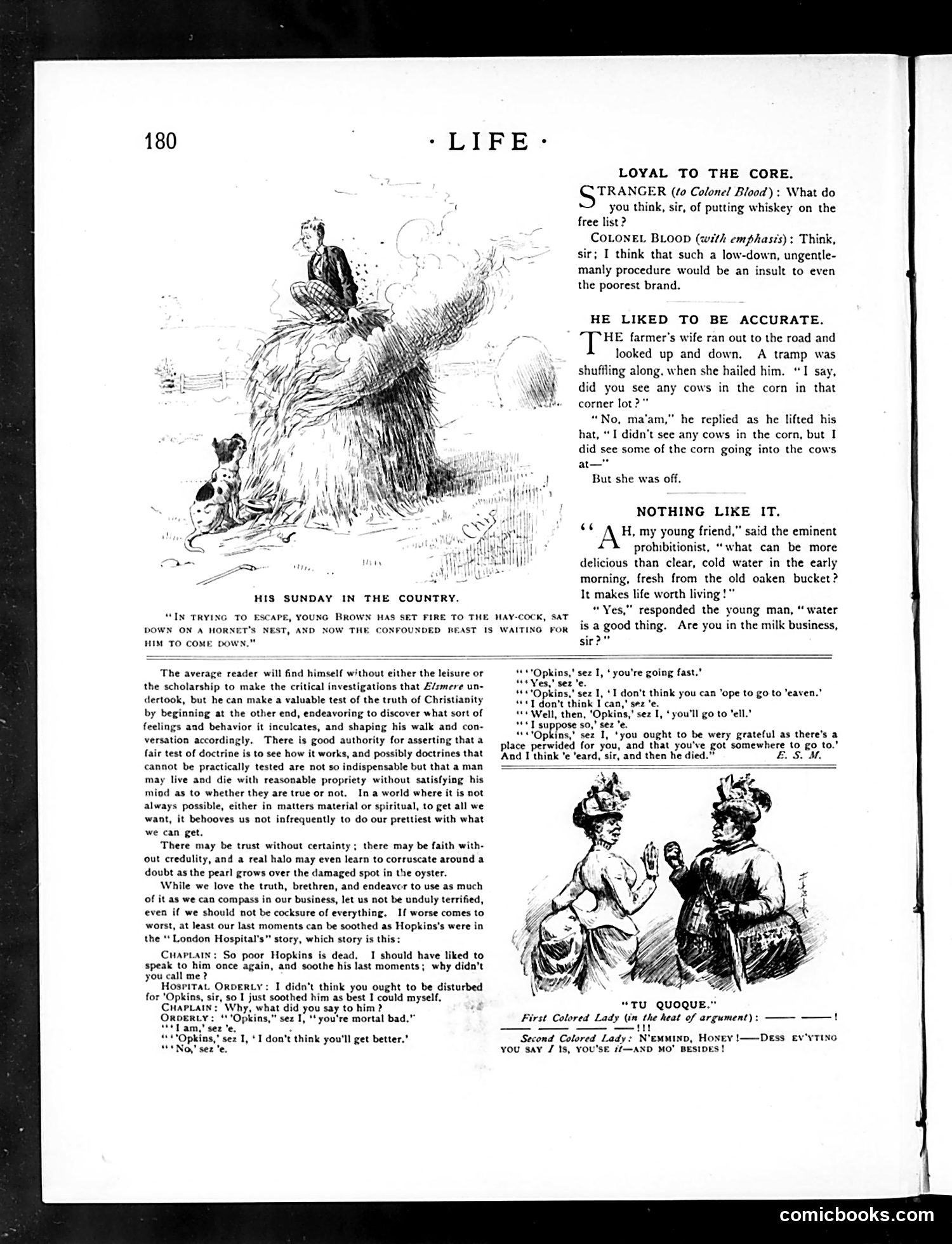
This page contains several brief satirical pieces typical of Life magazine's humor: **"Loyal to the Core"** mocks a character identified as "Colonel Blood" for his hypocrisy—he defends even "the poorest brand" of whiskey against placing it on a free list, revealing snobbish class pretensions masquerading as principle. **"He Liked to Be Accurate"** presents wordplay: a tramp pedantically distinguishes between seeing cows in corn versus corn entering cows' mouths, missing the farmer's wife's actual concern through literal-minded interpretation. **"Nothing Like It"** satirizes a prohibitionist's sanctimonious praise of water, which a young man deflates by asking if he works in the milk business—implying the prohibitionist profits from promoting water's "superiority." The bottom sketch, **"Tu Quoque,"** shows two Black women in argument, using dialect humor common (though offensive by modern standards) in period publications. The lengthy prose passage discusses Christian doctrine's practical effects rather than doctrinal certainty, followed by a hospital anecdote about comforting the dying through brutal honesty.
📄 Transcribed text from this page (OCR, searchable)
Machine-transcribed from the original scan — historical spelling and the odd misread are preserved.
HIS SUNDAY IN THE COUNTRY. “IN TRYING TO FE: DOWN ON A HORNE HIM TO COME DOWN. CAPE, YOUNG BROWN HAS ET FIRE TO THE HAY-COCK, SAT "$ NEST, AND NOW THE CONFOUNDED REAST 1S WAITING FOR LOYAL TO THE CORE. TRANGER (0 Colonel Blood): What do you think, sir, of putting whiskey on the free list ? COLONEL BLOOD (with emphasis): Think, sir; I think that such a low-down, ungentle- manly procedure would be an insult to even the poorest brand. HE LIKED TO BE ACCURATE, HE farmer's wife ran out to the road and looked up and down. A tramp was shuffling along. when she hailed him. “I say, did you see any cows in the corn in that corner lot?” No, ma‘am," he replied as he lifted his hat, I didn’t see any cows in the corn, but I did see some of the corn going into the cows ar—" But she was off. NOTHING LIKE IT. H, my young friend,” said the eminent prohibitionist, “what can be more delicious than clear, cold water in the early morning, fresh from the old oaken bucket? jife worth living!” responded the young man, is a good thing. Are you in the milk business, sir?" The average reader will find himself without either the leisure or the scholarship to make the critical investigations that Elsmere un- dertook, but he can make a valuable test of the truth of Christianity by beginning at the other end, endeavoring to discover what sort of feelings and behavior it inculcates, and shaping his walk and con- versation accordingly. There is good authority for asserting that a fair test of doctrine is to see how it works, and possibly doctrines that cannot be practically tested are not so indispensable but that a man may live and die with reasonable propriety without satisfying his miod as to whether they are true or not. In a world where it is not always possible, either in matters material or spiritual, to get all we want, it behooves us not infrequently to do our prettiest with what we can get. There may be trust without certainty; there may be faith with- out credulity, and a real halo may even learn to corruscate around a doubt as the pearl grows over the damaged spot in the oyster. While we love the truth, brethren, and endeavor to use as much of it as we can compass in our business, let us not be unduly terrified, even if we should not be cocksure of everything. If worse comes to worst, at least our last moments can be soothed as Hopkins’s were in the “* London Hospital's” story, which story is this: CuaPtain: So poor Hopkins is dead. 1 should have liked to speak to him once again, and soothe his last moments; why didn't you call me? HosriTat ORDERLY: I didn't think you ought to be disturbed for 'Opkins, sir, so I just soothed him as best I could myself, Cuartais:’ Why, what did you say to him? *'Opkins,” sez I, ** you're mortal bad.” e. E sez I, ‘I don't think you'll get better.” No," sez 'e. “'Opkins,’ sez I, ‘ you're going fast.’ “+Yes," sez 'e. ‘Opkins,’ sez I, ‘1 don't think you can ‘ope to go to ‘eaven." ‘Idon't think I'can,' sez ‘e. ‘Well, then, ‘Opkins,’ sez I, ‘ you'll go to ‘ell.’ “1 suppose so,” sez 'e. ““Opkins,’ sez I, ‘you ought to be wery grateful as there's a place pefwided for you, and that you've got somewhere to £0 to." And I think ’e 'eard, sir, and then he died.” ES. “TU QUOQUE.” First Colored Lady (in the heat of argument): Second Colored Lady ‘Nessun, Honey !—Dess ev'ytino you say / 18, YoU'sE #7—AND MO’ BESIDES! comicbooks.com