
Life, 1888-09-27 · page 2 of 14
Life — September 27, 1888 — page 2: what you’re looking at
What you’re looking at
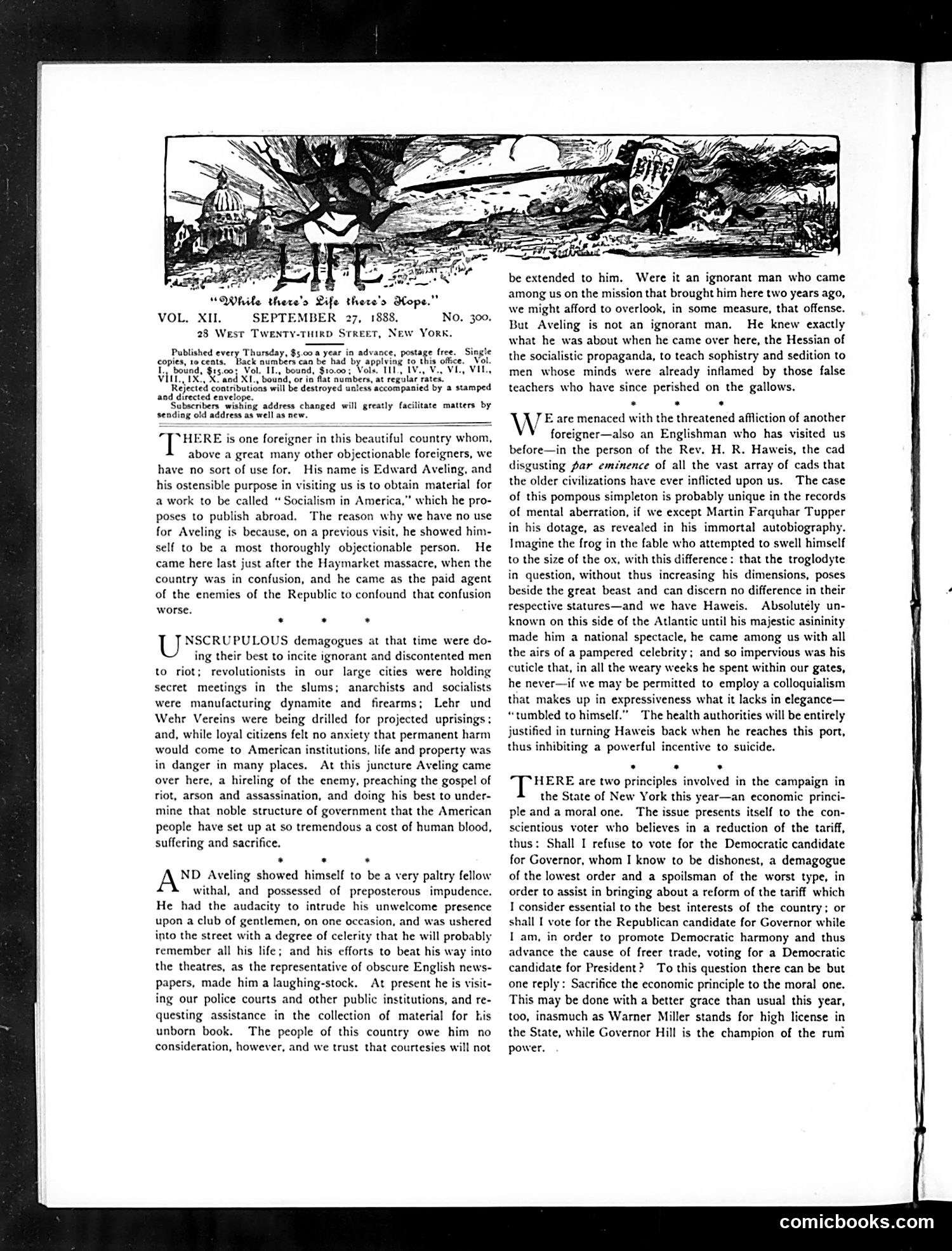
The small cartoon at the top depicts a figure labeled "Where there's a will there's a way," likely satirizing a political figure of the moment, though the specific identity is unclear from the image alone. The main text discusses a foreigner named Aveling visiting America to promote socialism. The article criticizes him as an "ignorant man" and "objectionable person" who came after the Haymarket massacre (1886) to spread socialist propaganda. The piece then pivots to New York state politics, debating whether voters should support a Democratic or Republican gubernatorial candidate based on moral principles versus economic policy—specifically mentioning positions on free trade and alcohol ("rum power"). The satire targets both foreign radical agitators and domestic political compromise.
📄 Transcribed text from this page (OCR, searchable)
Machine-transcribed from the original scan — historical spelling and the odd misread are preserved.
“While there's Life there's Hope.” XI, SEPTEMBER 27, 1888. 28 West TwWEnty-THIRD Str VOL. No, 300. ew York. Published every Thursday, $5.00. year in advance, postage free. Single copies, ro cents. Back aumbers can be had by applying to, this office, Vol. L., bound, $15.00; Vol. II., bound, $10.00; Vols. III, IV., V., Vi, VIL VitI., 1X!, XVand XI, bound, or in flat aumbers, at regular rates. Rejected contributions will be destroyed unless accompanied by a stamped and directed envelope. Subscribers wishing address changed will greatly facilitate matters by sending old address as well as new. “THERE is one foreigner in this beautiful country whom, above a great many other objectionable foreigners, we have no sort of use for. His name is Edward Aveling, and his ostensible purpose in visiting us is to obtain material for a work to be called “ Socialism in America,” which he pro- poses to publish abroad. The reason why we have no use for Aveling is because, on a previous visit, he showed him- self to be a most thoroughly objectionable person. He came here last just after the Haymarket massacre, when the country was in confusion, and he came as the paid agent of the enemies of the Republic to confound that confusion worse. . . . NSCRUPULOUS demagogues at that time were do- ing their best to incite ignorant and discontented men to riot; revolutionists in our large cities were holding secret meetings in the slums; anarchists and socialists were manufacturing dynamite and firearms; Lehr und Wehr Vereins were being drilled for projected uprisings: and, while loyal citizens felt no anxiety that permanent harm would come to American institutions, life and property was in danger in many places. At this juncture Aveling came over here, a hireling of the enemy, preaching the gospel of riot, arson and assassination, and doing his best to under- mine that noble structure of government that the American people have set up at so tremendous a cost of human blood, suffering and sacrifice. . . . ND Aveling showed himself to be a very paltry fellow withal, and possessed of preposterous impudence. He had the audacity to intrude his unwelcome presence upon a club of gentlemen, on one occasion, and was ushered into the street with a degree of celerity that he will probably remember all his life; and his efforts to beat his way into the theatres, as the representative of obscure English new papers, made him a laughing-stock. At present he is visit- ing our police courts and other public institutions, and re- questing assistance in the collection of material for his unborn book. The people of this country owe him no consideration, however, and we trust that courtesies will not be extended to him. Were it an ignorant man who came among us on the mission that brought him here two years ago, we might afford to overlook, in some measure, that offense. But Aveling is not an ignorant man. He knew exactly what he was about when he came over here, the Hessian of the socialistic propaganda, to teach sophistry and sedition to men whose minds were already inflamed by those false teachers who have since perished on the gallows. . . . V J E are menaced with the threatened affliction of another YV foreigner—also an Englishman who has visited us before—in the person of the Rev. H. R. Haweis, the cad disgusting par eméinence of all the vast array of cads that the older civilizations have ever inflicted upon us. The case of this pompous simpleton is probably unique in the records of mental aberration, if we except Martin Farquhar Tupper in his dotage, as revealed in his immortal autobiography. Imagine the frog in the fable who attempted to swell himself to the size of the ox, with this difference: that the troglodyte in question, without thus increasing his dimensions, poses beside the great beast and can discern no difference in their respective statures—and we have Haweis. Absolutely un- known on this side of the Atlantic until his majestic asininity made him a national spectacle, he came among us with all the airs of a pampered celebrity; and so impervious was his cuticle that, in all the weary weeks he spent within our gates, he never—if we may be permitted to employ a colloquialism that makes up in expressiveness what it lacks in elegance— “tumbled to himself.” The health authorities will be entirely justified in turning Haweis back when he reaches this port, thus inhibiting a powerful incentive to suicide. . . . HERE are two principles involved in the campaign in the State of New York this year—an economic princi- ple and a moral one. The issue presents itself to the con- scientious voter who believes in a reduction of the tariff, thus: Shall I refuse to vote for the Democratic candidate for Governor, whom I know to be dishonest, a demagogue of the lowest order and a spoilsman of the worst type, in order to assist in bringing about a reform of the tariff which I consider essential to the best interests of the country; or shall I vote for the Republican candidate for Governor while I am, in order to promote Democratic harmony and thus advance the cause of freer trade, voting for a Democratic candidate for President? To this question there can be but one reply: Sacrifice the economic principle to the moral one. This may be done with a better grace than usual this year, too, inasmuch as Warner Miller stands for high license in the State, while Governor Hill is the champion of the rum power. comicbooks.com